You’ll discover Bodie State Historic Park just 65 miles north of Mammoth Lakes, where nearly 200 weathered buildings stand frozen in time at 8,200 feet elevation. This authentic gold rush ghost town preserves century-old saloons, homes, and storefronts through “arrested decay“—leaving interiors untouched since miners abandoned them. The drive takes you past Mono Lake along US-395, ending with three miles of graded dirt road into California’s largest unrestored ghost town, where you can explore structures dating back to Bodie’s 1880 peak population of 10,000 fortune-seekers.
Key Takeaways
- Bodie State Historic Park, California’s official gold-rush ghost town, is located 65 miles from Mammoth Lakes via US-395.
- Bodie preserves 170–200 original buildings using “arrested decay,” maintaining authentic interiors and weathered exteriors from the 1880s gold rush.
- The town peaked at 10,000 residents in 1880 but declined to six by World War II’s end.
- Access requires driving ten paved miles plus three graded dirt miles on State Route 270 beyond US-395.
- Best visiting times are July through September, with September weekday mornings offering fewer crowds and ideal conditions.
Bodie State Historic Park: The West’s Largest Unrestored Ghost Town
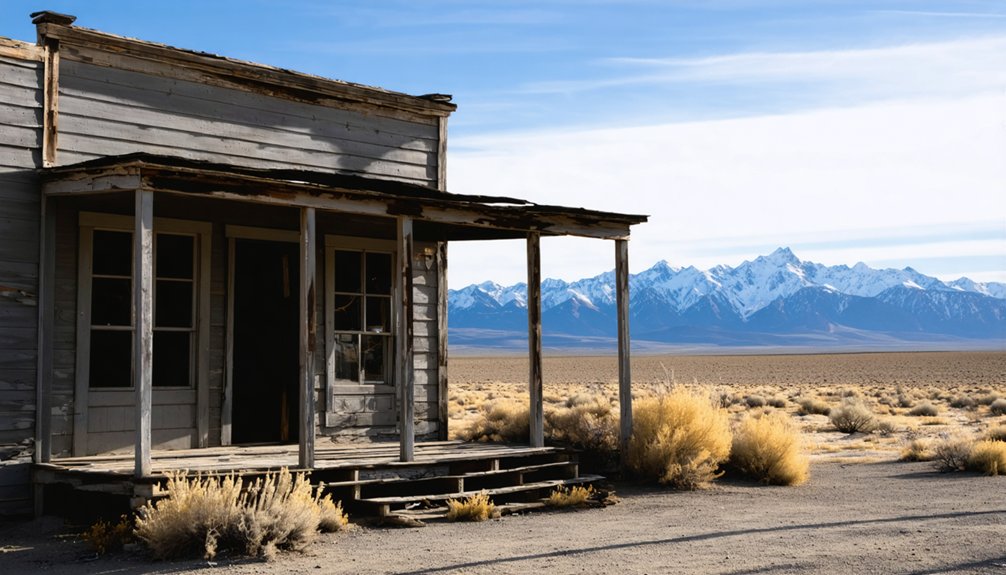
Perched at 8,200 feet in the windswept Bodie Hills east of the Sierra Nevada, Bodie State Historic Park stands as the American West’s largest and most complete unrestored ghost town—a distinction recognized by the World Monuments Fund.
America’s largest unrestored ghost town preserves authentic Western history at 8,200 feet through arrested decay, not restoration.
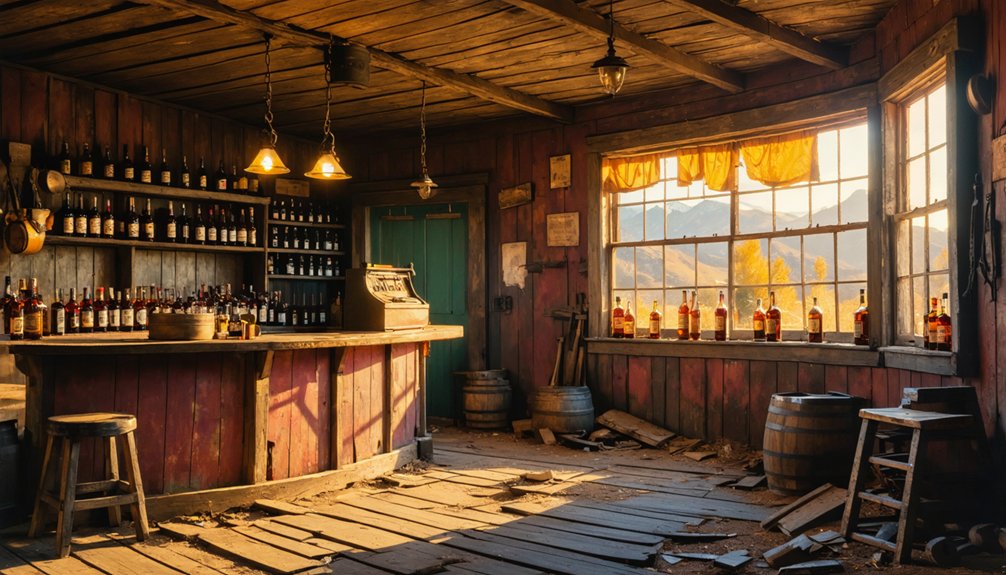
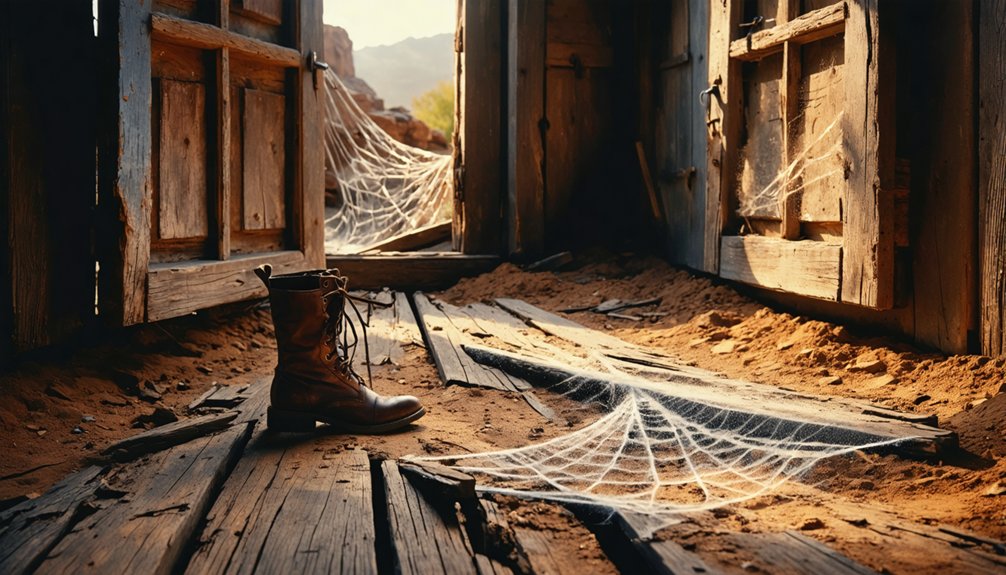
You’ll find roughly 170–200 buildings frozen in time through California State Parks’ remarkable “arrested decay” philosophy—no restorations, just stabilization. Bodie Preservation maintains structures exactly as found, with weathered paint, warped wood, and untouched interiors where furniture and goods remain scattered as if residents just walked away.
This National Historic Landmark’s Historical Significance earned it designation as California’s official state gold-rush ghost town in 1962. The town was named after Waterman S. Body, a gold discoverer who first struck gold in the hills north of Mono Lake.
These preserved structures represent only 5% of original buildings, as multiple devastating fires consumed much of the town throughout its history.
You’re free to wander authentic streets, peer through dusty windows, and witness genuine abandonment—no sanitized recreations here.
The Golden History of Bodie’s Rise and Fall
When W. S. Bodey struck gold in 1859 along those windswept hills, he couldn’t have imagined that his modest placer claim would explode into one of California’s wildest boomtowns within two decades.
You’d have witnessed an astonishing transformation after the Standard Company’s 1876 discovery—a remote camp of twenty hardy miners ballooning to nearly 10,000 fortune-seekers by 1879, their dreams built on $34-38 million worth of glittering ore.
But Bodie’s golden era burned bright and brief, collapsing into ghost town silence by 1881 when the veins ran dry and those thousands of hopefuls scattered like tumbleweeds across the desert. The name itself honors its founder, though Bodey’s original spelling was modified over time as the settlement grew into legend. Tragically, Bodey himself died in a snowstorm before ever witnessing the legendary town that would bear his name.
Gold Discovery Sparks Growth
In 1859, a full decade after forty-niners flooded California’s Mother Lode, a small band of prospectors stumbled upon gold in a shallow valley north of Mono Lake—a discovery that would write one man’s name across the desert, though he’d never live to see it.
W. S. Bodey perished that November in a blizzard while fetching supplies, but his legacy survived on a misspelled stable sign. By 1862, “Bodie” stuck.
For years the camp languished—overshadowed by Aurora and the Comstock, plagued by failed mills and low-grade ore.
Then in the mid-1870s, a cave-in at 120 feet exposed bonanza veins. Suddenly the gold rush ignited. Steam hoists rose along Bodie Bluff, twenty-stamp mills roared, and mining technology transformed scattered claims into an industrial juggernaut. The Standard Company produced $784,523 in gold and silver bullion in 1877 alone, drawing fortune seekers by the hundreds. By 1880, the town’s population exceeded 10,000, cementing its place as one of California’s largest mining camps.
Boomtown Peak and Prosperity
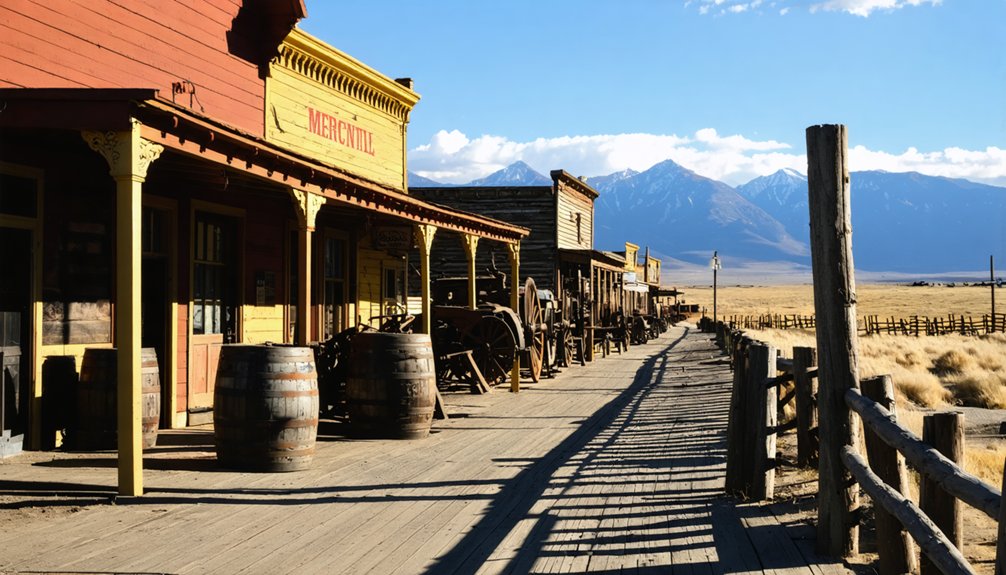
By the time the Standard Company’s bonanza veins transformed sleepy Bodie into California’s third-largest city around 1879, some 5,000 to 8,000 souls crowded into a mile-long corridor of false-fronted buildings clinging to the sagebrush hills.
You’d have witnessed raw boomtown dynamics in action—2,000 structures housing over 400 businesses, 65 saloons pouring whiskey until dawn, and 31 steam hoists thundering day and night.
The economic drivers were staggering: $3 million in gold and silver annually, processed through seven mills pounding 125 stamps.
Wells Fargo handled the money while four newspapers chronicled the chaos.
Miners’ unions bargained wages as volunteer fire brigades stood ready.
Between 1877 and 1882, the mines exported $35 million worth of gold and silver from the surrounding mountains.
This wasn’t just a mining camp—it was an industrial powerhouse carved from windswept freedom.
Yet the inevitable decline would leave behind preserved buildings that now stand as monuments to this fleeting prosperity.
Decline Into Abandonment
Bodie’s glory days couldn’t last forever, and the seeds of decline sprouted even before the town hit its peak. By 1880, promising strikes in Butte, Tombstone, and Utah lured prospectors away, triggering community decline. The population plummeted from 10,000 to just 1,500 by 1886.
Devastating fires struck in 1886 and 1892, while ore deposits grew scarcer each year. The economic downturn accelerated after 1900. Mines stopped producing, stores shuttered, and families packed up.
*The Bodie Miner* printed its final issue in 1912. By 1914, mining profits had collapsed to under $7,000. The railroad was abandoned in 1917. The 1932 fire—sparked by a child’s matches—destroyed most remaining structures.
When War Production Board order L-208 closed the last mine in 1942, Bodie’s transformation into a genuine ghost town was complete. By the end of World War II, only six residents remained in what had once been California’s third-largest city.
Walking Through Time: What You’ll See in Bodie Today
When you first step onto Bodie’s dusty main street, time seems to collapse—roughly 70 to 75 weathered buildings line two parallel dirt roads in a compact valley basin perched at 8,200 feet, their sagging porches and gap-toothed façades frozen in what preservationists call “arrested decay.”
These survivors represent fewer than 10% of the original 2,000 structures that once crowded this mountainside; major fires in 1892 and 1932 devoured whole blocks, leaving only this skeletal townscape.
Peer through any window and you’ll encounter ghostly encounters with the past: Boone’s Store shelves still stacked with century-old canned goods, schoolhouse desks holding faded notebooks, cursive lessons lingering on chalkboards.
This radical approach to historic preservation leaves everything aged and weathered—dust blankets every surface, wallpaper curls, furniture sits exactly where inhabitants abandoned it.
Mammoth Consolidated Mine: A Hidden Gem in Inyo National Forest
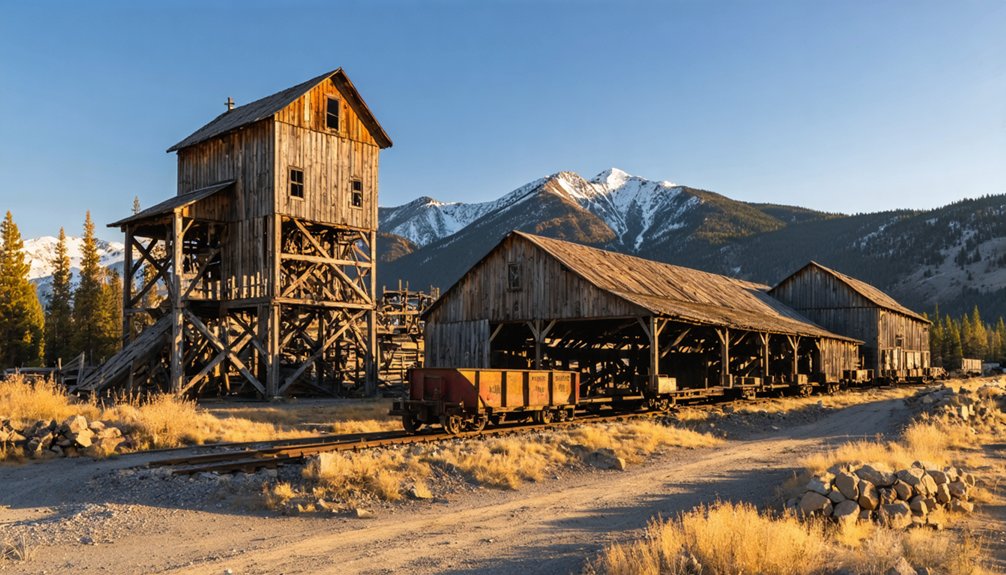
You’ll find the Mammoth Consolidated Mine tucked high above Old Mammoth in Inyo National Forest, where pine trees now shade the weathered remnants of a 1927 gold operation that once pulled $100,000 from Red Mountain’s slopes.
The site preserves a remarkably intimate collection of tar-papered bunkhouses, a diesel-powered mill, and the mine owner’s log cabin—all frozen in what rangers call “arrested decay,” much like Bodie but on a far smaller, more personal scale.
A half-mile dirt loop trail winds past mining offices, the assay building, and scattered equipment, letting you walk through a camp that housed only a few dozen souls chasing Depression-era gold.
Location and Access Details
The Mammoth Consolidated Mine sits tucked away at roughly 9,000 feet in the Mammoth Lakes Basin, where Coldwater Creek spills from Lake Mary through stands of lodgepole pine and mountain hemlock.
You’ll reach this ghost town by driving Lake Mary Road 3.6 miles past town, then maneuvering Around-Lake-Mary Road and Coldwater Campground Road to the day-use lot. A half-mile self-guided loop reveals the camp’s secrets—no fees, no gates, just open trail beneath alpine sky.
Your route from Highway 395:
- Turn west on CA-203 toward Mammoth Lakes
- Continue straight at Minaret Road onto Lake Mary Road (3.7 miles from 395)
- Left on Around-Lake-Mary Road at Lake Mary’s east shore
- Left again onto Coldwater Campground Road
- Park at trailhead; clockwise loop recommended
Preserved Structures and Features
Unlike Bodie’s sprawling commercial blocks frozen in 1880s grandeur, Mammoth Consolidated‘s dozen-odd buildings cluster intimately around a single ore-processing dream that flickered from 1927 to 1933.
You’ll walk among tar-paper bunkhouses where men slept between shifts, Arch Mahan’s log cabin where deals were struck, and the mill where a massive 100 HP diesel engine once thundered.
Preservation techniques mirror Bodie’s “arrested decay” philosophy—stabilizing what remains without sanitizing its weathered soul. The Inyo National Forest, alongside local historical societies, safeguards this compact landscape under Antiquities Act protection, maintaining spatial relationships between superintendent’s quarters, assay office, and tunnel portals.
Its historical significance lies not in scale but legibility: every privy, air compressor, and ore bin tells an unfiltered story of high-altitude prospecting ambition.
Self-Guided Tour Information
Where Mineral Hill‘s western slope meets the sky at 9,000 feet, a half-mile dirt loop winds through six years of Depression-era ambition compressed into two dozen weathered structures.
You’ll follow self guided trails past tar-papered bunkhouses where miners slept without electricity, through the assay office where gold’s worth was determined, and around equipment that hasn’t turned since 1933.
The mining history unfolds through interpretive signs marking each structure—cookhouse, blacksmith shop, Arch Mahan’s summer cabin.
What You’ll Discover:
- Two mine tunnels penetrating the hillside above camp
- Original 100 HP diesel engine from the ore-processing mill
- Miners’ outhouses preserved in arrested decay
- Superintendent’s cabin showcasing management quarters
- Portable compressor replacing fire-damaged equipment
Access requires federal permits; the Forest Service maintains authenticity over accessibility.
Getting to the Ghost Towns From Mammoth Lakes
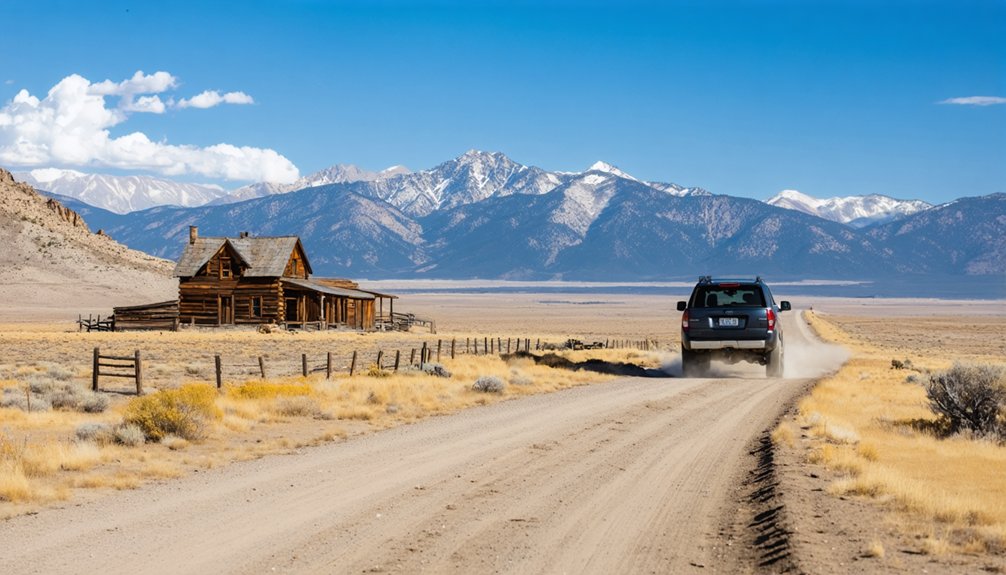
When you’re ready to trade Mammoth’s ski chalets for the weathered boardwalks of Bodie, you’ll find the journey north is half the adventure itself.
Your route options begin with a straightforward 65-mile drive via US-395, rolling past Lee Vining’s Mono Lake before catching State Route 270 seven miles south of Bridgeport. That final thirteen-mile stretch—ten paved, three graded dirt—takes thirty to forty minutes at reduced speeds, passable in most sedans when dry.
Smart travel tips: fuel up in Mammoth, Lee Vining, or Bridgeport; Bodie offers nothing.
Download offline maps before cell coverage fades. Tour operators bundle Bodie with Mono Lake if you’d rather let someone else navigate the dusty backroads.
Budget three hours round-trip driving, then lose yourself wandering a ghost town frozen in 1880s gold-rush twilight.
Best Times to Visit Eastern Sierra Ghost Towns
The high-desert calendar dictates your ghost-town pilgrimage more than any guidebook ever will. Seasonal weather shapes every mile above 8,000 feet, where July through September open Bodie’s windswept streets without snow or mud blocking your path.
At 8,000 feet, weather doesn’t negotiate—July through September are your only guaranteed windows into Bodie’s past.
Access challenges vanish when summer sun bakes the roads dry, though afternoon thunderstorms remind you who’s really in charge up here.
Prime visiting windows:
- Late June–early September for reliable high-elevation access and warm exploration hours
- Weekday mornings in September combining thinner crowds with golden photography light
- Early-fall afternoons when autumn sagebrush contrasts weathered wood structures
- Post-sunrise sessions avoiding both tourists and lightning-prone afternoons
- Pre-snowfall October days offering solitude before winter seals the roads
Spring’s mud and winter’s drifts will keep you out; summer sets you free.
Planning Your Ghost Town Adventure: Tips and Resources
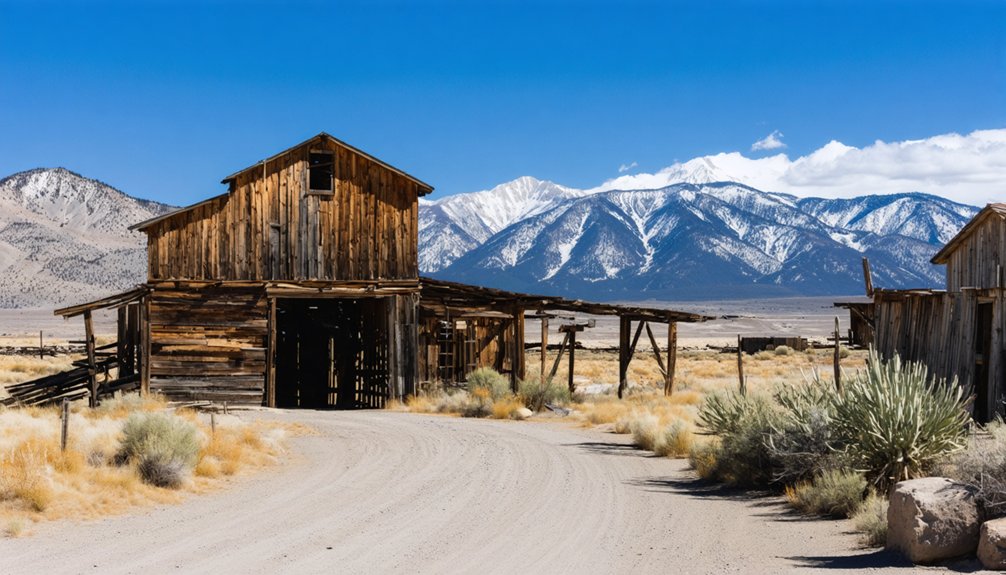
Consult BLM motor-vehicle maps and respect Bodie’s “arrested decay” policy.
Travel resources matter when freedom means self-reliance, not rescues.
Frequently Asked Questions
Are Pets Allowed at Bodie State Historic Park?
Yes, you’ll find pet policies welcome leashed dogs on Bodie’s dusty streets, though dog restrictions keep them from historic buildings. Remember those six-foot leash rules while exploring this weathered ghost town’s sun-baked pathways together.
What Are the Entrance Fees for Visiting Bodie?
You’ll pay $8 as an adult or $5 for children 4–17 to step into Bodie’s history during entrance hours. Kids under 3 roam free. Bring cash—this weathered ghost town keeps things wonderfully simple and untethered.
Can You Camp Overnight Near the Ghost Towns?
You can’t pitch your tent inside Bodie itself—those old wooden walls guard their secrets alone at night—but you’ll find freedom on nearby BLM land where dispersed camping’s allowed under standard camping regulations without overnight permits required.
Are the Ghost Town Sites Wheelchair Accessible?
Wheelchair accessibility varies—Bodie offers balloon-tired wheelchairs and gravel paths through town, though trail conditions remain rugged with boardwalks and steps limiting exploration. Mammoth Consolidated Mine lacks formal accessible infrastructure, preserving its wild, remote character.
What Should I Bring for a Ghost Town Visit?
Pack your camera equipment to capture fading memories, sturdy hiking gear for uneven ground, plenty of water for high elevations, and sun protection—you’ll need freedom to explore these weathered relics responsibly.
References
- https://en.wikipedia.org/wiki/List_of_ghost_towns_in_California
- https://www.snowcreekresort.com/blog/visit-eerie-ghost-towns-near-mammoth-lakes/
- https://californiahighsierra.com/trips/explore-ghost-towns-of-the-high-sierra/
- https://nvtami.com/2022/10/11/lessor-known-mono-inyo-ghost-towns/
- https://www.visitmammoth.com/directory/bodie-state-historic-park/
- https://www.visitmammoth.com/trip-ideas/bodie-ghost-town-mono-lake-june-lake-loop-full-day-itinerary/
- https://www.allmammoth.com/history_museums/bodie_ghost_town.php
- https://www.parks.ca.gov/bodie
- https://www.parks.ca.gov/?page_id=26330
- https://www.youtube.com/watch?v=2Foz-2R_mH8