You’ll find four genuine ghost towns within an hour of Medford that preserve Southern Oregon’s 1850s gold rush heritage. Buncom, established by Chinese miners in 1851, features weathered buildings from its chromite and cinnabar operations. Golden showcases two churches and a strict moral code enforced by its founder. Only Sterlingville’s hilltop cemetery remains of its 1,200 residents, while Waldo marks Oregon’s first major gold strike. Each site offers accessible remnants of communities abandoned after economic collapse, and understanding their complete stories reveals why these settlements vanished.
Key Takeaways
- Buncom, located 19 miles southwest of Medford, was established in 1851 and features remnants from the gold rush era.
- Golden, east of Interstate 5 near Wolf Creek, showcases weathered nineteenth-century buildings including two churches and a schoolhouse.
- Sterlingville Cemetery is the sole remnant of a town that once housed 1,200 residents after James Sterling’s 1854 gold strike.
- Waldo, Oregon’s first mining town established in 1851-1852, is located in southwest Josephine County with minimal traces remaining.
- A single-day circuit from Medford covering 120-140 miles allows visitors to explore multiple ghost towns with high-clearance vehicles recommended.
Buncom: Southern Oregon’s Best-Preserved Mining Town
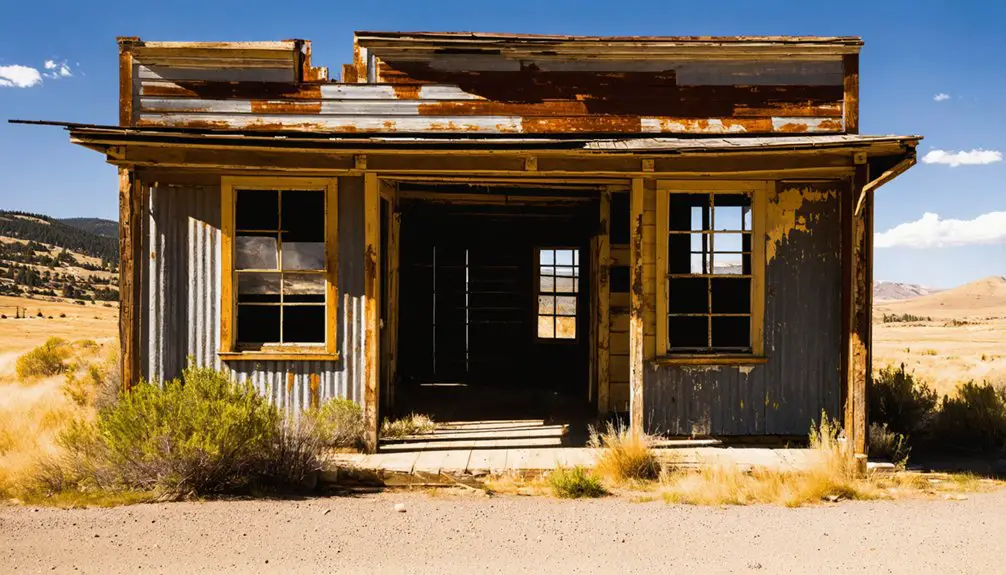
Nestled approximately 19 miles southwest of Medford at the intersection of Sterling Creek Road and Little Applegate Road, Buncom stands as Southern Oregon’s most intact ghost town—a weathered reminder of the region’s volatile mining past.
Chinese miners established this camp in 1851 following gold discoveries along Sterling Creek, employing placer mining techniques that extracted ore from the waterways.
Following the glimmer of gold along Sterling Creek, Chinese miners carved their fortune from the waterways in 1851.
The settlement formalized into the Buncom Mining District by 1867, diversifying operations to extract silver, chromite, and cinnabar alongside gold.
This Buncom heritage reflects the relentless pursuit of mineral wealth that drove frontier expansion.
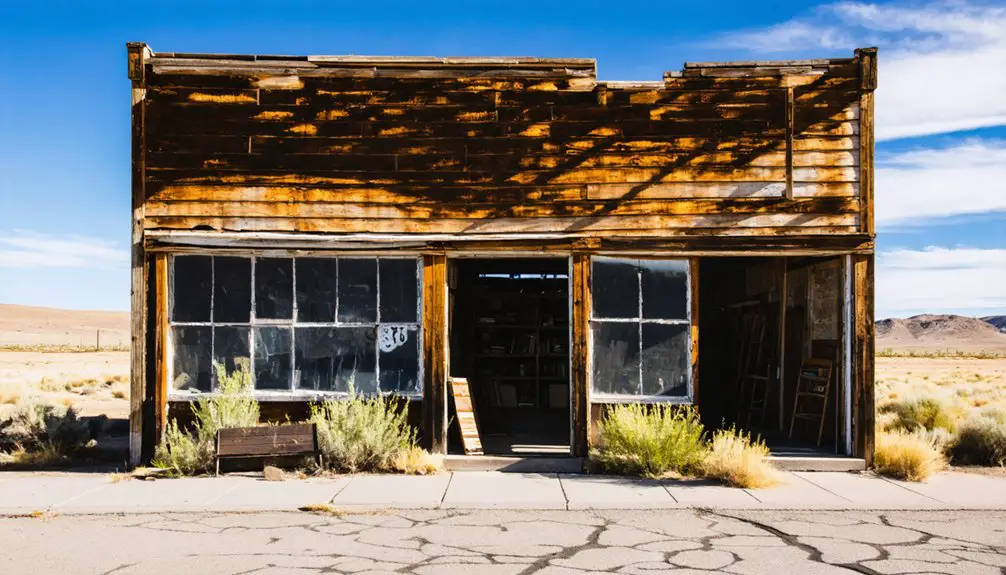
The town’s infrastructure eventually expanded to include a General Store, Livery Stable, and Post Office that served the miners and farmers working throughout the surrounding hills and valleys.
Golden: A True Ghost Town Experience Off Interstate 5
Just a few miles east of Interstate 5 near Wolf Creek, Golden offers visitors an authentic encounter with Southern Oregon’s mining heritage—a cluster of weathered buildings frozen in the late nineteenth century, where the echo of sluice boxes and hymns has long since faded into silence.
You’ll find two churches standing sentinel over this Oregon State Parks Heritage Site, monuments to Reverend William Ruble‘s vision when he established the community around 1890.
Unlike rowdy mining camps, Golden enforced a strict moral code—no saloon, no dancing—while gold mining operations on Coyote Creek sustained roughly 150 souls.
Town preservation efforts by local volunteers have stabilized the mercantile, schoolhouse, and church, creating an unvarnished window into a god-fearing settlement that thrived, then vanished when the gold ran dry.
Sterlingville: Where Only the Cemetery Remains
While Golden still displays its weathered buildings to passing visitors, Sterlingville has vanished so completely that only its hilltop cemetery confirms the town ever existed. Founded in 1854 after James Sterling’s gold strike, this boom town once housed 1,200 residents along Sterling Creek.
You’ll find no trace of its saloons, dance halls, or boarding houses today—nature reclaimed everything after the last miners left in 1957.
Cemetery preservation reveals Sterlingville’s forgotten story:
- The 1863 cemetery stands alone where an entire community thrived
- Weathered headstones mark pioneers who chased freedom in gold country
- Historical significance lives only in these scattered graves
- You’ll walk through silent woods where bustling streets once rang with miners’ voices
Four miles south of Jacksonville, this erasure reminds you how completely wilderness swallows abandoned dreams. The cemetery sits 4.2 miles from Buncom, connecting two of Jackson County’s most significant mining settlements. Like many mining or lumber camps, Sterlingville faced abandonment when the resources that sustained it were exhausted.
Waldo: Historic Placer Camp Near the California Border
The winter of 1851–1852 brought Oregon’s first major gold strike to a remote canyon near the California border, where Sailor’s Diggings erupted into existence practically overnight.
You’ll find traces of Waldo tucked among the creeks of southwest Josephine County, where 500 miners once worked placer deposits along Althouse Creek.
The camp’s Waldo history began when it became Oregon’s first mining town and Josephine County seat in 1855—a title it held only two years before losing political relevance.
Its mining heritage reflects the boom-and-bust cycle: brass bands and dance houses thrived alongside the log courthouse, quicksilver improved gold recovery in 1853, and 1,500 residents claimed this as southern Oregon’s largest settlement.
Then the placers played out, and Waldo faded into forest.
The Gold Rush That Built These Communities
You’ll find the origins of these ghost towns in the frenzied months following May 1851, when prospectors racing north from California’s exhausted diggings struck gold on Josephine Creek and ignited Southern Oregon’s boom.
Within a single day of the April announcement, 600 miners had already set out for Jackson County, staking claims along every promising creek within 50 miles of the border.
The white prospectors who grew rich on these placer deposits eventually sold their depleted claims to Chinese miners, who worked the remaining gravels until the camps emptied completely after 1861’s Eastern Oregon strikes.
At Althouse Creek alone, over 10,000 prospectors descended on the region within the first decade of discovery, transforming wilderness into bustling mining camps almost overnight.
By 1859, miners had discovered lode deposits throughout the county, though placer operations remained the primary source of gold production for decades to come.
1849 Sterling Creek Discovery
- Sterlingville exploded from wilderness to bustling boomtown eight miles south of Jacksonville.
- The Sterling Mine later produced $25,000–$60,000 per season through massive hydraulic operations.
- A nearby quartz ledge alone yielded $350,000 in surface gold.
- Claims sold for $100–$400 per share, letting original discoverers profit while others risked everything.
Chinese Miners’ Lasting Impact
When white miners abandoned Southern Oregon’s placer streams in the early 1860s—chasing richer strikes in Montana and Idaho—Chinese crews stepped in and rebuilt the entire economic foundation of the Rogue Valley.
By 1860, they comprised 50% of all miners in the region, turning “played-out” claims into steady profits that kept Jacksonville, Ashland, and nearby camps alive. Their Economic Influence extended beyond gold extraction: Chinese merchants, cooks, and farmers formed critical supply networks linking remote diggings to regional commerce.
Leaders like Gin Lin pioneered hydraulic mining techniques and built miles of ditches still visible today. Their Cultural Contributions—temples, festivals, herbal medicine—shaped town life, while contract-labor systems tied Rogue Valley wages to Guangdong villages half a world away, weaving Southern Oregon into global migration patterns.
What You’ll Find at Each Site Today
Unlike the bustling mining camps that once lined these Southern Oregon hillsides, today’s ghost town sites reveal themselves through weathered timber, crumbling foundations, and the profound silence of abandonment.
Among these remnants lie abandoned settlements near Baker City, each telling stories of dreams that faded. As the landscape reclaims its territory, the whispers of history can still be felt in the rustling leaves and the gentle breeze. Exploring these sites can evoke a sense of nostalgia for lives once lived amidst a thriving community.
In contrast, ghost towns to visit in Taos County offer a glimpse into the rich history of a different region, where the remnants of old buildings stand against a backdrop of stunning landscapes. Each site, from the well-preserved adobe structures to the scattered ruins, invites visitors to explore the stories of the past and connect with the cultural heritage of Northern New Mexico. As you wander through these forgotten places, the essence of the lives that shaped them lingers in the air, creating a haunting yet beautiful experience.
Each location offers self-guided exploration through landscapes where mining heritage meets nature’s reclamation.
What awaits at each site:
- Buncom—Three 1890s structures maintained by historic preservation volunteers, surrounded by overgrown tailings and Chinese miner artifacts.
- Golden—State heritage site with four stabilized buildings, viewable exteriors, and remnant orchards marking vanished neighborhoods.
- Sterlingville—Solely a hillside cemetery where weathered markers commemorate 1,200 vanished souls.
- Waldo—Roadside sign, scattered foundations, and a quiet cemetery accessed via dirt roads.
You’ll find simple interpretive plaques, minimal infrastructure, and fragile interiors kept locked—preserving these sites means respecting their deliberate stillness.
Planning Your Ghost Town Road Trip From Medford
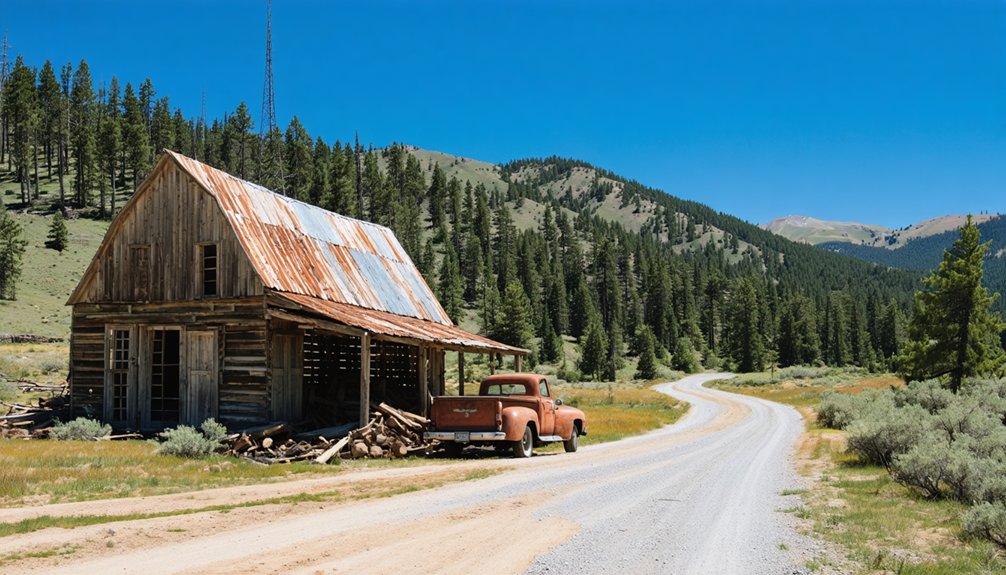
Planning a single-day circuit from Medford lets you combine the Applegate Valley’s Buncom and Sterlingville Cemetery with a northbound detour to Golden—a total driving distance of roughly 120–140 miles that fits comfortably between sunrise and sunset during the May–October window.
I learned from multiple trips that morning departures give you cooler temperatures at exposed sites and better light for photography, while shoulder-season visits in April or late September reward you with fewer crowds and vibrant foliage around historic cemeteries.
Pack a high-clearance vehicle if possible, sturdy footwear for uneven ground, plenty of water, and printed maps or downloaded GPS tracks, since cell coverage drops sharply along Sterling Creek Road and near Golden’s riverside location.
Recommended Multi-Site Itinerary Routes
Since Medford serves as the ideal launching point for exploring Southern Oregon’s mining heritage, you’ll want to maximize your day by linking Buncom, Golden, and Sterlingville Cemetery into a coherent triangle route.
Itinerary Highlights for Your Scenic Routes:
- Morning at Buncom (20 miles southwest) – Walk among weathered clapboard structures where Chinese miners struck gold in 1851, feeling the weight of history in every creaking board.
- Midday Golden exploration – Stand inside the abandoned church and post office, imagining 150 souls who built lives without saloons in these remote woodlands.
- Afternoon Sterlingville Cemetery (4.2 miles from Buncom) – Touch the aluminum gate marking where 1,200 miners once thrived before vanishing completely.
- Total circuit – Complete this 4-6 hour journey spanning two counties and five decades of mining dreams.
Essential Gear and Access Considerations
Before you turn the ignition key and head toward Buncom’s weathered storefronts, understand that these ghost town roads demand different preparation than a casual weekend drive.
Your essential gear begins with vehicle basics: a full-size spare, jack, and tire repair kit, since services vanish beyond Medford’s grid. Download offline maps—cell towers don’t reach wooded canyons near Sterling Creek—and pack paper atlases marking Sterlingville Cemetery’s coordinates.
Access considerations multiply in winter when storms close gravel spurs, so check Highway 238 conditions before departing. Keep your fuel tank above half, carry two liters of water per person, and share your route plan with someone reliable.
A high-clearance vehicle handles rutted cemetery tracks; a charged power bank keeps communication alive when breakdowns test your self-reliance.
Why Southern Oregon Has So Many Abandoned Towns
The ghost towns scattered across Southern Oregon owe their existence—and abandonment—to the region’s violent boom-and-bust cycles that began with the 1850s gold rush.
When ore veins ran dry, entire communities vanished overnight. You’ll find these patterns repeated across places like Buncom, Golden, and Sterlingville.
Four forces drove Southern Oregon’s mass abandonment:
- Economic decline struck when mining companies shuttered operations, leaving families with zero income and no reason to stay.
- Transportation impact devastated communities when railroads bypassed them for Medford and Grants Pass.
- Federal wartime restrictions in WWII killed gold mining operations permanently through Public Law 208.
- Geographic isolation in rugged terrain prevented diversification into logging or agriculture.
These settlements lacked the resilience to survive when their single industry collapsed.
Tips for Visiting and Photographing These Historic Sites
Understanding what drove these communities into abandonment makes visiting them far more meaningful.
Knowing the stories behind abandoned towns transforms casual sightseeing into a deeper connection with Oregon’s vanished past.
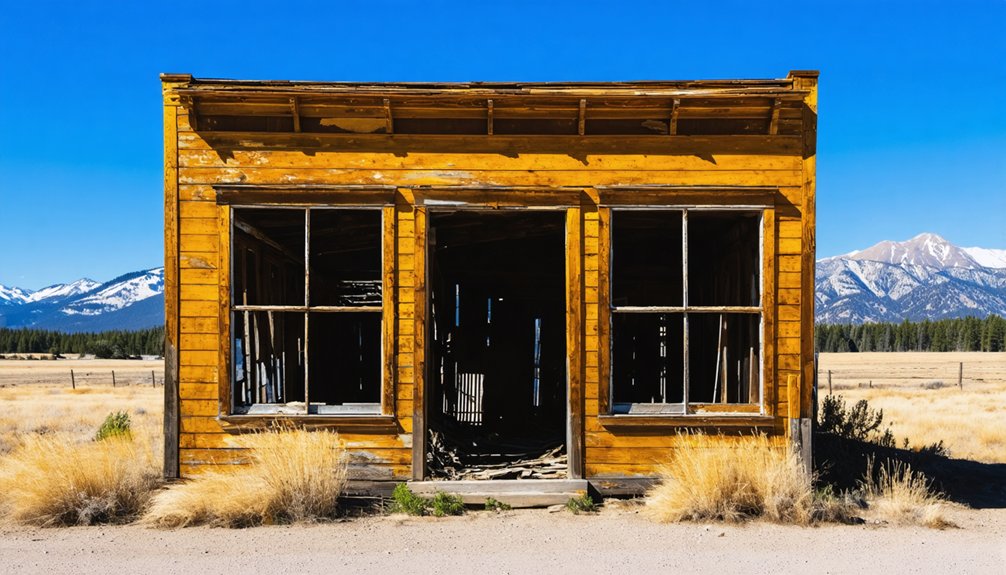
You’ll find all three sites within an hour’s drive, making them perfect for a single expedition. Golden’s State Heritage Site offers clearly marked structures you can explore freely, while Buncom’s weathered clapboard buildings stand roadside for easy access.
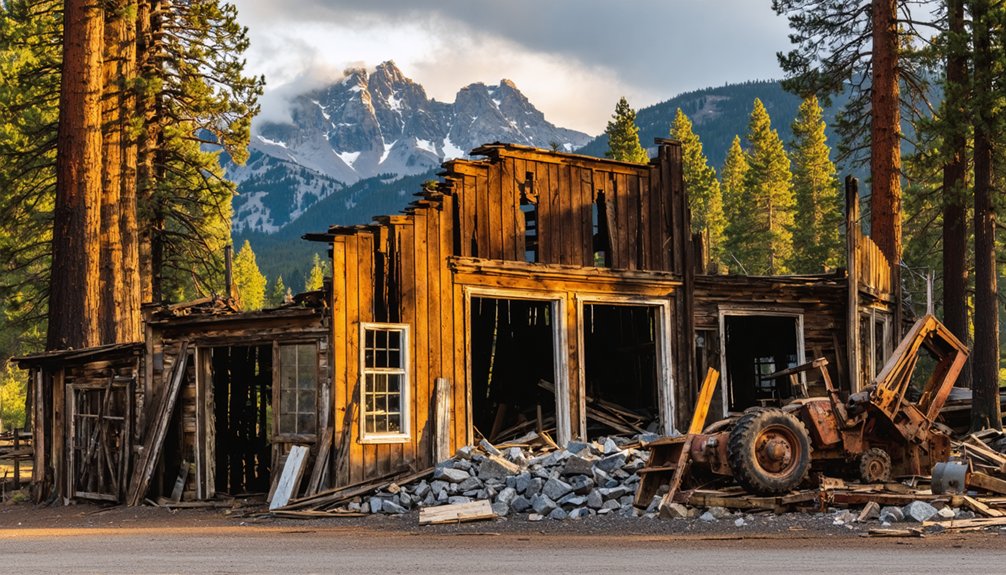
For photographing techniques, arrive during golden hour when sunlight filters through the tall pines and firs. The ancient trees provide natural framing, and wind movement creates atmospheric shots.
Visit Buncom’s May festival for unique documentary opportunities.
Practice proper ghost town etiquette: don’t enter deteriorating structures, leave artifacts untouched, and respect private property boundaries.
Your photographs become part of these sites’ historical record as they continue weathering into obscurity.
Frequently Asked Questions
Are Any Ghost Towns Near Medford Privately Owned or Off-Limits to Visitors?
Yes, many former mining-town areas around Medford reverted to private timber and ranch holdings after abandonment. You’ll find ghost town regulations permit visiting Golden and Buncom’s heritage sites, but private property access restrictions apply beyond marked boundaries.
What Wildlife or Safety Hazards Should I Watch for When Exploring These Sites?
Time hasn’t been kind to these crumbling sites. You’ll face wildlife encounters with returning waterfowl, unstable sinking structures, sharp stone debris, and isolated terrain. Essential safety precautions include sturdy boots and maintaining awareness of deteriorating buildings.
Can I Camp Overnight Near Any of the Ghost Town Locations?
You can’t camp directly at Buncom, Golden, or Sterlingville due to camping regulations protecting these historic sites. However, you’ll find dispersed camping on nearby BLM and national forest lands, though ghost town amenities like water don’t exist.
Are There Guided Tours Available for Medford-Area Ghost Towns?
You’ll find virtually *zero* standing tour guides at actual ghost towns—they’re gloriously unguarded ruins for your independent exploration. Ghost town history comes alive through self-guided visits, while tour guide availability centers on Jacksonville’s costumed haunted walks instead.
Which Ghost Town Is Best for Families With Young Children?
Golden State Heritage Site works best for young families, offering family friendly activities with four preserved buildings on level ground, interpretive signs for learning, and peaceful woodland atmosphere. It’s among Southern Oregon’s most accessible kid friendly attractions near Medford.
References
- https://en.wikipedia.org/wiki/List_of_ghost_towns_in_Oregon
- https://www.nationaldaycalendar.com/lists/12-oregon-ghost-towns
- https://www.visitoregon.com/oregon-ghost-towns/
- https://www.travelmedford.org/southern-oregon-ghost-towns-
- http://www.photographoregon.com/ghost-towns.html
- https://indigocreekoutfitters.com/news/2022/05/05/exploring-southern-oregons-ghost-towns/
- https://www.tripadvisor.com/Attraction_Review-g28958-d1898169-Reviews-Buncom-Oregon.html
- https://traveloregon.com/things-to-do/culture-history/ghost-towns/
- https://www.whattodoinsouthernoregon.com/blog/golden-state-heritage-site-ghost-town
- https://southernoregongrapevine.com/buncom-historic-ghost-town-in-jackson-county-oregon/