You’ll discover several authentic ghost towns within two hours of Mesa, with Goldfield Ghost Town being your closest option just 30 miles northeast along the Apache Trail. This reconstructed 1890s mining camp offers underground tours and Wild West reenactments. For a more remote experience, Vulture City sits 90 minutes northwest, where you can explore 18 restored buildings from Arizona’s most productive gold mine that yielded 340,000 ounces before closing in 1942. Each site requires different preparation regarding access rules, seasonal hours, and essential desert safety gear.
Key Takeaways
- Goldfield Ghost Town, 30 miles northeast of Mesa, offers free access with mine tours, railroad rides, and gunfight reenactments.
- Vulture City, 90 minutes northwest, features 18 restored buildings with guided tours available October to May for $10–$18 admission.
- Ghost towns range from 1.5–2 hours from Mesa, requiring route planning and confirmation of access rules before visiting.
- Essential desert gear includes one gallon of water per person, sun protection, closed-toe boots, and offline maps.
- Federal lands prohibit artifact collecting; visitors must respect historic sites by observing without touching or vandalizing structures.
Goldfield Ghost Town: Your Closest Adventure in Apache Junction
Just 30 miles northeast of Mesa along the legendary Apache Trail, Goldfield Ghost Town stands as the most accessible historic mining site in the region, offering visitors an authentic glimpse into Arizona’s territorial gold rush era.
Founded in 1893 after gold discoveries in the Superstition Mountains, this boom town swelled to 4,000 residents before mines faulted in 1898.
Goldfield’s explosive five-year gold rush transformed a desert outpost into a 4,000-person boomtown before geological faults ended the prosperity in 1898.
You’ll explore Goldfield history through reconstructed buildings on original foundations, where the Mammoth Mine once drove the entire economy.
Today’s experience includes underground mine tours, a narrow-gauge railroad, and gunfight reenactments.
The mining heritage comes alive in the museum’s artifacts and period structures—saloons, general store, and blacksmith shop—all carefully rebuilt since 1984 to preserve this twice-abandoned settlement’s remarkable story.
Bob Schoose purchased the Goldfield mill site in 1984 and began the ambitious reconstruction project, transforming his lifelong dream of owning a ghost town into a reality that now preserves Arizona’s mining heritage for future generations.
Located just 25 minutes from Superstition Springs in Mesa, Goldfield Ghost Town provides an easy day trip for those seeking to combine historical exploration with the area’s natural desert landscape.
Vulture City: Arizona’s Richest Gold Mine Heritage Site
You’ll find Arizona’s most productive gold mine about 90 minutes northwest of Mesa in Vulture City, where Henry Wickenburg’s 1863 discovery generated an estimated 340,000 ounces of gold before federal closure in 1942.
The preserved site lets you explore restored mine buildings, mills, and the original assay office that processed ore grading up to 20 troy ounces per ton during peak operations.
Today’s heritage site offers guided tours through structures that once supported 5,000 residents in territorial Arizona’s largest mining community. Located in Maricopa County, the site sits near the Vulture Mountains in Arizona’s distinctive desert landscape.
Historic Mine Operations Overview
When prospector Henry Wickenburg stumbled upon gold-bearing quartz outcrops in 1863, he set in motion what would become Arizona’s most productive gold mining operation.
The Vulture Mine extracted 340,000 ounces of gold and 260,000 ounces of silver between 1863 and 1942, generating roughly $200 million in cumulative value.
Early mining techniques relied on pick-and-shovel quarrying of surface deposits yielding an astounding 20 troy ounces per ton.
As operations expanded, ore processing evolved from simple crushing to sophisticated extraction methods designed to capture free gold and electrum from quartz veins.
Structural challenges—faulting, tilting, and rotation—constantly disrupted development, forcing miners to adapt their approach.
When primary veins played out by 1916, operators shifted focus to tailings retreatment, squeezing every ounce from previously discarded material.
The mining boom transformed the surrounding desert into a thriving community of approximately 5,000 residents at its peak, complete with homes, saloons, a school, and a post office.
Mill operations expanded dramatically to meet production demands, with 80 stamps running continuously to process the steady flow of ore from underground workings.
Restored Buildings and Tours
Eighteen meticulously restored buildings and structures transform Vulture City into Arizona’s most extensive gold rush heritage site, where visitors walk through an open-air museum preserving 1860s–1940s mining camp life.
You’ll explore the iconic two-story rock-walled assay office (1884), Henry Wickenburg’s reconstructed 1864 cabin, and authentic period structures including the blacksmith shop, schoolhouse, brothel, and cookhouse.
Adobe specialists from Mexico and the U.S. employed traditional restoration techniques during the thorough 2017 campaign, guided by historic photographs and engineering records.
Each building houses historical artifacts and interpretive displays showcasing mining technology and frontier society.
The mine’s remarkable productivity yielded over 340,000 ounces of gold and 260,000 ounces of silver during its operational lifetime.
The relocated headframe stands prominently in the town center as a significant component of mining operations, having been moved from its original location threatened by modern mining encroachment.
Choose between guided walking tours with costumed interpreters or self-guided exploration through marked routes.
Living-history events and nighttime specialty programs bring authentic mining-camp experiences to life throughout restored streetscapes.
Visiting Hours and Access
Vulture City operates on a seasonal schedule from October through May, with regular hours running 9 AM to 5 PM except Wednesdays when the site closes for maintenance.
You’ll need a general admission ticket to explore the 16 original 1800s buildings, typically priced between $10–$18 based on age.
The site closes during summer months due to extreme desert heat, though special events occasionally provide access. Access restrictions apply after dark unless you’ve booked a flashlight tour or evening event.
Most visitors spend 1–2 hours walking the grounds on uneven terrain. You’ll find fewer crowds on weekdays, giving you better freedom to explore at your own pace.
The heritage site enforces controlled entry during posted hours only, and visitor etiquette requires respecting the fragile historic structures throughout your self-guided experience. Guided tours are available seven days a week for groups of all ages and sizes, offering hands-on experiences with complete handicap accessibility. Children under 6 receive complimentary entry to the ghost town.
Jerome: Copper Boomtown Turned Mountain Retreat
Perched dramatically on Cleopatra Hill’s steep slopes, Jerome began as a rough copper camp in 1876 when three prospectors staked claims to rich ore deposits. The United Verde Copper Company, organized in 1883 and backed by financier Eugene Jerome, transformed board-and-canvas shacks into Arizona Territory’s largest producing copper mine.
By 1929, production peaked as Jerome’s mines ultimately yielded $1 billion in metals over seven decades.
You’ll discover this copper heritage through terraced streets where 300-plus workers once labored. Immigrant communities from Ireland, Italy, and Croatia built churches, an opera house, and schools.
When Phelps Dodge closed operations in 1953, Jerome became a near-ghost town. Today, its mining legacy attracts visitors exploring preserved buildings clinging to mountainsides, offering authentic Western history without corporate sanitization.
Southern Arizona Mining Camps: Courtland, Pearce, and Paradise
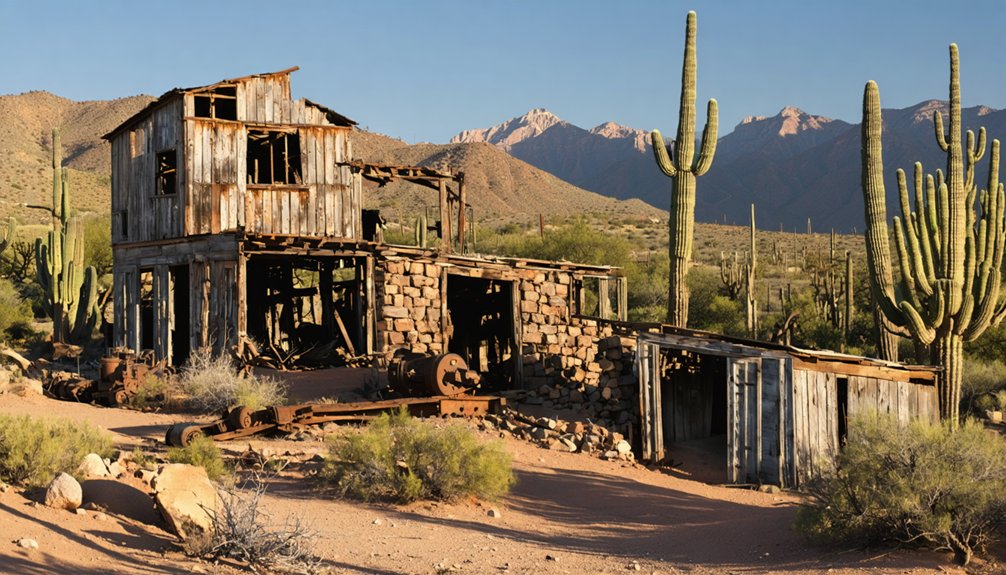
While Jerome commanded the heights of central Arizona’s copper country, a constellation of smaller camps dotted Cochise County’s desert floor, their fortunes rising and falling with remarkable speed in the early 1900s.
Courtland history begins in 1909 when copper strikes at the Dragoon Mountains’ base attracted major operators like Calumet & Arizona.
The town boasted electric lights, two newspapers, and even a car dealership—remarkably modern for its era.
But limestone at 300 feet killed the ore bodies, and closures began by 1917.
Pearce mining predated Courtland, starting when Jimmie Pearce discovered gold in 1894.
His Commonwealth Mine extracted $10.5 million in precious metals before cave-ins and Depression-era collapse shuttered operations.
Today you’ll find concrete ruins marking both camps’ brief prosperity.
Understanding Ghost Town Categories and What to Expect
The term “ghost town” carries romantic weight in the American West, yet no single definition governs its use.
You’ll encounter sites ranging from barren foundations requiring GPS coordinates to semi-active communities with museums and occupied homes. Understanding ghost town classifications helps set realistic expectations before you invest time reaching remote locations.
Common condition categories you’ll discover:
- Barren sites – only archaeological traces and foundations remain
- Classic ghosts – standing, roofed structures with zero permanent residents
- Near-ghosts – small populations amid numerous abandoned buildings
- Restored towns – preserved structures operating as tourist attractions with modern amenities
Visitor safety demands attention to access conditions, structural instability, open mine shafts, and desert hazards.
Remote sites often lack cellular coverage and clear signage, requiring self-reliance and preparation.
Planning Your Ghost Town Day Trip From Mesa
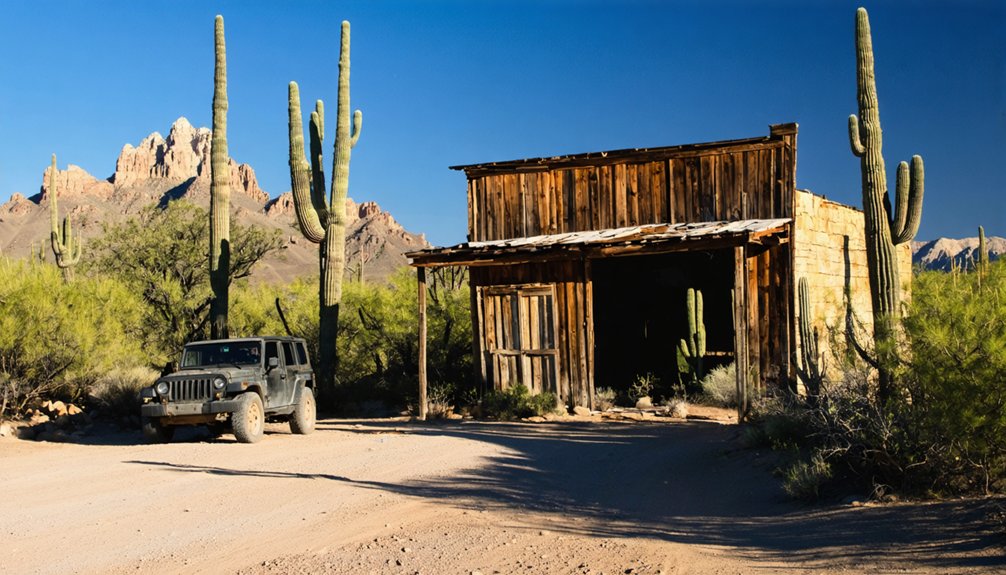
Most ghost towns near Mesa lie 1.5–2 hours away, so you’ll need to map your route carefully, confirm access rules, and prepare essential desert gear before departure.
Check whether your chosen site requires permits, charges admission fees, or restricts entry times—Goldfield Ghost Town, for example, offers free street access but sells tickets for mine tours and train rides.
Pack ample water, sun protection, closed-toe shoes, and navigation tools****, because extreme heat, limited cell service, and uneven terrain define the conditions you’ll encounter on these historic properties.
Distance and Drive Time
Planning your ghost town adventure from Mesa begins with understanding drive times and distances, which vary dramatically depending on your chosen destination. Your choices range from quick half-day excursions to full-day commitments requiring careful preparation.
Distance breakdown from Mesa:
- Goldfield Ghost Town – 35 miles via US-60 E to AZ-88 N (30–45 minutes), perfect for spontaneous half-day trips
- Vulture City – 110–120 miles via Loop 101/303 and US-60/93 toward Wickenburg (2–2.5 hours one way)
- Jerome – 130–150 miles via I-17 N then AZ-260/89A (2.5–3 hours one way), with winding mountain roads
- Swansea – 200+ miles requiring 4–5 hours one way on secondary highways
Travel tips: Factor in driving conditions like Jerome‘s mountain ascent and Swansea‘s unpaved approach roads when planning your escape into Arizona’s frontier past.
Essential Supplies and Gear
Once you’ve mapped your route and calculated drive time, success in Arizona’s backcountry hinges on what you pack.
Critical gear recommendations start with one gallon of water per person daily—increase to three gallons in summer heat. Bring closed-toe hiking boots for traversing loose rock and mine tailings, plus work gloves for handling rusted metal around historic structures.
Essential safety precautions include downloading offline maps, packing a portable power bank, and carrying a thorough first-aid kit with snakebite awareness materials.
SPF 30+ sunscreen, wide-brimmed hats, and UV-blocking sunglasses combat intense desert sun.
Don’t forget a headlamp with extra batteries for exploring shaded buildings, a whistle for emergencies, and high-calorie snacks to maintain energy during extended walking circuits through abandoned streets.
Access Rules and Permits
Before you load your vehicle and head into the desert, understanding access rules can mean the difference between a successful exploration and a locked gate or legal citation.
Ghost towns near Mesa present varied permit requirements and access limitations depending on ownership and jurisdiction.
- Goldfield Ghost Town allows free public access during business hours (10 a.m.–5 p.m.) but requires advance permission for professional photography and commercial shoots.
- BLM and USFS sites often need special use permits for organized groups, commercial tours, or filming activities.
- Ruby Ghost Town shifted to complete closure in 2024—now viewable only from the road with binoculars.
- Federal lands prohibit artifact collecting and metal detecting without scientific permits, carrying legal penalties for violations.
Always verify current status before traveling.
Access Tips and Etiquette for Visiting Historic Sites
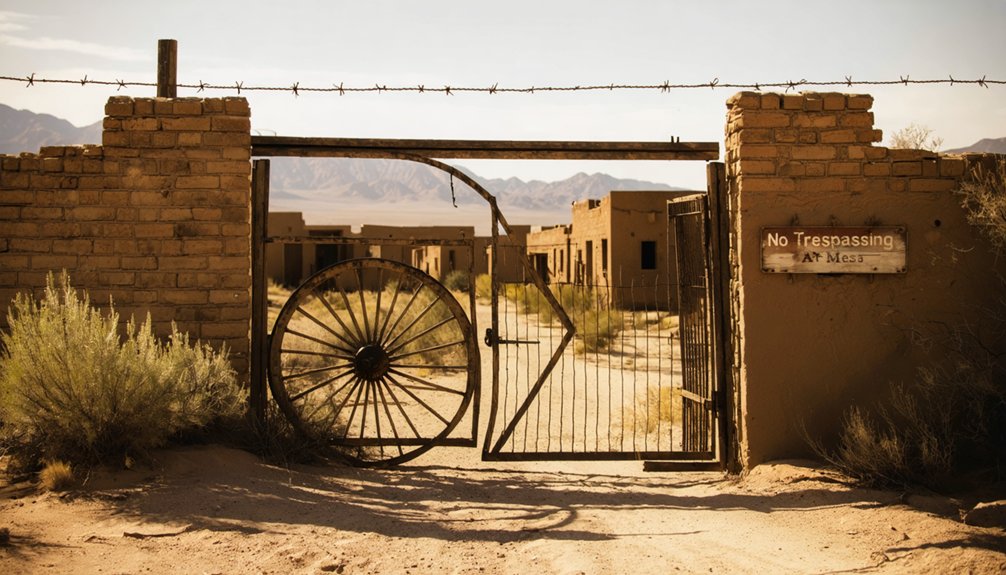
Visiting ghost towns near Mesa requires careful attention to land ownership and access rights, since these historic sites fall under multiple jurisdictions—including private property, state trust land, Bureau of Land Management parcels, National Forest boundaries, and tribal territories.
Ghost town exploration demands thorough research of land ownership and access rights across private, state, federal, and tribal jurisdictions.
Check posted regulations at trailheads and confirm seasonal restrictions related to wildfire risk or extreme heat. Essential safety measures include carrying ample water, avoiding unstable structures and open mine shafts, and monitoring flash-flood forecasts for canyon approaches.
Environmental protection demands staying on established trails to preserve cryptobiotic crust, parking on durable surfaces to prevent brush fires, and packing out all waste.
Respect historic resources by observing without touching—leaving artifacts, bottles, and tools undisturbed. Avoid metal detecting, artifact collection, and sharing precise coordinates publicly to reduce vandalism at unprotected sites.
Frequently Asked Questions
Are Any Ghost Towns Near Mesa Safe to Visit Alone?
You’ll find Goldfield Ghost Town your safest bet for solo travel—it’s a commercial attraction with staff, tours, and facilities just 25 minutes from Mesa. Follow basic safety tips and stick to daylight hours.
Can I Metal Detect or Collect Artifacts at Arizona Ghost Towns?
No, you can’t legally metal detect or collect artifacts at Arizona ghost towns. Metal detecting laws prohibit disturbing historic sites on public lands, and artifact preservation rules require permits. Most ghost town sites are private property requiring owner permission.
Which Ghost Towns Near Mesa Are Wheelchair or Stroller Accessible?
Goldfield Ghost Town offers partial wheelchair accessibility and stroller-friendly areas along its commercial core, though unpaved, sloping terrain limits full-site access. Power wheelchairs and all-terrain strollers handle the rough surfaces better than manual chairs.
Do Ghost Towns Near Mesa Offer Overnight Camping or Lodging Options?
You’ll find overnight camping at Goldfield Ghost Town campground with basic dry sites ($30) and hookups ($50). Camping regulations are minimal—no formal reservations required. For lodging availability, nearby Lost Dutchman State Park and Mesa KOA offer additional options.
What’s the Best Season to Visit Ghost Towns Near Mesa?
The best time is late fall through early spring (October–April) when you’ll enjoy comfortable temperatures for exploring historic sites, plus seasonal activities like October’s ghost tours and ideal winter photography conditions.
References
- https://en.wikipedia.org/wiki/List_of_ghost_towns_in_Arizona
- https://kids.kiddle.co/List_of_ghost_towns_in_Arizona
- https://www.elitevrs.com/blog/discover-these-top-10-ghost-towns-arizona
- https://www.americansouthwest.net/ghost-towns.html
- https://www.fyzical.com/superstition-springs-az/blog/goldfield-ghost-town-near-superstition-springs-history-location-and-community-connections
- https://www.tripadvisor.com/Attractions-g28924-Activities-c47-t14-Arizona.html
- https://goldfieldghosttown.com
- https://goldfieldghosttown.com/attractions/
- https://en.wikipedia.org/wiki/List_of_historic_properties_in_Goldfield
- https://www.ajpl.org/building-a-dream-goldfield-ghost-town/