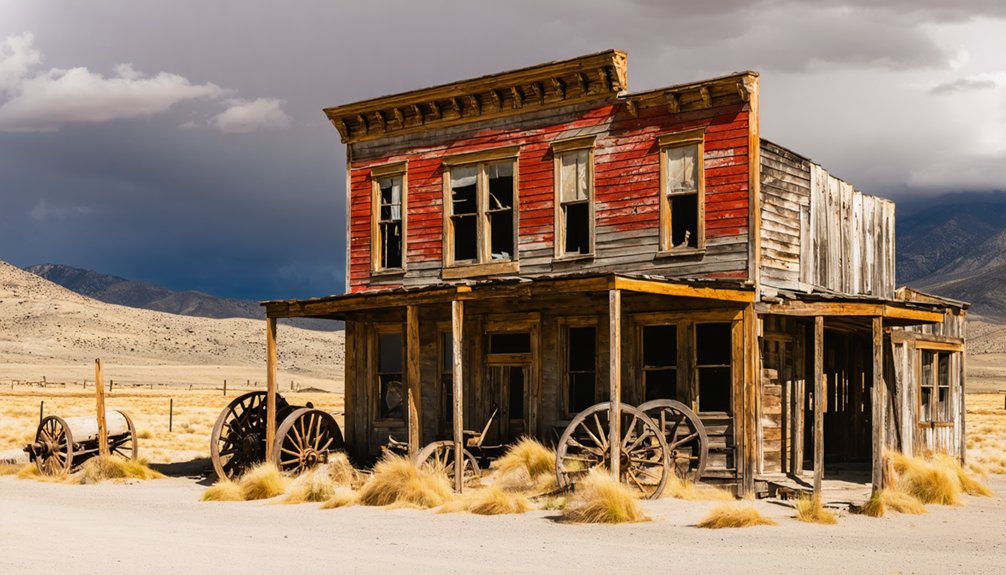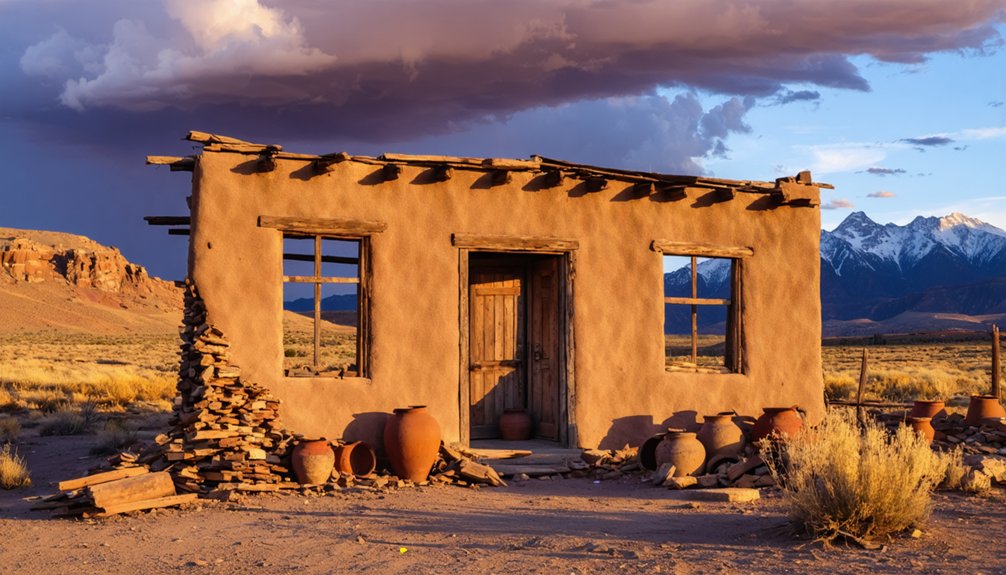
You’ll find over a dozen ghost towns within 110 miles of Mesa Verde, ranging from the park’s own 1,000-year-old Ancestral Puebloan cliff dwellings to 19th-century mining camps in the San Juans. Animas Forks sits at 11,200 feet with stabilized structures from its 1870s heyday, while Red Mountain Pass preserves scattered foundations from Colorado’s second-largest silver district. Alta’s skeletal remains mark a high-alpine camp that produced $5 million in precious metals. Each site reveals distinct chapters of Colorado’s settlement history worth exploring further.
Key Takeaways
- Mesa Verde contains over 4,400 Ancestral Puebloan sites, including Cliff Palace and other cliff dwellings abandoned around 1300 CE.
- Animas Forks, at 11,200 feet elevation, is Colorado’s most visited high-altitude ghost town with stabilized 1870s mining structures.
- Red Mountain Pass mining camps between Ouray and Silverton feature scattered foundations from Colorado’s second most important silver district.
- Alta, at 11,000 feet, preserves Colorado’s last major mining boardinghouse and produced over $5 million in minerals through 1948.
- Over a dozen mining-era ghost towns lie within 110 miles of Mesa Verde, accessible via high-clearance vehicles during summer months.
Ancient Puebloan Villages: Mesa Verde’s Prehistoric Ghost Settlements
Long before the Euro-American mining camps that dot the Four Corners region crumbled into ruin, Mesa Verde‘s sandstone alcoves and mesa tops held North America’s original ghost towns—villages abandoned by their Ancestral Puebloans around 1300 CE.
You’ll find over 4,400 documented sites across the plateau, spanning 750 years of continuous occupation. The cliff dwellings you see today—massive stone complexes like Cliff Palace with 150 rooms—were constructed in a concentrated building period between 1190 and 1300 CE.
Earlier generations farmed mesa-top communities like Far View, where 35 villages once clustered within half a square mile. When families departed for unknown southern destinations, they left behind intact architecture: multi-story room blocks, ceremonial kivas, and hand-cut access routes that remain frozen in time. The builders used sandstone and mud mortar to construct these enduring structures, employing ancient Pueblo techniques that have preserved the dwellings for over seven centuries. The dwellings showcase strategic cliff placement that provided both protection and natural climate control through microclimate engineering.
Animas Forks: Colorado’s Most Accessible High-Altitude Ghost Town
Twelve miles of graded mountain road northeast of Silverton will deliver you to Animas Forks, perched at 11,200 feet where three branches of the Animas River converge in a high basin of the San Juans.
Founded in 1873 as a mining camp, this settlement peaked at 450 residents by 1883, supporting a newspaper, school, and thriving gold-silver operations.
The 1891 fire, 1893 silver crash, and Gold Prince Mill’s 1910 closure ended the boom.
What makes Animas Forks exceptional is its preservation—the Bureau of Land Management maintains stabilized structures along the Alpine Loop Backcountry Byway, making it Colorado’s most visited high-altitude ghost town.
You’ll traverse the same routes miners used, experiencing authentic mining heritage without bureaucratic barriers limiting your exploration of this National Register site. Otto Mears built a wagon road in 1875 that connected the isolated camp to the outside world, dramatically boosting mining activity and commercial development. The journey requires a high-clearance 4-wheel-drive vehicle, with the best visiting conditions occurring during the summer season when over 100,000 visitors annually explore the Alpine Loop.
Red Mountain Pass Mining Camps: Ironton, Guston, and Red Mountain Town
Between Ouray and Silverton, the Million Dollar Highway‘s dramatic traverse of Red Mountain Pass carries you through Colorado’s second most important silver district—a cluster of camps that harbored 3,000 residents during the 1880s boom.
Red Mountain Town, perched at 11,300 feet, served as the commercial hub until an 1895 fire and the 1893 silver crash reduced it to ruins. Today you’ll find scattered foundations, tailings, and a small jail off Highway 550.
At 11,300 feet, Red Mountain Town reigned as the district’s heart until fire and economic collapse left only foundations and ruins.
North along the old railroad grade, Guston flourished after the Silverton Railroad arrived in 1889, complete with a miner-funded church dedicated in 1892. Initial settlements in the area appeared in the late 1870s, though the true boom didn’t begin until 1882.
The district’s Mining History centers on legendary operations—National Belle, Yankee Girl, Congress—that extracted rich silver “pipes” from these iron-stained peaks before abandonment. Sulfuric acid from local pyrites caused mining equipment to deteriorate rapidly, adding to the operational challenges miners faced in this harsh environment.
Alta and the Telluride Mining District Ruins
South of Telluride, the skeletal remains of Alta cling to Silver Mountain’s slopes at 11,000 feet, marking one of Colorado’s most significant high-alpine mining camps.
You’ll find crumbling boardinghouses, mill foundations, and miners’ dormitories scattered near Alta Lakes—authentic Alta ruins from a district that produced over $5 million in gold, silver, copper, and lead between 1877 and 1948.
The mining history here centers on technological innovation: Alta’s mines became the world’s first to receive alternating current power.
The 9,000-foot Black Hawk tunnel, driven in 1898, intersected three major veins and fed successive mills until 1948, when fire destroyed the final complex.
Unlike most San Juan camps, Alta operated through World War II.
Today’s ghost town preserves Colorado’s last major mining-camp boardinghouse, constructed in 1939.
The camp’s three-story miner’s dormitory stands as one of the district’s most impressive surviving structures.
Access requires a high-clearance 4×4 vehicle along Alta Lakes Road, which branches from Highway 145 approximately six miles south of Telluride.
Planning Your Ghost Town Adventure From Mesa Verde
Mesa Verde National Park’s location in Southwest Colorado positions you at the geographic heart of the state’s most accessible ghost town circuit, with over a dozen mining-era settlements scattered within a 110-mile radius.
Exploring abandoned sites near Santa Fe can also provide a glimpse into the region’s rich history and cultural evolution. Each location tells a story of resilience and adaptation, making them appealing to both history enthusiasts and curious travelers alike. These sites often evoke a sense of mystery and invite exploration, revealing the hidden narratives of those who once inhabited them.
You’ll want to prioritize St. Elmo and Animas Forks for ghost town photography—St. Elmo’s 43 original buildings and Animas Forks’ dramatic 11,200-foot elevation provide unmatched visual opportunities.
Summer months (June-September) open access to high-elevation sites like Independence at 10,830 feet, while St. Elmo remains reachable year-round.
Pack high-clearance vehicles for historic mining tours along the Alpine Loop 4×4 byway.
Combine these mining settlements with Mesa Verde’s Ancient Puebloan cliff dwellings to contrast Colorado’s 1300 AD archaeological heritage against its 1860s-1920s mining boom era. Many of these ghost towns are preserved as national historic treasures, offering protected glimpses into Colorado’s mining past. Independence, established after a gold discovery in 1879, once housed over 1,500 residents before being abandoned in 1899 due to severe snowstorms.
Frequently Asked Questions
Are Ghost Town Artifacts Protected by Law in Colorado?
Yes, Colorado law protects ghost town artifacts through strict artifact preservation rules. You’ll face fines up to $2,000 or jail time for unauthorized collection, recognizing their historical significance on public lands and designated sites.
What Permits Are Needed for Overnight Camping Near Ghost Town Sites?
Like a prospector staking a claim, you’ll navigate varied camping regulations: tribal parks require advance permits, Mesa Verde restricts you to Morefield Campground with campsite reservations, while surrounding national forests offer free dispersed camping without permits.
Can Children Safely Explore Mining Ghost Towns Near Mesa Verde?
Children can explore safely only with strict supervision and safety precautions—stay outside unstable structures, avoid all mine openings, and focus on child-friendly activities like photographing exteriors and reading interpretive signs at maintained sites.
Which Ghost Towns Allow Metal Detecting or Gold Panning Activities?
You’ll find zero legal metal detecting spots near Mesa Verde’s ghost towns due to strict metal detecting laws, but gold panning locations like Clear Creek near Vicksburg and Animas Forks’ high-altitude streams welcome your prospecting freedom.
Are Guided Ghost Town Tours Available From Mesa Verde Area Hotels?
Mesa Verde area hotels don’t operate in-house guided tours but readily connect you with independent outfitters offering jeep excursions to Alpine Loop ghost towns. Most ghost town accommodations refer guests to established Durango and Silverton tour companies for backcountry access.
References
- https://www.uncovercolorado.com/ghost-towns/
- https://www.americansky.co.uk/colorado-holidays/exploring-colorados-ghost-towns
- https://www.durango.com/colorado-ghost-towns/
- https://mild2wildrafting.com/rafting-blog/ghost-towns-of-colorado
- https://www.visitouray.com/ghost-towns
- https://www.ariverhouselodge.com/blog/3-ghost-towns-to-check-out-this-fall/
- https://exhibits.lib.utah.edu/s/ghost-towns/item/139477
- https://www.tripadvisor.com/Attraction_Review-g33581-d1072203-Reviews-Animas_Forks-Ouray_Colorado.html
- https://whc.unesco.org/en/list/27/
- https://www.oldonesdream.com/p/the-four-corners-mesa-verde-national