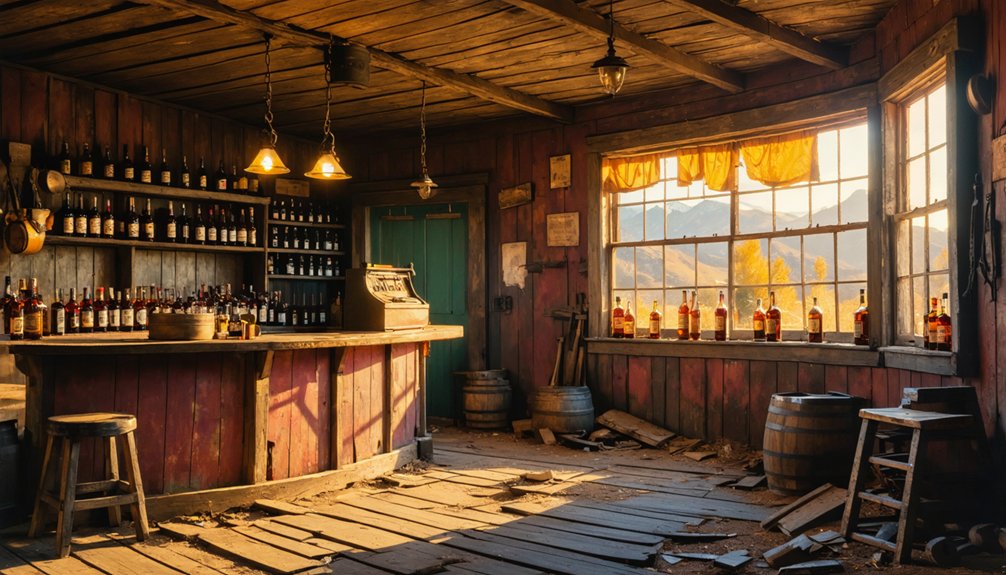
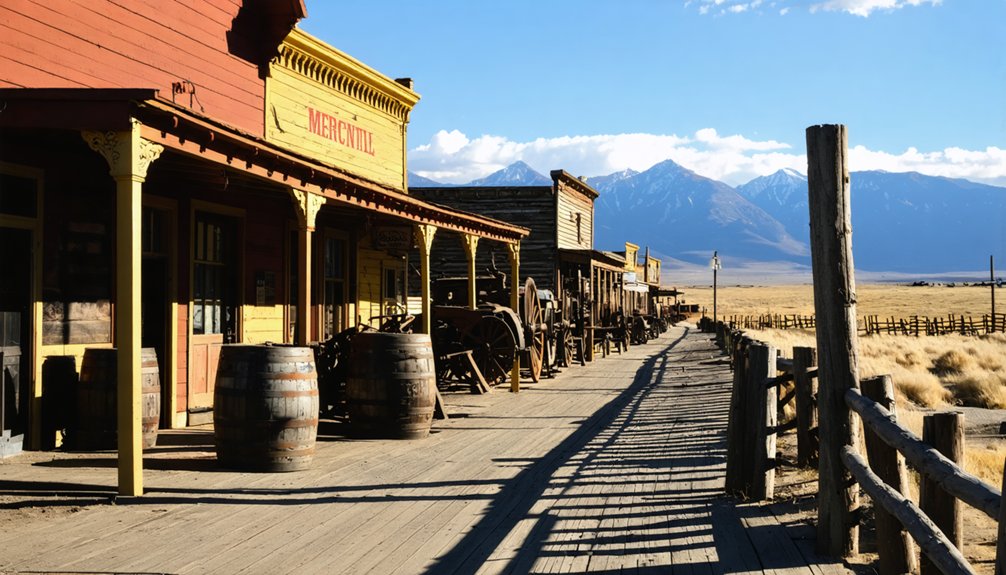
You’ll discover Monterey County’s closest authentic ghost towns in the abandoned mercury mining districts of San Benito and Santa Clara counties, particularly New Idria—once North America’s second-largest mercury producer—and the Almaden Quicksilver complex. Fort Ord itself functions as a modern military ghost town, with 28,000 acres of deteriorating structures since its 1994 closure. While coastal sites like Los Coches Adobe and Carmel Mission offer paranormal folklore rather than true depopulation, the region’s genuine abandoned settlements cluster inland where industrial collapse left entire communities frozen in time.
Key Takeaways
- Fort Ord is a 28,000-acre former military base abandoned in 1994, now featuring empty buildings and redevelopment areas.
- Los Coches Adobe served as a stagecoach station and saloon before foreclosure in the 1860s, now attracting paranormal enthusiasts.
- Carmel Mission Basilica, founded in 1770, experienced 19th-century abandonment and features ghost folklore despite remaining an active parish.
- New Idria Mining District in nearby San Benito County is the region’s most substantial abandoned mercury mining complex.
- Point Sur combines ghost town and haunted site characteristics, representing coastal California’s historical abandonment patterns.
Fort Ord: Monterey’s Modern Military Ghost Post
Though most ghost towns conjure images of weathered saloons and abandoned mine shafts from the 1800s, Fort Ord represents a different breed of abandonment—a 20th-century military city that sprawled across 28,000 acres of Monterey Bay coastline before the U.S. Army shuttered operations in 1994.
This former training ground, where 1.7 million soldiers prepared for combat from WWI through Desert Storm, carries profound historical significance as America’s first fully integrated military base.
Today you’ll find blocks of vacant barracks, empty motor pools, and overgrown ranges that evoke the installation’s sudden closure. Urban redevelopment has transformed portions into California State University Monterey Bay and residential neighborhoods, while environmental cleanup tackles unexploded ordnance across thousands of acres.
The area also serves as home to the endangered Smith’s blue butterfly, earning designation as the first nature reserve in the United States dedicated to insect conservation.
Community engagement now balances military heritage preservation with reclaiming land for public use. The Fort Ord Reuse Authority oversaw economic recovery efforts following the base closure until concluding its 26-year mission in June 2020.
Understanding Ghost Towns vs. Haunted Historic Sites in the Region
When you explore abandoned settlements around Monterey County, you’ll encounter two distinct categories that tourism brochures often conflate: genuine ghost towns—depopulated sites like the Los Burros Mining District’s Manchester or the residential compound at Point Sur Lightstation after its 1974 automation—and haunted historic sites such as Carmel Mission or Stokes Adobe, which remain active landmarks layered with paranormal folklore.
Ghost town definitions center on economic collapse or technological change that stripped settlements of residents, leaving infrastructure without inhabitants.
Haunted site distinctions rest on continuous use—these locations evolved into museums, churches, or commercial spaces while accumulating supernatural narratives tied to named individuals and documented tragedies. Fort Ord represents another example of military abandonment, where former Army post buildings have stood empty since 1994 BRAC closure, though paranormal reports of spectral military service dogs continue. The Los Coches Adobe, constructed in 1843 and expanded in 1848, transformed from an inn and stagecoach stop into a brothel, where legend claims the madame murdered guests for their gold.
Point Sur blurs both categories: its depopulated keeper quarters host apparition reports, merging physical abandonment with spectral presence.
Understanding this separation clarifies which sites you can freely roam versus those requiring entry fees and guided tours.
Los Coches Adobe: the Stagecoach Stop With Dark Secrets
Los Coches Adobe exemplifies the blurred boundary—roughly thirty miles south of Monterey near the Salinas River, this 1842 rancho structure operated as both an economically essential stagecoach station and a site now layered with ghost-town characteristics and paranormal folklore.
Haunted history and ghostly encounters define this roadside landmark:
- Captain John C. Frémont’s 1846–1847 military occupation seized livestock and supplies during the Mexican–American War.
- Severe 1860s drought forced the Richardson family into debt, leading to foreclosure and David Jacks’s 1865 sheriff’s-sale purchase.
- Post-railroad era transformation into a rowdy saloon featuring gambling, fights, and heavy drinking.
- The Butterfield Overland Stage used the rancho as a regular stop from 1854 to 1868, cementing its role in California’s transportation network.
- Apparitions near the road and phantom stagecoach sounds reported by visitors.
- Oral traditions cite crime and vice during its frontier-roadhouse phase.
- Travel Channel’s Ghost Adventures series featured the building’s unexplained activity, drawing paranormal enthusiasts.
You’ll discover layers of conflict, commerce, and unexplained phenomena.
Carmel Mission Basilica and Its Spectral Legends
Mission San Carlos Borromeo de Río Carmelo stands three miles south of Carmel as California’s second-oldest mission and the former headquarters of Alta California’s entire mission chain. Founded in 1770 by Fr. Junípero Serra, the stone basilica you’ll encounter today was dedicated in 1797.
Mission history reveals decades of 19th-century abandonment that left the church roofless and deteriorating—conditions that spawned enduring spectral folklore.
Local legend centers on cemetery hauntings involving a brown-robed Franciscan friar seen near Serra’s tomb inside the basilica or walking the cloisters at dusk. The mission’s layered burial grounds hold Native converts, Spanish soldiers, and early settlers beneath coastal fog that settles over crumbling headstones. Despite its ghostly reputation, the site maintains an active parish with Mass held throughout the week for community worship.
Serra’s remains, examined four times during canonization, anchor tales of lingering presence within these authentically restored walls. Visitors can explore four historical museum galleries that document the mission’s restoration and preserve artifacts from California’s earliest religious settlements.
Exploring California’s Classic Ghost Towns for Context
Before you venture into Monterey County’s lesser-known ruins, you’ll gain essential interpretive tools by examining California’s premier ghost towns.
Among these, the abandoned mining towns in California tell stories of a once-thriving economy fueled by gold rushes and hopeful prospectors. Each decaying structure serves as a silent witness to the ambitions of those who sought fortune in the rugged landscape. Exploring these remnants can offer unique insights into the region’s history and the challenges faced by its early inhabitants.
Bodie State Historic Park presents nearly 200 buildings frozen under an “arrested decay” policy, offering the clearest archival record of 1880s hard-rock mining culture in the Sierra Nevada. Visitors can explore the site via a self-guided walking tour while learning from the well-stocked bookstore available on site.
Calico, commercialized since the 1950s but grounded in genuine 1880s silver-rush infrastructure, and scattered Mojave settlements like Ballarat provide comparative frameworks for understanding how coastal mining camps near Monterey followed similar boom-and-bust trajectories despite markedly different geographies. Ballarat became neglected after the last resident died in 1968, marking the end of habitation in this remote Death Valley supply town.
Bodie’s Preserved Mining Legacy
Though Bodie lies roughly 200 miles northeast of Monterey—across the Sierra Nevada in the arid Mono Lake basin—it anchors any serious discussion of California’s ghost towns because its scale, preservation, and documentary record set the benchmark against which all others are measured.
Bodie’s Heritage demonstrates what authentic preservation looks like: 100–170 structures maintained in “arrested decay” since its 1962 State Historic Park designation. You’ll find original furnishings, merchandise, and mining equipment exactly where workers left them when the last mine closed in 1942.
- Peak population of 8,000 supported 400+ businesses across 2,000 structures
- Mining techniques included 31 steam hoisting works and seven quartz stamp mills
- Standard Mill alone extracted over $14 million in gold
- Two devastating fires (1892, 1932) reduced the town by 90%
- “Arrested decay” policy prevents restoration, maintaining historical authenticity
Calico’s Commercialized Silver Boomtown
Silver strikes in California’s Mojave Desert followed a predictable pattern—rapid discovery, explosive growth, then equally swift abandonment—and Calico exemplifies this cycle while adding a unique epilogue of commercial resurrection.
Founded in 1881 after discovery of the Silver King Mine, you’ll find Calico history reflects authentic boomtown economics: over 500 mines operated here, producing roughly $20 million in silver before federal price collapses gutted profitability by the mid-1890s.
Silver mining operations couldn’t survive when values plummeted from $1.31 to $0.63 per ounce. The post office closed in 1898, marking Calico’s shift to ghost town status.
What distinguishes Calico today is Walter Knott’s 1950s acquisition and reconstruction—transforming authenticated ruins into California’s most commercially developed ghost town experience, blending preservation with accessibility.
Mojave Desert Ghost Settlements
Beyond coastal California’s preserved missions and mining camps, the Mojave Desert preserves a different ghost town typology—settlements whose abandonment stems not from single-resource exhaustion but from transportation infrastructure evolution across three distinct eras.
Mojave Desert Ghost Settlements reveal layered abandonment patterns:
- Railroad-dependent towns like Kelso (1905) and Goffs collapsed when diesel locomotives eliminated water-stop requirements and division points.
- Route 66 service stops including Amboy, Ludlow, and Newberry Springs died after I-40’s 1973 bypass severed traffic flow.
- Dual-purpose communities such as Daggett combined railroad junction roles with mining support, creating compound vulnerability.
- Classic mining camps like Ballarat demonstrate complete resource depletion abandonment.
- Adaptive reuse transforms depots into visitor centers and iconic signs into film locations.
You’ll find transportation archaeology here—successive waves of obsolescence written across empty storefronts and crumbling depots.
Tor House & Hawk Tower: Carmel’s Stone Sanctuary of Spirits

You’ll find Robinson Jeffers’ hand-built Tor House and Hawk Tower standing as granite monuments to both literary achievement and alleged paranormal activity on Carmel Point.
The poet’s own verse promised his “ghost” would remain “deep in the granite,” a prophecy that attracted Ghost Adventures investigators in 2014 to document reported phenomena within the 40-foot medieval-style tower.
Visitors and preservationists have recorded unexplained sounds, shadow figures, and electromagnetic anomalies throughout the stone complex where Jeffers lived, wrote, and declared his spirit would eternally reside.
Jeffers’ Hand-Built Legacy
On a windswept granite promontory above Carmel Bay, poet Robinson Jeffers transformed raw coastal stone into what he’d call his most enduring work—not verse, but the hand-built walls of Tor House and Hawk Tower.
Between 1918 and 1924, Jeffers apprenticed himself to master stonemasons, learning to “make stone love stone” while hauling granite boulders from the shore below. His stone craftsmanship drew Jeffers’ inspiration directly from the wild coast, embedding his creative vision into every irregular wall and battlement.
- Tudor barn cottage (1918–1919) built deliberately small and low-slung to weather storms
- Jeffers personally hauled beach granite by horse and hand up the headland
- Hawk Tower (1920–1924) rose as his largely solo medieval-style creation
- No electricity until 1949, preserving candlelit atmosphere for three decades
- “My ghost lies deep in the granite” he wrote of his lasting presence
Ghost Adventures Investigation
Jeffers’ poetic invocation—”My ghost lies deep in the granite”—caught the attention of Zak Bagans and the Ghost Adventures crew, who arrived at Tor House in 2014 to investigate whether the poet’s words carried literal weight.
The Travel Channel episode framed the coastal stone compound as a convergence point for literary hauntings, where decades of creative energy might linger within moisture-holding granite walls quarried from Carmel Bay.
Production focused on after-hours access to Hawk Tower’s confined forty-foot spiral and the damp-thick atmosphere between Tor House’s boulder-built chambers—spaces normally restricted to daytime guided tours.
The crew emphasized how oceanfront isolation, constant surf noise, and the property’s fortress-like character created conditions ripe for ghostly encounters, positioning Jeffers’ sanctuary as both architectural artifact and paranormal conductor.
Reported Paranormal Activity
Visitors to Tor House and Hawk Tower regularly report encounters that blur the boundary between literary legacy and literal haunting. The poet’s own words—promising his ghost would live “deep in the granite”—seem prophetic when guests describe unexplained footsteps echoing through stone corridors and sudden cold spots along interior passageways.
Many attribute these paranormal experiences to Una Jeffers rather than the poet himself, reflecting local lore that positions her spirit as the property’s primary presence.
Reported ghostly encounters include:
- Shadowy figures appearing on Hawk Tower’s spiral staircase, where confined space and dim light intensify sensations
- Unexplained knocking sounds within thick granite walls built from Carmel Bay boulders
- Abrupt temperature drops near artifact-filled niches throughout the reliquary-like interior
- Persistent feeling of being watched during tours, particularly in Una’s former retreat spaces
- Apparitions in doorways and passages connecting the house’s intimate, liminal rooms
The Jeffers legacy lives on—literally, some insist.
The Ghost Tree of Pebble Beach and Coastal Lore

Where the 17-Mile Drive curves sharply around Pescadero Point, a bleached Monterey cypress rises from the rocky promontory like a sentinel of storms past.
You’ll recognize the Ghost Tree by its bone-white, twisted limbs—gnarled forms that locals say resemble spectral figures against the Pacific sky. This landmark has spawned decades of ghostly sightings, most importantly the “Lady in Lace,” a pale woman in wedding attire who reportedly appears during thick fog.
Some connect her to Doña Maria del Carmen Barreto, a historic landowner; others invoke La Llorona from maritime legends.
The tree also marks a notorious big-wave break where 60-foot swells thunder onto rock-strewn shores.
Foresters warn beetle blight threatens these remaining cypress, nature itself editing Monterey’s coastal mythology.
Access Challenges and Safety Considerations at Abandoned Sites
Although Fort Ord’s 28,000 acres appear ripe for urban exploration, the reality confronting ghost-town enthusiasts is a legal and physical minefield that demands careful navigation.
Access restrictions stem from complex jurisdictional boundaries—federal, state, BLM, and private parcels create a patchwork where “No Trespassing” signs carry real enforcement weight.
Safety hazards multiply beyond legal concerns:
- Unexploded ordnance from decades of live-fire training contaminates designated Munitions Response Areas
- Collapsing roofs, broken glass, and compromised floors threaten structural integrity in aging barracks
- Asbestos, lead paint, and industrial solvents permeate mid-century military infrastructure
- Hidden basements and utility corridors obscured by debris create entrapment risks
- Rusted metal and exposed rebar pose laceration and tetanus dangers
Citations, fines, and physical injury await those who ignore posted warnings.
San Benito and Santa Clara County Ghost Town Clusters
Moving east from the Salinas Valley, you’ll find San Benito and Santa Clara counties harbor significant ghost town clusters shaped by mercury extraction and industrial decline.
The New Idria Mining District stands as the region’s most substantial abandoned complex, its decaying mill buildings and contaminated tailings marking decades of quicksilver production that once fueled California’s gold rush economy.
Smaller sites like the Paicines and Tres Pinos area settlements, along with remnants of the Almaden Quicksilver Mining District, reveal how mercury mining created an interconnected network of now-abandoned communities across the Diablo Range foothills.
New Idria Mercury Mine
Deep in the Diablo Range at 2,440 feet elevation, the ghost town of New Idria grew around what became North America’s second most productive mercury mine.
From its 1854 founding through 1972 closure, mercury mining operations here produced over 38 million pounds from extensive underground workings stretching 15–20 miles.
At peak production, 200–300 workers lived in this company town, supporting thousands of residents with homes, shops, churches, and schools.
Today you’ll find:
- Dozens of dilapidated buildings and a massive rotary furnace amid 40+ acres of contaminated waste rock
- Fenced Superfund site with no public access due to mercury, arsenic, and acid mine drainage hazards
- Underground tunnels and square-set timbering from 118 years of continuous operation
- Fire-damaged structures from the 2010 blaze that consumed 13 buildings
- Remote mountain setting 135 miles southeast of San Francisco
Paicines and Tres Pinos
While New Idria’s mercury poisoned the mountains of the Diablo Range, similar contamination would later plague settlements to the north.
Paicines met its fate when the mercury mine shut down, transforming it into a Superfund site where monomethyl mercury—a potent neurotoxin—still contaminates local waterways twenty miles downstream.
You’ll find a different story in nearby Tres Pinos. Founded in 1873 alongside the Southern Pacific Railroad, it thrived as the region’s shipping hub for cattle, grain, and quicksilver.
The town hosted bullfights drawing San Francisco crowds and horse races down its main street. When the railroad pulled out in 1944, prosperity vanished.
Today, roughly 500 residents remain in Tres Pinos, anchored by an 1892 Catholic church and a solitary gas station.
Almaden Quicksilver Mining District
Three decades before the first gold rush prospectors arrived in California, Mexican cavalry officer Andres Castillero identified mercury ore at what would become New Almaden in 1845.
This mercury mining operation would prove more valuable than most gold strikes, supplying the essential quicksilver needed for gold amalgamation across the western territories.
What you’ll discover at this historic site:
- Randol Shaft extracted 300 tons of ore daily during its 20-year peak operation
- 84 million pounds of liquid mercury produced between 1845 and 1976
- Civil War significance when Lincoln briefly seized control, sparking threats of California secession
- Supreme Court battles involving four separate cases over mining rights
- Ghost town transformation by 1909 after ore discoveries ceased
The Quicksilver Mining Company’s 1912 bankruptcy sealed New Almaden’s fate as California’s first mining settlement turned monument.
Preservation Efforts and Photography at Fort Ord National Monument
Following its 1994 closure, Fort Ord confronted a complex environmental legacy that demanded unprecedented remediation efforts before any preservation or public access could proceed.
The EPA identified leaking petroleum tanks, contaminated landfills, and unexploded ordnance across 45 square miles. You’ll find only 20 percent of original structures remain, many stripped of lead paint and hazardous materials before demolition.
Photography opportunities abound throughout 80 miles of trails winding through the 2012-established National Monument, where decommissioned infantry roads now offer unrestricted views of coastal landscapes and Gabilan Range vistas.
The Bureau of Land Management balances public access with safety concerns, though certain zones remain off-limits due to munitions risks.
Modern preservation techniques prioritize environmental remediation over architectural conservation.
Frequently Asked Questions
Are There Any Ghost Town Tours or Guided Experiences Near Monterey?
You’ll find guided experiences at Point Sur Lightstation, where docent-led ghost town tours explore the abandoned 1889 keeper community atop a volcanic rock. It’s your closest authentic lightstation “ghost town” near Monterey, approximately 25 miles south.
What Is the Best Time of Year to Visit Abandoned Sites?
Timing is everything: best seasons are spring and fall for Monterey-area sites. Weather considerations favor mild coastal conditions—avoid summer fog and winter rains. You’ll find ideal access, comfortable temperatures, and dramatic light during shoulder months.
Can I Legally Metal Detect or Collect Artifacts at These Locations?
No, you can’t legally metal detect or collect artifacts at most Monterey-area ghost towns. Metal detecting regulations and artifact collection guidelines on BLM, state, and private lands strictly prohibit removing historical items without permits.
Are There Any Nearby Ghost Towns Accessible by Hiking Trails?
You’ll find Fort Ord’s abandoned military infrastructure accessible via hiking routes through the National Monument trail network, while New Idria’s remote mining ruins require backcountry experience—both offering significant historical significance beyond typical preserved sites.
Which Sites Are Safe to Visit With Children or Families?
Point Sur Lightstation’s guided tours and Old Monterey’s urban ghost walks are family-friendly attractions with supervised access. Follow safety tips: stay on maintained paths, avoid Fort Ord’s unstable ruins, and choose reservation-based experiences over unsupervised exploration.
References
- https://www.southbayriders.com/forums/threads/72607/
- https://en.wikipedia.org/wiki/List_of_ghost_towns_in_California
- https://www.seemonterey.com/blog/must-see-haunts-in-monterey-county-ca-this-halloween/
- https://californialocal.com/localnews/statewide/ca/article/show/51711-10-california-ghost-towns-to-see/
- https://www.visitcalifornia.com/road-trips/ghost-towns/
- https://canningproperties.com/blog/haunted-places-in-and-around-the-monterey-peninsula
- https://usghostadventures.com/americas-most-haunted-trending/ghost-towns-to-visit-on-your-summer-road-trip-along-route-66/
- http://www.gribblenation.org/2017/10/ghost-post-ruins-of-fort-ord.html
- https://storymaps.arcgis.com/stories/124e04142d3147078fb4519a6b9a5c64
- https://commons.wikimedia.org/wiki/Category:Ghost_towns_in_California