You’ll find American Flag ghost town just five miles southeast of Oracle, where Arizona’s oldest territorial post office still stands from 1877. Within driving distance, you can explore Ruby’s two dozen preserved buildings in Santa Cruz County, the Tombstone Corridor’s Charleston and Millville mill sites, and the Ghost Town Trail linking Gleeson, Courtland, and Pearce. Each site reveals the region’s mining heritage through weathered structures and archaeological remnants that tell stories beyond what federal monuments capture.
Key Takeaways
- American Flag Ghost Town, five miles southeast of Oracle, was founded circa 1870–1877 and features Arizona’s oldest territorial post office building.
- Ruby, Santa Cruz County’s most significant ghost town, has over twenty standing structures on private land and was known for lead-zinc production.
- The Ghost Town Trail connects three former mining communities—Gleeson, Courtland, and Pearce—reflecting southeastern Arizona’s mining transformations.
- Most ghost towns require high-clearance vehicles and safety precautions due to unpaved roads, abandoned mine shafts, and extreme desert heat conditions.
- The Oracle Historical Society organizes driving tours and archival exhibits to preserve and interpret the region’s vanished mining camp heritage.
American Flag: Oracle’s Closest Ghost Town Heritage
Just five miles southeast of Oracle, tucked into the northeastern folds of the Santa Catalina Mountains, American Flag stands as the closest ghost town to modern-day Oracle—a settlement whose brief but documented existence reveals the raw economics of territorial Arizona’s gold rush era.
Founded circa 1870–1877 by Martinique-born prospector Isaac Lorraine, this camp supported hard-rock operations at the American Flag mine.
You’ll find the mining legacy concentrated between the late 1870s and mid-1880s, when about forty residents worked claims before declining to fifteen by 1884.
The post office opened December 28, 1880, then closed July 19, 1890—marking American Flag’s formal abandonment.
After mining operations ceased, the settlement transitioned to ranching activities before complete abandonment.
The American Flag Ranch house opened a post office that served the mining community’s tent city in 1880.
Today, the 1877 stone ranch house survives as Arizona’s oldest standing territorial post office building, preserving tangible proof of this vanished community.
Pinal County’s Vanished Mining Camps
Beyond Oracle’s immediate orbit, Pinal County’s rugged backcountry harbors ghost towns that chronicle Arizona’s broader territorial mining saga—settlements that rose and fell with industrial tides far more dramatic than American Flag’s modest gold rush.
You’ll find Pinal City’s scattered foundations and historic cemetery east of Superior, where silver-lead ore financed hundreds of residents before 1891’s collapse.
Cochran, a Pinal mining ghost town near the Gila River, operated 1905–1915 as a railroad stop serving local gold operations; its five monumental stone coke ovens still stand, evidence to mesquite-fueled smelting operations. Each beehive-shaped oven reaches approximately 30 feet in height, testament to the industrial scale of fuel production needed for regional ore processing.
Ray’s story cuts deepest—an entire copper company town swallowed by the expanding open pit that birthed it, residents displaced to Kearny as corporate mining literally consumed the landscape. The Ray Copper Company established the settlement in 1882, naming it after the sister of one of the miners who first staked claims in what would become one of the largest copper reserves in the United States.
Ruby and the Santa Cruz County Mining Legacy
Sixty miles southwest of Oracle, Ruby stands as Santa Cruz County‘s most spectacular mining ghost—a sprawling lead-zinc camp that defied the copper orthodoxy dominating Arizona’s early twentieth-century mineral economy.
Ruby history traces back to the Montana mine’s 1910s–1930s golden era, when the operation ranked among Arizona’s richest lead-zinc producers, supporting 1,200 residents.
You’ll find over two dozen standing structures across 362 private acres—schoolhouse, jail, mercantile—preserving a company town that ran almost continuously until ore depletion forced closure in 1940.
The mining impact extended beyond economics: Ruby gained statewide notoriety for four murders at the Ruby Mercantile during the 1920s, including the 1921 Pearson double homicide.
Authorities deployed an airplane for manhunt operations for the first time in Arizona history to track the Mexican bandits responsible for the brutal attacks.
Today, 700,000 tons of tailings and three artificial lakes mark where frontier capitalism and violence intersected.
Caretaker Leslie Cherry maintains the 20 historical buildings as the town’s sole resident, living in the old Santa Cruz County courthouse that still bears bullet holes from Ruby’s violent past.
The Tombstone Corridor: Fairbank, Charleston, and Millville
The Charleston economy thrived darker—forty buildings housing mills, saloons, and Frank Stilwell’s outlaw crowd by 1879.
Across the river, Millville’s stamp mills crushed Tombstone ore for eight profitable years before abandonment claimed both settlements.
Fairbank emerged in 1881 as a railroad stopping point, connecting Tombstone’s silver wealth to distant markets and transforming southeastern Arizona’s commercial landscape.
The Ghost Town Trail links three former mining communities—Gleeson, Courtland, and Pearce—through 34 miles of lonely dirt road just outside Tombstone.
As you venture along the trail, the history of chilito ghost town unfolds, revealing stories of the past and the people who once thrived there. Abandoned buildings and remnants of old mining equipment dot the landscape, offering a glimpse into a life that feels frozen in time. Adventurers and history buffs alike find this route enticing, as it connects them to the rich heritage of the region.
Exploring the Gleeson-Courtland-Pearce Mining Belt
Stretching along the eastern flank of the Dragoon Mountains, three interconnected camps—Gleeson, Courtland, and Pearce—formed Arizona’s most concentrated mining belt outside the Tombstone district.
Gleeson history began with Apache turquoise workings before John Gleeson’s 1896 Copper Belle claim transformed the site into a 500-resident copper town.
You’ll find Courtland mining operations positioned centrally along Ghost Town Trail Road, where Phelps Dodge’s shaft-sinking crews chased $100,000 in oxidized ore around 1907 before deeper sulphide bodies pinched out by 1920.
Pearce anchored the belt’s southern end after Jimmie Pearce’s 1894 Commonwealth gold strike pulled capital from earlier camps. The Commonwealth Mine’s production exceeded $15 million in gold, establishing it as one of Arizona’s richest mining operations before the Great Depression forced its closure.
Minor gold placers were worked during the 1930s in Gleeson, yielding $1.12 per cubic yard from tested deposits east of the post office.
Today’s scattered foundations, mine headframes, and derelict jails mark this polymetallic corridor where copper, gold, and silver created Arizona’s densest cluster of adjacent boom-and-bust communities.
Planning Your Ghost Town Adventure: Access and Safety
Before you load your vehicle for Oracle’s backcountry ghost towns, you’ll need to understand that most historic mining camps sit at the end of unpaved Forest Service or mining roads that haven’t seen grading equipment in decades.
Road conditions deteriorate sharply after monsoon washouts, and low-clearance sedans won’t survive the rocky approach to sites like Ruby or American Flag. You’ll want high-clearance capability and paper maps—cellular navigation fails routinely in these canyons.
Safety precautions start with land ownership research: many ruins occupy private mining claims where trespass carries legal consequences. Abandoned shafts and unstable adits kill the careless.
Know before you go—trespassing on active mining claims brings prosecution, while unmarked vertical shafts bring something worse.
Desert heat demands two gallons of water per person daily, and rattlesnakes hunt the same shade you’ll seek. Travel with a second vehicle, set hard turnaround times, and respect posted boundaries.
Freedom means knowing the risks.
Preservation Efforts and Historical Significance
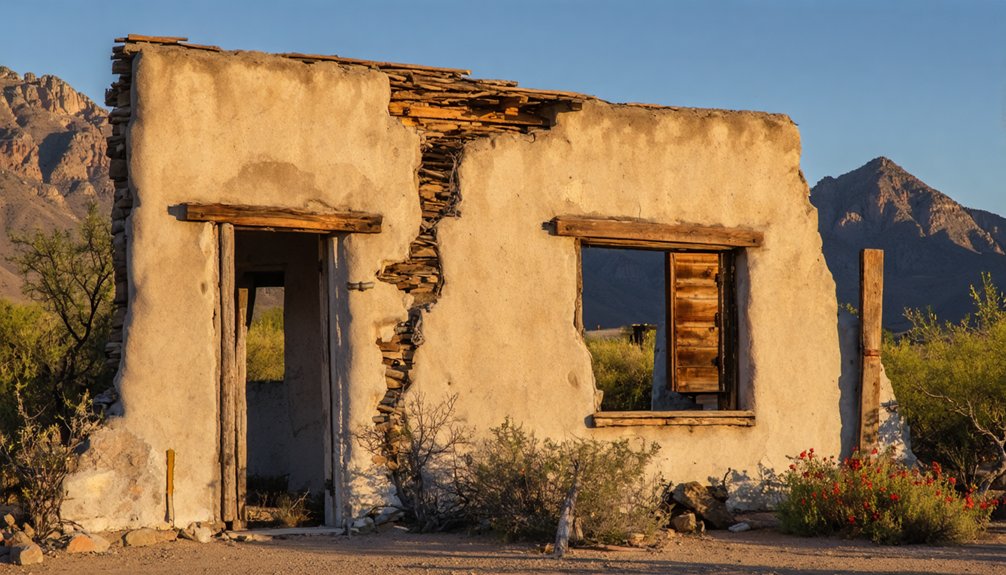
Unlike the preservation victories at larger Arizona mining centers, Oracle’s satellite camps survive mainly through paper—assay records, post office ledgers, and territorial land patents archived in Tucson and Phoenix repositories tell stories the desert has largely erased.
You’ll find American Flag’s post office building stands as a rare exception, its National Register listing protecting one of Arizona’s oldest territorial structures and opening doors to conservation grants.
The archaeological significance of vanished camps like Manleyville and Tiger lies beneath creosote and prickly pear, where artifact scatters reveal daily routines federal monuments never capture.
Copper Creek’s threatened ruins remind you that mining heritage preservation battles continue today.
Oracle Historical Society interprets this scattered landscape through driving tours and archival exhibits, keeping prospector memories alive without reconstructing what freedom-seeking miners left behind.
Frequently Asked Questions
Are Any Ghost Towns Near Oracle Still Inhabited by Full-Time Residents?
You won’t find full-time residents in Oracle’s nearby ghost towns like American Flag or Copper Creek. These abandoned mining camps hold historical significance as archaeological sites, while Oracle itself transformed into an inhabited artists’ community.
Can I Camp Overnight at Ghost Town Sites Near Oracle?
You’ll find camping regulations vary widely—commercial ghost town amenities like Goldfield’s hookups require fees, while BLM dispersed sites near Oracle’s mining ruins let you stay free for fourteen days before relocating.
What Ghost Town Near Oracle Has the Best Photography Opportunities?
Copper Creek offers you the best photography opportunities near Oracle. Its canyon-tier ruins and mountain backdrop provide varied compositions. You’ll capture ideal shots during golden-hour light, using leading lines through the multilevel townsite for compelling visual narratives.
Are Guided Ghost Town Tours Available From Oracle?
Guided tours aren’t regularly offered directly from Oracle. You’ll need to arrange self-guided visits to nearby American Flag or drive to commercial attractions like Goldfield, where you’ll find scheduled tours highlighting mining’s historical significance.
Which Ghost Towns Near Oracle Allow Metal Detecting or Artifact Collecting?
You’ll find metal detecting regulations prohibit collecting at American Flag and surrounding ghost towns due to artifact preservation concerns. National Register protections and federal land restrictions mean you can’t legally remove historical items from these sites.
References
- https://kids.kiddle.co/List_of_ghost_towns_in_Arizona
- https://www.visitarizona.com/like-a-local/4-arizona-ghost-towns-you-may-have-never-heard-of
- https://www.visittucson.org/blog/post/8-ghost-towns-of-southern-arizona/
- https://www.youtube.com/watch?v=Hl0qxYmKPoE
- https://en.wikipedia.org/wiki/American_Flag
- https://www.therockerbox.com/pinal_county_az_ghost_towns.htm
- https://azgw.org/pinal/ghosttowns.html
- https://kids.kiddle.co/American_Flag
- https://www.oracleunionchurch.com/history-of-oracle/
- https://oraclehistoricalsociety.org/american-flag-ranch/