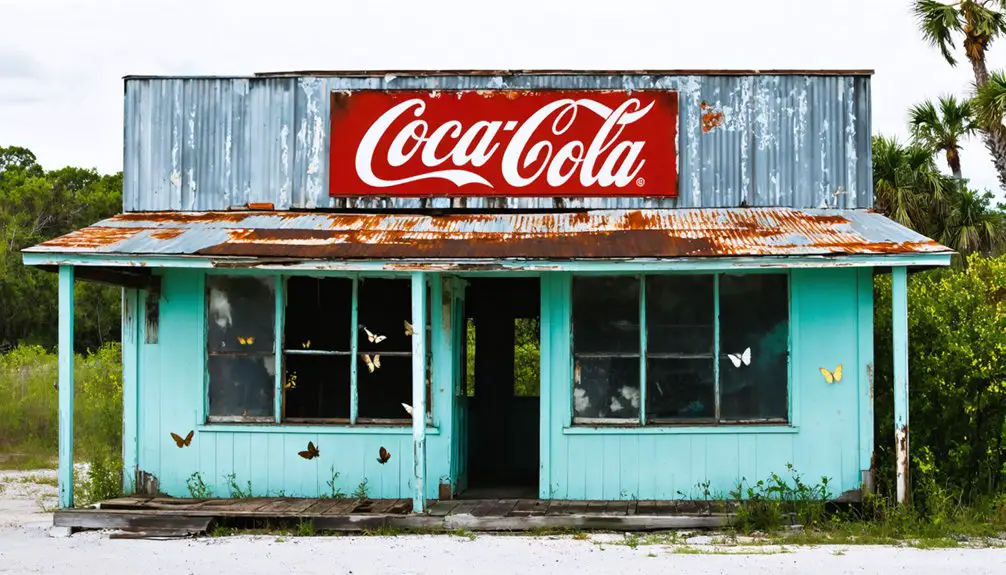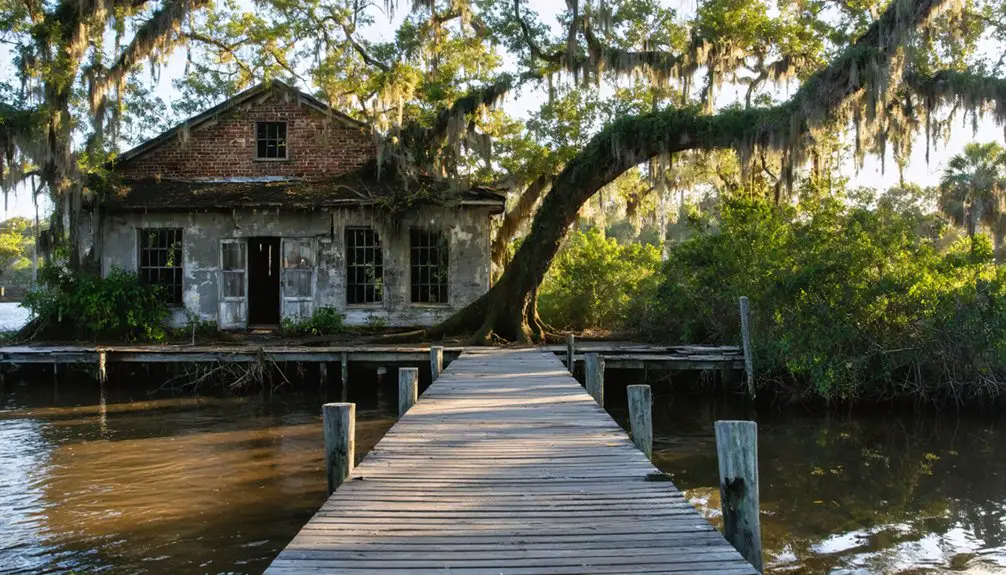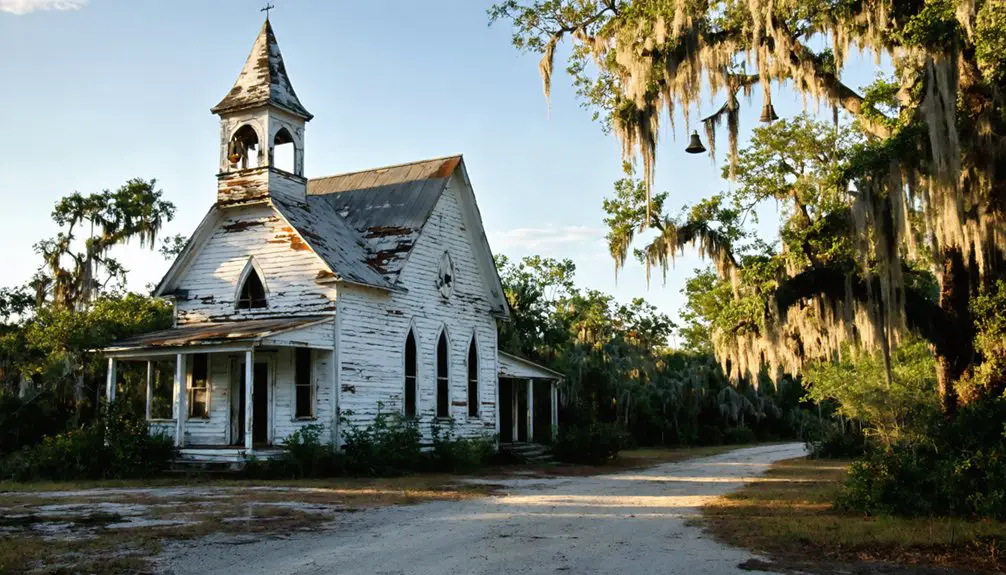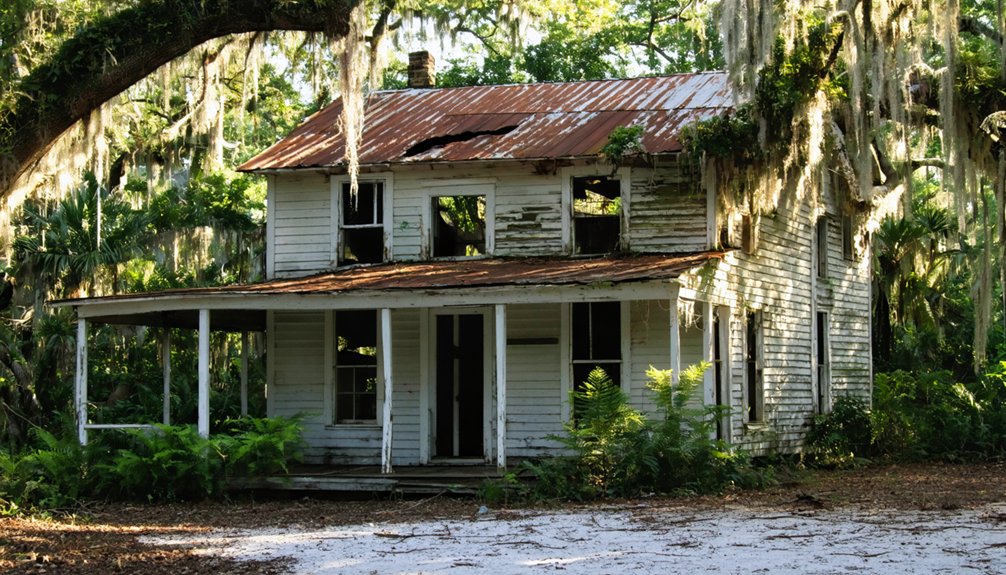
You’ll find several authentic ghost towns within an hour of Orlando, each telling a different story of Florida’s boom-and-bust cycles. Geneva, 25 miles northeast along the St. Johns River, preserves its 1837 military fort and steamboat-era heritage. Mannfield, hidden in Withlacoochee State Forest, lost its county seat status in an 1891 election and vanished by the 1930s. Rio Vista’s concrete ruins showcase 1920s land boom ambitions, while Bulow Plantation’s sugar empire burned in 1836 during Seminole conflicts. The Kissimmee Prairie harbors numerous settlements that disappeared beneath flooding and infrastructure projects.
Key Takeaways
- Geneva, located 25 miles northeast of Orlando, is a historic river town with Fort Lane and a museum preserving its steamboat era.
- Rio Vista features concrete ruins from a 1920s Mediterranean resort development, with Roman-style arches visible amid modern homes today.
- Bulow Plantation, established in 1821, was a major sugar estate burned by Seminole warriors in 1836, leaving significant historical ruins.
- Kismet was a planned citrus town from 1884 with extensive groves and infrastructure, abandoned after the devastating 1889 freeze.
- Mannfield, Citrus County’s first seat founded in 1884, was abandoned after losing a contested election and now has remnants near Mannfield Pond.
Geneva: The Old Florida River Town That Time Forgot
Twenty-five miles northeast of Orlando’s theme parks and subdivisions, Geneva sits along the St. Johns River like a fragment of frontier Florida that refused to modernize.
Geneva remains a stubborn remnant of frontier Florida, anchored along the St. Johns River while Orlando’s sprawl passes it by.
You’ll find oak hammocks, cattle pastures, and boat ramps instead of strip malls—a landscape rooted in riverboat commerce that once moved citrus, lumber, and passengers through Lake Harney’s landings.
Fort Lane, built in 1837 during the Second Seminole War, still stands as a monument to the town’s military origins.
When steamboat trade faded and railroads bypassed serious development, Geneva simply stopped growing.
The Museum of Geneva History preserves what little remains of the town’s riverboat era and frontier heritage.
Today’s scattered structures and cemeteries reflect minimal historic preservation efforts, leaving you with an unvarnished view of Old Florida—a place that never quite died but never moved forward either.
Unlike its Alabama namesake founded as a trading post in 1819, this Florida Geneva emerged from military necessity rather than frontier commerce.
Mannfield: Lost County Seat Hidden in Withlacoochee State Forest
While Geneva clung to the St. Johns River, Mannfield staked its future on politics—and lost everything. Founded in 1884 by cattleman Austin Shuey Mann, this scrubland settlement became Citrus County‘s first seat in 1887.
You’ll find its ruins about six miles west-southwest of Inverness, deep in Withlacoochee State Forest’s Citrus Tract.
Mannfield history centers on a fierce county seat rivalry with neighboring Inverness. After Inverness won a contested 1891 election, locals claim the wooden courthouse was literally rolled away under cover of darkness—records, furniture, and county clerk included. Mannfield residents refused to concede the loss, leading to heated disputes and fistfights during elections.
Without governmental clout and bypassed by the 1893 railroad, Mannfield’s 200 residents scattered. The federal government acquired the abandoned townsite in the late 1930s, erasing what ballot-box politics had already destroyed.
Today, hikers can spot remnants of building foundations around Mannfield Pond, including a derelict stairwell locals call the Stairway to Hell.
Rio Vista Ruins: Concrete Remnants Along the River Corridor
During Florida’s frenzied 1920s land boom, Ohio developer W.C. Hardesty envisioned Rio-Vista-on-the-Halifax—a 3,000-lot Mediterranean resort along the Halifax River.
He constructed ornamental Roman-style arches and columns on Calle Grande Avenue in 1924 for $50,000, creating a grand gateway to his planned hotel and yacht basin.
Then the 1926 bust hit. Construction halted on the unfinished Riviera Hotel, leaving only foundations and architectural remnants scattered along the corridor.
The 1926 collapse froze construction mid-dream, abandoning the Riviera Hotel as scattered foundations and crumbling architectural ghosts.
Today you’ll find concrete columns, balustrades, and broken arches lining Calle Grande near Holly Hill—deliberately styled to mimic ancient ruins, now genuinely decayed. The columns are painted to resemble marble, enhancing the grandiose Mediterranean aesthetic Hardesty sought to create.
Friezes depicting charioteers and statesmen once adorned these structures, adding classical grandeur to the ambitious development.
These urban decay fragments stand amid modern homes and marinas, their rusted rebar and weathered surfaces telling stories of speculative ambition.
You’re free to explore this roadside colonnade, where manufactured nostalgia became authentic abandonment.
Bulow Plantation: Sugar Empire Destroyed by Seminole War
Along Bulow Creek’s tidal marsh in 1821, Major Charles Wilhelm Bulow acquired 4,675 acres of wilderness and transformed it into one of territorial Florida’s most formidable sugar empires.
Between 150 and 400 enslaved laborers cleared 2,200 acres for sugarcane, cotton, rice, and indigo, working the Bulow estate under brutal conditions.
His son John Joachim expanded operations after 1823, building a massive coquina sugar mill and maintaining friendly trade with Seminole bands.
The plantation attracted notable visitors, including John James Audubon, who spent Christmas 1831 to January 1832 painting wildlife with Bulow’s buildings in the background.
When John opposed federal removal policies and fired a cannon at state militia in 1835, troops arrested him and occupied Bulowville as a military base.
After their withdrawal on January 23, 1836, Seminole warriors burned the plantation in retaliation against government aggression, reducing the $83,475 sugar empire to ruins.
John Joachim Bulow died later in 1836, leaving no heirs to claim the destroyed estate.
Vanished Communities of the Kissimmee River Prairie
You’ll find the Kissimmee Prairie‘s forgotten settlements scattered across what’s now preserved ranchland and state parks, where summer floods and depleted soil doomed agricultural dreams.
Tuckersville emerged in the 1870s as farmers staked claims on prairie land that looked promising in dry winter months but turned waterlogged and unworkable each summer.
The Tucker family’s mysterious disappearance during violent storms marked the settlement’s final chapter, though whether neighboring disputes or natural disaster caused their fate remains unclear in fragmentary local records.
Hurricanes and crop failures brought economic ruin to the agricultural settlement by the early 1900s, erasing Tuckersville from Florida’s maps entirely.
Before Hamilton Disston’s drainage projects in the 1880s, Central Florida remained primarily swampland that made permanent settlement nearly impossible for these early pioneers.
Tuckersville: Prairie Settlement Lost
The vanished prairie hamlet of Tuckersville represents one of the Kissimmee River basin’s most obscure failures—a small agricultural settlement founded in the 1870s on the seasonally flooded grasslands of south-central Florida that couldn’t withstand the environmental realities of frontier life.
Tuckersville history reveals a community dependent on mixed farming and cattle ranching, vulnerable to the prairie’s brutal drought-flood cycles. Repeated crop failures devastated the local economy, while a series of hurricanes delivered the final blow.
River Hamlets and Decline
While Tuckersville’s fate illustrates the perils facing prairie farmers on solid ground, an entire constellation of river hamlets scattered along the Kissimmee’s meandering channel faced an even more precarious existence.
These prairie communities relied on seasonal flooding and river transport by steamboat, establishing landings at oak hammocks along the 103-mile corridor. Families combined fishing, cattle ranching, and transport services, adapting to the predictable wet-dry cycle.
Yet recurrent floods—especially 1947’s catastrophe—devastated livestock and buildings. Large ranch consolidations absorbed smallholdings, draining economic life from scattered settlements.
Then came the C‑38 canal: between 1962 and 1971, channelization drained 50,000 floodplain acres and severed oxbows, eliminating boat access that sustained these hamlets.
Road-based travel bypassed former landings, leaving foundations vanishing beneath pasture.
Kismet, St. Francis, and Other Forgotten Lake County Settlements
North of Orlando’s sprawl, Lake County’s forests and riverbanks conceal the remains of ambitious settlements that flourished briefly during Florida’s first citrus boom.
Kismet history begins in 1884, when land promoters transformed “howling wilderness” near Lake Dorr into a planned citrus town with 200 acres of orange groves, a 50-room hotel, and sawmill.
The 1889 freeze destroyed everything—groves died, settlers fled, and forest reclaimed the land.
Today you’ll find only scattered foundations within Ocala National Forest.
Meanwhile, St. Francis significance lies in its role as a St. Johns River steamboat stop, serving inland homesteads with freight and mail connections.
Both settlements remind you that Florida’s development wasn’t inevitable—nature and economics ruthlessly erased entire communities.
What Drove Central Florida Towns to Abandonment
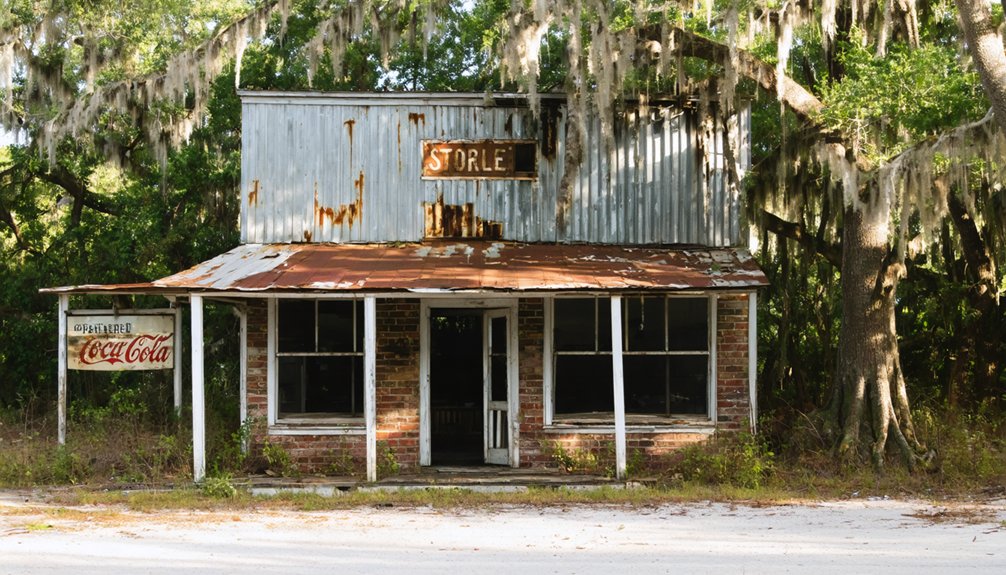
Repeating patterns of disaster, neglect, and economic collapse scattered Central Florida’s landscape with abandoned settlements from the 1880s through today.
You’ll find ghost towns born from resource exhaustion, like Ellaville when yellow pine timber ran out by 1900. Highway relocations created abandoned infrastructure—the 1986 Hillman Bridge rerouting stripped Ellaville’s commercial relevance overnight.
Economic shifts transformed upscale developments into ruins; The Place at Alafaya near UCF became uninhabitable after Hurricane Ian’s 2022 flooding submerged the entire complex.
Natural disasters, coupled with maintenance failure, accelerated decay. Buildings stripped by scavengers and consumed by mold lost functionality.
Communities that once thrived became fenced-off monuments to changing fortunes. Transportation modernization, environmental catastrophes, and vanishing industries consistently drove populations elsewhere, leaving skeletal remains across the region’s expanding metropolitan footprint.
Frequently Asked Questions
Are Any Ghost Towns Near Orlando Legally Accessible to the Public?
Yes, you’ll find legally accessible ghost town history at Bulow Plantation Ruins Historic State Park near Palm Coast and Geneva’s General Store area. You’re free exploring ruins, walking cemeteries, and discovering archived settlements without trespassing concerns throughout accessible sites.
Can You Camp Overnight at Central Florida Ghost Town Sites?
You can’t camp overnight at Central Florida ghost town sites due to camping regulations protecting archaeological areas. These locations lack ghost town amenities and overnight facilities, but you’ll find designated campgrounds at nearby state parks instead.
What Safety Precautions Should Visitors Take When Exploring Abandoned Settlements?
Over 60% of urban exploration injuries involve structural collapses and falls. You’ll need safety gear—sturdy boots, gloves, helmet, flashlight—plus permission from landowners, since most Central Florida ghost town parcels remain privately held.
Do Any Ghost Towns Near Orlando Have Guided Tours Available?
No formal guided ghost-town tours exist near Orlando. You’ll find occasional ranger-led hikes at Rock Springs Run State Reserve covering historic homesteads, plus sporadic guided exploration events from local history organizations focusing on vanished Central Florida settlements.
Which Ghost Town Site Is Closest to Downtown Orlando?
Sometimes the closest things are the easiest to overlook. Markham ghost town sits nearest—just 16–18 miles north—offering you downtown proximity and historical significance through its turpentine-era cemetery and vanished forestry settlement traces.
References
- https://en.wikipedia.org/wiki/List_of_ghost_towns_in_Florida
- https://www.florida-backroads-travel.com/florida-ghost-towns.html
- https://www.clickorlando.com/features/2024/09/25/floridas-creepiest-ghost-town-is-stashed-on-an-island-heres-the-lowdown/
- https://fdc.com/blog/ghost-towns-in-florida/
- https://doorlandonorth.com/top-15-haunted-places-orlando/
- https://www.youtube.com/watch?v=OtKF4m3MNFI&vl=en-US
- https://floridatrailblazer.com/tag/ghost-towns/
- https://abandonedfl.com/city/central-florida/
- https://johannessenlights.com/location/geneva-florida/
- https://encyclopediaofalabama.org/article/geneva/