You’ll find several authentic ghost towns within three hours of Palm Springs, including Eagle Mountain, Kaiser Steel’s abandoned 4,000-resident company town from 1948; Pioneertown, a 1946 Hollywood film set that served as backdrop for over 200 Western productions; and Calico, which produced millions in silver during the 1880s before its mining collapse. The Salton Sea’s decaying resort communities and Route 66’s Amboy offer different perspectives on abandonment, while Randsburg preserves original 1897 buildings from California’s gold rush era. These desert destinations reveal distinct chapters of Western settlement, industrial ambition, and economic transformation that shaped Southern California’s frontier landscape.
Key Takeaways
- Eagle Mountain, a Kaiser-built mining town with 400 homes, and Route 66’s Amboy are accessible industrial ghost towns.
- Pioneertown, established in 1946, served as a working Western film set for over 200 productions near Joshua Tree.
- Salton Sea resort communities declined from California’s Riviera status due to rising salinity and pollution since the 1980s.
- Calico, California’s most productive silver mining town with 500 mines, is now a restored tourist attraction and historical landmark.
- Randsburg and Johannesburg preserve 1895 gold rush heritage, including the original bank building and Yellow Aster Mine site.
Eagle Mountain: Kaiser Steel’s Abandoned Desert Community
In 1948, industrialist Henry J. Kaiser founded Eagle Mountain as a company town to support his nearby iron ore mine in Riverside County’s desert.
You’ll find this was Southern California’s largest mining operation, built to feed Kaiser’s Fontana steel mill via a 51-mile railroad. The planned community housed 4,000 residents at its peak, offering 400+ homes, three schools, shopping center, bowling alley, and swimming pool—embodying postwar suburban ideals in an isolated desert setting.
Eagle Mountain history reached its zenith when workers celebrated their 100 millionth ton of ore in 1977.
Yet Kaiser Steel impact proved fleeting: foreign competition forced the mine’s 1981 closure announcement. By summer 1983, you could walk palm-lined streets emptied of residents, transforming this once-thriving town into California’s largest modern ghost community. The grocery store closure in October 1982 signaled the beginning of the town’s decline, followed by the post office shutting down in 1983. In April 2023, the entire ghost town sold for $22.5 million to Ecology Mountain Holdings, LLC, sparking speculation about its future use.
Pioneertown: Hollywood’s Wild West Movie Set Town
When actor Dick Curtis pitched the idea of a working Western town that could double as both a film set and a real community in 1946, he assembled a roster of Hollywood’s biggest cowboy stars to make it happen.
Roy Rogers, Gene Autry, and sixteen other investors purchased 32,000 acres of high desert near Joshua Tree to build an 1880s frontier streetscape.
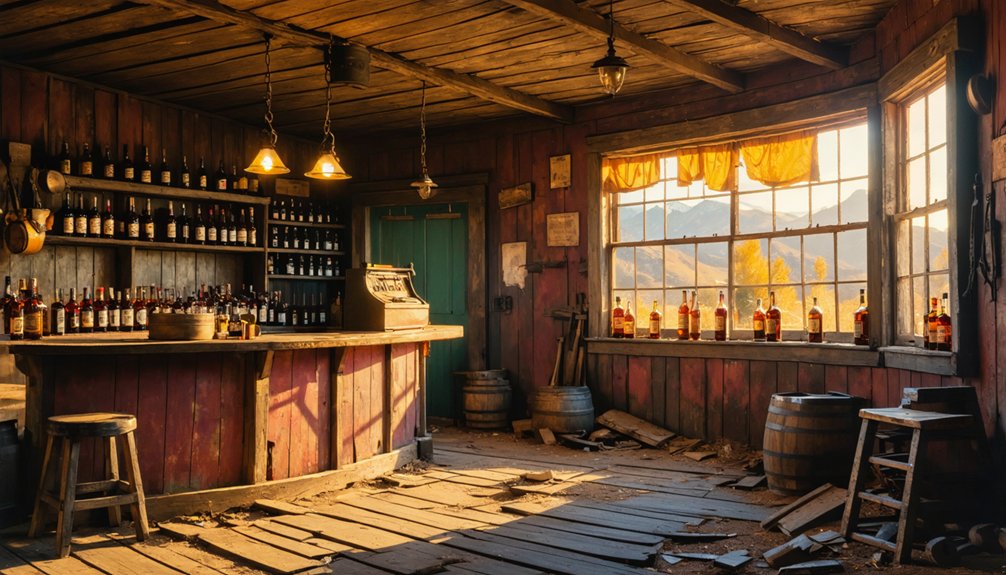
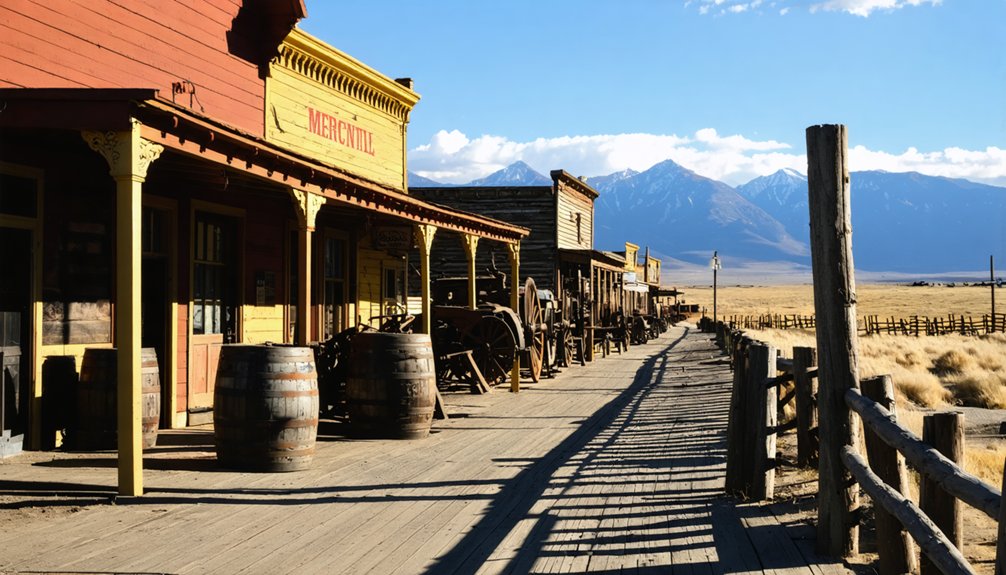
Pioneertown history began with Mane Street’s false-front buildings concealing functional businesses—saloons, bowling alleys, and ice-cream parlors served film crews and residents alike.
The Western film legacy spans over 200 productions, including The Cisco Kid series and Gene Autry’s Flying A shows.
When Westerns declined and a 1948 real estate collapse hit, the town slipped into semi-abandonment, preserved today as a living monument to midcentury cowboy cinema.
The historic main street buildings continue to attract photography enthusiasts and reenactment groups on specific weekends.
Today, visitors can experience Pappy & Harriet’s Pioneertown Palace, a beloved music venue and restaurant that continues the town’s tradition of entertainment.
Salton Sea Resort Communities: California’s Vanished Riviera
While Pioneertown offered visitors a carefully constructed fantasy of the Old West, another desert mirage was taking shape sixty miles southeast—though this one emerged entirely by accident.
The Salton Sea formed in 1905 when Colorado River water flooded through broken irrigation canals into the Salton Sink. By the 1960s, it’d become California’s Riviera, drawing more tourists than Yosemite.
From accidental flood to desert paradise—the Salton Sea transformed into California’s unlikely Riviera within six decades.
Frank Sinatra and the Beach Boys frequented North Shore Beach and Yacht Club, Southern California’s largest marina. Fishing became legendary after successful fish transplants made it California’s most productive fishery. Sport fishing was promoted as early as 1907, transforming the accidental lake into a recreational destination.
Yet resort decline came swiftly. Rising salinity, agricultural runoff, and massive fish die-offs drove wealthy vacationers away. Tropical storms demolished marinas in 1976-77. The flagship yacht club shuttered in 1984, leaving abandoned streets and empty promises.
Today, the lake is over 50% saltier than the Pacific Ocean, transforming what was once a recreation paradise into a landscape of decaying resorts and sun-bleached fish bones.
Calico: Silver Mining Boomtown Turned Tourist Attraction
A flash of multicolored rock caught the attention of four prospectors from Grapevine Station on April 6, 1881, as they trekked northeast into the Mojave Desert’s barren expanses. Their discovery launched California’s most productive silver mining operation—the Silver King Mine—generating $86 million over three decades.
Calico history records over 500 mines operating simultaneously during the 1883-1885 peak, supporting 3,000 residents with infrastructure including Wells Fargo offices, courts, and medical services. The town established its own sheriff, courthouse, and judicial district during this prosperous period.
Silver mining collapsed in the mid-1890s when market prices plummeted, transforming the bustling town into a deserted relic.
Walter Knott restored Calico in 1951 using original photographs, later donating it to San Bernardino County. Today you’ll find it operating as California Historical Landmark #782, blending authentic ghost town architecture with modern amenities. Visitors can explore attractions like Maggie’s Mine for $3.50, experiencing the original mine workings with historical displays.
Amboy: Route 66’s Mojave Desert Time Capsule
Midway between Barstow and Needles, Amboy emerged from an 1858 mining camp into an essential Atlantic & Pacific Railroad depot in 1883—the first in an alphabetically sequenced chain of stations stretching across the Mojave.
Route 66’s 1926 paving transformed it into a boomtown peaking at 200 residents by the 1940s, when 13 businesses—including Roy’s Motel & Café—sustained cross-desert travelers.
Roy Crowl’s 1938 service station evolved into a 24-hour complex crowned by a 50-foot neon sign in 1959, epitomizing Googie Route 66 architecture and becoming one of the highway’s most photographed landmarks.
Interstate 40’s 1973 bypass devastated local commerce, triggering decades of closures and ownership disputes.
Today you’ll find census counts as low as four residents, yet Roy’s iconic silhouette remains a pilgrimage site documenting Amboy history and mid-century roadside design.
Albert Okura purchased the entire town for $425,000 with plans to restore its historic structures and attract visitors to this Mojave Desert remnant.
The town originally served as a watering stop for the Southern Pacific Railroad, essential for steam locomotives crossing the harsh desert terrain.
Kelso Depot: Railroad Ghost Town in the Mojave Preserve
You’ll find Kelso Depot standing as a fully restored Mission Revival railroad station within Mojave National Preserve, built in 1923–1924 by Union Pacific to serve steam locomotives on the steep desert grades between Los Angeles and Salt Lake City.
The town of Kelso swelled to nearly 2,000 residents during World War II due to nearby iron mining operations, but the closure of the Vulcan Mine and the shift from steam to diesel locomotives in the 1950s transformed the settlement into a ghost town.
Today, the depot operates as the preserve’s primary visitor center, where you can explore museum exhibits on railroad history and desert mining while experiencing the preserved architecture of this once-vital desert outpost.
History of Kelso Depot
In 1905, the Los Angeles and Salt Lake Railroad established the first depot at Kelso as a critical water stop for steam locomotives crossing the Mojave Desert.
The town emerged in 1906 when railroad construction completed, named after warehouse worker John H. Kelso whose name was randomly drawn from a hat.
Between 1923-1924, architects John and Donald Parkinson designed the iconic two-story Mission Revival depot, featuring a 24-hour restaurant, telegraph office, and employee dormitory.
The Kelso Depot‘s historical significance peaked during the 1940s-50s when it transported ore from local mines and served as a major passenger train meal stop.
Union Pacific closed operations in 1985, announcing demolition plans. Local preservation efforts succeeded when the Bureau of Land Management acquired the property in 1992 for one dollar.
Exploring the Preserved Buildings
Following its acquisition and restoration, the Kelso Depot stands today as one of the Mojave Desert’s most architecturally significant preserved structures.
You’ll encounter preserved architecture showcasing Mission Revival design—stucco walls, red-tile roofing, and arcaded façades that define its Southwestern character.
Inside, the original ticket office, telegraph areas, and “The Beanery” restaurant retain their spatial configuration, now serving as museum galleries interpreting railroad operations, mining history, and desert ecology.
The building’s historical significance extends beyond aesthetics; its adaptive reuse as Mojave National Preserve’s visitor center demonstrates how functional preservation serves public access without compromising architectural integrity.
Second-floor dormitories, restored wood windows, and period-appropriate finishes document the depot’s dual role as transportation hub and railroad worker hotel, offering you authentic glimpses into early-twentieth-century desert commerce and community life.
Visiting Mojave National Preserve
Reaching Kelso Depot requires traversing one of the Mojave Desert‘s most remote national preserves, where Kelso Cima Road intersects with the sparse network of paved highways crossing 1.6 million acres of protected wilderness.
The 2005-restored Mission Revival depot now serves as the Preserve’s primary visitor center, offering museum exhibits on railroad operations, mining history, and the surrounding Mojave landscape.
You’ll find historically furnished rooms, interpretive displays, and orientation materials for exploring the 1.6-million-acre wilderness.
Desert wildlife including bighorn sheep, desert tortoises, and kit foxes inhabit the surrounding terrain.
The facility operates as an information hub where you can plan backcountry routes, secure permits, and access resources for traversing this vast, roadless desert expanse without bureaucratic constraints on your exploration.
Randsburg and Johannesburg: Living Mining Relics
You’ll discover authentic mining history at Randsburg and Johannesburg, twin settlements that emerged from the Yellow Aster Mine‘s 1895 discovery and still house residents among weathered buildings from the district’s $20 million gold rush.
These towns preserve the stark character of what locals called a “poor man’s camp,” where desperate prospectors from Panamint Valley once ground ore by hand to scrape together the $1.60 claim filing fee.
Walking Randsburg’s streets today, you’ll pass the original 1897 bank building and church while the Yellow Aster’s 100-stamp mill site stands as evidence to operations that extracted $25 million in gold before shifting to silver production in 1919.
Historic Mining District Charm
Unlike the silent ruins scattered across California’s desert basins, Randsburg and Johannesburg endure as living relics where original storefronts still frame dusty streets and a handful of residents maintain continuity with the district’s 1895 founding.
You’ll walk past weathered wooden facades that once served prospectors who hand-ground ore to scrape together $1.60 claim-filing fees during the depression-era rush following the Yellow Aster discovery.
The Rand District’s mining heritage remains tangible: operational general stores occupy century-old buildings, while rusted headframes and mill foundations punctuate surrounding hills where $60 million in gold, silver, and tungsten emerged from desert rock.
California Historical Landmark No. 938 recognizes this triad’s significance—a working monument where everyday commerce unfolds amid artifacts of hard-rock mining culture that shaped the Mojave frontier.
Preserved Buildings and Operations
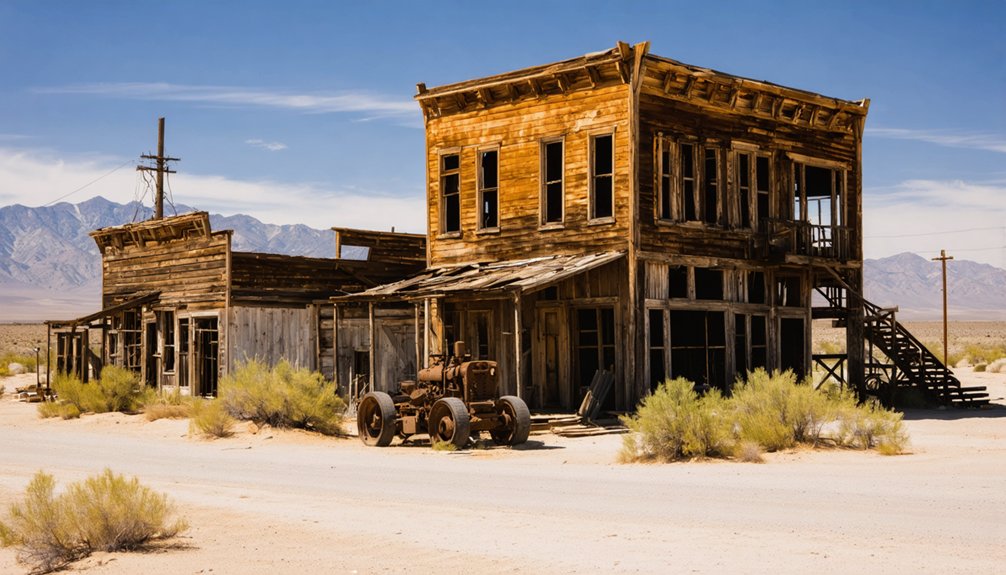
Randsburg’s Butte Avenue presents a remarkably intact 1890s commercial corridor where weathered false-front storefronts frame the same dusty street prospectors walked after the Yellow Aster strike.
You’ll find the original general store dispensing phosphate sodas from antique fixtures, while the functioning saloon maintains its period back bar where miners once gathered.
Antique shops occupy preserved facades alongside the two-room jail, now staged with mannequins behind barred windows. The $60 million in gold extracted here funded this infrastructure you’re exploring today.
Weekend operations keep these structures economically viable rather than abandoned—the General Store stocks supplies, the Cottage Hotel offers lodging, and cafés serve off-roaders.
Nearby Johannesburg’s scattered buildings and cemetery, where Burro Schmidt rests, complete this living mining district.
Planning Your Ghost Town Adventure From Palm Springs
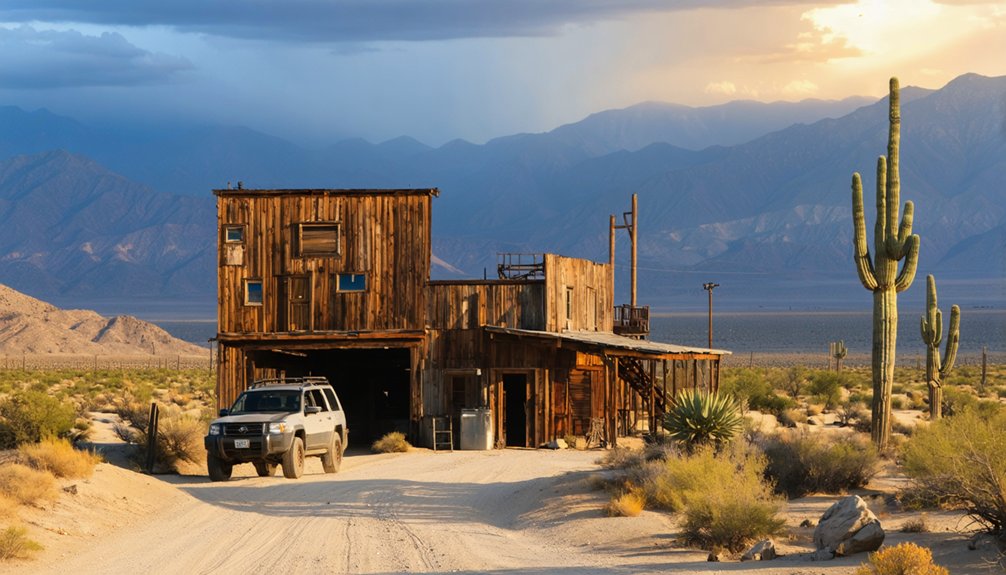
Before you load your camera and water bottles, understanding the logistics of reaching California’s desert ghost towns from Palm Springs will shape every aspect of your expedition.
Exploring abandoned places near Riverside California can add an intriguing layer to your journey. Each site tells a unique story of a bygone era, sparking curiosity and adventure. Additionally, be sure to check local regulations and safety tips before venturing into these deserted locations to ensure a safe and enjoyable experience.
Most destinations require 45 minutes to three hours of desert driving via Interstate 10 or State Route 62, with remote stretches offering limited services. You’ll want to plan fuel stops in Indio, Desert Hot Springs, or Barstow before venturing onto two-lane roads flanked by railroad tracks and tailings.
Ghost town safety demands preparation: high-clearance vehicles handle unimproved spur roads better, while closed-toe boots protect against loose debris and unstable terrain.
Visit during late fall through early spring when temperatures stay manageable, and carry considerably more water than you’d pack for urban outings.
Check forecasts for dust storms, and download offline maps—cell coverage disappears quickly beyond the valley.
Frequently Asked Questions
Do I Need a High-Clearance or 4×4 Vehicle for Some Ghost Towns?
Desert trails hold hidden teeth—you’ll need high-clearance for Eagle Mountain’s broken pavement and 4×4 for remote mining sites with deep sand, steep grades, and washouts. Vehicle recommendations depend on specific road conditions beyond paved access.
Are Any Ghost Towns Near Palm Springs Still Partially Inhabited Today?
Yes, Bombay Beach at the Salton Sea remains partially inhabited with around 200 modern residents living among ruins, while Randsburg operates as a “living ghost town” where historic buildings still house active businesses and a small community.
Can I Visit Ghost Towns Year-Round or Only Certain Seasons?
You’ll find desert ghost towns accessible year-round, though the best times are fall through spring. Weather considerations matter most: scorching summers demand early-morning visits, while cooler seasons let you explore freely without heat-related risks.
What Happened to Eagle Mountain’s Proposed Landfill Project?
Eagle Mountain’s landfill project, approved in 1992, faced decades of environmental lawsuits over its potential impact on Joshua Tree National Park. Los Angeles County Sanitation Districts formally abandoned the controversial plan in May 2013.
Are Permits Required to Explore Abandoned Buildings at Ghost Town Sites?
Like Odysseus maneuvering between Scylla and Charybdis, you’ll need permits for most abandoned buildings. Exploration guidelines and legal considerations require formal authorization through film offices or property owners, as “No Trespassing” signs indicate restricted access across ghost town sites.
References
- https://en.wikipedia.org/wiki/List_of_ghost_towns_in_California
- https://www.pbssocal.org/shows/socal-wanderer/where-to-find-the-mojaves-greatest-ghost-towns
- https://whimsysoul.com/must-see-california-ghost-towns-explore-forgotten-histories/
- https://secretlosangeles.com/california-largest-ghost-town-eagle-mountain/
- https://patch.com/california/banning-beaumont/13-ghost-towns-explore-california
- https://www.tripadvisor.com/Attractions-g659472-Activities-c47-t14-California_Desert_California.html
- https://www.themodernpostcard.com/the-salton-sea-a-ghost-of-former-glory-in-the-california-desert/
- https://www.avoidingregret.com/2025/04/photo-essay-silver-city-ghost-town-made.html
- https://www.sfgate.com/travel/article/eagle-mountain-california-ghost-town-18096768.php
- https://www.photopilot.com/blog/eagle-mountain-california/