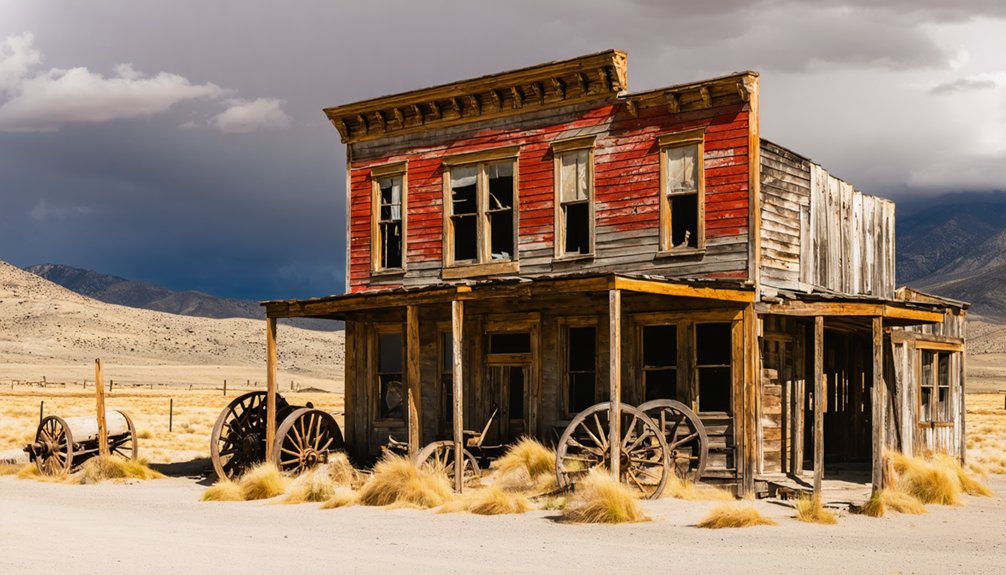
You’ll find Adamana, a defunct Atlantic & Pacific Railroad depot established in 1882, just outside Petrified Forest’s northern boundary—its remnants include Campbell’s Hotel foundations and telegraph-line scars. Holbrook’s semi-abandoned downtown, bypassed by Interstate 40 in the 1960s, preserves hollow Route 66 storefronts and the 1898 county courthouse. Within the park itself, an 8.1-mile abandoned Route 66 segment showcases weathered pavement, concrete culverts, and a rusted 1932 Studebaker shell. Twin Arrows, thirty miles west near Flagstaff, displays boarded-up 1940s trading-post buildings beneath iconic wooden arrows—each site revealing how transportation corridors determined settlement survival across northeastern Arizona’s high desert.
Key Takeaways
- Adamana, established in 1882 as a railroad depot, served tourists visiting the Painted Desert before declining when highways bypassed it.
- Holbrook’s historic downtown became semi-abandoned after Interstate 40 bypassed Route 66 in the 1960s, leaving hollow storefronts and quiet sidewalks.
- Twin Arrows, 30 miles east of Flagstaff, features boarded-up buildings and iconic wooden arrows from its 1940s trading post era.
- An 8.1-mile abandoned Route 66 segment within Petrified Forest National Park preserves weathered pavement, telephone poles, and a 1932 Studebaker shell.
- Transportation shifts from railways to Route 66 to Interstate 40 determined which gateway communities thrived or became ghost towns.
Adamana: The Forgotten Railroad Hub at Petrified Forest’s Doorstep
When the Atlantic & Pacific Railroad punched its transcontinental line across northeastern Arizona in 1882, it planted a string of sidings and flag stops that would anchor settlement patterns for decades.
Adamana emerged as one such depot—named for rancher Adam Hanna—serving the petrified wood badlands long before federal designation in 1906.
You’ll find its railroad history woven into the very fabric of early Petrified Forest access: tourists disembarked here, hired wagons, and vanished into the Painted Desert.
Campbell’s Hotel anchored extensive tourist services, orchestrating guided excursions from platform to petrified log fields.
This rail-tour complex thrived until highways bypassed the tracks, leaving Adamana‘s section houses and hotel foundations to weather silently beside the Santa Fe right-of-way.
The railroad had earlier shored up Agate Bridge in 1917, preserving the massive 100-foot petrified log that spans a 40-foot gully as one of the area’s signature attractions.
By the 1930s, the Fred Harvey Company had begun offering guided tours into what was then Petrified Forest National Monument, further cementing the area’s reputation as a must-see destination.
Holbrook’s Faded Route 66 Glory and Semi-Ghost Downtown
When I-40’s bypass severed Holbrook from cross-country traffic in the 1960s, the town’s Main Street corridor—Route 66 since 1926—began a slow fade from bustling motor thoroughfare to semi-abandoned relic.
You’ll find the concrete teepees of the 1950 Wigwam Motel still standing alongside shuttered filling stations and empty motor courts, vestiges of the 1926–1978 era when US 66 channeled travelers through downtown.
Today’s landscape presents a paradox: Holbrook survives as a county seat of 5,067 residents, yet its historic core retains the hollow storefronts and quiet sidewalks characteristic of towns bypassed by interstate progress. The town first gained county seat status in 1895, followed by construction of a new courthouse in 1898. The 1923 flood that washed away portions of the original business district had already forced commercial relocation north of the railway tracks, reshaping the town’s geography decades before the interstate dealt its final blow.
Bypassed by Interstate Progress
After Route 66 cut through Holbrook in 1926, Navajo Boulevard and Hopi Drive became the town’s commercial lifeline, channeling transcontinental traffic between Chicago and Los Angeles directly past cafes, motor courts, and curio shops that sprouted along the corridor.
Interstate 40’s arrival between the 1960s and 1978 severed that artery. Long-distance travelers now roared past downtown at 75 mph, pulling lodging and fuel stops toward distant interchanges. The 1985 decommissioning of Route 66 formalized the realignment.
Bypass impacts hollowed Main Street: Joe & Aggie’s Café closed, the Plainsman’s neon went dark, and the Globetrotter Lodge shuttered. Downtown revitalization remains incomplete—stone buildings south of the depot stand underutilized, their windows blank, while your exploration reveals parking courts reclaimed by weeds and faded roadside relics marking a prosperity that rerouted elsewhere. A deteriorating Whiting Bros. filling station on Holbrook’s east side showcases the vintage architectural style that once defined the highway corridor. Yet Holbrook retains quirky Route 66 charm through its neon-lit motels and dinosaur-themed rock shops that still draw heritage travelers seeking authentic Mother Road experiences.
Vintage Motels Still Standing
Among Holbrook’s shuttered storefronts and vacant motor courts, a handful of vintage lodgings still accommodate travelers, their survival anchored in deliberate preservation rather than commercial momentum.
The Wigwam Village Motel #6 stands as mid century nostalgia incarnate—fifteen concrete tepees built in 1950, featuring original hickory furniture and National Register status. Chester Evert Lewis’s family operation weathered Interstate 40’s bypass in the late 1970s, closed during two dormant years following his death, then reopened in 1988 when his widow and children reclaimed the property.
You’ll find vintage roadside authenticity maintained through minimal modernization: air conditioning and WiFi discretely added while preserving the architectural character that draws Route 66 pilgrims. Classic car displays outside the wigwam units further enhance the nostalgic atmosphere for road trip enthusiasts. The restored lobby houses an antique National cash register alongside petrified wood specimens and Native American artifacts collected by the original owner.
Only three wigwam villages survive nationwide, making this Arizona outpost genuinely irreplaceable.
Abandoned Route 66 Segments Within and Around the Park
You’ll find the only segment of Historic Route 66 preserved inside a U.S. national park at Petrified Forest, where a faint 1920s–1958 roadbed traces parallel to weathered telephone poles across the Painted Desert section.
The abandoned alignment, lying north of today’s park road and south of I-40, survives as a walk-up viewpoint marked by a rusted 1932 Studebaker shell and interpretive wayside rather than intact pavement.
This in-park remnant anchors a broader corridor of bypassed Mother Road fragments scattered between Holbrook and the New Mexico line, most overbuilt by Interstate 40 or reduced to discontinuous stretches of crumbling asphalt and vanished roadside commerce. The Painted Desert Trading Post, which opened in the early 1940s selling rugs and gasoline, has undergone restoration by a non-profit Route 66 Co-Op to preserve this piece of roadside history. Just east of the park entrance near the Little Lithodendron Wash Bridge, a 243-foot wooden truss structure from 1932 stands as one of the last remaining original Route 66 bridges in Arizona.
Road Remnants Inside Park
Petrified Forest National Park holds the distinction of being the only national park with an in-park segment of Historic Route 66, where a faint roadbed and weathered telephone poles mark the corridor that once carried thousands of cross-country travelers between Chicago and Los Angeles.
The abandoned alignment runs parallel to the present park road, its original pavement now largely eroded into discontinuous asphalt fragments and gravel base visible from designated viewpoints.
You’ll find the National Park Service interpretive overlook labeled “Historic Route 66,” where interpretive signage details the corridor’s history and a 1960s-era car shell serves as a monument to the lost highway.
Historic preservation guidelines protect this 8.1-mile segment as a cultural landscape resource, while modern Interstate 40 replaced the route, leaving these remnants frozen in time.
Deteriorating Mid-Century Infrastructure
Beyond the preserved 8.1-mile segment maintained by the National Park Service, abandoned Route 66 realignments near Petrified Forest trace a fractured network of bypassed pavement that documents six decades of highway evolution and obsolescence.
Decommissioned in 1985, these dilapidated pavements exhibit alligator cracking, potholes, and vegetation encroachment from decades of deferred maintenance. Concrete culverts from 1930s construction display spalling and exposed rebar, while eroded infrastructure along shoulders reveals gully washouts where grading ceased after realignment.
Corroded guardrails mark original roadway widths, and rusted telephone poles frame ghost alignments stripped of function. Federal land managers ripped up some segments entirely, restoring natural contours.
What remains serves heritage tourism rather than transportation—a 1932 Studebaker rusts deliberately on the historic alignment, symbolizing mid-century automobile culture‘s complete obsolescence in this high-desert corridor.
Twin Arrows: Roadside Ruin on the Approach From Flagstaff
Approximately 30 miles east of Flagstaff along Interstate 40, the weathered remains of Twin Arrows mark one of Route 66‘s most photographed roadside ruins.
Established in the late 1940s as Canyon Padre Trading Post by F.R. “Ted” Griffiths and his wife Jewel, the complex served travelers with Mobile gasoline and a Valentine Diner.
Founded by Ted and Jewel Griffiths in the late 1940s, Canyon Padre Trading Post welcomed weary Route 66 travelers with fuel and home-style dining.
The Troxell Family acquired the property in 1955, installing two towering wooden arrows that became the site’s defining feature.
Despite promotional efforts branding it “the Best Little Stop on I-40,” declining revenues forced permanent closure in 1995.
Today, you’ll find boarded-up buildings covered in graffiti, owned by the Hopi tribe while Arizona holds the land.
One iconic arrow was removed in 2022, leaving a solitary sentinel gradually surrendering to time.
How Transportation Shaped the Rise and Fall of Gateway Communities
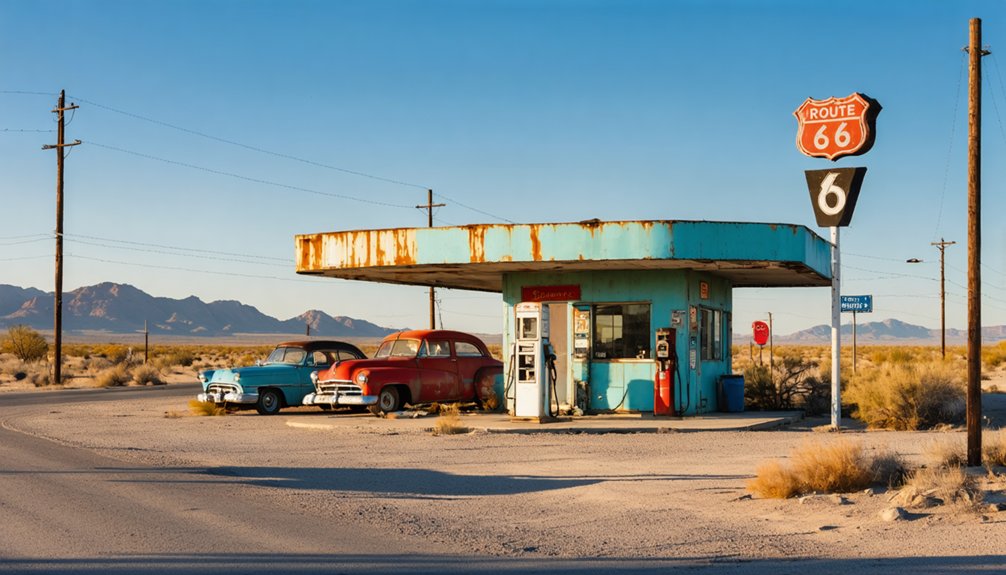
Since the 1880s, transportation corridors have dictated which settlements near Petrified Forest would thrive and which would vanish into desert dust.
You’ll see this transportation evolution unfold in distinct phases:
- 1880s–1920s: Santa Fe Railway whistle-stops like Adamana anchored ranching economies and early monument access.
- 1920s–1950s: Route 66 shifted prosperity to highway strips, fueling motor-court boomtowns between Holbrook and Gallup.
- 1960s: Interstate 40 bypassed historic main streets, severing incidental traffic that sustained family businesses.
- 1962–present: Park expansion with direct interstate exits eliminated traditional gateway dependence.
Communities lacking community resilience—diversified economies, alternative access routes—couldn’t survive when transportation technology leapfrogged their locations.
You’re witnessing infrastructure Darwinism: adapt to new corridors or fade into architectural skeletons.
Planning Your Ghost Town and Petrified Forest Adventure
How do you transform scattered historical fragments and protected desert landscapes into a cohesive exploration route? Base yourself in Holbrook, positioning within 20 minutes of both Petrified Forest’s south entrance and Adamana Ghost Town.
Structure your trip as a single-day NP scenic drive with short hikes, then dedicate half a day to ghost town exploration along unpaved spur roads. Schedule site visits between late morning and mid-afternoon for ideal scenic photography and safe navigation around unstable ruins.
As you make your way through the abandoned settlements near Biscayne National Park, take the time to appreciate the remnants of history that tell stories of resilience and survival. Each site offers a glimpse into the past, with crumbling structures and overgrown paths that invite exploration. While wandering, be sure to capture the unique flora and fauna that have reclaimed these forgotten places, adding to the charm of your adventure.
April–May and September–October offer moderate temperatures and clearer conditions. Carry offline maps—mobile coverage fails near remote sites. Respect all closures on private land, never remove artifacts, and maintain Leave No Trace principles at cemetery and cultural locations.
A standard vehicle suffices in dry weather; higher clearance helps on rougher approaches.
Frequently Asked Questions
Are Any Original Buildings From Adamana Still Safe to Enter and Explore?
No original architecture from Adamana remains certified safe for urban exploration. You’ll find privately owned structures without documented stability assessments, legal access routes, or official clearance—entering poses structural, liability, and trespassing risks.
Can You Camp Overnight Near the Adamana Ghost Town Ruins?
You can’t legally camp at Adamana’s ruins—they’re on private property and industrial land. Camping regulations prohibit overnight stays there. Adamana history buffs must use nearby designated campgrounds or established RV parks instead.
What Happened to Residents When These Railroad Towns Were Abandoned?
You’ll find residents adapted through town migration to automobile-centered communities like Holbrook and Winslow, while others maintained their independence by shifting to ranching and shepherding across the Little Colorado River Valley’s open terrain throughout the mid-twentieth century.
Are There Guided Ghost Town Tours Available in the Petrified Forest Area?
No commercial guided tours operate specifically for ghost town history near Petrified Forest. You’ll explore Adamana and similar sites independently, while developed experiences at Jerome or Oatman require separate road trips from Holbrook.
Which Ghost Town Is Closest to Petrified Forest’s Main Visitor Center?
Adamana sits just 6–8 miles from the Painted Desert Visitor Center. Founded in 1896, this ghost town’s history intertwines with park tourism, while local legends speak of petrified wood thieves who once prowled its abandoned buildings.
References
- https://www.minq.com/new/2562208/five-arizona-ghost-towns-on-route-66-i-want-to-visit/
- https://www.youtube.com/watch?v=YDjUasPwb9M
- https://www.elitevrs.com/arizona-activities/ghost-towns-oatman-az
- https://www.tripadvisor.com/ShowTopic-g143028-i157-k11439608-Ghost_towns_family_friendly_near_Sedona_gc_petrified_for-Grand_Canyon_National_Park_Arizona.html
- https://www.mapquest.com/us/arizona/adamana-ghost-town-471816755
- https://theprivateoperative.wordpress.com/2013/01/05/holbrook-arizona-route-66s-forgotten-town/
- https://npshistory.com/newsletters/crm/crm-v22n10.pdf
- https://www.petrifiedforestbookstore.com/the-railroad/
- https://www.hmdb.org/m.asp?m=119934
- http://streamlinermemories.info/SF/SF49AlongtheWay.pdf