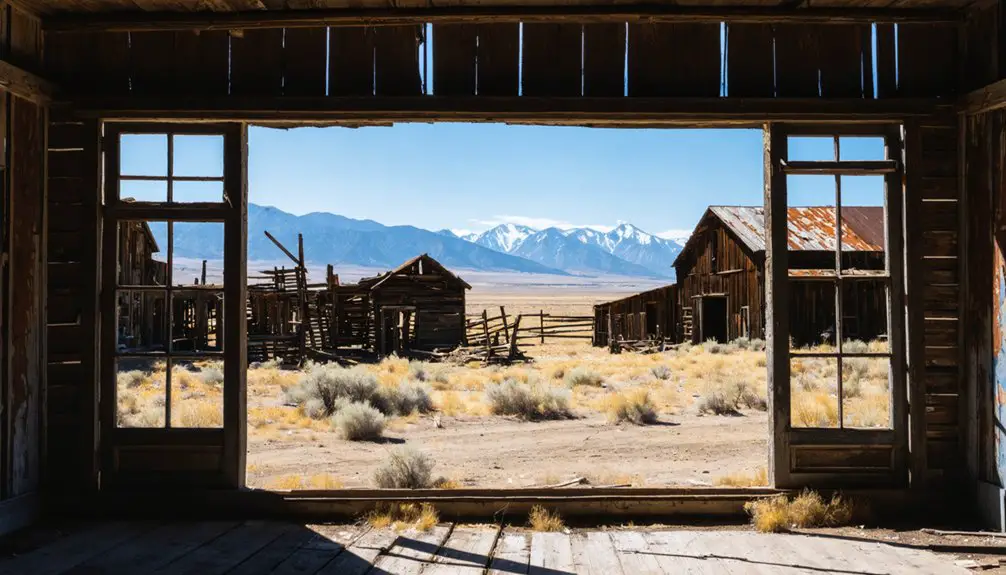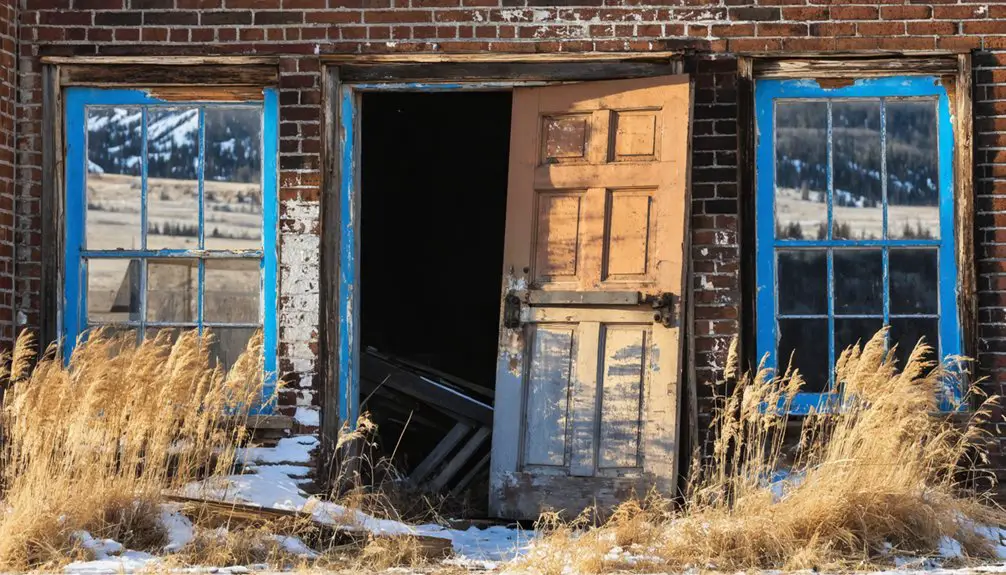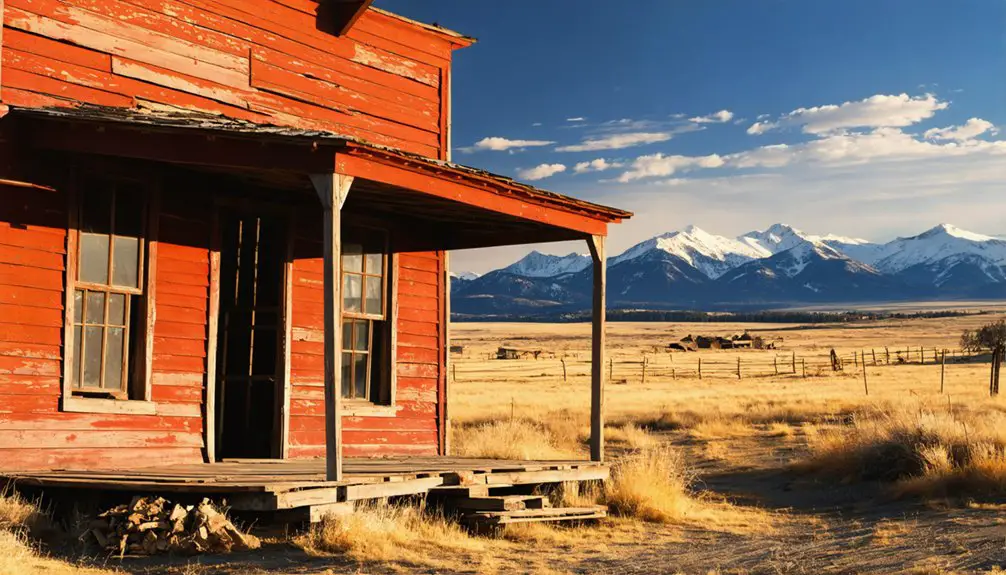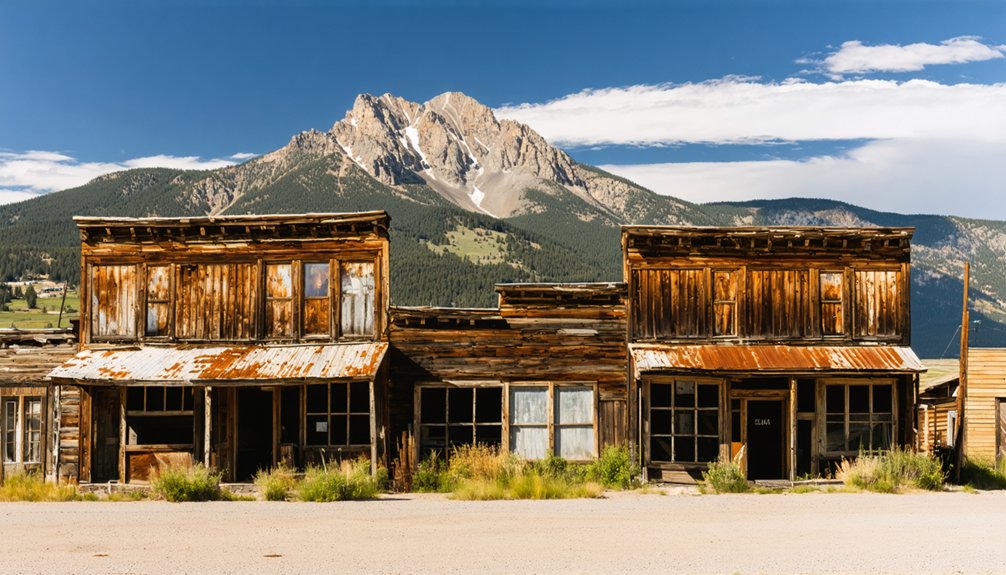
You’ll find three exceptional ghost towns within 30 miles of Philipsburg, each accessible via steep mountain roads that climb through Montana’s mineral-rich ranges. Granite, just five miles away, showcases a 100-stamp silver mill and the preserved Miners’ Union Hall from its 3,000-resident heyday. Garnet, Montana’s best-preserved ghost town, features over 30 original structures including the J.R. Wells Hotel and fourteen saloon foundations. While Bannack and Elkhorn lie farther out, they offer equally compelling glimpses into the region’s boom-and-bust mining heritage that shaped these remote communities.
Key Takeaways
- Granite Ghost Town, discovered in 1865, once housed 3,000 residents and produced $30 million in silver from 1883 to 1898.
- Garnet Ghost Town is Montana’s best-preserved ghost town with over 30 original structures from the late 1890s gold rush era.
- Bannack Ghost Town marks Montana’s first major gold rush in 1862 and features over 60 preserved structures for exploration.
- Elkhorn Ghost Town was founded after 1868 silver discovery and peaked at 2,500 residents before declining due to epidemics.
- High-clearance vehicles are recommended for Granite Road; download offline maps as cell service is nonexistent in these areas.
Granite Ghost Town: A Silver Empire’s Rapid Decline
When prospector Hector Horton identified silver in the Philipsburg district in 1865, he couldn’t have imagined the bonanza that would erupt on Granite Mountain a decade later.
In 1865, prospector Hector Horton struck silver near Philipsburg, unknowingly setting the stage for Montana’s greatest bonanza.
You’re standing where Montana’s “Silver Queen” once dominated global markets, producing $30,000,000 between 1883 and 1898. By 1889, monthly output exceeded $250,000, powering a town of 3,000 residents with 18 saloons, churches, and a Miners’ Union Hall.
The 100-stamp mill processed ore that assayed 1,700 ounces of silver per ton. A 9,750 ft long Aerial Tramway transported ore from the mine to the processing mill below. Yet Granite’s decline came swiftly when silver prices collapsed in 1893.
Within years, the empire vanished, leaving only weathered foundations as evidence to this silver legacy—a stark reminder that boom times don’t last forever in mining country. Today, the Miners Union Hall still stands with its third-floor dance hall, second-floor offices, and ground-floor saloon, though roof supports have caved and the structure risks collapse.
Exploring the Ruins and Walking Trails at Granite
When you arrive at Granite’s mountaintop townsite, you’ll find the signed Granite Ghost Town Walk looping through dispersed ruins where 3,000 residents once lived and worked.
The trail leads you past crumbling main street foundations, scattered residential areas along Sunnyside and Magnolia streets, and the imposing stone walls of large silver mills clinging to upper slopes.
One of the route’s highlights is the Miners’ Union Hall from 1890, a photogenic stone building with native rock and brickwork that stands as one of the best-preserved structures in Montana’s ghost town country. The hall once hosted community events including dances, meetings, and gatherings for the diverse workforce.
Hiking trails marked with GGW signs meander through the forest, helping visitors navigate between the scattered building sites and historic remnants.
Walking Trail Historical Structures
The walking route passes remnants of:
- 18 saloon foundations lining the main street
- Four churches integrated into the hillside grid
- Multiple banks and commercial buildings
- Hospital ruins and mine superintendent’s house
- Home sites and cabin remains accessible via informal spurs
Many foundations remain unsigned, so grab the printed walking-tour map from Philipsburg’s Chamber of Commerce before ascending the mountain—cell coverage proves unreliable among these weathered monuments to 1880s ambition. The Miners Union Hall, though in disrepair, still stands as a testament to the organized labor movement that once thrived here. Trails are poorly marked throughout the park, and some paths may inadvertently lead onto private property, so staying on established routes is essential.
Miners’ Union Hall Remnants
Among Granite’s scattered ruins, the Miners’ Union Hall stands as the most architecturally ambitious remnant—three towering walls of native granite and brick that once framed a $23,000 showplace at 7,000 feet.
Built in 1890, this three-story structure housed pool parlors, an auditorium with spring-maple dance floors, and lodge rooms where the miners’ union organized away from company control.
You’ll recognize its architectural significance immediately: decorative facade elements still cling to Victorian-era masonry, and the front elevation commands Main Street like it did during silver boom years.
After 1893’s Silver Panic emptied the town overnight, weather claimed the roof and interior floors.
What remains—listed on the National Register since 1974—tells you everything about boomtown ambition meeting high-altitude reality. The building served as a significant social center for Granite’s community, hosting gatherings and events that brought together miners and their families during the town’s peak years. The second floor also contained an office and library, providing miners with resources and administrative space beyond the main assembly areas.
Garnet Ghost Town: Montana’s Best-Preserved Mining Settlement
You’ll find Garnet perched high in the Garnet Range east of Missoula, where roughly 1,000 prospectors and their families chased lode gold in the late 1890s before exhausted mines triggered steady decline by 1905.
The devastating 1912 fire that tore through the business district destroyed many commercial buildings, yet what survives today makes Garnet Montana’s most intact ghost town—dozens of original structures still stand with artifacts inside.
Walking among the weathered cabins, hotel, and Davey store building, you’re experiencing a remarkably complete snapshot of hard-rock mining life that vanished over a century ago. Preservation funding comes from “Explore Ghost Town” license plates, which direct the majority of proceeds toward maintaining and enhancing Garnet’s historic structures. The Garnet Preservation Association based in Missoula works to maintain and restore the town’s historical sites through community education and outreach efforts.
Gold Mining Legacy
Fortune seekers struck placer gold in First Chance Gulch in 1865, launching Garnet’s transformation from wilderness to Montana’s best-preserved mining settlement.
You’ll discover the gold mining legacy that shaped this remote district through decades of boom and bust.
The Nancy Hanks mine‘s 1895 discovery catalyzed Garnet’s golden era, drawing 1,000 residents by 1898.
This historical significance endures through preserved structures and documented wealth extraction:
- The Nancy Hanks produced $690,000 in its peak year of 1896
- Fifty mines operated simultaneously during boom years
- Between 1897-1917, miners extracted $950,000, with 95% being gold
- Unemployed silver miners flooded in after the 1893 Sherman Silver Purchase Act repeal
- Production continued intermittently until 1954
You’re walking where millions in gold emerged from Montana’s rugged mountains.
Devastating 1912 Fire
Garnet’s prosperity ended abruptly on a single day in 1912 when flames tore through the business district, consuming stores, saloons, and the commercial heart that had sustained 1,000 residents just fourteen years earlier.
You’ll find the fire impact evident in Garnet’s fragmented layout today—surviving cabins stand amid conspicuous gaps where storefronts once thrived. The blaze destroyed roughly half the town, and nobody rebuilt what burned.
This community loss accelerated an exodus already underway from declining ore yields. Without stores or gathering places, miners had little reason to stay.
Intact Historical Structures
What survived the 1912 blaze and decades of abandonment stands today as Montana’s most complete mining ghost town.
You’ll find roughly 30 structures preserved in “arrested decay”—stabilized but not rebuilt—showcasing the historical significance of 1890s hard-rock mining life.
The architectural styles reflect practical frontier construction:
- Log and frame cabins where miners’ families lived steps from the workings
- Commercial buildings including a saloon, hotel remnants, and general stores
- Industrial structures near the 1895 stamp mill site at First Chance Gulch
- Blacksmith shop representing essential support services
- Two rentable cabins offering overnight immersion in preserved interiors
Managed by the BLM, these timber-and-minimal-masonry buildings form an unmatched visual record of Montana’s gold-mining settlements—functional, compact, and built to last just long enough.
What to See at Garnet: Buildings and Artifacts
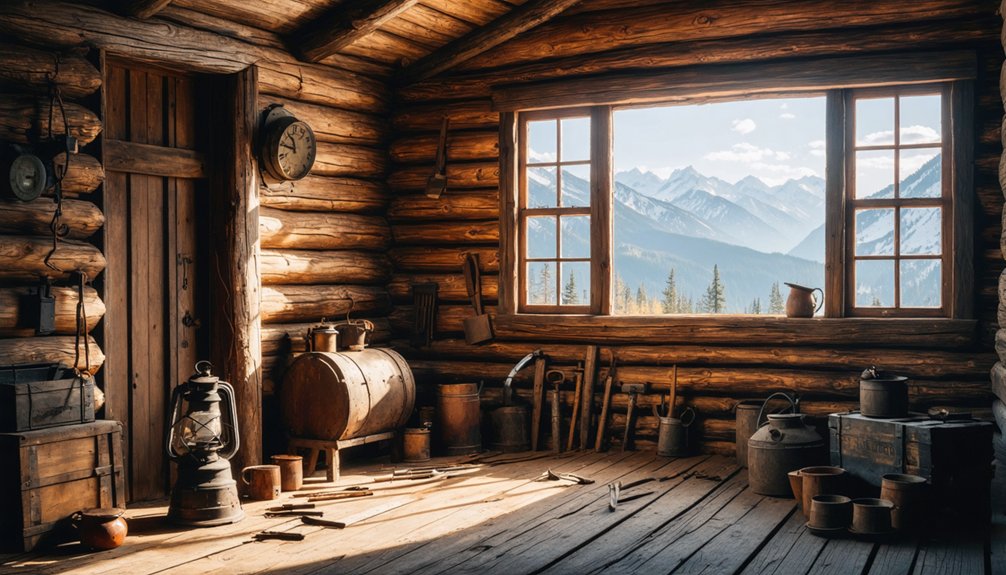
Stepping into Garnet feels like walking onto a movie set frozen in 1912.
You’ll explore over 30 preserved structures, including the prominent J.R. Wells Hotel with its narrow guest rooms and creaky wooden stairs. The Garnet architecture showcases hastily-built log cabins constructed without foundations, designed for quick shelter rather than permanence.
Historical artifacts remain scattered throughout—beds still frame empty rooms, bottles line store shelves at F.A. Davey’s Store, and you’ll spot abandoned bicycles and sewing machines inside cabins.
Fourteen saloons once operated here; survivors like Kelley’s Bar reveal the town’s gambling culture with two-story layouts.
The site’s “arrested decay” management preserves this authentic frontier atmosphere, letting weathered buildings tell their own stories without heavy-handed restoration.
Bannack Ghost Town: Where Montana’s Gold Rush Began
You’ll find Montana’s birthplace as a gold territory at Bannack, where John White struck gold on Grasshopper Creek in July 1862 and sparked the state’s first major rush.
This remote site served as Montana’s first territorial capital in 1864 and once supported 10,000 residents along a main street packed with saloons, hotels, and the original governor’s mansion.
Today you can walk through over 60 preserved structures, pan for gold in the creek, and explore the same courthouse where vigilantes hanged Sheriff Henry Plummer without trial in 1864.
Gold Discovery in 1862
On July 28, 1862, prospector John White and his small party of “Pikes Peakers” struck placer gold at Grasshopper Creek while heading toward the Idaho gold fields—a discovery that would transform Montana forever.
This first major strike in Bannack history established the foundation for Montana Territory itself.
The discovery site, later known as White’s Bar, revealed remarkably pure gold:
- Purity levels: 99–99.5% pure, exceeding typical western fields’ 95%
- Rapid growth: population surged from handful to 3,000 by 1863
- Production value: $700,000 in gold extracted by winter 1862
- Creek renaming: previously Willard Creek, renamed for grasshopper swarms
- Pioneer experiences: 10–12 hour workdays defined early mining life
You’re standing where Montana’s territorial story began.
Preserved Buildings and Activities
Unlike most ghost towns where visitors peer through chain-link fences at crumbling ruins, Bannack opens its doors—literally. Over 50 original structures remain accessible for self-guided exploration, letting you walk through the two-story schoolhouse, Hotel Meade (once the county courthouse), and the church with its decaying pews and creaky floorboards.
This approach to historic preservation prioritizes authenticity over polish—buildings are stabilized but not modernized, maintaining their weathered character.
Visitor engagement extends beyond architecture. You’ll find interpretive trails mapping key events, camping facilities for overnight stays, and fishing along Grasshopper Creek.
The unpaved streets and false-front storefronts create an immersive 19th-century setting. Photography thrives here, documenting everything from Masonic emblems to the original gallows standing sentinel over Main Street.
Year-Round Activities and Events at Bannack State Park
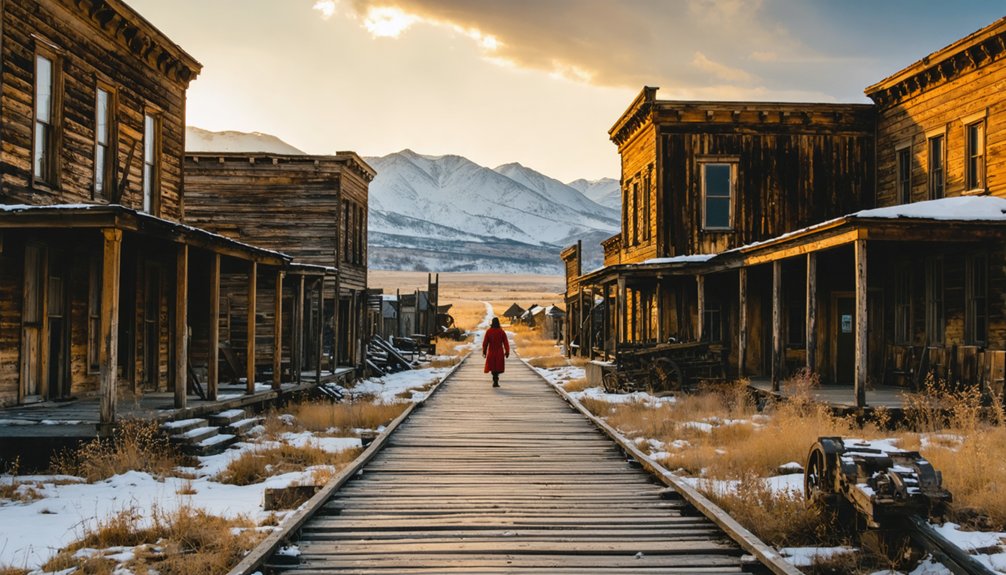
Because Bannack State Park remains open year-round, you can explore this exceptionally preserved ghost town any day except Christmas Eve and Christmas Day.
The visitor center operates Memorial Day through Labor Day, offering guided tours and historic exploration programs that bring the 1860s gold-rush era to life.
Year round activities include:
- Bannack Days (third weekend in July) featuring blacksmithing demonstrations, gold panning, and gunfight reenactments
- Ghost Walk tours in October with spine-tingling stories from Montana’s first major gold discovery site
- Ice skating on the dredge pond January–February with warming house amenities
- Self-guided tours exploring 60+ preserved structures across all seasons
- Photography and wildlife viewing throughout surrounding high-desert landscape
Winter hours run 8 a.m.–5 p.m., while summer extends until 9 p.m.
Elkhorn Ghost Town: A Swiss Immigrant’s Silver Discovery
While Bannack draws visitors with its gold-rush heritage, another Montana ghost town tells a different precious metal story just 35 miles northwest of Philipsburg.
You’ll find Elkhorn nestled beneath the mountains where Swiss immigrant Peter Wyes discovered silver veins in 1868. His death four years later brought Norwegian entrepreneur Anton Holter, who purchased the claim and established the town that’d reach 2,500 residents at its peak.
The community thrived with Fraternity Hall hosting dances and theater productions while miners worked shafts exceeding 1,000 feet deep.
But a diphtheria epidemic between 1884-1889 devastated families, filling the cemetery with children’s graves. The Silver Panic of 1893 delivered the final blow.
Today, you can explore the weathered buildings that stand as evidence of frontier ambition and hardship.
The Architectural Highlights of Elkhorn State Park
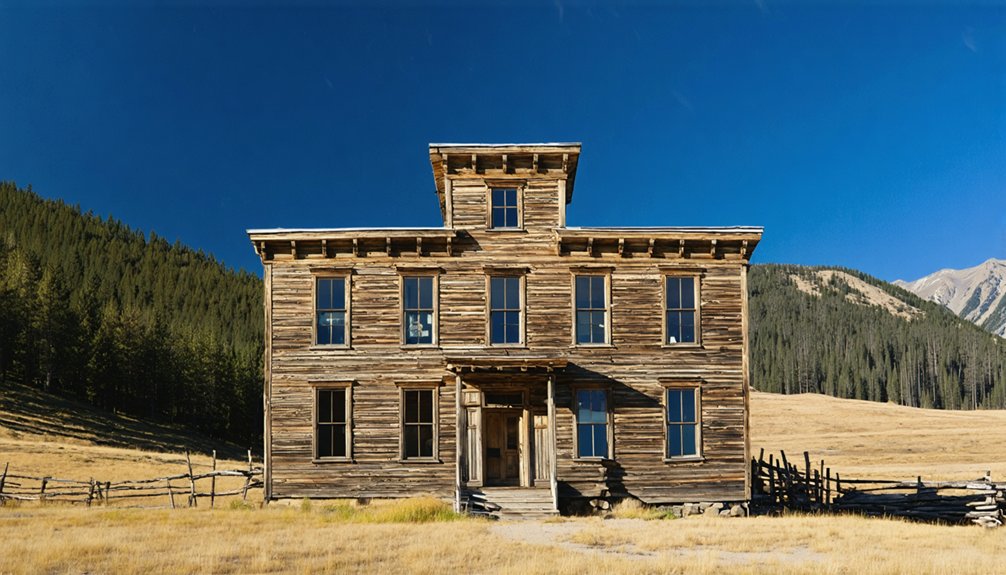
Two weathered wooden structures stand side by side along Elkhorn’s main street, their peeling paint and wind-worn facades drawing more camera clicks than perhaps any other buildings in Montana.
Fraternity Hall and Gillian Hall represent outstanding examples of frontier architecture, earning documentation in the Historic American Buildings Survey for their architectural significance and adherence to preservation standards.
These structures offer you a glimpse into authentic 1800s construction:
- Fraternity Hall’s neo-classical balcony and pillars crafted entirely from wood
- False front design typical of western gold camp buildings
- Second-floor dance hall in Gillian Hall for frontier entertainment
- Minimal restoration approach preserving genuine relics over polished reconstructions
- 0.3-mile interpretive trail explaining their history
You’ll find these buildings within Montana’s smallest state park, occupying less than one acre at 6,500 feet elevation.
Philipsburg: The Town That Survived the Mining Bust
Unlike Elkhorn’s frozen-in-time silence, Philipsburg’s downtown still hums with year-round commerce—a rare feat for a Montana mining camp that watched silver prices collapse in 1893.
You’ll find Philipsburg history written in every brick storefront, yet the town refused to die when the Sherman Silver Purchase Act’s repeal shuttered the massive Granite Mountain mines.
Mining resilience came through diversification: manganese deposits saved the economy during World War I, when local mines supplied half the nation’s output for steel production.
While neighboring camps emptied into ghost towns, Philipsburg pivoted from silver to manganese, then tourism.
That adaptability—switching from one ore to another, building mills when terrain demanded them—explains why you’re browsing candy shops today instead of photographing collapsed headframes.
Planning Your Ghost Town Adventure: Access and Tours
How do you actually reach Granite’s weathered superintendent’s house and crumbling Miners’ Union Hall perched 7,000 feet up the Pintlers? Granite Road climbs 1,280 feet in less than five miles from Philipsburg—a steep, winding gravel gauntlet demanding high-clearance or 4WD vehicles.
Understanding ghost town logistics means planning around seasonal access: wet conditions render the road treacherous, and snow closes it entirely.
Before you tackle the drive, consider these essentials:
- Stop at the ranger station south of Philipsburg for trail maps and current road conditions
- Download offline maps—cell service is nonexistent
- Bring recovery gear if venturing to remote sites like Black Pine
- Respect state park rules and avoid climbing unstable structures
- Book an ATV tour if you’re uncomfortable traversing mountain roads
The Granite County Museum’s Ghost Town Hall of Fame provides invaluable context before exploring.
Frequently Asked Questions
Are There Accommodations Available for Overnight Stays Near These Ghost Towns?
You’ll find local lodgings in Philipsburg—motels, historic hotels, and vacation rentals—just three miles from Granite Ghost Town. Camping options include dispersed forest sites and private campgrounds nearby, since the ghost town itself offers no overnight facilities.
What Safety Precautions Should Visitors Take When Exploring Abandoned Structures?
Never enter posted structures—they’re genuine death traps with hidden rot and collapse risks. Stay on marked trails, wear sturdy exploration gear, respect closures, and photograph from outside. Structural hazards killed miners then; they’ll kill trespassers now.
Can Visitors Use Metal Detectors to Search for Artifacts?
No, you can’t legally use metal detectors at Garnet, Granite, or registered historic sites. Metal detecting regulations and historical artifact preservation laws prohibit disturbing artifacts on these protected public lands without permits.
Which Ghost Town Is Most Suitable for Young Children?
Garnet Ghost Town is most suitable for young children, offering family‑friendly activities among twenty well‑preserved buildings you’ll easily explore. The compact layout provides excellent educational opportunities about mining‑camp life without steep terrain or hazardous access roads.
Are Pets Allowed at the Ghost Town State Parks?
Like a hiking buddy on a leash, your pet’s welcome at Granite Ghost Town State Park under Montana’s pet policies. You’ll follow ghost town regulations: six-foot leash, stay on trails, pack out waste, respect posted closures.
References
- https://ghosttownfinder.com/guides/philipsburg-montana
- https://philipsburgmt.com/ghost-towns
- https://melissawhitneyphotography.com/2020/10/01/the-ghost-towns-of-garnet-and-granite-montana/
- https://www.budgettravel.com/article/montana-ghost-towns
- https://www.atlasobscura.com/things-to-do/montana/ghost-towns
- https://southwestmt.com/specialfeatures/this-is-montana/communities/philipsburg-and-the-flint-creek-valley-silver-and-sapphires/
- https://www.tripadvisor.com/Attraction_Review-g45303-d4813270-Reviews-Granite_Ghost_Town_State_Park-Philipsburg_Montana.html
- https://visitmt.com/things-to-do/ghost-towns
- https://fwp.mt.gov/stateparks/granite-ghost-town
- https://www.youtube.com/watch?v=u-RoFjipFJ0