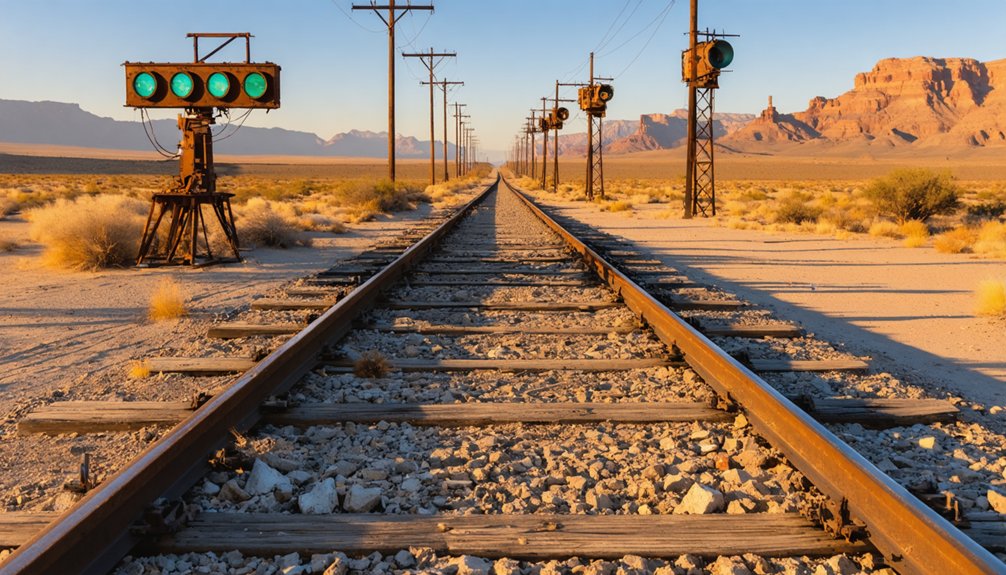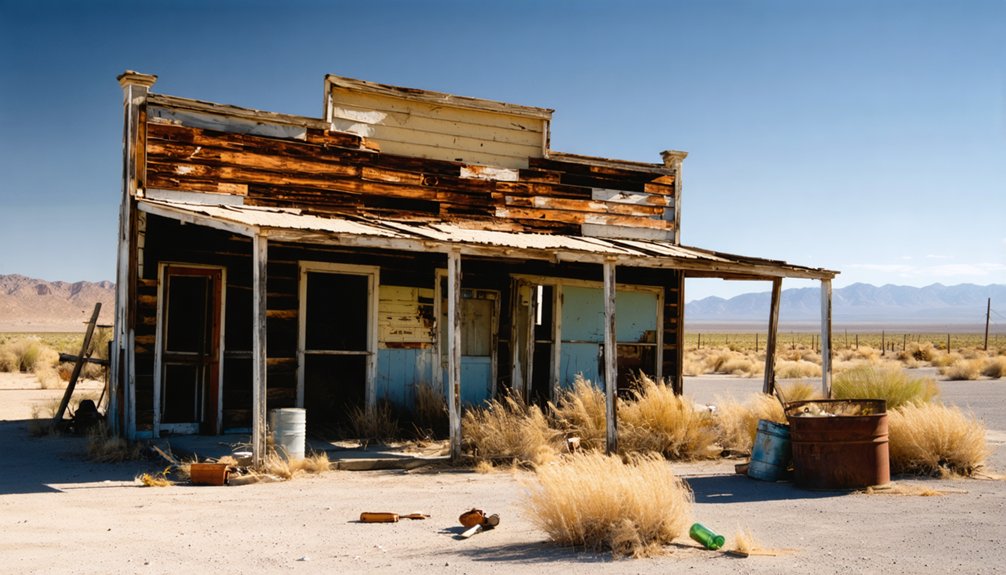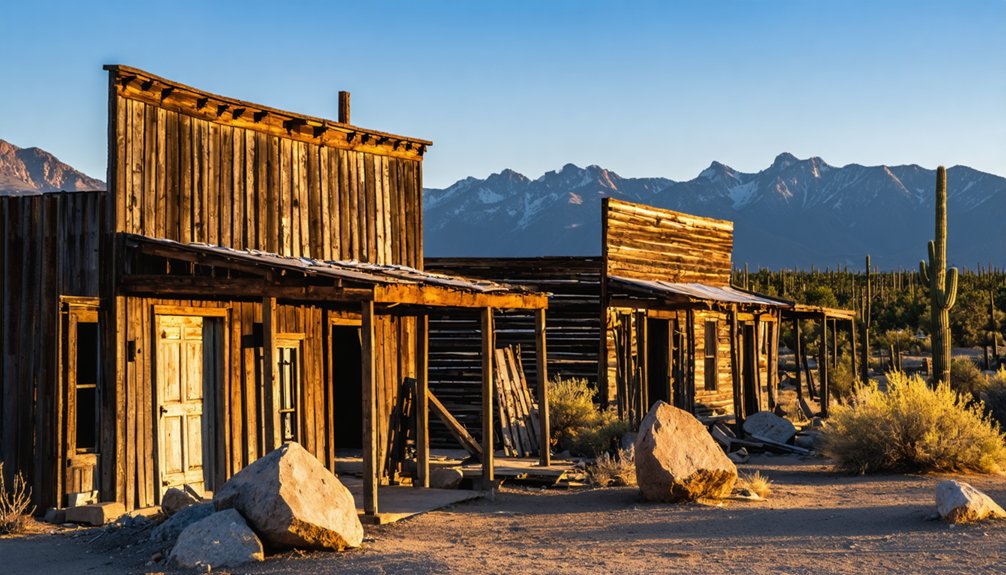
You’ll discover over a dozen ghost towns within 25 miles of Prescott, the densest concentration in Arizona. Crown King, Big Bug, and Placerita mark the Bradshaw Mountains’ 1863 gold rush legacy, while Congress represents the region’s peak production era with its 2,700-foot shaft—once Arizona’s deepest. Vulture City, two hours south, offers eighteen preserved structures including Henry Wickenburg’s original cabin. These abandoned camps cluster around former stamp mills and railway spurs, their weathered buildings and cemeteries revealing stories of miners who extracted millions in gold before veins played out and economic realities forced their departure.
Key Takeaways
- Prescott Valley has Arizona’s highest concentration of ghost towns, with over 40 sites from the 1860s-1880s gold rush era.
- Vulture City, two hours south of Prescott, features eighteen preserved structures and produced over 340,000 ounces of gold since 1863.
- Congress Mine town, once employing 400 miners monthly, was abandoned in the 1930s due to declining gold prices and economic pressures.
- Crown King and notable camps like Big Bug and Walker Creek are located within 25 miles of Prescott in the Bradshaw Mountains.
- Jerome evolved from a mining camp into Arizona’s richest district through a copper boom after initial gold and silver extraction.
Placerita: A Remote Gold Camp in the Bradshaw Mountains
Deep in the Bradshaw Mountains, where steep canyons and narrow gulches slice through ancient Precambrian rock, Placerita emerged as one of central Arizona’s fleeting gold camps—a place where Mexican placeros first traced coarse gold back to weathered quartz veins in 1863.
You’ll find remnants of an old stamp mill still standing by the workings, evidence to placerita history that burned bright and brief.
Those early miners employed simple mining techniques—dry washers, rockers, and crude sluices—to extract gold from shallow pay streaks near bedrock.
Water scarcity and brutal access limited operations to small crews working seasonally.
Once they’d stripped the richest surface gravels, the camp emptied.
The gold was sent to the Philadelphia mint, where it joined other documented discoveries that helped map the expanding mineral wealth of the American West.
By the mid-1850s, about 6,000 prospectors had flooded similar gold camps across the West, their populations often surpassing even established cities.
Today, scattered foundations and tailings mark where free men once chased fortune through remote Arizona wilderness.
Why Prescott Valley Has Arizona’s Highest Ghost Town Density
You’ll find more ghost towns packed around Prescott Valley than anywhere else in Arizona because the Bradshaw Mountains Gold Rush of the 1860s–1880s sparked dozens of small camps within a ten-mile radius, each tied to narrow veins that played out quickly.
In addition to ghost towns, you can also explore the fascinating history of abandoned mines near Scottsdale Arizona, which were once bustling with activity during the mining boom. These remnants of past endeavors offer a glimpse into the challenges faced by miners and the allure of striking it rich. While some sites are still marked by rusting equipment, others have become hidden treasures waiting to be discovered by adventurous explorers.
The Santa Fe Prescott & Phoenix Railway and spur lines built stamp mills and ore‑processing plants at strategic valley points, clustering settlements around shared infrastructure rather than spreading them across the desert.
When prices crashed and high-grade ore ran dry by the 1910s, entire camps emptied within months, leaving you a condensed field of stone foundations, collapsed adits, and forgotten townsites that preserve a single intense boom‑and‑bust cycle. Today’s population of roughly 40 million in the broader region includes a median age of 53.4 years, reflecting how younger fortune-seekers long ago abandoned these mining districts for urban centers. The Prescott Valley Metropolitan Statistical Area classification helps researchers track how demographic shifts have transformed this once-thriving mining region into a retirement destination.
Bradshaw Mountains Gold Rush
The discovery of gold along Lynx Creek in 1863 set off a frantic scramble that transformed the Bradshaw Mountains into one of Arizona’s most densely populated mining frontiers—and later, its richest graveyard of abandoned camps.
Brothers William and Isaac Bradshaw recovered an ounce of gold daily using rudimentary mining techniques, while single pans yielded $4.80—extraordinary returns that drew prospectors from California’s exhausted fields.
The economic impact was immediate: these strikes helped establish Arizona Territory in 1863. Bradshaw City alone swelled to 5,000 residents before vanishing.
Over 40 ghost towns now pepper these mountains, including Crown King, whose mine produced $2 million in gold.
The range’s Precambrian schist held countless gold-bearing quartz veins, fueling waves of placer and hard-rock operations that built—then abandoned—an entire frontier. Miners also extracted silver and copper alongside gold, with operations like the Poland silver mine burrowing deep into Mount Union before being permanently sealed. The Bradshaw Indian War ended in 1873, opening the floodgates for even more intensive prospecting across previously contested lands.
Railroad and Mining Infrastructure
When the Santa Fe, Prescott & Phoenix Railway hammered its final spike in 1893, engineers couldn’t have known they were sketching the blueprint for Arizona’s densest ghost town corridor.
Railroad expansion through Chino Valley and Granite Dells spawned dozens of sidings, each attracting hopeful camps clustered around water stops and section houses. Mining infrastructure followed the tracks—ore wagons gave way to freight spurs serving Jerome’s copper and local gold districts.
You’ll find the highest concentration of abandoned townsites where rail met mine: clusters around depot yards, turntable facilities, and the Hell Canyon bridge. The railway’s 1905 westward relocation and expansion forced entire support communities to uproot or dissolve as infrastructure shifted away from original settlements.
The United Verde and Pacific Railway connected Jerome’s copper operations to Prescott’s Santa Fe line in 1894, creating a 26-mile supply corridor that sustained numerous work camps along its challenging route. When the 1960s Peavine Bypass rerouted traffic away from Prescott’s steep grades, whole communities lost their economic lifeline overnight. Tax subsidies had encouraged overbuilding; realignment guaranteed mass abandonment.
Ore Depletion and Abandonment
Rails and processing mills meant nothing once miners hit barren rock.
You’ll find Prescott Valley’s ghost towns clustered where single veins played out fast. Early mining techniques chased high-grade shoots instead of bulk ore, exhausting profits within years. As shafts deepened past 500 feet, groundwater flooded workings and ventilation costs soared beyond what remaining low-grade ore could support.
When silver prices crashed in the early 1900s, camps died overnight—no economic cushion existed in these single-industry settlements. You can still see abandoned infrastructure scattered across the Bradshaws: rusted hoists, collapsed headframes, silent mill foundations.
Each piece marks where the grade-to-cost ratio failed. Without capital for deep exploration or modern flotation technology, operators simply walked away, leaving complete towns frozen in sudden abandonment. These sites now attract visitors as historic tourist attractions, preserving the visible remaining structures that characterize Arizona’s mining heritage. The Prescott area contains multiple abandoned settlements sharing similar names, requiring careful navigation when researching specific ghost town locations.
Congress: A Major Gold Producer Along the Prescott Corridor
When you explore Congress today, you’ll find remnants of what was territorial Arizona’s largest gold producer, a mine that employed 400 workers and extracted over 400,000 ounces of gold by 1910.
The Congress Mine‘s Number 1 shaft reached 2,700 feet deep—Arizona Territory’s deepest at the time—while three main veins yielded nearly $7.7 million in gross returns during the peak years between 1894 and 1910.
Though the mine closed during World War II after brief 1930s revival operations, the site’s deteriorating structures and scattered mining equipment tell the story of a once-thriving mining camp that processed over a million tons of ore.
Peak Production and Population
By the turn of the twentieth century, Congress had become Arizona Territory’s gold-mining powerhouse, with a monthly payroll of 400 miners and production figures that dwarfed most competitors.
The mine’s Number 1 shaft plunged 2,700 feet—Arizona’s deepest at the time—while twenty stamps crushed ore averaging 0.28 ounces per ton.
You’ll find records showing more than $5 million in gold mining output by 1900, climbing past $8 million through the following decade.
This workforce demographics snapshot reveals approximately 425 men at peak employment, their labor supporting not just underground operations but railroads, freighting outfits, and the entire Congress townsite.
Mill men and underground specialists arrived from across Arizona, drawn by steady wages and rich ore that would eventually yield roughly 500,000 ounces.
Decline and Modern Remains
The Congress Mine’s remarkable output couldn’t sustain operations indefinitely, and declining gold prices through the 1930s rendered the deep shaft workings uneconomical.
Despite advances in mining technology like cyanide processing and 40-stamp mills, economic shifts forced permanent closure. The 400-plus miners who’d kept this operation running packed up and left, taking the town’s lifeblood with them.
Today, you’ll find precious little at the original townsite. What the 1898 and 1900 fires didn’t consume, time and salvagers finished off.
The modern settlement called “Congress” actually sits at the old Congress Junction, where the spur railroad once connected.
If you’re seeking authentic mining ruins, you’ll discover that Arizona’s largest gold producer has surrendered most of its physical evidence to the desert, leaving behind stories worth more than the ore itself.
Vulture City: the Premier Day Trip From Prescott
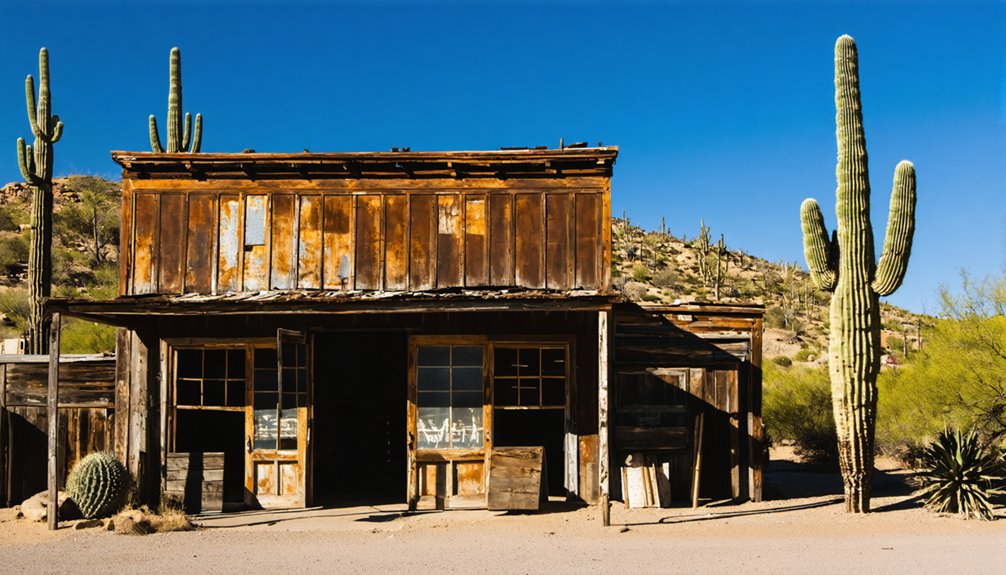
Just two hours south of Prescott, Vulture City stands as Arizona’s most storied gold mining ghost town and an essential destination for anyone tracing the threads of territorial history.
Founded in 1863 when Henry Wickenburg struck a rich vein, the Vulture Mine produced over 340,000 ounces of gold—fueling the growth of Wickenburg and even helping finance Phoenix’s early irrigation canals.
The historical significance resonates through eighteen preserved structures: the Assay Office, brothel, blacksmith shop, and Wickenburg’s original cabin.
You’ll find the infamous Hanging Tree where frontier justice was swift and brutal, reminders of Apache raids, and tales of high-grading miners who risked execution for pocketing ore.
Open October through May, this 5,000-resident boomtown-turned-museum offers self-guided walks through authenticated 1800s buildings.
Notable Abandoned Mining Camps Within 25 Miles of Prescott
Within a day’s drive of Prescott, you’ll discover a constellation of forgotten mining camps that trace the frantic 1860s gold rush through the Bradshaw Mountains—settlements where stamping mills once thundered, saloons spilled lamplight across muddy streets, and fortunes vanished as quickly as they appeared.
Big Bug camp, twenty miles southeast, preserves mining history through crumbling foundations and prospect pits along its namesake creek.
Walker Creek’s gold diggings, closer at ten miles south, blend abandoned structures with modern cabins—a living ghost town.
Northeast, the copper boom transformed Jerome into Arizona’s richest district, spawning satellite camps like Haynes, where the Gold King Mine’s 1890s workings now stand frozen as a museum.
Each site offers tangible freedom to explore Arizona’s unvarnished past without velvet ropes or admission gates.
Understanding Ghost Town Categories in Yavapai County
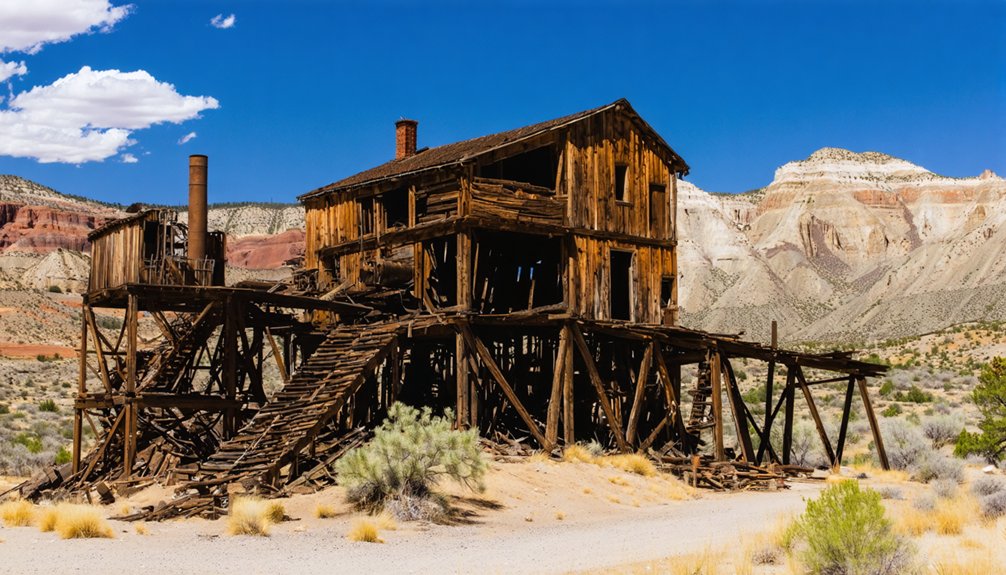
Before you set out for a windswept foundation or sagging head-frame, understanding how historians and explorers classify Yavapai County’s ghost towns will sharpen your appreciation for what you’re actually seeing.
Ghost town origins here trace mainly to mining booms, stage routes, and ranching outposts—each with distinct paths toward economic collapse.
You’ll encounter barren sites reduced to artifact scatter, neglected ruins with caved roofs, abandoned street grids awaiting bulldozers, semi-ghost hamlets clinging to a handful of residents, and restored towns marketing their demise as heritage.
No legal statute governs these categories; they’re descriptive tools reflecting how completely a settlement died. Recognizing whether you’re walking through a Class 2 ruin or a Class 5 tourist attraction changes how you document, photograph, and respect what remains.
Best Roads and Access Routes for Exploring Near Prescott
Once you’ve pinpointed which ghost towns deserve your attention, getting there safely becomes the next puzzle—and around Prescott, that means choosing your route by what you drive and what you’re willing to steer through.
AZ-89A to Jerome delivers thrilling scenic routes with hairpin switchbacks and steep drop-offs, perfect for motorcycles and passenger cars but punishing for RVs. If you’re towing or driving something long, swing south on AZ-69 to I-17, then approach Jerome via Cottonwood’s gentler grades.
For ghost town exploration around Humboldt, AZ-69’s flat corridor handles any rig. South toward Congress, AZ-89 opens access to distant mining camps.
Guardrails protect cliff edges near Jerome, but narrow lanes and sharp curves demand your full attention—freedom here rewards skill and respect for mountain terrain.
What Remains: Ruins, Cemeteries, and Historic Structures to Visit
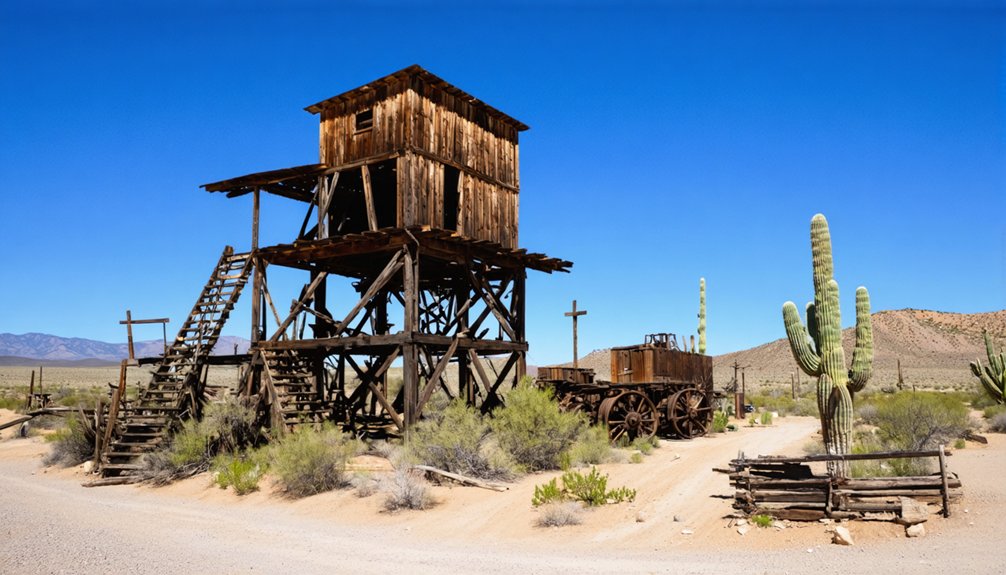
When you arrive at Jerome’s steep hillside perched above the Verde Valley, you’re walking into one of the Southwest’s most intact mining landscapes—a National Historic Landmark District where hundreds of brick commercial facades, stacked wooden houses, and concrete industrial ruins still cling to Cleopatra Hill exactly where copper miners left them.
The 1916 Douglas Mansion overlooks tailings piles, while the Sliding Jail sits 225 feet downslope from its foundation.
At Vulture City, sixteen original buildings—assay office, bunkhouses, headframes—anchor Arizona’s best-preserved gold-rush ghost town architecture.
Throughout the Bradshaw Mountains, you’ll find collapsed cabins, stone walls, and cemetery plots marking vanished camps like Placerita and Stanton, each preserving fragments of mining heritage once scattered across 7,000 Yavapai County prospect sites.
Frequently Asked Questions
Are Any Ghost Towns Near Prescott Safe for Children and Families?
Yes, you’ll find family friendly activities at Jerome and Vulture City, where guided tours and preserved structures minimize hazards. You’ll need standard safety precautions—supervise children near old buildings, avoid abandoned mines, and bring plenty of water for desert exploration.
Do I Need Permits to Explore Ghost Town Sites Around Prescott?
You’ll generally need permits for commercial tours, metal detecting, or artifact collecting, but casual day-hiking on most BLM lands doesn’t require one—just confirm exploring regulations with local offices to respect preservation and avoid trespassing issues.
What Is the Best Season to Visit Prescott-Area Ghost Towns?
While summer heat scorches desert ruins, spring and fall offer you comfortable exploration temperatures. You’ll discover vibrant fall foliage framing Jerome’s weathered structures, creating perfect conditions for photographing these historic preservation sites during weekday visits.
Can I Camp Overnight Near Ghost Town Locations Around Prescott?
You’ll find dispersed camping allowed on some federal lands near ghost towns, but always verify camping regulations first—private mining claims and cultural sites restrict access. Prioritize overnight safety by avoiding unstable ruins and open shafts.
Are Guided Ghost Town Tours Available From Prescott?
The road less traveled leads downtown—guided tours focus on Prescott’s haunted historic core, not remote ghost towns. You’ll explore local history through Whiskey Row’s saloons and territorial-era buildings where spirits allegedly linger.
References
- https://en.wikipedia.org/wiki/List_of_ghost_towns_in_Arizona
- https://www.arizonahighways.com/article/arizona-ghost-towns
- https://www.ghosttowns.com/states/az/azyavapai.html
- http://bradshawmountains.com/mines.htm
- https://www.geotab.com/ghost-towns/
- https://www.tripadvisor.com/Attractions-g28924-Activities-c47-t14-Arizona.html
- http://prescottazhistory.blogspot.com/2016/10/the-forgotten-ghost-town-of-placerita.html
- https://www.acrossthestreetprescott.com/a-tale-of-two-ghost-towns/
- https://www.elsmerecanyon.com/placerita/goldsite/goldsite.htm
- https://www.latimes.com/archives/la-xpm-1990-03-08-vw-2800-story.html