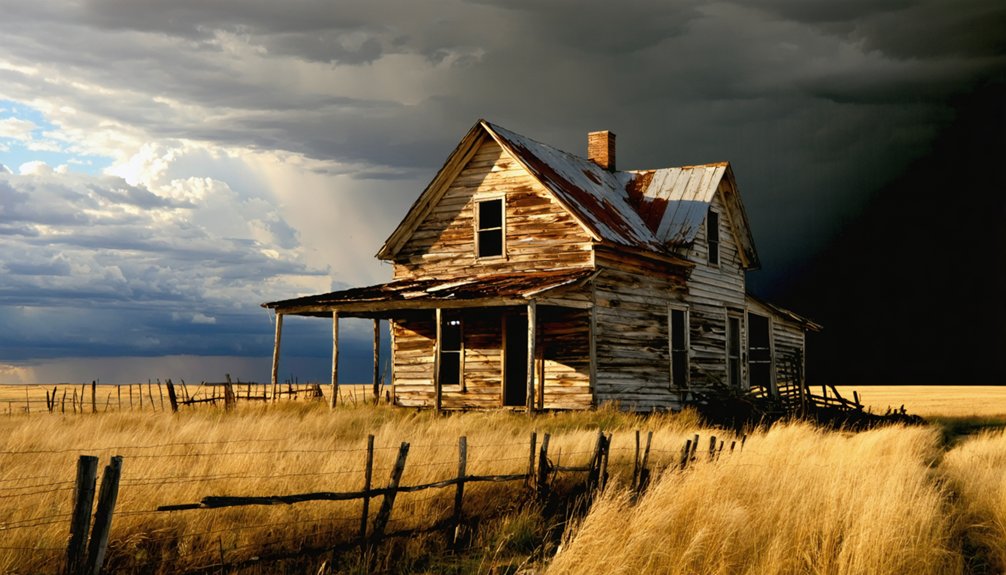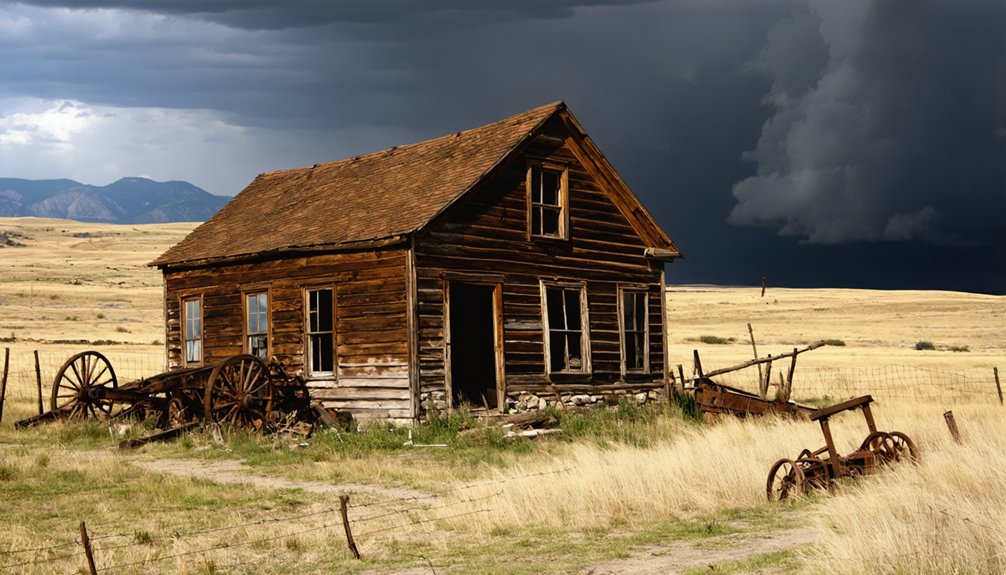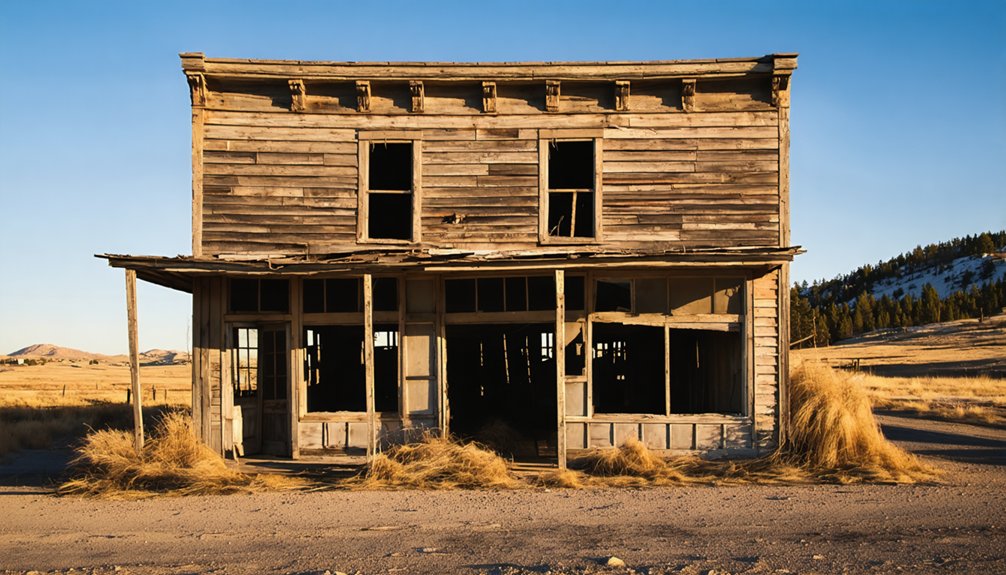
You’ll find exceptional ghost towns within an hour of Rapid City, including Spokane—the region’s best-preserved settlement with intact period furnishings—located 16 miles east of Custer. Mystic served as the Black Hills’ first railroad gateway after 1896, while Rockerville along Highway 16 offers accessible false-front buildings from its 1880 peak. The Nemo-Galena corridor showcases lead-silver mining remnants 25 miles northwest. With over 600 documented abandoned sites, the Black Hills region preserves extensive architectural and operational evidence from the 1875-1900 gold rush era that rewards thorough exploration.
Key Takeaways
- Nemo-Galena mining corridor sits 25 miles northwest of Rapid City, featuring semi-ghost communities with accessible remnants via forest roads.
- Spokane, located 16 miles east of Custer, is the best-preserved abandoned settlement with intact manager’s house and period furniture.
- Mystic serves as a former railroad hub requiring 12 miles of gravel road access from Rapid City area.
- Rockerville along US Highway 16 offers an accessible ghost-town experience with false-front buildings and wooden boardwalks.
- Deadwood provides organized ghost tours with historical context, while seasonal conditions affect access to remote gravel road locations.
Exploring Mystic: A Forgotten Railroad and Mining Hub
Tucked into the Castle Creek valley of the central Black Hills, Mystic began as the Sitting Bull Mining Camp in 1875–1876, when prospectors fanned out from Custer’s 1874 expedition and the Jenney–Newton geological party’s confirmation of gold on Castle Creek.
You’ll find Mystic history reflects transformation from a modest placer camp—housing just 100 residents by 1879—into a crucial logistics center.
The railroad impact reshaped everything: the Chicago, Burlington & Quincy completed its line in 1896, followed by the spectacular Crouch Line from Rapid City in 1906.
That 34-mile engineering marvel featured 14 full loops and roughly 100 bridges, hauling gold ore, timber, and coal while bringing supplies inbound.
Mystic became the region’s first railroad gateway into central Black Hills mining districts.
Spokane: The Black Hills’ Best-Preserved Abandoned Settlement
You’ll find the manager’s house remarkably intact with period furniture, a deteriorating schoolhouse, and the watchman’s residence—occupied until the mid-1980s.
Rusting automobiles, root cellars, and foundations dot the reclaimed landscape, making Spokane the Black Hills’ most authentic abandoned settlement accessible today.
Located 16 miles east of Custer in the Black Hills area, this former mining town shipped over $114,000 worth of metals during its 1927 peak before the mine closed in 1940.
The mine also produced gold, silver, lead, copper, mica, and zinc, attracting miners who built houses and businesses around the operation.
Rockerville and Etta: Accessible Historic Sites Along Major Highways
Along US Highway 16 in the central Black Hills, Rockerville offers one of the region’s most accessible ghost-town experiences, combining authentic gold-rush history with the curious remnants of mid-20th-century roadside tourism.
Founded in 1876 when placer gold was discovered in Rockerville Gulch, the settlement peaked around 1880 with nearly 1,000 residents and over 100 structures. Gold-washing “rockers” gave the town its name, while massive flumes from Sheridan Lake supplied hydraulic operations. The first discovery by Wm. Keeler in February 1877 yielded $1.52 in gold from initial pans, sparking excitement that drew prospectors throughout the year.
After the 1915 post office closure marked mining’s end, Rockerville reinvented itself as a tourist attraction with false-front buildings and wooden boardwalks. Originally known as Captain Jack’s Dry Diggins, the settlement was one of the earliest placer mining camps in the Black Hills.
Today you’ll find layered evidence of both eras—the original cabin chimney, deteriorating tourist structures, and scattered relics. Meanwhile, nearby Etta attractions complement your exploration of Highway 16’s historic corridor through authentic Black Hills mining territory.
The Nemo-Galena Mining Corridor and Its Semi-Ghost Communities
While Highway 16‘s tourist-friendly ghost towns like Rockerville reveal the gold rush’s roadside legacy, the remote Nemo-Galena corridor 25 miles northwest of Rapid City preserves a different mining story—one defined by lead-silver extraction rather than placer gold.
Galena mining began when prospectors discovered galena veins near Bear Butte Creek in 1875, establishing a camp by March 1876. Colonel John H. Davey transformed operations after arriving from Chicago in 1878, purchasing the Florence, Sitting Bull, and Yellow Jacket Mines. His 125-worker operation disbursed $16,000 monthly until legal disputes with Richmond Mine owners forced closure. The Sitting Bull Mine alone generated over $750,000 in silver revenue by 1883, making it one of the corridor’s most productive claims. Galena’s commercial district included 75 homes and two smelters by 1877, serving a community that would reach 800 residents at its peak.
Nemo history intertwines with Galena’s fortunes—both communities thrived until ore depletion and collapsing silver prices shuttered operations by 1891, leaving skeletal remnants accessible only via unpaved forest roads.
Planning Your Visit: Tours, Road Conditions, and Access Guidelines
Before venturing into the Black Hills‘ scattered mining remnants, you’ll need to distinguish between tourist-accessible sites and remote locations requiring serious backcountry preparation.
Ghost town accessibility varies dramatically—Rochford maintains operational saloons with year-round visitor amenities, while Mystic demands traversing 12 miles of gravel roads north from Hill City. You’ll reach Etta within five minutes from Keystone, and Spokane sits just 17 minutes from local lodges via standard vehicle routes.
Accessibility ranges from paved highway convenience to challenging backcountry routes requiring gravel road navigation and weather-dependent timing.
For structured exploration, Deadwood’s ghost tours provide historical context through mining-era narratives and paranormal accounts.
Highway 44 West connects multiple sites, though seasonal conditions affect gravel road maintenance throughout the pine forest terrain. Consider weather impacts before attempting remote locations, and note that most sites display foundational ruins rather than intact structures, requiring safety awareness around mine shafts and equipment. Many ghost towns across the region exist in various states of disrepair, with some locations featuring standing buildings while others have reverted completely to empty fields. Visitors are encouraged to practice preservation of historic structures by avoiding damage to fragile buildings that remain at these sites.
The Legacy of 600+ Ghost Towns in the Black Hills Region
Beyond the handful of preserved sites open to modern visitors lies a far more sprawling phenomenon: the Black Hills region once supported over 600 mining camps and settlements, at least 246 of which are now classified as ghost towns across South Dakota’s western mining belt.
These communities rose around gold, silver, lead, and copper strikes after 1874, then vanished as ore depleted and prices collapsed. Ghost town demographics reveal a pattern of multi-decade decline rather than sudden evacuation—settlements dropped below 25 residents, lost municipal functions, and disappeared from highway maps entirely.
This mining town heritage preserves stories of immigrant laborers, epidemic outbreaks, and families who chased frontier fortune. Abandoned shafts, tailings, and cemetery markers document both the environmental costs and the collective memory of South Dakota’s largest boom-and-bust cycle.
Frequently Asked Questions
Are Any Ghost Towns Near Rapid City Considered Haunted or Have Ghost Stories?
Yes, several ghost towns harbor haunted legends and ghost sightings. You’ll find paranormal reports at abandoned mining sites like Hornblend, Blue Lead, and Trojan, where whispers, shadowy figures, and footsteps echo through deteriorating structures and gaping mine shafts.
Can I Camp Overnight Near Ghost Town Sites in the Black Hills?
You can’t camp directly on most ghost town sites due to private property, but you’ll find legal dispersed camping and nearby campgrounds throughout Black Hills National Forest by following camping regulations and respecting posted boundaries.
What Artifacts or Relics Can Legally Be Taken From Ghost Town Sites?
Practically nothing—artifact preservation and legal considerations prohibit taking relics from federal, state, or private ghost town sites without permits. You’ll face fines for removing century-old items. Modern trash on authorized private land remains your only legal option.
Are There Guided Ghost Town Photography Tours Available From Rapid City?
You’ll find few dedicated ghost town photography tours, but tour companies like Black Hills Tour Company offer customizable private trips. Request photography tips and stops at Scenic or Spokane when booking your independent itinerary.
Which Ghost Towns Have the Best Fall Foliage or Winter Scenery?
Spokane near Keystone delivers exceptional fall photography with mixed conifers against ponderosa pines, while Rochford and Mystic offer superior winter landscapes where mine ruins meet snowy valleys and atmospheric fog through central Black Hills timber.
References
- https://en.wikipedia.org/wiki/List_of_ghost_towns_in_South_Dakota
- https://www.powderhouselodge.com/black-hills-attractions/fun-attractions/ghost-towns-of-western-south-dakota/
- https://www.youtube.com/watch?v=_0WNYsFLSLA
- https://www.sdpb.org/rural-life-and-history/2023-08-21/some-black-hills-ghost-towns-and-their-origins
- https://www.blackhillshikingbikingandmore.com/old-mining-ghost-towns
- https://kxrb.com/the-creepiest-ghost-towns-in-all-of-south-dakota/
- https://www.tripadvisor.com/Attractions-g28962-Activities-c47-t14-South_Dakota.html
- https://www.toursbylocals.com/tours/united-states/rapid-city/tour-details/black-hills-ghost-towns-and-mines-664d234cf7e596905bd58562
- https://www.travelsouthdakota.com/trip-ideas/haunted-hotels-places-western-south-dakota
- https://www.historynet.com/ghost-towns-mystic-south-dakota/