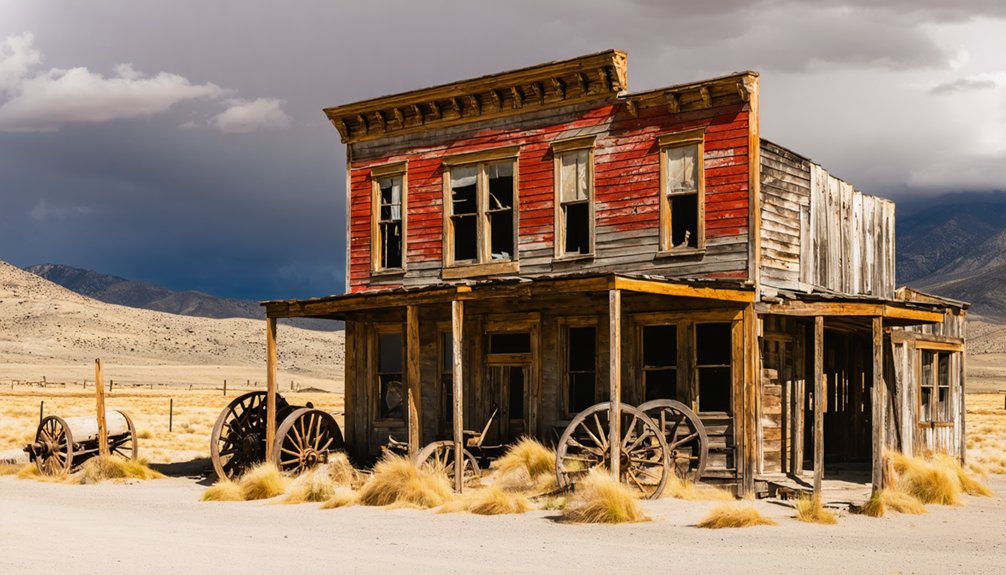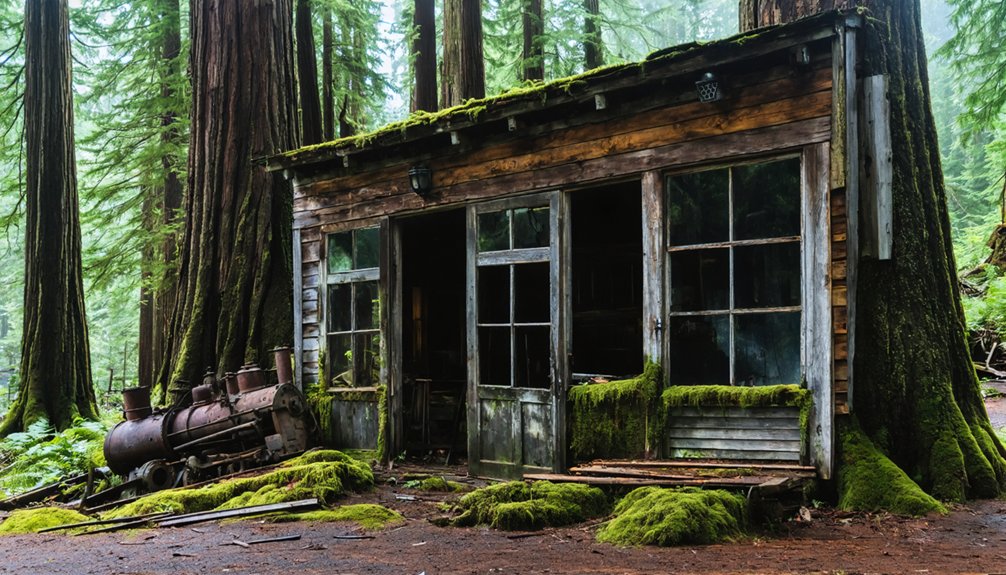
You’ll find four notable ghost towns near Redwood National Park in Humboldt County. Falk, founded in 1884, lies within Headwaters Forest Reserve and is accessible via a two-mile hike through old-growth redwoods. Samoa exists as a “living ghost town” on the peninsula across from Eureka, with condemned buildings alongside the operational Samoa Cookhouse. Rohnerville, established in 1857, was absorbed by Fortuna after an 1895 fire devastated its commercial district. Bridgeville gained fame when it sold on eBay for $700,000 in 2002. These abandoned logging communities offer insights into the region’s timber industry heritage, supernatural folklore, and cryptid legends.
Key Takeaways
- Falk, founded in 1884, is a National Register-listed ghost town accessible via a two-mile hike through Headwaters Forest Reserve.
- Samoa on the peninsula remains a “living ghost town” with condemned buildings and the operational historic Samoa Cookhouse.
- Rohnerville, established in 1857, declined after an 1895 fire and now exists as residential neighborhoods with minimal historical traces.
- Bridgeville gained fame in 2002 when auctioned on eBay for $700,000, now a semi-ghost town with abandoned structures.
- These ghost towns showcase Humboldt County’s logging history and feature supernatural lore including hooded apparitions and Bigfoot sightings.
Falk: The Logging Town Reclaimed by Headwaters Forest
Deep in what’s now the Headwaters Forest Reserve, the ghost town of Falk stands as a tribute to Humboldt County’s logging history. Entrepreneur Noah Falk founded this company town in 1884, and it quickly grew to 400 residents who harvested old-growth redwoods from 9,000 surrounding acres.
You’ll find evidence of a self-sufficient settlement where immigrant workers from Sweden, Norway, and Ireland built their lives around the mill. The community culture centered on a cookhouse, general store, school, and dance hall—all company-owned. Workers operated steam-powered winches, known as steam donkeys, to haul massive logs from the forest.
Falk’s Bucksport and Elk River Railroad transported logs through a narrow canyon until the Great Depression forced closure in 1937. The lumber company demolished most structures in 1979, but the archaeological district earned National Register status in 2023. The preserved structures offer insights into the lives of loggers and their families who once called this remote settlement home.
Samoa: A Living Ghost Town on the Peninsula
While Falk disappeared entirely into the forest, Samoa presents a different kind of abandonment—a partially inhabited settlement frozen between life and death.
Located on the Samoa Peninsula across from Eureka, this company town‘s Samoa history traces back to 1865, when dairy rancher James Henry Brown became the first permanent white settler. The Hammond Lumber Company transformed it into a classic mill complex, controlling housing, stores, and services.
The Hammond Lumber Company controlled every aspect of life in this isolated peninsula settlement, creating a complete company town ecosystem.
After Louisiana-Pacific’s closure ended operations, the town entered ghost town dynamics—condemned houses stand boarded despite being “almost perfect inside,” while the historic Samoa Cookhouse remains operational among decayed industrial remnants. The abandoned Cadman Court area features fallen lampposts and structures scarred by fire, creating an eerie atmosphere for those who pass through. The Eagle House, one of Samoa’s historic buildings, is rumored to be haunted by the spirit of a captain who was mysteriously murdered there.
Purchased for redevelopment around the early 2000s, much of Samoa remains an eerie streetscape where residents inhabit what locals call a “living ghost town.”
Rohnerville: The Settlement Absorbed by Fortuna
Unlike fully abandoned settlements reclaimed by wilderness, Rohnerville vanished through absorption—swallowed by the expanding city limits of neighboring Fortuna in 1979.
Rohnerville history traces back to 1857, when its post office opened as Eel River before being renamed in 1874 for founder Henry Rohner. The Rohnerville economy thrived through the 1880s as a supply hub for loggers, farmers, and travelers. It even hosted the Humboldt County Fair from 1866 to 1895.
Four factors erased this independent town:
- Railroad routing favored Fortuna in the 1880s, diverting commerce away.
- Northwestern Pacific completion (1914) reinforced Fortuna’s dominance.
- Business migration followed the rail-based trade consolidation.
- Formal annexation (1979) ended Rohnerville’s separate identity.
A devastating August 1895 fire destroyed most of the commercial district, marking a critical turning point from which the town never fully recovered. Today, residential neighborhoods occupy the former townsite, leaving minimal trace of its pioneer origins. Henry Rohner’s influence persists through Rohner Park, which includes his grand house built on Fortuna’s Main Street.
Bridgeville: The Remote Town That Was For Sale
A forgotten bridge crossing in California’s backcountry achieved global fame when its entire townsite landed on eBay in 2002.
Bridgeville history begins in the late 1800s as a stopover for miners and loggers traveling the Redwood Coast corridor, positioned along the Van Duzen River roughly 50 miles inland from the Pacific.
Originally called Bridgeport, the settlement took its current name in 1877 when a post office was established.
The remote settlement shed its Bridgeport identity in 1877, adopting the Bridgeville name alongside its newly minted postal service.
The eBay auction generated international media attention, branding it as the first town ever sold on the platform.
Initial reports cited a $1.4 million sale, though local accounts indicate a $700,000 purchase followed by a 2006 resale for $1.25 million—including three cows, eight houses, and a post office.
Today, Bridgeville exists as a semi-ghost town with abandoned structures outnumbering occupied homes.
How to Reach Falk’s Historic Townsite From Eureka
Just six miles outside Eureka, you’ll find the Falk historic townsite nestled within the Headwaters Forest Reserve in Humboldt County. This accessible ghost town offers a straightforward two-mile round trip hike through old-growth redwoods, where transportation routes once connected isolated logging families to civilization.
Your Route to Falk:
- Drive to the parking lot at Elk River Road and Headwaters Forest Trail
- Start at the trailhead near Zanes Ranch Covered Bridge
- Hike one mile on the Elk River Trail through redwood forest
- Arrive at the townsite where the Bucksport and Elk River Railroad once ran
The Bureau of Land Management manages this archaeological district.
Allow one hour for your self-guided tour exploring Falk history, where railroad tracks (removed in the 1950s) transported residents to school and social gatherings. The townsite sits within the 7,500-acre reserve, which was acquired in March 1999 following two decades of forest protection activism. Archaeological findings at the site include medicine bottles, kitchenware, and logging tools that provide glimpses into the daily lives of the logging community.
Exploring What Remains: Structures and Interpretive Signs
You’ll find minimal structural remnants at Falk today, as Sierra Pacific Lumber Company demolished most buildings in 1979 to prevent squatters and antique hunters from occupying the property.
The reconstructed train barn stands as one of few remaining structures, while mill foundations remain visible along the hillside where 400 lumber workers and their families once lived.
Bureau of Land Management rangers provide historical documentation and interpretive context as you observe the cookhouse remnants, abandoned merchandise, and forgotten mail that still mark this temporary resource extraction settlement.
Falk’s Remaining Physical Traces
The restored locomotive barn stands as Falk’s most substantial surviving structure, now serving as the Bureau of Land Management‘s education center. This early 1900s redwood building once sheltered mechanics working on locomotives that hauled logs to the mill.
You’ll discover these physical remnants throughout the site:
- Trestle remnants lean against hillsides where bridges once crossed rivers, maintaining level railroad grades before tracks were removed in the 1950s.
- Foundation ruins mark where 400 residents lived, with domestic plants like ivy and roses still growing along the former townsite.
- English yew trees stand in columns where they decorated residences, with water tank remains visible behind them.
- Falk artifacts uncovered through archaeological excavations include medicine bottles, kitchenware, and logging equipment from the town’s operational years.
Interpretive Materials and Signage
Beyond Falk’s physical foundations and industrial remnants, visitors can deepen their understanding through carefully placed interpretive materials that explain both the logging history and subsequent ecological recovery.
At Redwood Creek Overlook, interpretive signage combines historic logging photographs with text describing early 20th-century clear-cuts, erosion impacts, and restoration efforts since the 1970s. The wayside exhibits contrast dark old-growth redwoods against lighter second-growth forests below, linking visual landscape features directly to educational content.
Visitor engagement extends through Ada Limón’s “You Are Here: Poetry in the Parks” installation, where Francisco X. Alarcón’s poem “Never Alone” appears on a picnic table.
This multimodal approach—merging narrative panels, historic images, and literary art—creates accessible outdoor interpretation that connects you to both Redwood Creek valley’s industrial past and its ongoing ecological transformation.
Haunted Redwoods: Supernatural Lore in the Ancient Forests
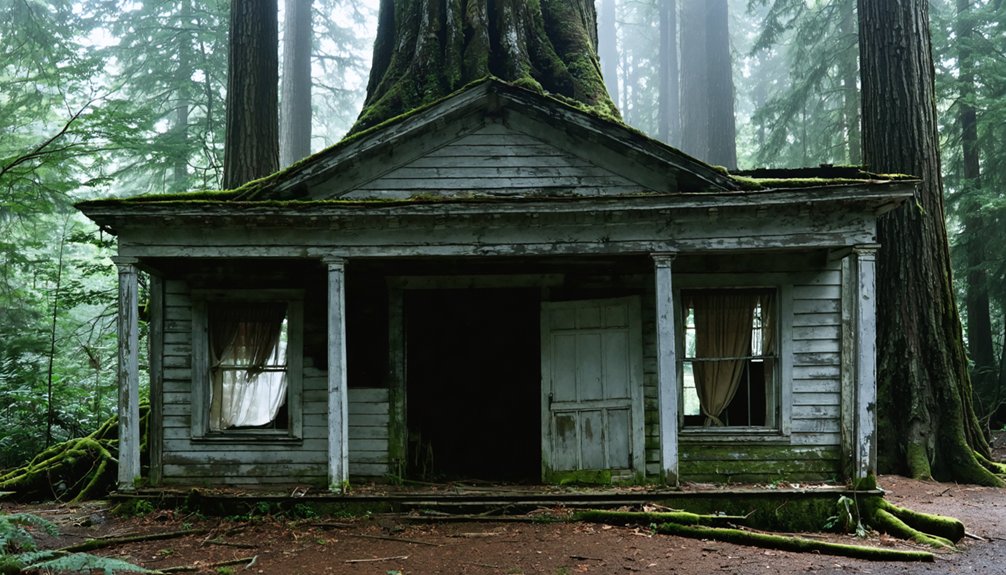
Among the towering groves near Redwood National Park, supernatural lore intertwines with centuries of Indigenous tradition and frontier history. Sinkyone oral traditions speak of spiritual guardians protecting sacred trees, while modern hikers report ethereal apparitions vanishing into mist when approached. These encounters often occur near former village sites and burial grounds.
The forests harbor distinct supernatural phenomena:
- Ghost Trees – Rare albino redwoods lacking chlorophyll survive parasitically, appearing as luminescent white pillars that folklore frames as cursed omens or gateways for wandering souls.
- Falk’s Lingering Presence – This abandoned logging town’s former 400 residents seemingly left spectral traces; rangers report persistent watching sensations and unexplained artifacts.
- Indigenous Protector Spirits – Full-bodied figures stand motionless among trunks, silently observing before disappearing.
- Cryptid Encounters – Redwood shadows reportedly conceal unidentified creatures beyond conventional explanation.
The Hooded Figures and Spirits of Humboldt County
Why do certain stretches of Humboldt County’s fog-shrouded backcountry inspire consistent reports of hooded apparitions where mill towns once thrived?
Witnesses near Falk—founded 1884, abandoned and razed in 1979—describe silent, dark figures lingering along the Elk River Trail. Local folklore ties these spectral sightings to loggers, mill workers, and ship captains who perished in documented accidents.
The semi-ghost towns of Samoa and Bridgeville host similar accounts, often on foggy mornings when coastal conditions distort silhouettes. Eagle House in Samoa features a murdered captain said to roam at 4 a.m.
These narratives anchor hooded apparitions to specific tragedies—burned mills, demolished housing, decaying wharves—embedding them in Humboldt’s frontier-era hardship and economic collapse, where physical structures vanished but stories persisted.
Bigfoot Country: Cryptid Encounters Among the Giants
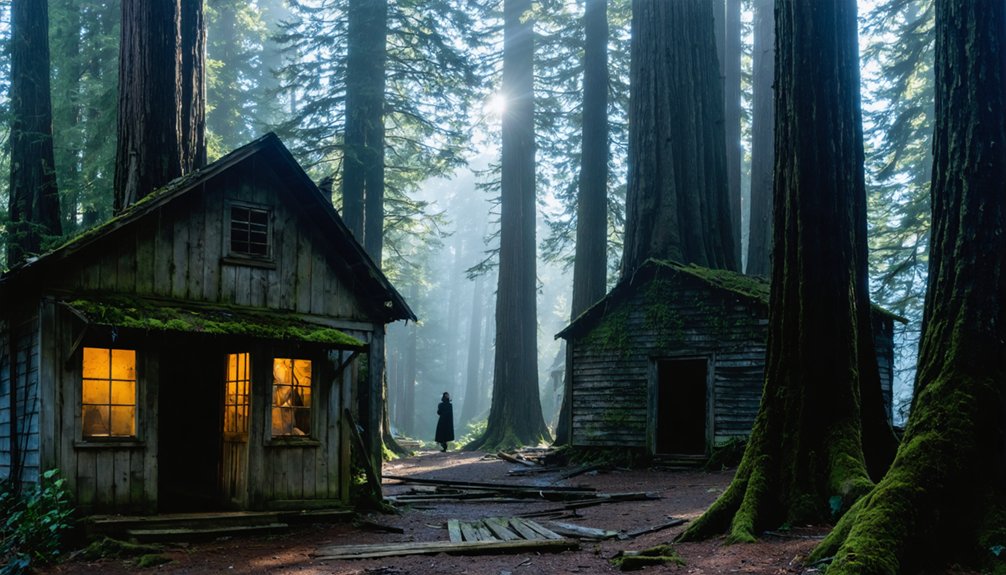
Where coastal fog thins and ancient redwood canopy towers over logging roads, California’s most famous cryptid finds its stronghold.
You’ll find Humboldt County leads California with 47 Bigfoot sightings, many concentrated near Redwood National & State Parks‘ backcountry. The 1967 Patterson–Gimlin film at Bluff Creek cemented this region’s cryptid legacy, while Indigenous traditions long referenced large, hairy forest beings.
Key encounters in Bigfoot Country:
- Willow Creek hub – Museum, annual Bigfoot Days festival, and expedition staging area
- Acoustic anomalies – Unidentified howls and wails recorded throughout redwood parks
- Road crossings – Numerous reports of bipedal figures near Highway 101 corridors
- Cultural symbol – Decades of anecdotal evidence versus scientific skepticism
Despite no verified physical specimens, tens of thousands of rugged acres maintain the mystery that draws researchers and freedom-seeking adventurers alike.
Planning Your Ghost Town and Redwood Adventure
How do you weave together ancient forests and forgotten settlements into a single Northern California expedition?
Base yourself in Crescent City or Klamath, positioning within twenty miles of Jedediah Smith and Del Norte Coast Redwoods. Dedicate mornings to redwood hiking along Prairie Creek or Newton B. Drury Parkway, then drive inland for afternoon ghost town exploration.
This rhythm—dawn among thousand-year-old giants, dusk exploring vanished settlements—creates unexpected narrative symmetry across a single day’s itinerary.
Falk, six miles southeast of Eureka within Headwaters Forest Reserve, offers interpretive trails through a 1884 logging community abandoned in 1937. Bridgeville and Rohnerville add context to the region’s extractive past. Plan two to three hours’ driving for combined trips.
Pack layered clothing—coastal fog meets warmer inland zones—plus sturdy boots for muddy Headwaters trails. Carry backup navigation; cell coverage vanishes quickly. Avoid unstable structures, respect BLM signage, and fuel up before twisting routes like CA-36.
Frequently Asked Questions
Are There Any Ghost Towns Inside Redwood National Park Boundaries?
No ghost towns exist inside Redwood National Park boundaries. The region’s ghost town history and abandoned mining settlements were located outside current park lands, removed before park creation, or reclaimed by forest regrowth over time.
Exploring the abandoned villages in the Smokies reveals a hauntingly beautiful landscape where nature has begun to reclaim structures long forgotten. These remnants of human life serve as a fascinating reminder of the region’s past, drawing in adventurers and historians alike. As the forest envelops these sites, each visit becomes a journey through time, offering glimpses into the lives that once flourished there.
What Safety Precautions Should I Take When Exploring Abandoned Structures?
When exploring abandoned structures, you’ll need proper urban exploration gear: sturdy boots, respirator, flashlight, and first-aid kit. Always assess structural integrity visually, explore with partners, establish exit routes, and verify property ownership beforehand.
Can I Camp Overnight Near the Falk Townsite?
You’ll need to check current camping regulations with Redwood National Park rangers before visiting Falk Townsite. They’ll provide specific guidance on designated camping areas, permits required, and local wildlife considerations for safe, responsible backcountry exploration.
Are Guided Ghost Town Tours Available in Humboldt County?
Don’t judge a book by its cover—guided tours in Humboldt County focus on Eureka’s Old Town paranormal sites, not remote ghost towns. Falk offers occasional guided tours emphasizing historical insights, not regular ghost-themed experiences.
What Is the Best Season to Visit These Ghost Towns?
Late spring through fall offers the best balance: you’ll enjoy spring blooms and navigable roads, fewer crowds in shoulder seasons, or winter solitude with dramatic atmosphere—though muddy trails and closures increase.
References
- https://thelumberjack.org/2019/11/15/humboldt-county-ghost-towns/
- https://www.visitcalifornia.com/road-trips/ghost-towns/
- https://redwoodburl.com/the-haunted-redwoods-of-humboldt-county/
- https://www.savetheredwoods.org/blog/spooky-redwoods-ghost-town-remains-a-presence/
- https://californiahighsierra.com/trips/explore-ghost-towns-of-the-high-sierra/
- https://www.sfgate.com/california-news/article/ghost-town-haunts-California-redwood-forest-16569914.php
- https://www.visitredwoods.com/listing/falk-historic-logging-ghost-town/526/
- https://en.wikipedia.org/wiki/Falk_Archaeological_District
- https://www.nps.gov/redw/learn/historyculture/thenandnow1.htm
- https://now.humboldt.edu/news/local-ghost-town-added-national-register-historic-places-0