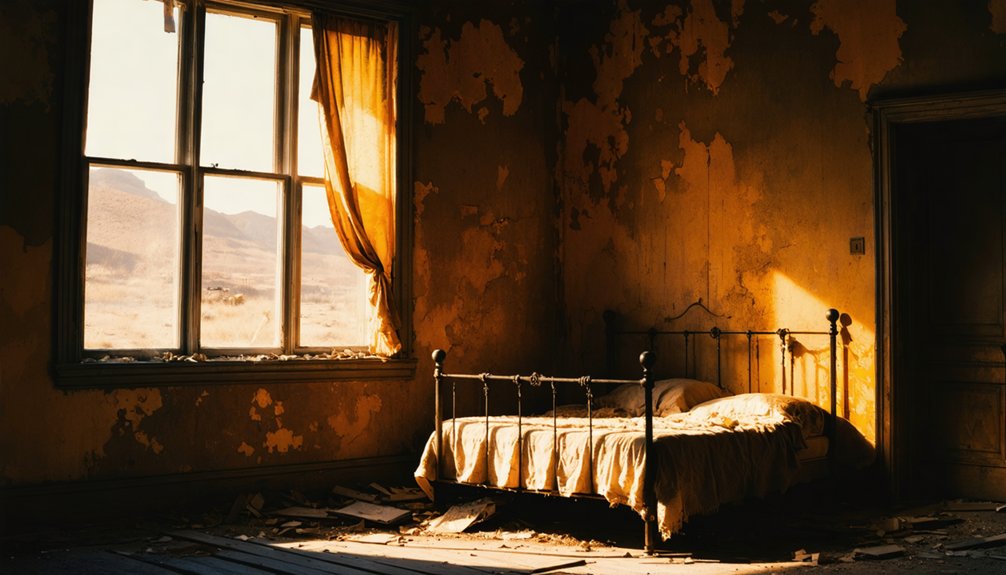
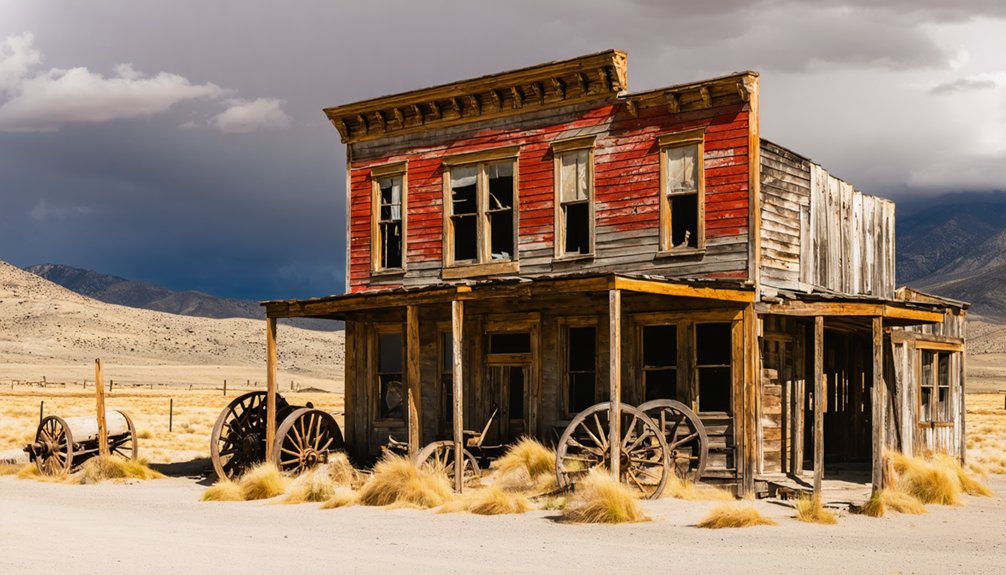
You’ll find Saskatchewan’s best ghost town hunting along Highway 13, just 90 minutes southwest of Regina. This 675-kilometer stretch, known as the Ghost Town Trail, passes through 32 abandoned settlements between Wauchope and Govenlock. You can spot weathered grain elevators, collapsed churches, and overgrown townsites right from your car window. Each town tells a different story of railway expansion and economic decline, from Bromhead’s leaning structures to Maryville’s trio of abandoned churches. The route offers photographers and history buffs an authentic glimpse into prairie settlement patterns that shaped the province.
Key Takeaways
- Highway 13, known as the Ghost Town Trail, features 32 abandoned villages across southern Saskatchewan within driving distance of Regina.
- Notable ghost towns include Kayville, Bromhead, Horizon, and Trossachs, each offering unique stories of prairie settlement history.
- Abandoned structures like grain elevators, churches, and one-room schools are visible directly from Highway 13 without specialized vehicles.
- Ghost towns attract history enthusiasts and photographers, with some offering guided tours and heritage tourism events for visitors.
- Preservation efforts by local organizations maintain historical integrity, though restoration faces challenges including funding and environmental factors.
Highway 13: The Ghost Town Trail Route
Highway 13 cuts across southern Saskatchewan for roughly 675 kilometers, but locals and tourism boards know this stretch by another name: the Ghost Town Trail.
You’ll find 32 abandoned villages dotting this route between Wauchope in the east and Govenlock to the west. It’s one of Canada’s most concentrated ghost towns corridors, layered right on top of the historic Red Coat Trail.
What makes this route compelling is how accessible everything is. You won’t need a 4×4 or GPS coordinates to find crumbling homesteads—they’re visible straight from the highway.
Weathered grain elevators, collapsed farmhouses, and overgrown townsites appear between working farms, creating an eerie contrast. RV travelers and photographers regularly cruise these travel routes, stopping wherever something catches their eye. Each ghost town along the route offers unique stories and experiences that reveal different chapters of prairie settlement history.
The causes behind these abandoned settlements vary—rerouted highways, pulled train tracks, and exhausted resources each played their part in emptying once-thriving communities.
No permits, no restrictions—just open prairie and forgotten history.
Railroad Abandonment and Economic Collapse
When the Canadian Pacific Railway punched through to Pile O’Bones in 1882, it didn’t just create Regina—it wired together an entire economic ecosystem across southern Saskatchewan.
Competing railways—CPR, Grand Trunk Pacific, Canadian Northern—built dense branch-line grids, spacing townsites every six to ten miles so farmers could haul grain by wagon.
Every six to ten miles, a new townsite sprouted—close enough for farmers to wagon their grain to the nearest elevator.
But by the 1940s, trucking and mechanization made these lines “not economically feasible.” Railway decline accelerated through multi-decade abandonment programs, pulling rails and closing stations.
The community impacts hit hard:
- Population collapse tracked branch-line closures, with hundreds of residents dwindling to double digits
- Elevator shutdowns eroded tax bases and forced longer hauling distances
- Retail infrastructure vanished—hotels, garages, community halls stood empty
The consolidation of facilities wasn’t limited to abandoned towns—even Regina saw major railway restructuring as competing lines merged operations. Regina’s Union Station served as the primary transportation hub until passenger service ended after WWII, marking the beginning of the city’s own railway transition.
Today you’ll find ghost-town remnants: lonely churches, foundations, faint rail grades disappearing into prairie grass.
Architectural Remnants and Historical Structures
As you drive the grid roads radiating out from Regina, the skeletal architecture of abandonment rises from the prairie in predictable sequence.
First comes the grain elevator—leaning, stencilled with faded Wheat Pool logos—then the church with its intact pews and peeling Gothic Revival trim.
You’ll spot one-room schools with blackboards still mounted, community halls with hardwood dance floors buckling under collapsed roofs.
The architectural significance lies in these layered ruins: each structure documents a different phase of rural collapse, from railroad withdrawal to school consolidation.
Historical preservation here isn’t institutional—it’s accidental survival and occasional volunteer effort.
Hutterite colonies repurpose some elevators; faithful descendants mow church grounds seasonally.
In some locations, cages around windows were installed to combat vandalism, though these measures came too late to prevent significant damage.
What remains teaches more than any museum could.
At certain intersections, the concentration of religious architecture becomes particularly striking—Maryville notably features three abandoned churches converging at a single crossroads, a testament to the denominational diversity that once characterized these settlements.
Notable Ghost Towns Worth Visiting
If you’re planning a day trip from Regina, Kayville sits about 100 kilometres south and delivers exactly what you expect from a prairie ghost town—the kind of place where you’ll pull over twice just to photograph the abandoned Catholic church from different angles.
The Kayville history centers on farming service, but now only ten residents remain among the grain fields.
Bromhead photography enthusiasts favor the derelict gas station along Highway 18’s Ghost Town Trail, where you’ll find roughly 32 abandoned communities clustered between Wauchope and Govenlock.
In addition to this hidden gem, many visitors also seek out the historic sites in rocky mountain national park, where the breathtaking landscapes weave tales of the past. These sites offer a glimpse into the rich history of the area, attracting both history buffs and nature lovers alike. Exploring the park provides a perfect balance of adventure and education, making it a must-visit destination.
Horizon and Trossachs round out the southeast circuit, each offering scattered structures and unobstructed prairie views.
Essential stops for your ghost town route:
- Kayville’s preserved church bell and intact interior fixtures
- Bromhead’s roadside commercial remnants along the Ghost Town Trail
- Horizon’s mid-route positioning for circular day trips
These settlements were originally established 6 to 10 miles apart to accommodate early horse and wagon travel methods before automobiles reduced the need for such proximity.
For optimal photography conditions, plan your visit during fall or early spring when barren trees expose building details and create stark compositional elements.
Planning Your Ghost Town Exploration
Before you load up the car for your Saskatchewan ghost town circuit, you’ll want to check current road conditions through the provincial Highway Hotline—these gravel township roads turn into impassable mud traps after spring melt or heavy summer rain.
Pack essentials like extra water, a detailed topographic map (cellular coverage disappears quickly), and sturdy boots for traversing collapsed structures.
Essential gear for ghost town exploration: extra water, topographic maps for areas without cell service, and sturdy footwear for unstable terrain.
You’ll find the best exploration tips come from chatting with locals at rural cafés—they know which sites are accessible and often share local folklore about former residents.
Bring a camera with extra batteries since these abandoned homesteads and grain elevators photograph beautifully during golden hour. Consider exploring by bike or on foot to access sites where vehicle passage becomes too challenging.
Most ghost town hikes involve minimal elevation gain, typically under 100 feet, making them accessible for explorers of varying fitness levels.
Most importantly, respect private property boundaries and leave artifacts untouched; Saskatchewan’s heritage belongs to everyone.
Frequently Asked Questions
Are the Ghost Towns Safe to Explore Alone?
Solo exploration isn’t recommended—crumbling floors await your misstep. You’ll face structural hazards, limited cell service, and trespassing risks. Essential safety precautions include daylight visits, communication plans, and respecting posted boundaries to avoid legal trouble.
Can I Enter Abandoned Buildings in These Ghost Towns?
You shouldn’t enter abandoned buildings—most remain privately owned with legal considerations against trespassing. Urban exploration enthusiasts face liability issues and structural dangers. Property owners post warnings, and preservation groups now control access to many historically significant structures.
What Is the Best Season to Visit Ghost Towns?
The best time is late August through September when you’ll enjoy warm, stable seasonal weather, long daylight for exploring multiple sites, and dry roads—plus everything’s open nearby for fuel and lodging.
Are There Any Guided Tours Available for Ghost Towns?
You won’t find organized guided tour options for ghost towns near Regina—they’re best explored independently. Local museums occasionally offer informal walks highlighting historical significance, but the real adventure lies in charting your own path through these abandoned prairie settlements.
Do Any Ghost Towns Have Amenities Like Restrooms?
You won’t find public restrooms at these sites—ghost town amenities are virtually nonexistent. I’ve learned to plan fuel stops in Regina or highway rest areas beforehand, since restroom availability disappeared when services closed decades ago.
References
- https://en.wikipedia.org/wiki/List_of_ghost_towns_in_Saskatchewan
- https://www.youtube.com/watch?v=xg4HzbBFZ6A
- https://www.youtube.com/watch?v=qG7zMIf6c3s
- https://www.readersdigest.ca/travel/canada/saskatchewan-ghost-towns/
- https://www.youtube.com/watch?v=GDyc46RqKpo
- https://www.youtube.com/playlist?list=PLNOd0dfnA4SWDXULhDtmxv5ge4JANXxyv
- https://moose-jaw-348f.squarespace.com/lifestyles/2023/5/26/vy7lhkgxj1a336w6lmvpbdpoxmno9z
- https://www.youtube.com/watch?v=z-xrpAWtriI
- https://www.tourismsaskatchewan.com/blog/haunted-house-on-the-prairie
- https://travelthruhistory.com/ghosts-of-southern-saskatchewan/