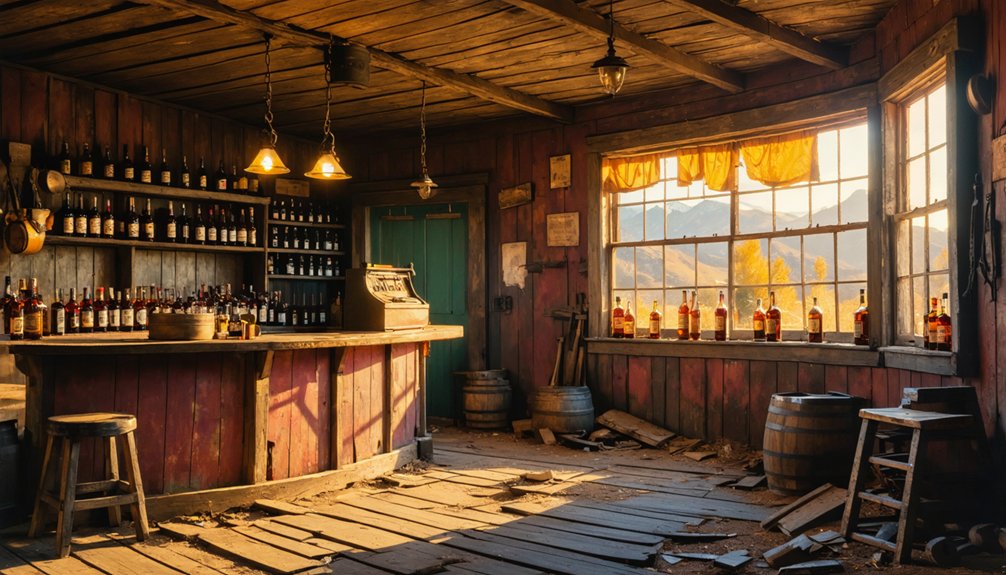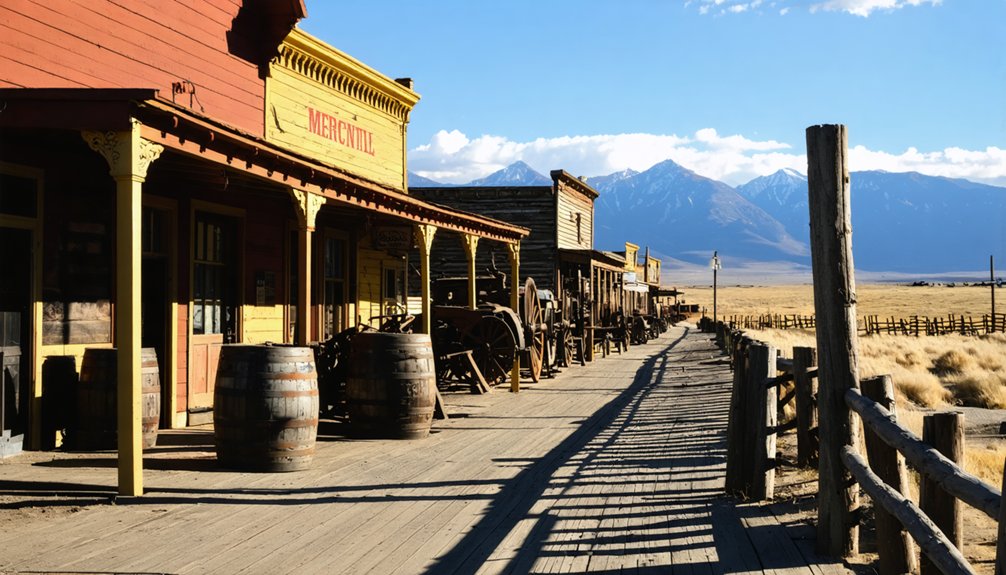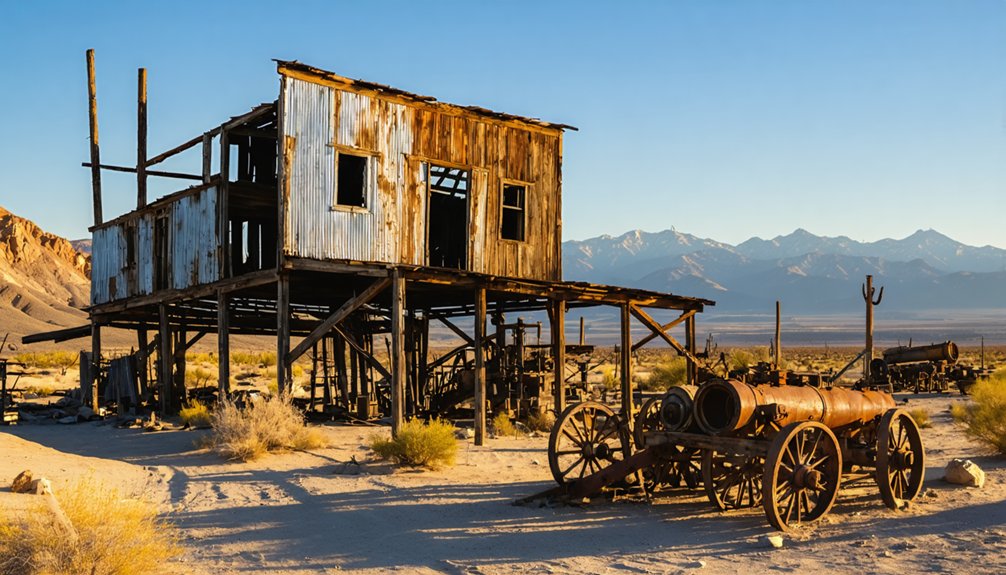
You’ll find exceptional ghost towns within an hour’s drive of Ridgecrest, where California’s mining legacy remains remarkably preserved. Randsburg and Johannesburg stand as “living ghost towns” with original structures from their 1895 gold rush, while Darwin offers 200 deteriorating homes and a haunting commercial district inhabited by just 30 residents. Cerro Gordo, perched in the Inyo Mountains, was California’s largest silver producer, extracting $17 million in ore through 30 miles of tunnels. Saltdale’s four-story mill ruins mark where 700 tons of salt were processed weekly. The surrounding desert conceals dozens more abandoned prospects that reveal mining techniques spanning multiple boom cycles.
Key Takeaways
- Randsburg, five miles from Ridgecrest, produced $60 million in gold and remains a living ghost town with historical landmarks.
- Johannesburg was established in 1896 as a service hub with rail connections, now preserved alongside Randsburg.
- Darwin features abandoned buildings and roughly 200 collapsing homes, with 30 to 50 residents creating art installations today.
- Cerro Gordo produced 4.4 million ounces of silver from 1865 to 1949, financing Los Angeles’s early growth.
- Saltdale operated industrial salt production with a four-story mill processing over 700 tons weekly by 1915.
Understanding Ridgecrest’s Mining Heritage and Geography
Sparse vegetation and exposed bedrock gave you direct access to mineralized zones, while the Sierra Nevada’s rain shadow created the arid conditions that preserved both ore and the ghost towns left behind when veins pinched out. The Rademacher mining district, located approximately five miles south of Ridgecrest in northeastern Kern County, represents one of these historic mining areas where gold-bearing quartz veins attracted prospectors in the 1890s. Mining booms from the 1860s to 1890s brought waves of prospectors and settlers to Indian Wells Valley, leaving behind settlements that would later become ghost towns when the ore deposits were exhausted.
Saltdale: The Rise and Fall of a Salt Empire
While prospectors combed nearby ranges for gold and silver, an equally lucrative resource lay beneath their boots on the alkali flats of Koehn Dry Lake.
Saltdale’s “empire” emerged when Consolidated Salt Company seized control of sixty scattered claims in 1914, transforming indigenous harvesting grounds into industrial-scale salt production.
The operation’s backbone rested on three pillars:
- Moist playa hydrology – groundwater seeping upward deposited renewable salt crusts with each evaporation cycle
- Four-story mill infrastructure – processing 700+ tons weekly by 1915, dominating the desert skyline
- Railroad siding economics – Southern Pacific connection enabled bulk shipping to distant markets
Community dynamics revolved entirely around company control. Your housing, wages, and store prices depended on salt output. The settlement included a school and post office, providing essential services to worker families alongside the mill and factory buildings.
Claim jumping sparked violent disputes, culminating in an 1912 gunfight between rivals—testament to the stakes involved in this crystalline frontier.
At its height, the operation sustained 30 to 65 employees who extracted what seemed an inexhaustible mineral reserve from the lakebed.
Randsburg and Johannesburg: The Living Ghost Towns of the Rand District
The Rand District’s dual heartbeat began pulsing in 1895 when three prospectors—Singleton, Burcham, and Mooers—traced promising float up Rand Mountain’s slopes to what would become the Yellow Aster Mine.
Three desert prospectors followed glittering rock fragments upslope in 1895, unknowingly tracing the path to California’s legendary Yellow Aster Mine.
Randsburg history exploded from that discovery: 2,500 residents by 1899, devastating fires in 1898, and $60 million in gold extracted from desert rock.
Meanwhile, Johannesburg heritage took a different path—planners deliberately laid it out in 1896 as the district’s service hub, naming it after South Africa’s famous goldfields.
When rails reached Johannesburg in December 1897, it became the freight artery supplying Randsburg’s mines.
Today both towns cling to Highway 395 with sixty-nine souls between them, preserving false-front buildings and mine ruins as California Historical Landmark No. 938—living ghost towns refusing to surrender completely. Photographer C. W. Tucker captured this mining era through his lens, documenting the mines and town development in images that remained largely unknown until a collection surfaced at auction in 2011. Visitors seeking authentic Western experiences flock to Randsburg’s annual Western Days Celebration each September, complete with staged gunfights and live bands.
For those interested in exploring more about the region’s rich history, there are numerous historic sites near Chico California that offer insight into the area’s past. From gold rush remnants to ancient Native American artifacts, each location tells a unique story. These sites provide a perfect backdrop for those looking to immerse themselves in the history and culture of Northern California.
Darwin: A Near-Ghost Town Frozen in Time
When you turn off Highway 190 onto the rough dirt spur leading to Darwin, you’ll find yourself tracing the path of miners who arrived in 1874 after silver and lead discoveries transformed this remote slope of the Argus Range into Inyo County’s largest settlement.
By 1876, nearly 3,500 people crowded into a boomtown boasting 200 homes, multiple saloons, a hotel, and a newspaper office—all perched at 4,790 feet above the scorching Death Valley floor.
Today, Darwin shelters only 30 to 50 residents among its weathered structures, making it a semi-ghost town where you can still walk past remnants of that violent, short-lived rush for precious metals. The town’s small population includes artists, writers, and musicians who have chosen this isolated location as their creative refuge, with installations made from animal bones and old appliances scattered throughout the decaying townscape. On the slopes of Mt. Ophir above town, you can still spot remnants of the company camp and mining infrastructure from Darwin’s most productive era.
1874 Mining Camp Origins
Nestled against the rugged slopes of the Coso Range, Darwin’s story begins with silver ore glinting in the sunlight around 1870, drawing prospectors who’d heard whispers of riches hidden southeast of Owens Lake.
Dr. E. Darwin French’s expedition from Visalia pioneered these wild territories in the early 1860s, searching for the legendary Lost Gunsight Mine while discovering something equally valuable.
The initial camp, Coso Junction, exploded into the New Coso Mining District by 1874:
- Rich silver outcrops staked by French’s party attracted hundreds seeking fortune
- Mining techniques evolved rapidly as smelters processed ore using water piped from distant mountains
- Historical artifacts from twenty working mines reveal the camp’s transformation into Darwin’s commercial center
By 1875, the settlement housed 700 residents alongside two smelters that processed the district’s silver and lead deposits.
The Defiance mine emerged as the principal operation, anchoring the district’s economy alongside notable producers like Argus-Sterling and Christmas Gift.
You’ll find remnants of this raw frontier spirit embedded in every abandoned shaft and weathered claim marker.
Abandoned Buildings Stand Today
Ghostly silhouettes of Darwin’s commercial district rise from the desert floor like monuments to ambition abandoned—restaurants with gaping doorways, saloons stripped to their wooden skeletons, a hotel that once welcomed hundreds now sheltering only wind and shadow.
You’ll find roughly 200 homes in various stages of collapse, their historical significance preserved through neglect rather than restoration. The 1875 post office building stands hollow, while smelter barracks cling to surrounding hillsides alongside rusted machinery and mining debris.
What makes these abandoned structures compelling isn’t commercialization—you won’t encounter gift shops or guided tours. Instead, weathered facades and broken windows frame an authentic tableau of desertion.
Around 35 artists and writers now occupy scattered dwellings among the ruins, creating an off-grid enclave where past and present coexist without pretense.
Cerro Gordo: Silver Legends and Hidden Treasures
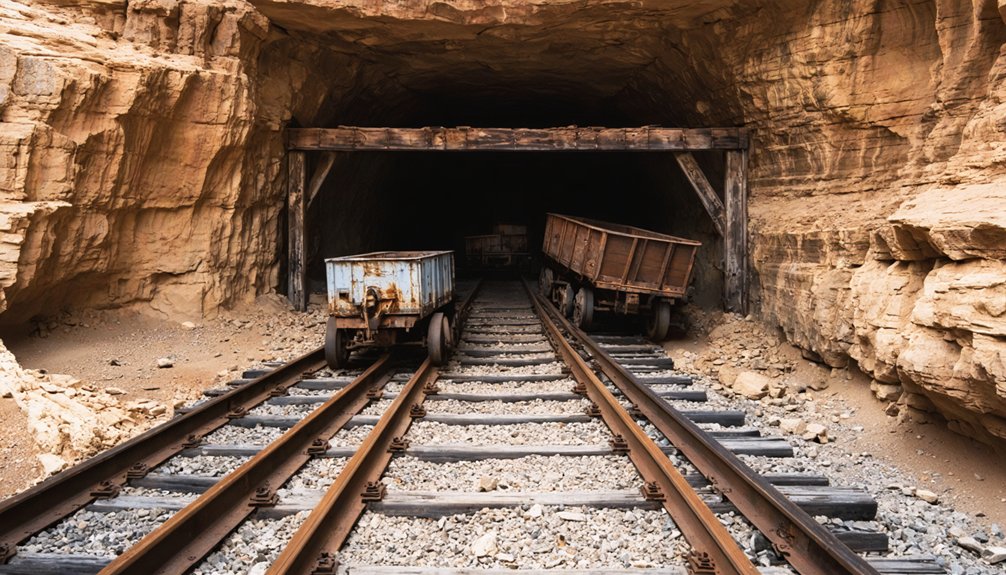
You’ll find Cerro Gordo’s reputation as California’s largest silver producer firmly rooted in documented fact: between 1865 and 1949, miners extracted 4.4 million troy ounces of silver from over 30 miles of underground tunnels honeycombing the Inyo Mountains.
The boom years of the late 1860s through mid-1870s saw bullion wagons hauling hundreds of tons of silver bars down to Los Angeles banks, where merchants displayed the gleaming ingots to prove the mountain’s extraordinary wealth.
Yet beneath the verified production records lies a persistent folklore of lost bonanza stopes and sealed chambers—stories fed by the mine’s labyrinth of unexplored drifts and the tantalizing reality that early miners worked only the richest surface ore before abandoning countless side passages.
Peak Silver Production Era
Between 1868 and 1879, Cerro Gordo emerged as California’s dominant silver producer, outpacing every other district in the state through a combination of rich galena deposits and industrial infrastructure that hadn’t existed just years earlier.
You’ll find that Mortimer Belshaw’s smelters transformed raw ore into steady streams of bullion, operating around the clock.
The economic impact of silver mining reshaped southern California:
- Los Angeles received massive bullion shipments that financed its evolution from dusty pueblo to commercial hub
- The Cerro Gordo Water and Mining Company raised $2,000,000 in capital, deploying 20,000 shares to fund mills and flumes
- Engineers projected employment for 1,000 miners over a decade, drawing skilled labor to this remote high-altitude camp
Contemporary records document roughly $17,000,000 in ore value by 1900—wealth extracted through 30 miles of underground tunnels.
Lost Gold Cache Folklore
Whispers of buried treasure have clung to Cerro Gordo’s slopes since the 1870s, when bullion shipments worth thousands moved down the mountain under constant threat of ambush.
Folklore origins trace back to teamsters and mine foremen who allegedly stashed strongboxes in tunnels during bandit scares, then died before retrieval.
You’ll find tales centered on the Morning Star—the so-called “secret” gold mine—where visible quartz veins hint at overlooked riches beneath silver workings.
The Union Mine’s 200 level, sealed for decades, feeds speculation about entombed pay satchels and unremoved ore.
Modern explorers document unopened side drifts and collapsed stopes, each a potential site for hidden treasures.
Whether panic-stashing, misidentified gold ore, or tax evasion drove concealment, these narratives blur history and legend into irresistible mystery.
Exploring the Coso Range and Lesser-Known Mining Camps
North of Ridgecrest, the Coso Range rises as a volcanic barrier between Indian Wells Valley and the vast stretches of the Owens Valley beyond. Its eroded domes and lava flows bear witness to geothermal forces still simmering beneath the surface.
The Coso geology reveals Mesozoic granite overlain by younger volcanic rocks, hosting scattered adits where prospectors chased quartz veins during the boom-and-bust cycles. These lesser-known workings connected to prominent districts like Randsburg through supply trails, their historic significance overshadowed by China Lake’s restricted access.
What you’ll encounter exploring the Coso fringe:
- Indigenous art exceeding 100,000 petroglyphs in protected canyons
- Abandoned prospects exploiting altered volcanic host rock
- Mining techniques evident in hand-drilled shafts and stone tool-sharpening stations
Access requires traversing military boundaries and respecting cultural sites.
Planning Your Ghost Town Adventure: Access and Preservation Tips
Before you load the truck and strike out across the creosote flats, understand that reaching Ridgecrest’s ghost towns demands equal parts preparation and respect—these aren’t roadside attractions but fragile remnants scattered across unforgiving terrain where poor planning can strand you miles from help.
Your safety precautions should include high-clearance vehicles, extra water (one gallon per person daily), offline maps, and paper topos since cell coverage vanishes beyond pavement.
Navigation tips: scout BLM land-status maps to avoid trespassing on patented claims, never disturb artifacts that serve as in-place exhibits, and watch for unmarked mine shafts in every ruin.
Summer heat exceeds 110°F; rattlesnakes shelter in foundations. Leave structures untouched, stay on established tracks to protect desert crust, and pack out everything you bring.
Frequently Asked Questions
Are Any Ghost Towns Near Ridgecrest Wheelchair Accessible or Family-Friendly?
Randsburg offers the best wheelchair accessibility and family-friendly activities among nearby ghost towns. You’ll find a living community with paved roads, a soda fountain, desert museum, and main-street businesses, though unpaved sections require assistance maneuvering.
Can You Legally Metal Detect or Collect Artifacts at These Sites?
No, you can’t legally metal detect or collect artifacts at most sites. ARPA violations carry fines up to $20,000. Metal detecting regulations and artifact collection laws strictly prohibit removing historical items from BLM and park lands without permits.
What Are the Best Months to Visit Ghost Towns Near Ridgecrest?
You’ll find the best seasons are late October through April, when weather conditions shift from scorching summer extremes to comfortable 70s–80s°F. I’ve explored these sites most successfully during fall and spring’s perfect desert light.
Are Guided Tours Available for Ghost Towns in the Ridgecrest Area?
Formal operators are rare—most tours are self-guided—but you’ll find guided exploration at Maturango Museum’s petroglyph trips and Calico’s narrated walks, both emphasizing historical significance through archival research and firsthand desert stories.
Which Ghost Towns Near Ridgecrest Allow Overnight Camping Nearby?
Randsburg’s your best bet for overnight camping, offering off-roading and hiking opportunities with nearby amenities like the General Store and White House Saloon. You’ll find camping regulations flexible in this living ghost town’s surrounding desert areas.
References
- https://www.legendsofamerica.com/ca-deathvalleyghosttowns/
- https://californiacrossings.com/best-ghost-towns-in-california/
- https://whimsysoul.com/must-see-california-ghost-towns-explore-forgotten-histories/
- https://www.homeswithscottkmiller.com/blog/The-Hidden-Mysteries-of-Ridgecrest–California–Unveiling-the-Unknown
- https://www.california.com/creepy-california-ghost-towns-you-need-experience/
- https://nvtami.com/kern-county-california-ghost-towns/
- https://www.visitcalifornia.com/now/california-ghost-towns-road-trip/
- https://westernmininghistory.com/library/467/page1/
- https://www.ridgecrestguide.com/blogs/history
- https://vredenburgh.org/mining_history/pages/west_mojave_desert.htm