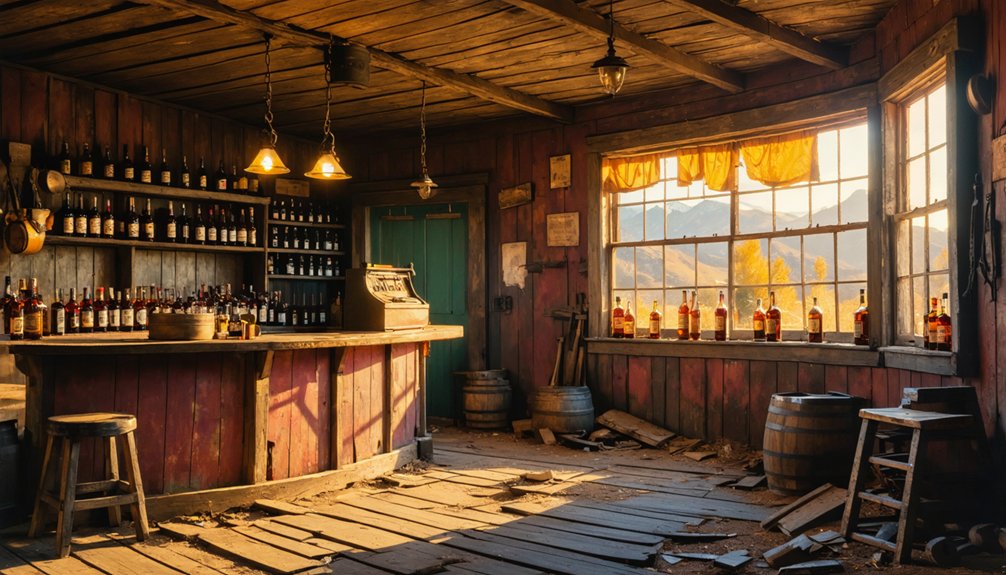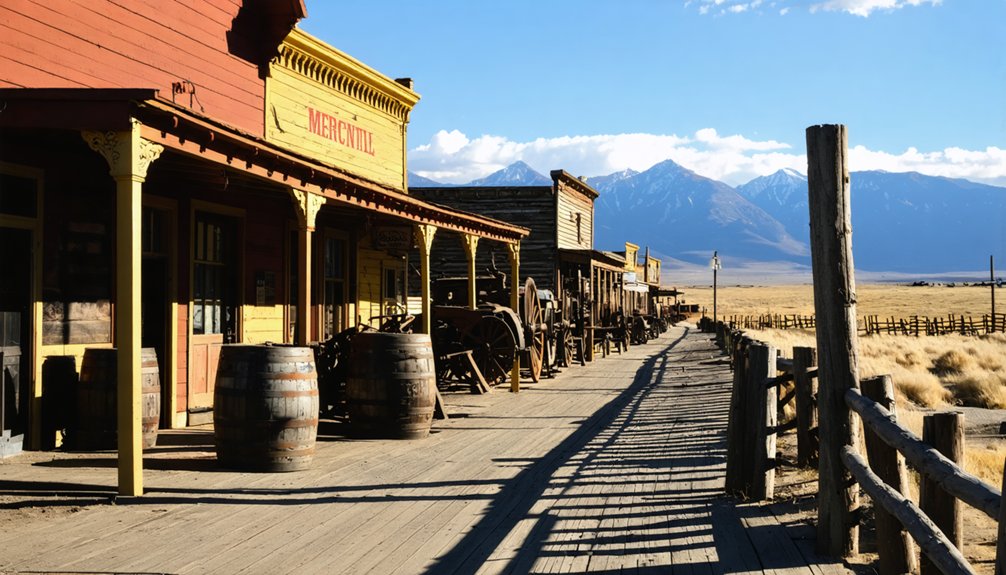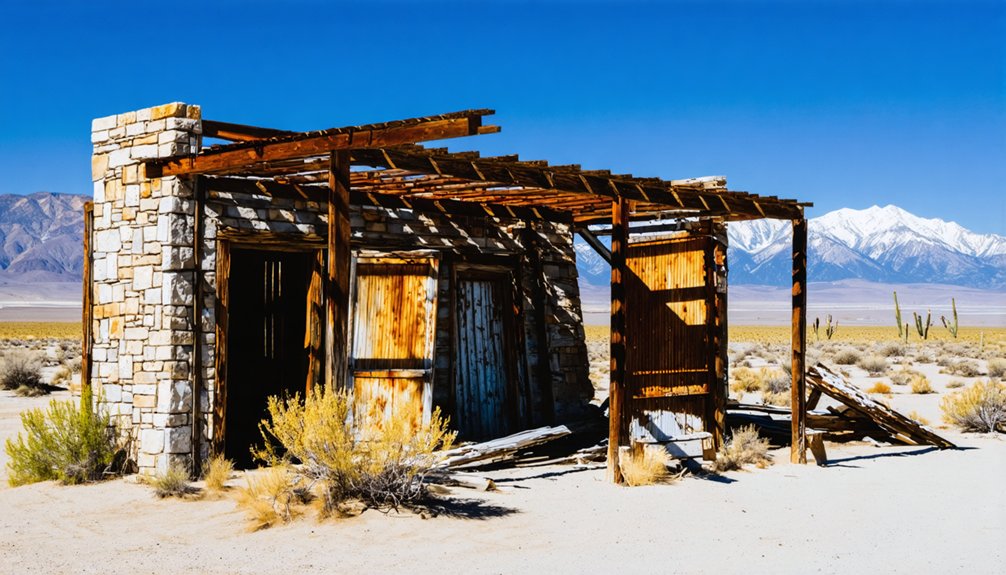
You’ll find several fascinating ghost towns within 90 minutes of Riverside, each preserving different chapters of California’s mining history. Calico Ghost Town, a restored 1880s silver mining settlement, offers the most developed visitor experience with original buildings and tours. Eagle Mountain, a 1948 company town housing 4,000 workers at its peak, stands abandoned after mine closure in 1983. Pioneertown blends Hollywood history with frontier authenticity, while Randsburg maintains active businesses alongside its gold rush heritage. Route 66 relics like Amboy showcase roadside Americana’s decline. The surrounding Mojave Desert conceals numerous lesser-known camps that reveal the region’s extensive mineral extraction past.
Key Takeaways
- Eagle Mountain, founded in 1948 near Riverside, housed 4,000 residents supporting iron mining before closing in 1983.
- Calico Ghost Town, established in 1881, features restored buildings, mine tours, and museums showcasing California’s silver mining era.
- Pioneertown, built in 1946 as a film set, now offers shops, music venues, and weekend gunfight reenactments.
- Randsburg, founded in 1895, remains a living ghost town with preserved buildings from its gold mining peak.
- Route 66 ghost towns Amboy and Ludlow feature abandoned motels and cafés from their mid-century highway heyday.
Eagle Mountain: The Desert Company Town Frozen in Time
Deep in the Colorado Desert of Riverside County, thirteen miles north of Desert Center, the abandoned streets of Eagle Mountain stand as a tribute to mid-century American industrial ambition.
Industrialist Henry J. Kaiser founded this mining community in 1948 to support Southern California’s largest iron mine operation. You’ll find over 400 homes lining landscaped boulevards, remnants of a town that housed 4,000 residents during the 1970s.
Eagle Mountain history includes a 350-seat recreation hall, high school opened in 1962, and post office established in 1953.
Kaiser Steel’s board announced closure in 1981 after consecutive losses, shuttering operations by 1983. The iron ore mined here supported steel production and secured significant contracts, including one with Mitsubishi. The town celebrated shipping its 100 millionth ton of iron ore in 1977, marking a peak achievement before the decline.
The site’s served various purposes since—a correctional facility from 1991-2003, proposed landfill, and most recently purchased by Ecology Mountain Holdings for $22.6 million in 2023.
Calico Ghost Town: California’s Premier Silver Rush Attraction
You’ll find California’s most celebrated silver rush ghost town just 90 miles northeast of Riverside, where Calico’s 1881 founding sparked a boom that yielded over $20 million in silver ore from more than 500 mines.
Walter Knott purchased and restored the abandoned townsite in the 1950s before donating it to San Bernardino County in 1966, preserving five original structures alongside numerous reconstructions that recreate the 1880s streetscape.
Today’s Calico Ghost Town Regional Park offers mine tours, period shops and restaurants, and camping facilities that transform this California Historical Landmark into an accessible heritage destination. Governor Arnold Schwarzenegger proclaimed Calico California’s Silver Rush Ghost Town in 2005. The town welcomes visitors daily from 9 AM to 5 PM, with admission priced at $8 for adults, $5 for youth aged 6-15, and free entry for children under 5.
Silver Mining Boom History
When prospectors staked the Silver King Mine claim on April 6, 1881, they triggered one of California’s most dramatic silver rushes in the rugged Calico Mountains east of Barstow.
The multicolored hills concealed silver-bearing veins that would fuel an extraordinary boom. Within months, Calico’s population surged to 1,200 residents, eventually reaching 3,500 by 1890 as miners from China, Europe, and America flooded the district.
The Calico mines proved spectacularly productive. Over 500 operations, including the Silver King, Oriental, and Bismarck mines, extracted an estimated $86 million in silver over three decades. The Silver King Mine became California’s top silver producer in the mid-1880s, cementing the town’s status as a premier mining destination. However, the town’s fortunes reversed when silver prices plummeted from $1.31 per ounce to just 63 cents in the mid-1890s, making mining operations economically unsustainable.
Restored Buildings and Attractions
Calico’s silver wealth vanished in the 1890s when prices crashed, but the town found new life as California’s most extensively restored ghost town attraction.
Walter Knott reconstructed the majority of structures in the 1950s to match their 1880s appearance, leaving only five original buildings untouched.
You’ll find wooden false-front buildings lining Main Street, housing saloons, a general store, and a schoolhouse—all featuring period antiques that illustrate daily mining camp life.
The Maggie Mine offers self-guided tours through authentic 1880s workings, with interpretive displays explaining extraction methods.
Lucy Lane Museum preserves artifacts documenting women’s roles in frontier development.
The quirky Bottle House, constructed from glass bottles set in mortar, exemplifies historic architecture born from frontier resourcefulness.
The Calico Odessa Railroad provides scenic train rides through the historic mining area, offering visitors perspectives of the surrounding desert landscape.
Visitors can also try their hand at gold panning experiences, recreating the prospecting activities that once defined the region’s economy.
Visiting Calico Today
The San Bernardino County Regional Park encompasses 480 acres of California’s most accessible silver-rush landscape, positioned 3 miles north of Interstate 15 between Barstow and Yermo—approximately 90 minutes from Riverside and two hours from Los Angeles.
Your visitor experience extends beyond restored storefronts: you’ll access the Maggie Mine’s underground passages, board narrow-gauge trains circling historic shafts, and follow self-guided routes through hillside mining districts.
Calico history comes alive during recurring festivals—Calico Days features costume parades and living demonstrations, while Civil War reenactments and seasonal ghost tours add interpretive depth. Walter Knott, founder of Knott’s Berry Farm, acquired the abandoned town in the 1950s and transformed it into a tourist attraction before donating it to San Bernardino County in 1966.
Paid admission grants entry to the California Historical Landmark No. 782 site, where saloon-style restaurants, mineral shops, and picnic areas support day-use exploration of over 500 mine locations that yielded $20 million in silver ore between 1881 and the early 1890s. The park offers camping and outdoor recreation opportunities that complement the historical attractions and provide visitors with extended stays in the desert environment.
Pioneertown: Where Hollywood Meets the High Desert
Unlike traditional ghost towns abandoned by fleeing miners, Pioneertown was born in 1946 as a deliberate Hollywood creation**—a fully functional 1880s frontier town** designed by actor Dick Curtis and 17 investors including Roy Rogers and Dale Evans to serve as a permanent Western backlot.
The town’s false-front buildings concealed working businesses like bowling alleys and ice cream parlors, allowing it to operate simultaneously as a filming location for over 200 productions and a tourist attraction where visitors could watch Gene Autry shoot episodes on “Mane Street.”
Today you’ll find Pioneertown transformed into a living hybrid: a preserved movie set with historic facades housing modern shops and restaurants, where weekend gunfight reenactments remind visitors of its fabricated—yet wholly authentic—Hollywood heritage.
Film Set Origins
In 1946, actor Dick Curtis spearheaded an ambitious venture in the Morongo Basin that blurred the line between authentic Western town and Hollywood backlot.
Curtis and seventeen investors—including Roy Rogers, Dale Evans, and Russell Hayden—purchased 32,000 acres to create what they envisioned as a “living, breathing movie set.”
Unlike typical hollow studio facades, Pioneertown‘s 1880s-style buildings featured fully functional interiors housing ice cream parlors, motels, and shops beneath their false fronts.
This unique Pioneertown history allowed production crews to film by day and socialize on-site by night, eliminating costly Los Angeles commutes.
The town’s rocky desert landscape and Joshua tree backdrop became essential to Hollywood’s Western legacy, serving triple duty as film hub, vacation destination, and permanent residence for entertainment professionals seeking creative freedom.
Living Ghost Town Today
Today’s Pioneertown defies the traditional ghost town label, sustaining a permanent residential community at 4,400 feet elevation where artists, entrepreneurs, and remote workers have claimed the high desert as an alternative to urban Southern California.
The surrounding areas, rich in history and natural beauty, invite exploration beyond the town itself. Adventurers often seek out abandoned gold mines near Susanville, intrigued by the stories and treasures that lie within. These places offer a glimpse into the past, capturing the spirit of those who once sought fortune in the rugged terrain.
The town’s living history character emerges from 1880s-style facades on Mane Street that house functioning shops and galleries rather than empty sets.
Cultural significance centers on Pappy & Harriet’s, which anchors the community as a destination music venue hosting national acts while serving Texas-style barbecue.
You’ll find mock gunfights staged for visitors, but residents prioritize preserving their quiet, small-town identity.
The surrounding Pioneertown Mountains Preserve offers hiking and trail running, while events like the John Wayne Grit Series races draw participants to this evolving high-desert outpost just off Highway 62.
Randsburg: A Living Remnant of the Gold Rush Era
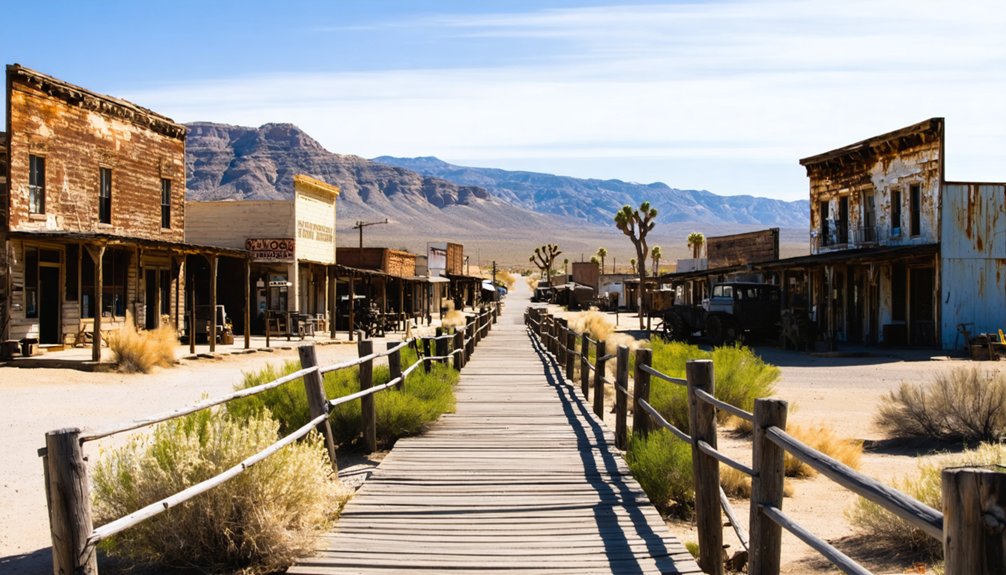
Randsburg emerged from the Mojave Desert on April 25, 1895, when prospectors John Singleton, Frederic M. Mooers, and Charles Burcham discovered gold at the Yellow Aster Mine. This strike launched the Rand Mining District and transformed a remote camp into a thriving town of 2,500–3,500 residents by 1899.
Randsburg history centers on extraordinary mineral wealth—the Yellow Aster alone produced nearly $25,000,000 in gold through 1933, while district-wide yields reached $60,000,000.
The Yellow Aster Mine’s $25 million fortune anchored a district that extracted $60 million in gold from the Mojave Desert.
Randsburg mining operations supported infrastructure including a 100-stamp mill processing ore worth $100,000 monthly by 1902.
Despite devastating fires and population decline to just 69 residents by 2010, preserved buildings and operating businesses maintain Randsburg’s status as a “living ghost town” you can still explore today.
Lesser-Known Mining Camps Throughout Riverside County
Beyond the well-documented camps of the Mojave Desert, Riverside County conceals dozens of smaller mining settlements that rarely appear in regional histories yet reveal the county’s remarkable mineral diversity.
You’ll find Hodge Mining District’s interconnected workings in the Mule Mountains, where Spanish-era tunnels penetrated gold-bearing quartz veins centuries before American prospectors arrived. Evidence of an ancient wooden mill—built without metal fastenings—testifies to sophisticated pre-Anglo operations dating to the 1500s.
Further west, Cajalco Mine stands as Riverside County’s only tin producer, its 10-acre camp marked by palm plantings and concrete foundations. The site yielded 113 long tons before a 1953 federal report extinguished revival hopes.
These forgotten camps demonstrate how thoroughly miners scoured every promising outcrop across Riverside’s varied terrain.
Route 66 Relics: Amboy, Ludlow, and Highway Ghost Towns
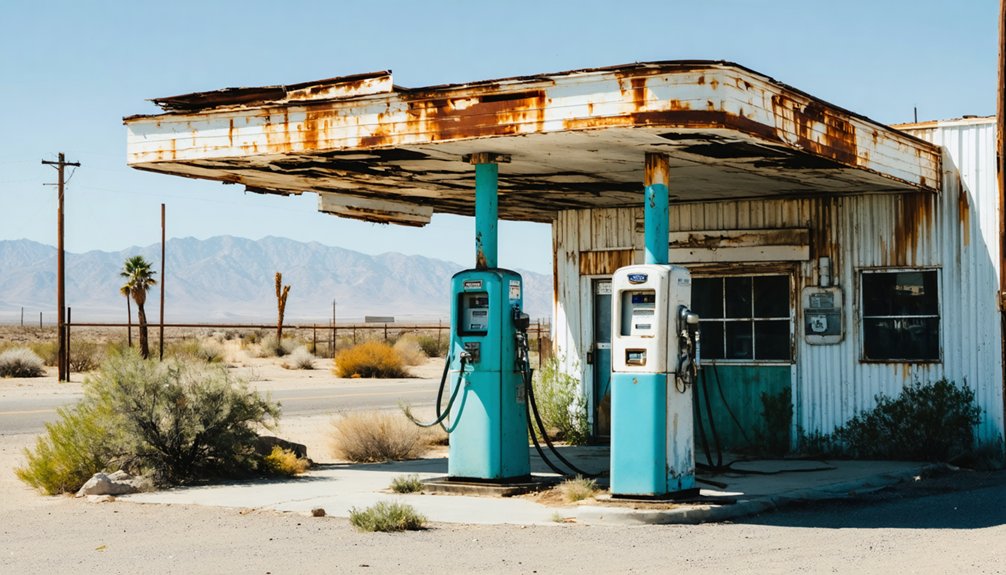
While mining camps dotted Riverside County’s mountains and valleys, another category of ghost town emerged along the desert’s transportation corridors, where roadside economies rose and collapsed with shifting traffic patterns.
Amboy exemplifies this phenomenon—established in 1858, it transformed into a Route 66 boomtown after 1926, serving cross-country motorists. Roy’s Motel & Café, with its iconic 50-foot Googie sign, anchored the settlement through its mid-century peak of 65 residents.
Interstate 40’s completion in 1972–1973 bypassed Route 66, triggering near-abandonment. Nearby Ludlow followed identical decline, leaving derelict motels and cafés along the historic alignment.
These highway ghost towns document America’s automotive era, now attracting photographers and Route 66 enthusiasts exploring preserved fragments of roadside Americana before anticipated centennial tourism in 2026.
Boom and Bust: Understanding the Mining Economy That Built These Towns
Mineral wealth transformed Riverside County into a proving ground for America’s speculative mining frontier, where discovery, investment, and collapse followed rhythms set far beyond the desert itself.
You’ll find that the General Mining Act of 1872 fueled claim-staking rushes, while national monetary shocks—the 1873 Coinage Act, the Panic of 1893—dictated which camps survived.
Riverside’s nineteen commercial minerals in 1919, valued at $2.58 million, reflected wartime demand, yet economic cycles always reasserted control.
Mining regulations encouraged speculation but offered no protection against commodity-price swings or capital flight.
Stamp mills and cyanide processing extended marginal operations temporarily, but high fixed costs for hoists, water, and freight meant any grade drop or railroad delay triggered shutdowns.
Repeated boom-bust patterns left only well-capitalized properties standing, scattering ghost towns across the Colorado Desert’s pre-Cambrian outcrops.
Planning Your Ghost Town Road Trip From Riverside
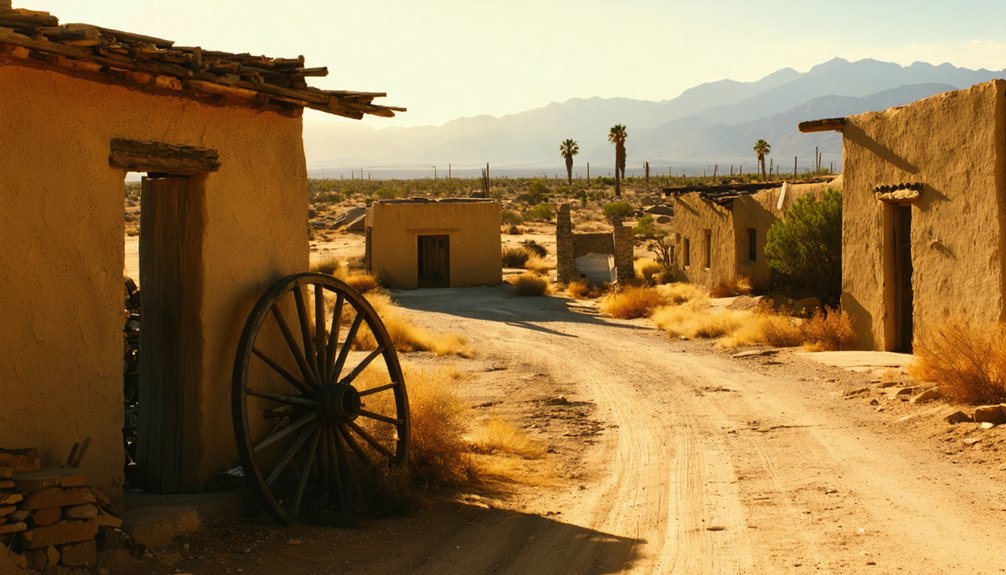
Planning a ghost-town circuit from Riverside demands attention to desert distances, road conditions, and seasonal extremes that transformed these same routes into barriers for nineteenth-century prospectors.
You’ll find Pioneertown just outside Yucca Valley, while Calico requires a two-hour northeast drive from Homeland. Eagle Mountain sits on Joshua Tree’s southeastern corner, accessible via desert roads that reveal street layouts through mapping applications.
Consider ghost town preservation efforts when visiting—Calico operates daily 9 AM to 5 PM as a regional park, while Bodie maintains arrested decay without restoration.
Each site’s historical significance varies: Calico earned State Historical Landmark designation in 2005, Eagle Mountain dates to Kaiser’s 1948 industrial venture, and Ballarat served mines from the 1890s until 1917’s abandonment.
Preservation Efforts and the Future of Southern California’s Ghost Towns
Visiting these remote sites brings you face-to-face with the physical vulnerability of abandoned structures—weathered wood, crumbling foundations, and artifact-strewn interiors that won’t survive another century without intervention.
Preservation challenges across Southern California ghost towns stem from piecemeal ownership and regulatory gaps. Calico’s county-park model and state landmark designation demonstrate how public stewardship secures long-term protection, while Bodie’s “arrested decay” approach stabilizes buildings without reconstruction, maintaining authentic atmosphere.
Yet many Mojave sites suffer theft, vandalism, and erosion without caretakers.
Tourism impacts cut both ways: Calico’s commercial attractions fund maintenance but risk over-commercialization, whereas under-visited camps decay faster. Heritage-based visitation—mine tours, interpretive museums—offers economic justification for conservation while keeping these historical records accessible to those who value self-directed exploration.
Frequently Asked Questions
Are Ghost Towns Near Riverside Safe to Explore Alone?
No, solo exploration isn’t safe—because nothing says “freedom” like plunging down an unmarked mine shaft. You’ll face trespassing laws, extreme desert heat, unstable structures, and zero emergency services. Always take safety precautions and companions.
Do I Need Permits to Visit Abandoned Mining Sites?
You’ll typically need permits for any digging or collecting under mining regulations, though casual hiking may not require permission on federal lands. Always verify permit requirements and access restrictions, as abandoned sites often have safety closures.
What Should I Bring When Exploring Desert Ghost Towns?
You’ll need safety gear including sturdy boots, sun protection, and emergency supplies, plus photography equipment to document structures. Pack ample water, navigation tools, and vehicle recovery equipment for remote desert conditions requiring self-reliance.
Are There Guided Tours Available for Riverside County Ghost Towns?
Yes, you’ll find guided tours available, though most focus on Riverside’s downtown haunted sites rather than abandoned ghost towns. For authentic desert ghost towns like Calico, you can explore self-guided paths with historical significance markers instead.
Can You Camp Overnight at Ghost Town Locations?
Overnight camping depends on camping regulations set by each site’s land manager. Calico offers developed ghost town amenities with reservations, while Pioneertown and Eagle Mountain restrict access. Always verify ownership and dispersed-camping rules beforehand.
References
- https://en.wikipedia.org/wiki/List_of_ghost_towns_in_California
- https://www.staxupstorage.com/blogs/exploring-ghost-towns-near-homeland-california/
- https://www.camp-california.com/california-ghost-towns/
- https://patch.com/california/banning-beaumont/13-ghost-towns-explore-california
- https://parks.sbcounty.gov/park/calico-ghost-town-regional-park/
- https://en.wikipedia.org/wiki/Eagle_Mountain
- https://www.ghosttowns.com/states/ca/cariverside.html
- https://iefilmpermits.com/library/ghost-towns/
- https://www.sfgate.com/travel/article/eagle-mountain-california-ghost-town-18096768.php
- https://www.photopilot.com/blog/eagle-mountain-california/