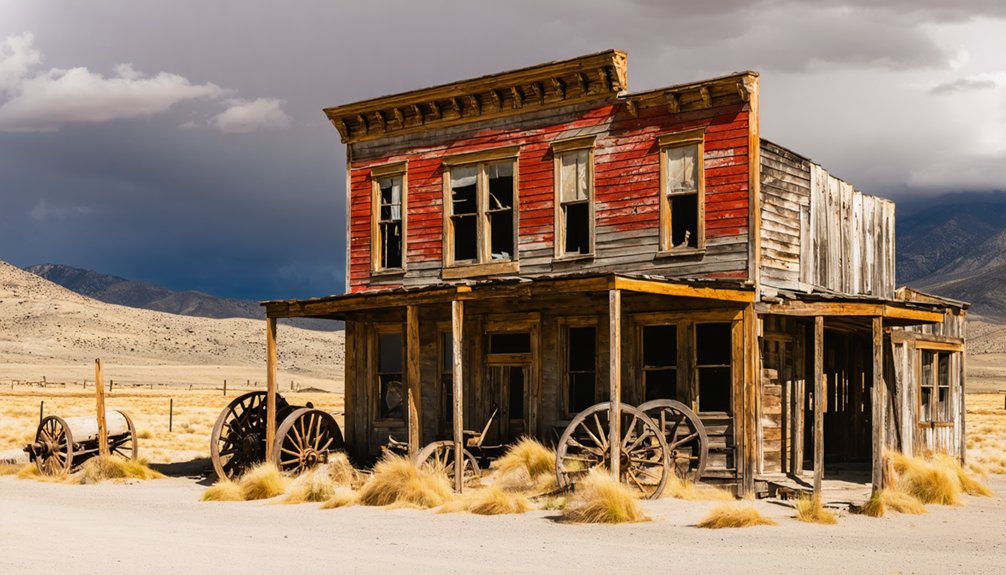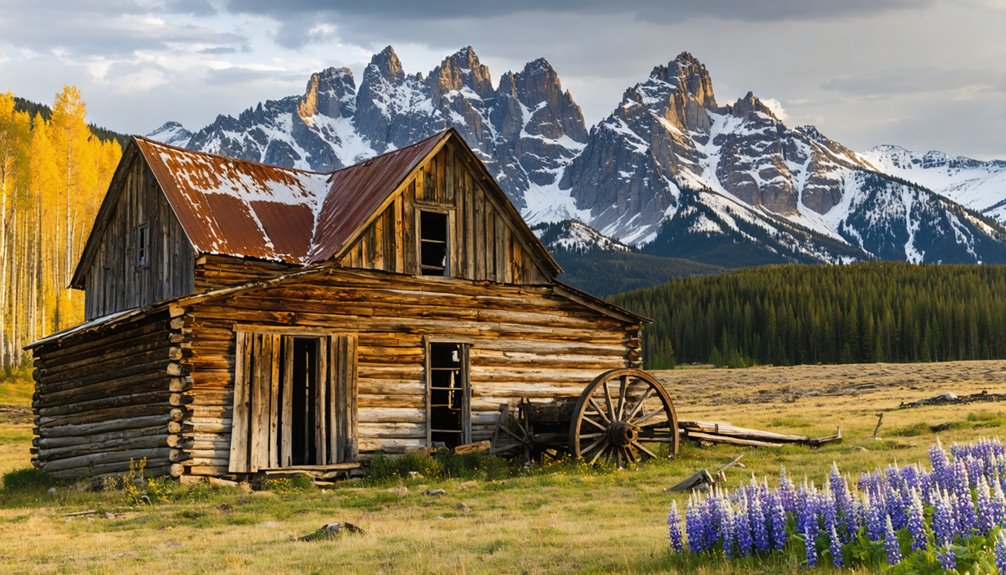
You’ll find several ghost towns within easy reach of Rocky Mountain National Park, with Lulu City being the most accessible—a 3.7-mile hike from the Colorado River Trailhead reveals the remnants of an 1879 silver boom settlement that once housed 1,500 residents. Nearby Gaskill and Dutchtown also mark the Kawuneeche Valley‘s brief mining era, while Mount Vernon’s cemetery and stone ruins lie near Golden, preserving Colorado’s territorial history. Each site offers distinct stories of frontier ambition, from silver prospectors to homesteaders, with trails ranging from moderate walks to backcountry expeditions that reveal the region’s layered past.
Key Takeaways
- Lulu City, founded in 1879 in Kawuneeche Valley, peaked at 1,500 residents before abandoning completely by 1885 due to low-yielding silver.
- Gaskill, established in 1880 two miles north of Lulu City, served as a way-station with fewer than 50 residents until 1886.
- Dutchtown housed Dutch miners expelled from Lulu City during 1879-1880, lasting barely five years before disappearing at timberline.
- Mount Vernon served as Jefferson Territory’s de facto capital from 1859-1861 before economic decline left only one family by the 1870s.
- Visit ghost towns in summer or early fall, follow NPS preservation rules, and carry navigation tools due to unreliable cellular reception.
Lulu City: Silver Dreams in the Kawuneeche Valley
In the summer of 1879, Fort Collins merchant Benjamin Burnett and prospector William B. Baker founded Lulu City after discovering silver on Mount Shipler along Lost Creek.
Named for Burnett’s daughter, this ambitious settlement sprawled across 100 blocks in the Kawuneeche Valley.
You’ll find it hard to imagine today, but 1,500 hopeful souls once crowded this remote location, building sawmills, hotels, saloons, and filing over 20 lode claims by August 1880.
Silver mining proved the town’s undoing—low-yielding ore couldn’t justify hauling it 100 miles to distant mills.
By winter 1881-1882, only 10 mines remained active. The post office closed in 1884, and complete abandonment followed by 1885.
The community’s brief existence was marked by internal strife, with reports of violence and prejudice among residents despite its frontier amenities like barber shops and general stores.
Today, within Rocky Mountain National Park‘s boundaries, you’ll discover merely scattered logs where fortune-seekers once chased their silver dreams. A 7.8-mile round trip hike along the Colorado River Trail leads modern visitors to these haunting remnants of Lulu City’s past.
Gaskill: A Forgotten Mining Settlement Along the Colorado River
Just two miles north of Lulu City’s failed silver dreams, another settlement emerged in August 1880 when Fort Collins merchant Al J. Warner built a log cabin store below Bowen Gulch.
While Lulu City’s silver rush faded into memory, merchant Al J. Warner saw opportunity two miles north in Bowen Gulch.
Named for L.D.C. Gaskill—Civil War veteran and respected Wolverine Mine foreman—this way-station served travelers and miners along the toll road connecting Grand Lake to northern camps.
Gaskill’s Economy and infrastructure:
- Strategic location on 60 platted acres positioned the town midway between Grand Lake and Lead Mountain Mining District
- Mining Infrastructure supported nearby Wolverine and Ruby Mines through supply services and ore transport
- Toll road system enabled wagon traffic from Georgetown through Middle Park to Wyoming
- Peak population reached fewer than 50 residents before speculation collapsed in 1886
The settlement received its first postmaster, John K. Mowery, in October 1880. The post office operated until 1886, when declining mining activity forced its closure.
Today only scattered foundations remain in meadow and forest.
Dutchtown: High Country Outpost of the Lulu Mining District
When ethnic tensions boiled over in Lulu City during the winter of 1879–1880, a group of Dutch miners found themselves forcibly expelled following a violent, alcohol-fueled brawl that laid bare the camp’s underlying prejudices.
Rather than abandon the district entirely, these Netherland-born prospectors established their own settlement a few miles west at timberline—a hardscrabble outpost they’d occupy while working the same silver veins that drew them to Colorado’s Never Summer Range.
You’ll find Dutchtown’s four collapsed cabin ruins today within Rocky Mountain National Park, markers of silver speculation that lasted barely five years.
The Dutch squatters endured brutal winters and isolation while pursuing low-grade ore that never justified transport costs.
When commercial viability evaporated by mid-decade, they vanished—leaving only logs and foundations to document their defiant, short-lived community.
Homestead Meadows: Frontier Ranch Life in the Front Range
Unlike the silver-chasing prospectors who flocked to Lulu City and Dutchtown, the families who filed claims in Homestead Meadows between 1889 and 1923 came to stay—building cattle operations, cutting timber, and proving up 160-acre parcels under the Homestead Act’s five-year residency requirement.
You’ll find evidence of Homestead Life scattered across Lion Gulch’s upper meadows:
- Hewn-log cabins where families like the Engerts and Griffiths wintered livestock and stored hay
- Collapsing sawmill foundations from William Turner House’s 1933–1950s lumber operation
- Stone-lined cisterns that captured snowmelt for drinking water and cattle
- Rusted hand tools revealing Ranching Techniques—scythes for meadow hay, axes for fence posts
Most homesteaders combined subsistence farming with wage work in Lyons, diversifying income streams when cattle prices dropped during the Depression. Sarah Walker stood out among the pioneer women, earning the distinction as the only woman to receive a Certificate of Patent in her own name before converting her cabin into a schoolhouse for local children. The trail climbs through a three-mile ascent along a stream in Lion Gulch before reaching the historic homestead sites.
Dearfield: Colorado’s Historic Black Agricultural Colony
While homesteaders carved out ranches in the mountain valleys west of Rocky Mountain National Park, another group of pioneers pursued a different vision on the eastern plains. In 1910, O.T. Jackson established Dearfield—an all-Black agricultural colony twenty-five miles east of Greeley—after white landowners repeatedly refused him land sales. Inspired by Booker T. Washington’s self-sufficiency philosophy, Jackson secured 320 acres through a desert land claim.
You’ll find the Dearfield legacy reflects both remarkable achievement and harsh realities. By 1920, nearly 700 residents raised cattle, grew sugar beets, and built forty-four cabins. Weekend dances attracted visitors from Denver, providing crucial entertainment revenue for the farming community. The community sustained itself for over a decade through residents’ determination to create a self-sufficient farming settlement.
Yet agricultural challenges proved insurmountable: settlers couldn’t afford South Platte water rights, forcing dry-land farming on unsuitable soil. The 1930s Dust Bowl devastated the community.
Mount Vernon Town Site & Cemetery: Gateway to the Gold Rush
You’ll find Mount Vernon’s ruins tucked into the foothills west of Denver, where it briefly served as Jefferson Territory’s de facto capital from 1859 to 1861 under Governor Robert W. Steele.
This stage stop once funneled up to fifty wagons daily toward the Gregory Gulch gold fields, but its prominence collapsed within two years when Colorado Territory shifted power to Denver and competing toll roads diverted traffic elsewhere.
Dr. Joseph Castro founded the settlement in fall 1859, establishing a toll road connection to mining camps in Black Hawk and Central City while offering free land plots to encourage construction.
The settlement’s name honored George Washington’s Virginia estate, reflecting the mid-19th century fascination with the first president’s legacy that swept across the expanding nation.
Today, you can explore the historic cemetery and trace remnants of the old wagon road that once made this site the primary gateway to Colorado’s mountain mining districts.
Historic Territorial Capitol Role
Mount Vernon’s political significance extended far beyond its modest size when it became a de facto capital of the unofficial Jefferson Territory in 1859-1861. Governor Robert W. Steele conducted territorial governance from this settlement, famously carrying legal documents in his silk hat.
The town’s strategic location attracted officials and miners alike, creating an impromptu center of frontier democracy.
Key moments in Mount Vernon’s political history:
- Legislature voted Golden City as official capital on November 22, 1860
- First legislative session afterward met in Mt. Vernon House’s front room
- Town helped form breakaway Ni Wot County in 1861, challenging federal authority
- Congress ended extra-legal experiments by creating Colorado Territory on February 28, 1861
This scrappy settlement embodied pioneer self-governance before federal recognition arrived.
Stage Stop Decline
The same competitive forces that made Mount Vernon politically relevant in 1860 destroyed its economic foundation within a decade.
You’ll find that transportation decline hit hard when Governor Steele departed north to establish competing toll roads through Apex, fracturing Mount Vernon’s monopoly on mountain passage.
Denver’s emergence as the territorial hub accelerated economic shifts that left Dr. Castro’s settlement stranded.
Multiple routes now bypassed the canyon entirely, rendering the town’s single toll road obsolete.
By the 1870s, the transportation decline was complete—miners who’d once stopped at Mount Vernon’s two hotels now traveled alternative pathways westward.
Within decades, only one family remained among abandoned stone buildings, marking the settlement’s transformation from vital stage stop to forgotten canyon outpost.
Cemetery and Trail Access
Just 0.3 miles from the Matthews/Winters Park trailhead, two weathered gravestones mark what remains of Jefferson Territory’s earliest documented burial grounds.
You’ll find Reverend Isaiah Rogers Dean (1860) and James H. Judy (1867) resting on a hillside west of Village Walk Trail, though burial mounds and historical accounts reveal more pioneers lie beneath unmarked ground.
Cemetery Features and Trail Details:
- Access Route: Moderate dirt path climbs from Morrison I-70 exit through red rock meadows on a 2.3-mile loop
- Burial Practices: Four wooden crosses once marked additional graves, now vanished, leaving only earthen mounds
- Historic Context: Stone building ruins and Governor Steele’s house footprint dot the 1859 town site
- Regional Network: Nearby Rockland Cemetery holds 120+ interments from toll road communities
You’re walking frontier burial grounds shaped by westward movement.
Planning Your Ghost Town Exploration
How do you transform a casual interest in abandoned settlements into a rewarding exploration of the mining camps, homesteads, and railroad towns scattered around Rocky Mountain National Park?
Start by selecting sites that match your vehicle’s capabilities—Lulu City’s meadow traces require only a hike, while remote mining camps demand high-clearance 4×4s.
Respect ghost town etiquette by following NPS rules against artifact collecting and staying on designated paths.
Time your trips for summer and early fall when snow clears from high-elevation routes, but leave before afternoon thunderstorms roll through.
Practice exploration safety by informing contacts of your itinerary, carrying navigation tools and first-aid supplies, and avoiding unstable structures marked with warnings.
Choose base towns like Estes Park or Grand Lake for staging multi-day explorations across different historical contexts.
Hiking Tips and Trail Access Information
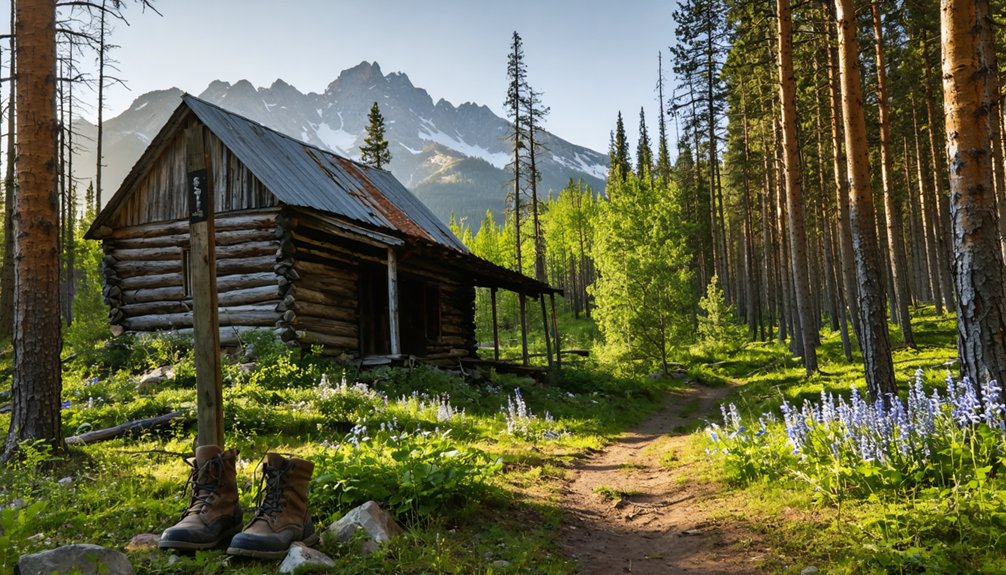
- Bringing your own water—no potable sources exist at the trailhead.
- Maintaining wildlife awareness in bear and elk country.
- Starting hikes early to avoid afternoon thunderstorms above 8,000 feet.
- Downloading offline maps since cellular reception remains unreliable.
Expect subtle foundations rather than intact structures at historical townsites.
Preserving History: What to Know Before You Visit
Beyond preparing for the physical challenges of reaching these remote sites, you’ll want to understand your role in protecting what remains.
Historic preservation organizations like the Rocky Mountain Conservancy have worked since 1931 to restore structures within the park, while groups such as the Ghost Town Club of Colorado and San Juan County Historical Society direct funds toward conservation techniques at sites like Lulu City and Animas Forks.
The 2020 East Troublesome Fire destroyed numerous historic buildings, including Onahu Lodge and the Trails and Tack Barn, making preservation more critical than ever.
Modern conservation techniques now employ 3D digital mapping and drone technology to document fragile structures.
You’re free to explore, but respecting artifact laws and avoiding disturbing remaining structures guarantees these places survive for future adventurers.
Frequently Asked Questions
Can You Camp Overnight Near Any of These Ghost Town Sites?
You can’t camp at RMNP ghost towns like Lulu City—camping regulations prohibit it—but you’ll find dispersed sites near Arrow townsite and Homestead Meadows ruins in national forest lands, though ghost town amenities don’t exist.
You can also explore abandoned sites near Haleakala National Park, where remnants of the past offer a unique glimpse into Hawaii’s history. While the settings might be more remote, the experience of wandering through these forgotten locations can be equally captivating. Just remember to respect the natural environment and preserve the remnants for future visitors.
Are Dogs Allowed on the Trails to These Ghost Towns?
No, dogs aren’t allowed on RMNP ghost town trails like Lulu City. You’ll need dog-friendly trails outside park boundaries for pet safety. Consider national forest routes or leave your companion at kennel facilities nearby.
Which Ghost Towns Are Accessible in Winter or Require Snowshoes?
Ashcroft’s accessible year-round via plowed Castle Creek Road, while Mt. Falcon’s Walker Home and Mount Vernon require snowshoes for winter accessibility. You’ll need snowshoe recommendations for backcountry sites above 10,000 feet with deep snow conditions.
Do Any Ghost Towns Charge Entrance Fees or Require Permits?
Most ghost towns don’t charge entrance fees, but you’ll pay Rocky Mountain National Park’s vehicle fee to reach Lulu City. No permit requirements exist for day hiking, though backcountry camping needs authorization from park authorities.
What Wildlife Should I Watch for When Visiting These Areas?
You’ll spot elk, mule deer, and marmots near ghost-town ruins. Watch for yellow-bellied marmots on old foundations and pikas in mine tailings—their animal behavior reveals excellent wildlife spotting opportunities at dawn and dusk in historic areas.
References
- https://en.wikipedia.org/wiki/List_of_ghost_towns_in_Colorado
- https://www.mycoloradoparks.com/park/rocky-mountain-ghost-town-ruins/
- https://es.uchealth.org/today/ghost-towns-abound-in-colorado/
- https://www.uncovercolorado.com/ghost-towns/
- https://www.101travelbits.com/single-post/2018/08/01/three-ghost-towns-of-rocky-mountain-national-park
- https://www.youtube.com/watch?v=_VGfCLKHwNw
- https://www.harborsandhavens.com/blog/towns-near-rocky-mountain-national-park
- https://www.tripadvisor.com/ShowTopic-g143048-i3489-k7776808-Ghost_towns-Rocky_Mountain_National_Park_Colorado.html
- https://www.denver7.com/news/local-news/clothes-left-hanging-in-the-closet-the-story-behind-lulu-city-a-ghost-town-in-rocky-mountain-national-park
- https://www.travelawaits.com/2678053/hiking-lulu-city-rocky-mountain-national-park/