You’ll find White Oaks about an hour north of Ruidoso—a genuine gold rush town from 1879 where Victorian homes stand among the ruins and locals still call it home. Lincoln’s preserved Main Street takes you back to Billy the Kid‘s violent 1878 standoff, complete with the courthouse where he killed two deputies during his legendary escape. Corona and Jicarilla offer more remote exploration, though they’re rougher remnants. The journey through these weathered settlements reveals stories most history books never captured.
Key Takeaways
- White Oaks, an hour north via Highway 54 and 349, features Victorian homes, a saloon, museum, and historic cemetery.
- Lincoln operates as a living museum with authentic buildings from the Lincoln County War and Billy the Kid’s famous jailbreak courthouse.
- Jicarilla exists as deteriorated ruins from its former mining camp days, with a history of turquoise and gold extraction.
- Corona remains a semi-ghost town with few residents and historical buildings, shaped by boom-and-bust economic cycles.
- Fill fuel tanks in Ruidoso, download offline maps, carry water, and share travel plans before visiting these remote locations.
White Oaks: the Premier Ghost Town Adventure From Ruidoso
When gold glittered in the Jicarilla Mountains in 1879, White Oaks exploded from empty desert into one of New Mexico Territory’s liveliest boomtowns—a place where fortunes changed hands in smoky saloons, newspapers competed for readers’ attention, and the opera house drew crowds in their Sunday finest.
You’ll discover ghost town culture at its finest here, where Victorian homes with widow’s walks still stand among the ruins, defying New Mexico’s typical adobe landscape.
Once the territory’s second-largest city, White Oaks declined when locals refused railroad passage, sending prosperity to Carrizozo instead. The Old Abe Mine became the town’s largest operation, employing about 40 workers at its peak.
White Oaks’ fatal mistake—rejecting the railroad—transformed this thriving metropolis into a ghost town while neighboring Carrizozo claimed its destiny.
Today’s semi-inhabited settlement preserves extraordinary mining heritage: abandoned gold mines scar the hillside, while Cedarvale Cemetery holds miners who chased their dreams into these unforgiving mountains.
Billy the Kid frequented these streets—freedom’s ultimate outlaw walking where you’ll walk.
How to Reach White Oaks From Ruidoso
Your adventure to White Oaks begins with an easy hour’s drive north from Ruidoso—a journey that’ll take you through landscapes where wild flowers punctuate the roadside and tumbleweeds cartwheel across your path on breezy afternoons.
Route navigation couldn’t be simpler: head to Carrizozo, then watch for the turn-off three miles north on US Highway 54. From there, Highway 349 carries you the final nine miles on fully paved road—no four-wheel-drive needed for this scenic drive.
Once you arrive, dirt roads connect the scattered remains of White Oaks, bumpy in spots but passable in any standard vehicle. For those seeking alternative routes, scenic back routes offer travelers a different perspective of the area.
You’ll spot about a dozen weathered buildings from the main route, alongside a dozen functioning homes where modern residents still call this ghost town home. Unlike typical New Mexico sites, you’ll notice the distinctive pitched roofs that reflect the town’s eastern architectural influences rather than traditional flat-roofed adobe construction.
Exploring the area further will lead you to discover some intriguing ghost towns near Carlsbad New Mexico, each with its own unique history and stories to tell. As you wander through these remnants of the past, you’ll find artifacts and remnants that provide insight into the lives of those who once thrived here. It’s a captivating experience that contrasts sharply with the vibrant life of the nearby modern communities.
White Oaks History: From Gold Rush Boom to Bust
Three prospectors—John Wilson, Jack Winters, and Harry Baxter—struck gold in the Jicarilla Mountains in 1879, and within twelve months a tent city sprouted where white oak trees lined a nearby stream.
You’d have witnessed remarkable transformation as 50 businesses emerged, including newspapers, hotels, and an opera house serving over 4,000 residents. Gold mining operations like the Old Abe Mine extracted 45-50 tons daily, generating $20 million in total mineral wealth.
Within a year, over 4,000 fortune-seekers transformed pristine oak groves into a booming metropolis of newspapers, grand hotels, and cultural landmarks.
But freedom’s double-edged sword cut deep when landowners demanded excessive prices during railroad negotiations in the late 1890s. The tracks bypassed White Oaks for Carrizozo instead.
The town attracted legendary figures from the Lincoln County War, including Susan McSween, who built a cattle empire of over 5,000 head after finding refuge in White Oaks. At Baxter Gulch, numerous Mexican miners actively washed gold from the streambeds, with one reporting $16 worth extracted in a single day. Combined with depleted deposits and collapsed gold markets, this sealed the town’s fate. Economic decline reduced the population to 200 by 1910, transforming New Mexico’s second-largest city into silent ruins.
What to See and Do in White Oaks Today
The weathered boardwalk of the No Scum Allowed Saloon creaks underfoot exactly as it did when miners emptied their pockets here over a century ago.
You’ll find cold drinks, weekend barbecue, and live music in this American Cowboy Magazine-recognized bar that’s remained genuinely unpolished.
Wander dusty streets past Victorian Hoyle House and hollow-eyed storefronts where exploring history means stepping through doorways time forgot.
The schoolhouse museum waits with hand-cranked gramophones and artifacts from White Oaks’ peculiar past—a lawyer-and-merchant town that never got its railroad.
At Cedarvale Cemetery, you’ll stand before Deputy James Bell’s grave, remembering local legends of Billy the Kid’s bloody escape.
Each August, the town resurrects itself for White Oaks Miners Day, drawing visitors with food, festivities, and frontier spirit.
The compact ghost town makes walking the primary way to experience every corner of this preserved settlement.
Bring sturdy boots, water, and your camera. This isn’t a sanitized theme park; it’s the unvarnished West you came searching for.
Lincoln: Where Billy the Kid’s Legend Lives On
Unlike most ghost towns frozen in time, Lincoln’s main street hums quietly with living history—the same dusty lane where Billy the Kid gunned down Sheriff Brady in 1878 and later blasted his way out of the old courthouse jail with a stolen shotgun.
You’ll walk past the actual buildings where merchants, gunmen, and cattlemen fought the bloody Lincoln County War, their adobe walls still pocked with bullet holes from the five-day siege.
The courthouse where Billy awaited his hanging stands open for tours, letting you climb the same wooden stairs he descended after killing his two guards in the West’s most legendary jailbreak.
The conflict erupted when John Tunstall challenged the mercantile and banking monopoly controlled by James Dolan and John Riley, transforming Lincoln into a battleground between rival factions.
Today’s visitors experience a carefully managed anticipation as they wait to enter the historic courthouse during peak tourist seasons, with the National Park Service controlling visitor flow to preserve the fragile wooden floors and artifacts.
Historic Main Street Sites
Walking Lincoln’s dusty main street feels like stepping onto a film set—except every weathered adobe wall, every hand-hewn timber portal, and every sun-faded shutter is absolutely genuine.
This historic preservation marvel showcases America’s largest collection of original Territorial Style adobe buildings, their architectural significance frozen in the 1870s-1880s frontier era.
You’ll discover authentic frontier commerce at these essential stops:
- Tunstall Store – Original 1877 mercantile with shelving, counters, and Victorian-era goods preserved exactly as merchants left them
- El Torreón – 1850s circular stone tower where Hispanic settlers defended against raids
- Old Lincoln County Courthouse – 1874 Murphy Store transformed into territorial courthouse, complete with restored woodwork
- San Juan Mission – 1887 frontier chapel anchoring community life
Each structure tells its own unvarnished story of self-reliance and frontier independence.
Billy the Kid Connections
Among these preserved structures, one figure’s shadow stretches longest across Lincoln’s sun-baked streets—Billy the Kid transformed this sleepy territorial settlement into America’s most infamous outlaw battleground.
You’ll walk where he ambushed Sheriff Brady on April 1, 1878, gunning him down with a dozen bullets near Tunstall’s store. The McSween house marks where Billy escaped through flames during the five-day battle that July.
But nothing captures Billy’s legacy like the courthouse itself—where he killed two deputies and fled on April 28, 1881, just months before Pat Garrett ended his run.
The Kid’s escapades weren’t distant legends happening elsewhere; they unfolded on these exact boardwalks, through these bullet-scarred doorways, making Lincoln the authentic stage for frontier justice gone wild.
Other Ghost and Semi-Ghost Towns in Lincoln County
Beyond White Oaks, you’ll find Lincoln County scattered with smaller remnants of frontier ambition—some barely clinging to life, others vanished entirely.
Lincoln itself still breathes as a living museum where adobe walls echo Billy the Kid’s footsteps, while Jicarilla has crumbled into the Sacramentos’ silence, its mining camp dreams reduced to foundation stones and sagebrush.
Corona, perched on the county’s western edge, lingers as a semi-ghost where a handful of residents still tend to weathered buildings that once served a booming railroad junction.
Lincoln: Living History Town
You’ll explore seventeen preserved structures managed as a living museum:
- Old Lincoln County Courthouse—where Billy the Kid made his legendary jailbreak
- Tunstall Store—still displaying original 1870s merchandise on period shelving
- El Torreón—the fortified tower built against Apache raids
- Seven year-round museums—with additional seasonal exhibits throughout town
This semi-ghost town operates without entry gates or manufactured nostalgia.
Jicarilla and Corona Ruins
The weathered log schoolhouse sits quietly among pinon and ponderosa pine, marking what remains of Jicarilla—a mining camp whose story stretches back five centuries.
Jicarilla Apaches extracted turquoise here in the 1500s, followed by Spanish prospectors panning creeks with wooden bateas. The real rush came in 1892 when gold and coal discoveries transformed this into a legitimate boomtown with a post office and assay office.
Jicarilla mining continued until the early 2000s when Jerry Fennell, the last holdout, couldn’t afford the reclamation bond the Forest Service demanded. He’d worked his claim for thirty years.
You’ll find Corona history equally compelling—though that’s another tale of boom, bust, and the government’s heavy hand pushing independent miners off their land.
Planning Your Ghost Town Day Trip: Tips and Considerations
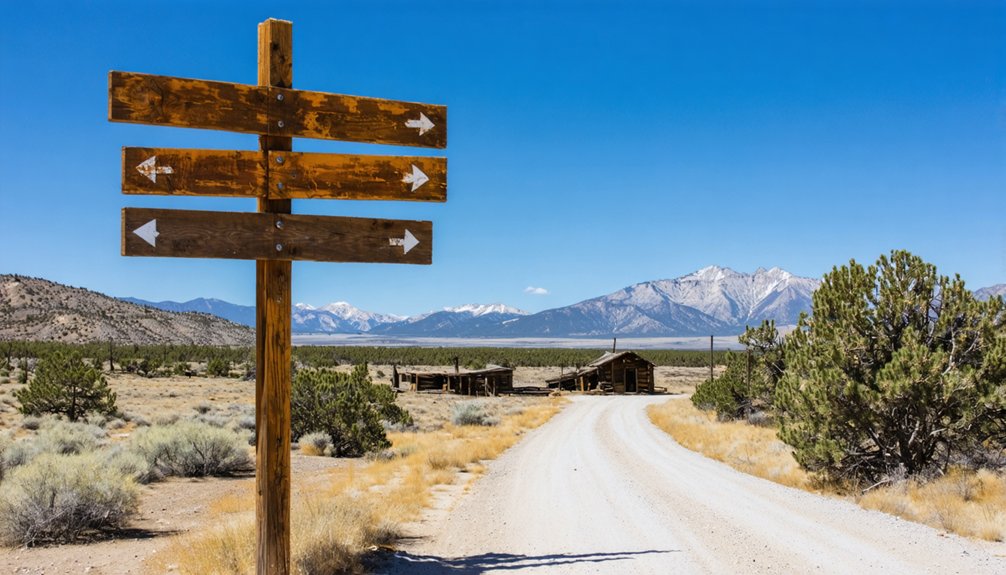
Before you set out on the dusty two-track toward White Oaks or drop down into the canyon where Lincoln sleeps in the shadows, you’ll want to square away a few practical details that separate a memorable day from a frustrating—or dangerous—one.
Essential safety precautions and navigation tips:
- Fill your tank in Ruidoso—ghost-town country offers zero services, and gravel roads drink fuel faster than pavement.
- Download offline maps and pack paper backups; cellular signals vanish in remote valleys and canyon bottoms.
- Carry a gallon of water per person and sun protection; the high-desert combination of altitude and low humidity dehydrates quickly.
- Share your route plan with someone reliable, including expected return time, especially for solo excursions into roadless territory.
New Mexico’s Ghost Town Trail Beyond Ruidoso
Dozens of weathered settlements dot the high country radiating out from Ruidoso, strung together by New Mexico Tourism’s official Ghost Towns Trail—a loose network of highways, ranch roads, and gravel spurs that thread through the Sacramento and Capitan ranges like a miner’s claim map come to life.
You’ll trace the boom-bust arc of mining heritage from 1860 through 1920, when gold, copper, and silver strikes pulled prospectors into elevations topping 7,200 feet.
White Oaks anchors the route three miles north of Carrizozo on US 54, its stone facades and hillside cemetery frozen in place after the railroad passed it by.
When the railroad chose a different path, White Oaks became a monument to ambition abandoned—stone walls standing guard over silence.
Lincoln, Jicarilla, and Nogal complete the loop, each preserving ghost town history through crumbling headframes, adobe walls, and rutted wagon tracks disappearing into ponderosa pine.
Best Times to Visit and What to Bring
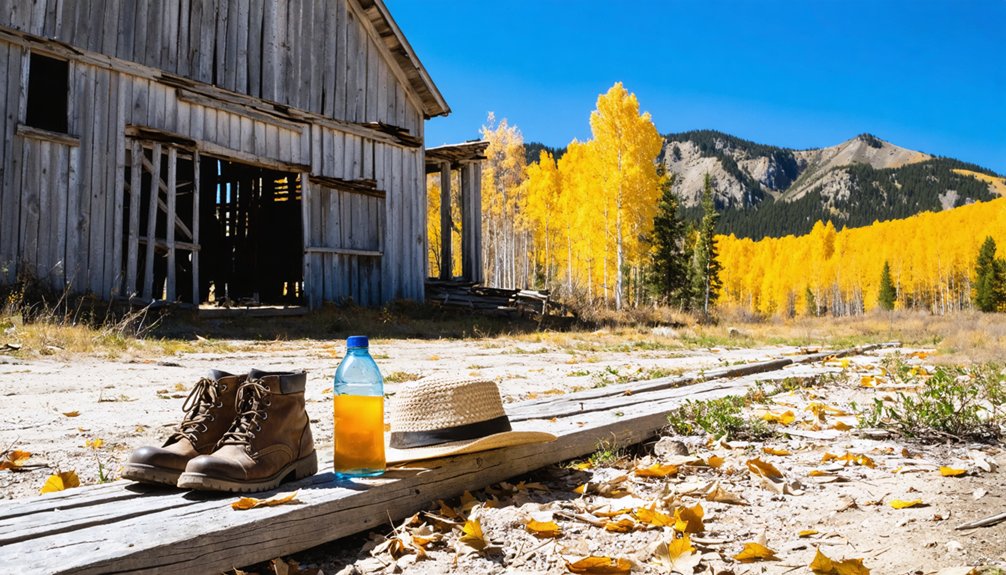
When September rolls around and the aspen begin their slow gold fade across the Sacramento slopes, you’ll find the old camps at their most forgiving—crisp mornings in the low fifties that climb into the seventies by noon, empty two-tracks firming up after the monsoon mud, and a slant of autumn light that pulls every chisel mark and hand‑hewn timber joint into sharp relief.
Spring mirrors that sweetness. Summer stays surprisingly mild near Ruidoso’s elevation. Winter demands respect—snow-packed roads, gear for the twenties.
Essential gear for best visiting:
- Layered clothing for forty-degree temperature swings
- Sturdy boots to navigate rubble and nails
- Offline maps where cell towers vanish
- Full fuel tank, spare tire on lonesome gravel
Pack your daypack. Check the forecast. Let the ghost towns breathe around you.
Frequently Asked Questions
Are Ghost Towns Near Ruidoso Safe to Explore With Children?
Ghost town safety for children exploration requires serious caution—you’ll face unstable buildings, hidden mine shafts, and rattlesnakes. While nostalgia calls, these aren’t playgrounds. Supervise closely, respect private property, and you’ll create memorable adventures responsibly.
Can I Camp Overnight at White Oaks or Other Ghost Towns?
White Oaks won’t welcome wanderers overnight—camping regulations prohibit it, and no overnight facilities exist. You’ll find freedom staying in Ruidoso instead, just twelve miles away, then exploring this nostalgic ghost town during daylight hours when memories unfold naturally.
Do I Need a Four-Wheel-Drive Vehicle to Visit These Ghost Towns?
You won’t need four-wheel-drive for most ghost towns near Ruidoso. Road conditions to White Oaks and Cerrillos remain suitable for standard vehicles. Vehicle recommendations favor conventional cars, letting you explore these nostalgic destinations freely.
Are There Guided Ghost Town Tours Available From Ruidoso?
No regular guided tours operate from Ruidoso—you’ll discover White Oaks independently, following dusty county roads to explore its historical significance yourself. Local outfitters occasionally arrange private trips, but freedom-seekers typically venture solo.
Is Metal Detecting Allowed at White Oaks and Other Sites?
Metal detecting regulations prohibit you from hunting historical artifacts at White Oaks without landowner permission and federal permits. Most ghost town sites fall under ARPA protection, making unauthorized detecting illegal regardless of posted signs.
References
- https://socorronm.org/location-activity/ghost-towns-of-socorro-county/
- https://santafe.com/new-mexico-road-trip-ghost-towns/
- https://ruidoso.com/ghost-towns-of-new-mexico/
- https://www.newmexico.org/places-to-visit/ghost-towns/
- https://www.newmexicoghosttowns.net/counties
- https://www.newmexico.org/places-to-visit/ghost-towns/white-oaks/
- https://en.wikipedia.org/wiki/List_of_ghost_towns_in_New_Mexico
- https://www.discoverruidoso.com/info/white-oaks-ghost-town
- https://www.discoverruidoso.com/info/tag/ghost+town
- https://www.newmexicoghosttowns.net/white-oaks-nm