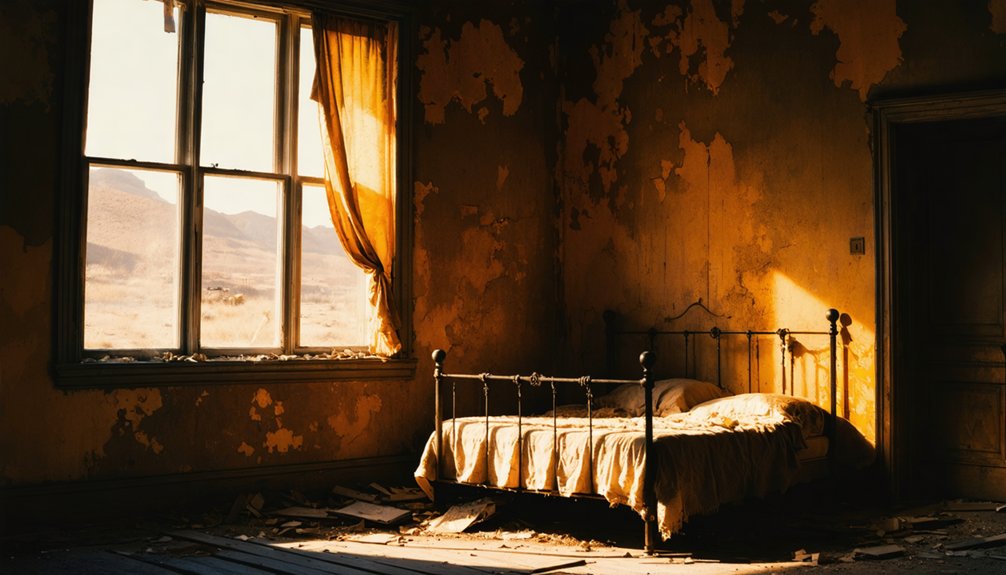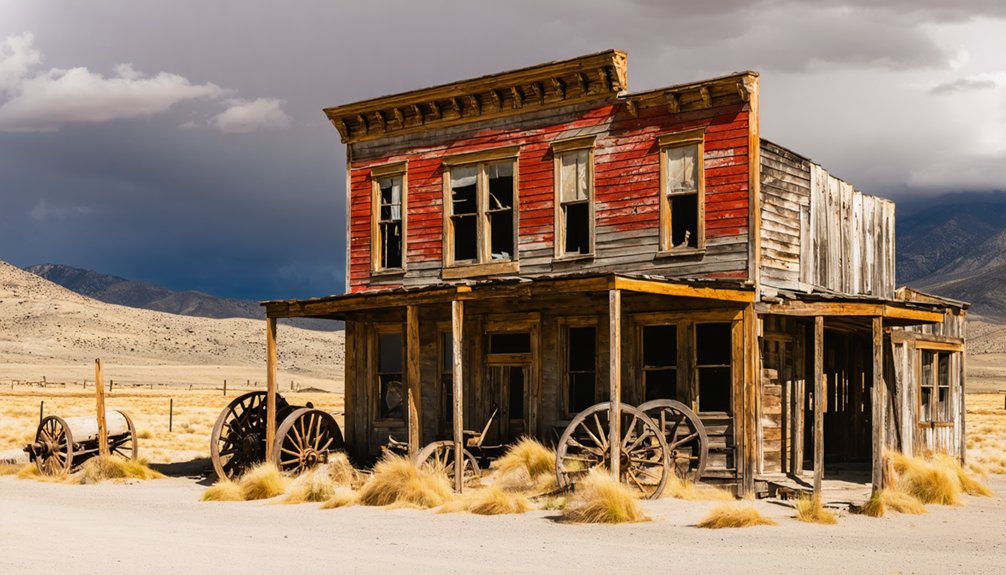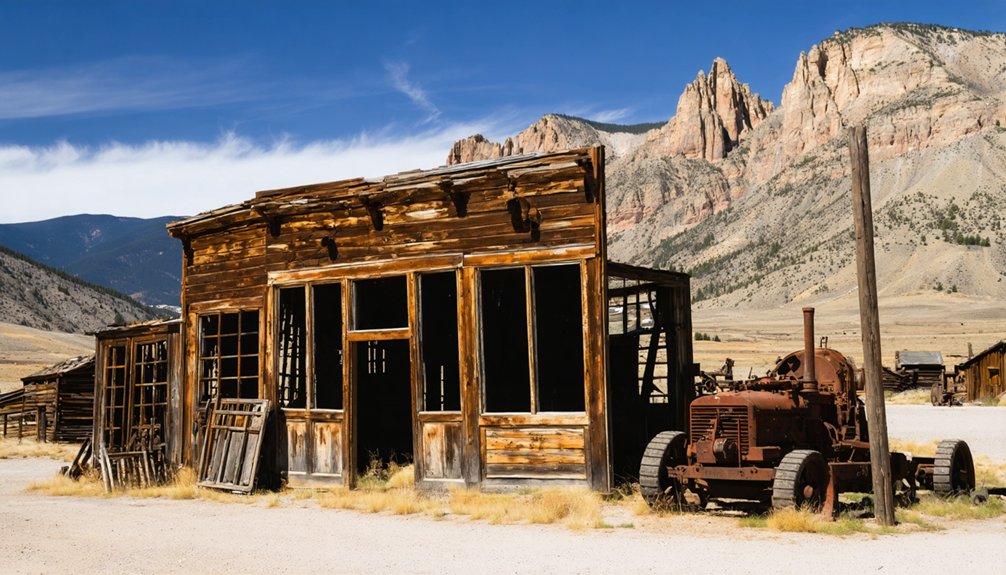
Within 100 miles of Salt Lake City, you’ll discover over a dozen authentic ghost towns spanning 140 years of Western history. Thistle, America’s most recent abandonment, vanished beneath a landslide in 1983. Eureka’s mining headframes still pierce the skyline where $231 million in precious metals once flowed. Frisco’s charcoal kilns stand as monuments to its lawless silver boom, while Carbon County’s coal camps recall devastating tragedies. From I-15 corridor ruins to remote settlements, each site preserves architectural remnants and industrial relics that reveal Utah’s frontier past.
Key Takeaways
- Eureka, seventy miles southwest of Salt Lake City, preserves mining infrastructure and commercial buildings from its peak of 5,000 residents.
- Thistle became Utah’s newest ghost town in 1983 when a catastrophic landslide created Lake Thistle, submerging the entire community.
- Carbon County coal mining towns like Winter Quarters, Wattis, and Latuda offer remnants of early 20th-century mining operations.
- Accessible I-15 corridor sites include Old Iron Town, Silver Reef, Cove Fort, and Corinne with interpretive signage and restored structures.
- Iosepa, a Polynesian settlement from 1889 to 1917, offers unique cultural history distinct from typical mining ghost towns.
Thistle: Utah’s Most Recent Ghost Town
Tucked into Spanish Fork Canyon where U.S. 6 meets U.S. 89, Thistle once hummed with the rhythms of railroad life—steam whistles echoing off sandstone cliffs, coal smoke drifting over modest homes, and the clatter of turntables servicing Denver and Rio Grande Western locomotives bound for distant terminals.
Founded in 1883, the town peaked at 600 residents by 1917, serving as a crucial servicing hub with roundhouses, coal chutes, and machine shops.
At its 1917 zenith, Thistle bustled with 600 souls keeping Denver and Rio Grande Western trains running through canyon country.
Thistle history took a catastrophic turn in April 1983 when record snowmelt triggered a massive earthflow. The slide created a 220-foot natural dam, forming Lake Thistle that swallowed the entire community. The landslide moved at 3.5 feet per hour, spanning 1000 feet wide and reaching 200 feet thick.
The Thistle disaster forced complete evacuation and cost over $200 million, marking America’s costliest landslide and earning Utah’s first presidential disaster declaration. Today, visitors can still see water-ravaged homes and railroad entrances rising from the landscape, making Thistle unique among Utah’s ghost towns as one that fell into ruin in recent memory.
Western Mining Settlements: Eureka and Frisco
You’ll find Eureka seventy miles southwest of Salt Lake City, where deteriorating headframes and mine shafts still mark one of Utah’s wealthiest nineteenth-century silver districts.
The town incorporated in 1892 as the financial heart of Tintic Mining, once ranking among the state’s ten largest cities with over 5,000 residents from twenty-one nationalities. The Elks Lodge, built in 1902, became a community hub and remains one of the oldest in the West.
Visitors can explore the Tintic Mining Museum, which displays mining relics and artifacts from the town’s prosperous past.
Eureka’s Mining Heritage Today
Though the mines have long ceased their roar, Eureka’s industrial bones still rise from the valley floor seventy miles southwest of Salt Lake City, evidence to one of Utah’s most enduring mineral frontiers.
You’ll find headframes, waste dumps, and shaft collars scattered across the landscape—relics of the Big Four mines and Chief Consolidated operations that once defined Eureka’s economy. These structures illustrate the underground mining techniques that extracted $231 million in silver, gold, and base metals through 1975.
Listed on the National Register in 1979, Eureka preserves its commercial core and mining infrastructure as tangible reminders of autonomy won through ore and enterprise. The town’s early prosperity attracted James Cash Penney, who opened his second Golden Rule store here in 1909, launching what would become the J.C. Penney chain. The Ruby Hill Mining Company, formed in 1960 as a joint venture between Richmond-Eureka and Eureka Corporation, conducted extensive drilling and feasibility studies that ultimately proved economically unviable despite promising ore reserves.
Today’s semi-ghost community anchors Highway 6, welcoming travelers who appreciate landscapes shaped by self-determination and rugged ambition.
Frisco’s Violent Past
Thirty miles northwest of Eureka, Frisco earned a darker reputation—one built not merely on mineral wealth but on bloodshed that made Dodge City seem tame by comparison.
During its 1870s–80s peak, this camp of 6,000 souls witnessed daily murders, with bodies carted to Boot Hill so regularly that officials contracted a dedicated wagon.
Twenty-three saloons lined streets where gunfights over claims and gambling debts turned routine. The Frisco violence spiraled until Marshal Pearson arrived from Pioche with a stark policy: shoot on sight.
Six outlaws died his first night. Within weeks, his iron fist crushed the anarchy, though the lawlessness legacy lingered—a proof to how fortunes from the Horn Silver Mine, “the richest silver mine in the world,” bred chaos before order.
The town’s prosperity ended abruptly on February 12, 1885, when a massive cave-in closed the main shaft and collapsed tunnels, with tremors felt as far as Milford. Today, charcoal kilns stand as weathered monuments on the National Register of Historic Places, their beehive shapes reminding visitors of the smelting operations that once fed Frisco’s fortune.
Industrial Ruins and Kilns
Beyond the gunsmoke and violence, Frisco and its neighbor Eureka left behind skeletal remains that speak to the industrial machinery of Utah’s mining empire.
At Frisco, you’ll find the most striking evidence: beehive-shaped stone kilns that fueled the smelters processing Horn Silver Mine‘s ore. These masonry domes controlled heat and airflow for charcoal production, transforming local timber into high-temperature fuel.
By 1885, this infrastructure helped extract over $60 million in metals—silver, lead, copper, zinc, and gold. The Horn Silver mine collapsed that same year on February 12th, causing tremors felt 15-20 miles away. The Utah Southern Railroad reached Frisco on June 23, 1880, enabling efficient ore transport from the district’s mines. Meanwhile, Eureka’s industrial heritage endures in civic structures like the old jail and courthouse, built to govern a booming ore town.
Together, these ruins document the complete supply chain: from charcoal production through smelting to rail shipment, revealing how remote desert camps became extraction powerhouses.
Carbon County Coal Mining Communities
You’ll find Carbon County’s coal legacy written in the ruins of Winter Quarters, where Utah’s first major commercial mine opened before disaster struck in 1900, claiming roughly 200 lives.
The nearby camp of Wattis rose and fell with the railroad’s appetite for fuel, its fortunes tied to the Denver & Rio Grande Western‘s operations through the early twentieth century.
Latuda, another company town carved from the canyon, finally closed its doors in 1967 when the coal played out and the last families packed their belongings for Helper.
Winter Quarters Mining History
Tucked into the rugged canyons of Pleasant Valley, Winter Quarters emerged in 1875 as Carbon County’s first major coal operation, transforming Utah’s energy landscape before most settlers had even heard the region’s name.
You’ll find the Pleasant Valley Coal Company opened its first mine in summer 1876, initially hauling coal by mule and wagon on a grueling four-day route to Springville markets. By 1879, the Utah & Pleasant Valley Railroad linked the camp directly to Provo, expanding distribution across the territory.
Skilled Scottish and Welsh miners drove the shafts deeper, extracting black seams that powered Utah’s railroads and homes.
Yet Winter Quarters carried a dark legacy—the catastrophic May 1, 1900 explosion killed at least 200 men, making it Utah’s deadliest disaster and exposing coal mining’s brutal human cost.
Wattis Settlement Overview
While Winter Quarters drew headlines for tragedy, the quieter settlement of Wattis emerged in the early 20th century as Lion Coal Company carved another company town into Huntington Canyon’s southwestern reaches.
Named for engineer A.C. Wattis, this coal mining camp became your gateway to understanding Carbon County’s industrial diversity.
Wattis Town’s fabric reflected Utah’s immigrant-powered energy boom:
- Greek, Japanese, Hispanic, and African American miners worked underground seams side by side
- Company-controlled housing rows clustered near mine portals, dictating community layout
- Rail spurs hauled black gold to Wasatch Front markets, linking canyon isolation to urban demand
- Ethnic neighborhoods and fraternal lodges preserved Old World traditions against company-store monotony
You’ll find Wattis exemplified coal mining’s monospecialized economy—where company decisions determined community survival and eventual abandonment.
Latuda’s 1967 Closure
In 1966, they blasted the entrance shut permanently.
Within a year, all 400 residents had scattered, and the town was literally hauled away—lumber, equipment, everything salvagable disappeared.
By 1967, no one remained.
What you’ll find today is a stone mine office standing alone amid Spring Canyon’s silence, a stark monument to Carbon County’s mining legacy and the swift erasure of company towns when the coal runs dry.
Accessible Ghost Towns Along the I-15 Corridor
For travelers who crave authentic remnants of Utah’s boom-and-bust past without venturing far from modern amenities, the I-15 corridor offers a remarkable concentration of preserved and semi-abandoned settlements spanning the state’s mining, railroad, and early Mormon colonization eras.
Prime I-15 Ghost Town Stops:
- Old Iron Town – Stone furnace ruins and beehive charcoal kilns 20 miles west of Cedar City document 1860s Mormon iron-smelting ambitions.
- Silver Reef – Mid-1870s silver boomtown near Leeds features stone commercial buildings, museum, and historic cemetery with paved access.
- Cove Fort – Restored 1867 way-station at I-15/I-70 junction represents frontier settlement patterns.
- Corinne – 1869 “Gentile” railroad town northwest of Brigham City retains 19th-century commercial structures.
You’ll find interpretive signage, basic facilities, and graded roads connecting these atmospheric sites to major exits.
Latuda: A Mid-Century Mining Abandonment

Tucked seven miles west of Helper in the narrow confines of Spring Canyon, Latuda emerged in 1917 as a coal camp born from the ambitions of Francisco “Frank” Latuda and Charles Picco, who’d acquired 326 acres of coal lands and established the Liberty Fuel Company.
This Latuda history began with tents sheltering miners before permanent structures rose in 1918. The mining community peaked at 300–400 residents, sustained by a company store, school, and stone office building.
Perched at 6,700 feet amid steep canyon walls, the town faced recurring avalanche dangers—two miners died in devastating snow slides in 1927.
The canyon’s unforgiving geography exacted a deadly toll, claiming two miners in avalanche disasters that swept through the isolated settlement.
After World War II, declining coal demand emptied the camp. By the mid-1960s, Latuda stood abandoned, its population scattered, leaving only weathered remnants of a once-thriving mountain settlement.
Unique Historical Communities Worth Exploring
Beyond the coal camps and railroad stops that defined Utah’s industrial heritage, a collection of ghost towns near Salt Lake City reveals remarkably diverse chapters of frontier ambition—from silver boomtowns that descended into violent chaos to peaceful religious colonies that struggled against desert isolation.
Another intriguing collection of ghost towns near Saguaro National Park offers insights into the West’s storied past, showcasing miners and settlers who sought fortune amid unforgiving landscapes. Each site carries tales of resilience and lost dreams, contrasting the vibrant life that once flourished with the desolation that remains. Exploring these remnants provides a haunting yet captivating glimpse into a bygone era, inviting visitors to reflect on the layered history of the region.
Distinctive communities await your exploration:
- Frisco’s violent silver rush (1879–1885) saw near-daily murders before catastrophic mine collapse ended the boom.
- Iosepa’s Polynesian settlement (1889–1917) created a unique Hawaiian community in Skull Valley’s harsh desert.
- Eureka’s living ghost town atmosphere preserves National Register buildings alongside 600 current residents.
- Home of Truth’s Utopian experiment near Monticello offered mystical healing promises in southeastern Utah’s isolation.
Each site presents authentic frontier architecture, cemeteries, and industrial relics that tell stories conventional history often overlooks.
Frequently Asked Questions
What Supplies Should I Bring When Visiting Remote Utah Ghost Towns?
Like prospectors of old, you’ll need water supplies—one gallon daily per person—plus navigation tools: offline topo maps, GPS devices, and satellite communicators. Pack emergency gear, sturdy boots, and first-aid essentials for Utah’s unforgiving backcountry.
Are Ghost Towns Near Salt Lake City Safe to Explore Alone?
Solo exploration isn’t recommended due to physical hazards like open mine shafts, unstable structures, and extreme weather. You’ll face better odds following essential safety tips: never venture alone into these atmospheric ruins from mining’s golden age.
Can I Camp Overnight at Utah Ghost Town Sites?
You’ll need to check the land manager first—camping regulations vary widely. BLM lands often permit dispersed camping, but private property, watersheds, and historic preservation zones frequently prohibit overnight stays without explicit authorization.
Which Ghost Towns Require Four-Wheel Drive Vehicles to Access?
You’ll need four-wheel drive for Grafton’s rugged terrain after rainfall and Gooseberry Mesa’s challenging routes. Most northern ghost towns like Eureka offer standard vehicle access, though dirt roads can test your adventurous spirit year-round.
What Is the Best Season to Visit Utah Ghost Towns?
Spring and fall offer you the best weather for exploring Utah’s forgotten settlements—mild days in the 60s–80s°F, fewer crowds, and reliable road conditions. You’ll also catch seasonal events at operating historic sites like Ophir.
References
- https://www.axios.com/local/salt-lake-city/2024/09/03/utah-best-ghost-towns-mine-abandoned
- https://en.wikipedia.org/wiki/List_of_ghost_towns_in_Utah
- https://www.visitutah.com/things-to-do/history-culture/ghost-towns
- https://www.utahsadventurefamily.com/5-ghost-towns-in-utah-for-families/
- https://www.atlasobscura.com/things-to-do/utah/ghost-towns
- https://saltlakeexpress.com/7-utah-ghost-towns-close-15/
- https://diaryofabandonment.com/thistle-ghost-town-utah/
- https://en.wikipedia.org/wiki/Thistle
- https://saltproject.co/blog/thistle-ghost-town
- https://geology.utah.gov/map-pub/survey-notes/geosights/thistle-landslide/