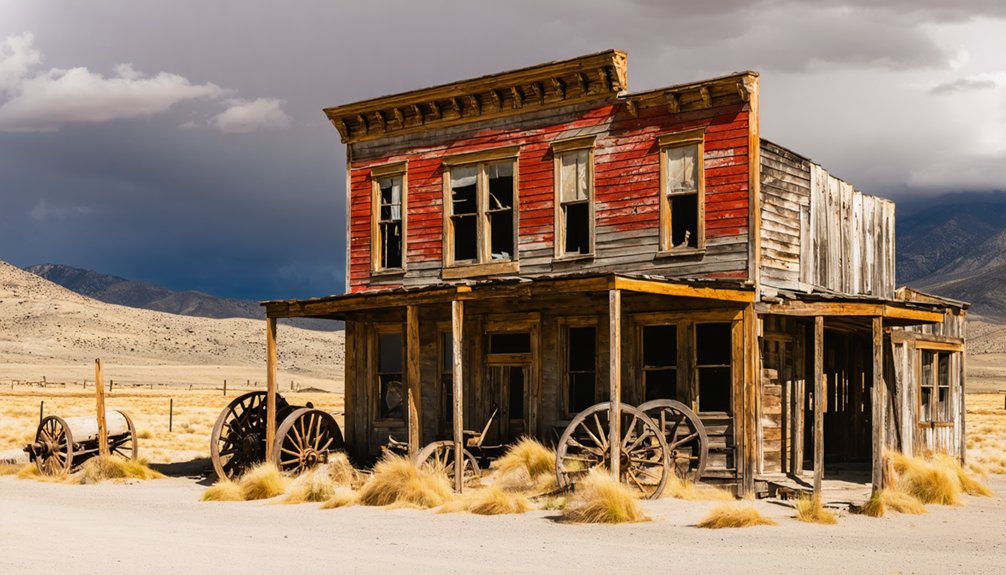
You’ll find three significant ghost towns within 90 minutes of San Diego along Historic Highway 80: Buckman Springs, established in the 1880s as a lithium-rich mineral water resort; Jacumba Hot Springs, once a thriving railway destination that collapsed after the 1960s interstate construction; and Bankhead Springs, a former Hollywood retreat now attracting paranormal enthusiasts. These settlements exemplify how infrastructure decisions—specifically Interstate 8’s completion—transformed prosperous waypoints into abandoned remnants documenting Southern California’s settlement patterns and tourism economy evolution. Further exploration reveals the complex interplay of accessibility challenges, preservation concerns, and safety considerations essential for visiting these historical sites.
Key Takeaways
- Buckman Springs, Jacumba Hot Springs, and Bankhead Springs are notable ghost towns along Historic Highway 80 east of San Diego.
- Interstate 8’s construction in the 1960s diverted traffic from Highway 80, causing economic collapse and abandonment of these communities.
- These sites originally thrived as hot springs resorts, attracting tourists and Hollywood celebrities during the early twentieth century.
- Visitors face challenges including extreme heat, limited water, rattlesnakes, scorpions, and delayed emergency response in remote desert locations.
- Access requires navigating private property rights, tribal lands, and artifact-protection laws while practicing self-sufficiency and informed route planning.
Buckman Springs: A Pioneer’s Dream Along Historic Route 80
In the 1880s, Amos Buckman transformed a remote desert spring into one of Southern California‘s most distinctive roadside enterprises, establishing what would become Buckman Springs along the route that later evolved into Historic Highway 80.
You’ll find this site east of San Diego, where naturally carbonated water rich in lithium and iron created a marketable product that sustained operations for over fifty years.
Buckman’s daughter Winifred maintained the bottling enterprise until 1946, serving travelers on the “Broadway of America” transcontinental route.
The mineral springs resort functioned as both therapeutic destination and essential highway landmark, supporting a small community that thrived on automobile tourism.
Interstate 8’s construction ultimately altered groundwater flows, ending the springs’ productivity and transforming this once-prosperous venture into backcountry ruins.
Today, visitors can still observe the ruins of an old stone house that belonged to town founder Amos Buckman, along with remnants of the old bottling plant that once processed the mineral water.
The highway was phased out in 1964 with the introduction of Interstate 8, which bypassed the original route and fundamentally changed the region’s transportation patterns.
The Rise and Fall of Jacumba Hot Springs
Long before developers recognized its commercial potential, the natural 104°F mineral hot spring at Jacumba had sustained Kumeyaay communities for millennia, serving as sacred space and seasonal gathering ground in the harsh desert borderlands east of San Diego.
Jacumba history took a violent turn in 1880 when the Hakumba Massacre claimed sixteen lives amid escalating land conflicts.
The 1919 arrival of the San Diego & Arizona Eastern Railway transformed the springs into a resort destination, with developer Bert Vaughn constructing elaborate facilities that drew up to 5,000 weekend visitors by the 1940s.
However, Interstate 8’s 1960s construction bypassed the town, triggering economic collapse.
The 1983 arson fire that destroyed Jacumba Hotel symbolized the community’s descent from premier health spa to near-ghost-town, erasing Kumeyaay heritage and resort legacy alike. For decades, Jacumba Hot Springs faced severe economic challenges, its population dwindling to just 540 residents with a median age around 62. The historic hotel remained defunct since the 1980s, standing as a testament to the town’s faded glory.
Bankhead Springs: From Senator’s Legacy to Silent Ruins
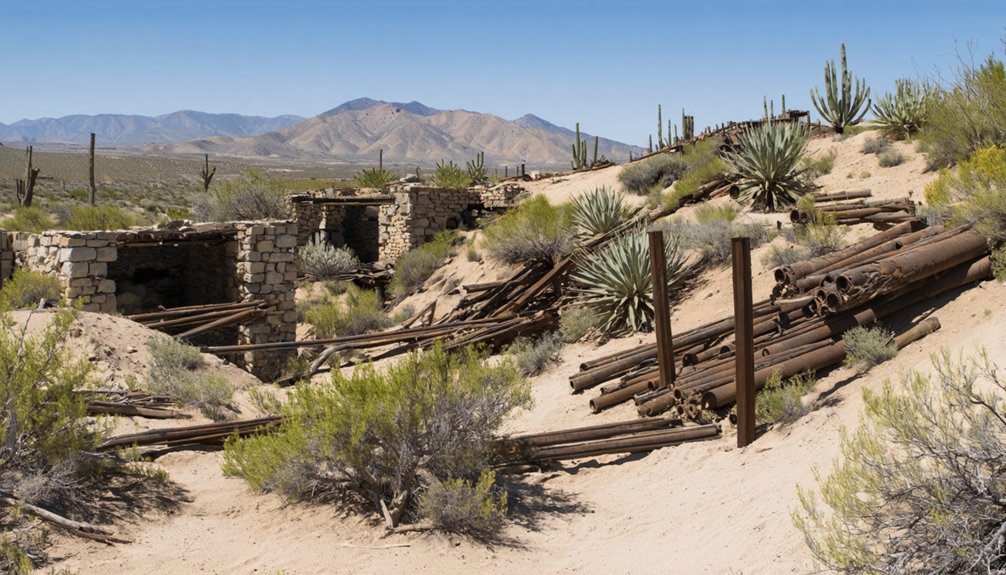
While Jacumba Hot Springs attracted visitors with its thermal waters, the nearby settlement of Bankhead Springs emerged as a demonstration of America’s early highway infrastructure ambitions, bearing the name of Alabama Senator John H. Bankhead, who championed transcontinental highway development.
The Senator’s influence extended beyond mere nomenclature—his advocacy shaped Highway 80‘s route, connecting this Kumeyaay ancestral territory to broader regional networks.
During the early twentieth century, natural hot springs transformed Bankhead Springs into a Hollywood celebrity retreat, attracting wealthy investors seeking leisure.
However, Interstate 8‘s 1960s construction bypassed the community, condemning it to obscurity.
The interstate’s new path sealed Bankhead Springs’ fate, transforming a thriving community into forgotten ruins virtually overnight.
The settlement developed as an extension of Jacumba Hot Springs, featuring a hotel, restaurant, and cabins that served travelers along the historic highway route.
Today, you’ll find accumulated documentation of paranormal encounters spanning decades—visual apparitions and auditory phenomena drawing researchers to these silent ruins, where indigenous heritage intersects with abandoned western expansion dreams. Paranormal investigators have collaborated with local historians to compile eyewitness accounts of unexplained phenomena throughout the abandoned structures.
Exploring the Historic Route 80 Corridor
As you travel east from San Diego along Historic Highway 80, you’ll encounter a corridor of abandoned settlements that chronicle the dramatic economic collapse following Interstate 8’s construction in the 1960s.
The route reveals a pattern of hot springs communities—from Buckman Springs to Jacumba—that once thrived on resort tourism and transcontinental traffic, now reduced to crumbling concrete foundations and overgrown cisterns. At Buckman Springs, naturally carbonated lithia water was bottled and sold as a cure-all from the 1880s until the 1940s, when the springs dried up due to agricultural development. Along the journey, you’ll discover original concrete road sections and bridges dating back to 1916 that remain visible today.
These ruins stand as archaeological evidence of how infrastructure decisions transformed prosperous waypoints into ghost towns within a single generation.
Abandoned Hot Springs Communities
The Interstate 8 bypass in the 1970s severed the economic lifeline of Route 80’s hot-springs communities, transforming once-thriving desert health resorts into skeletal remnants of California’s early automotive tourism era.
Jacumba Hot Springs exemplifies this trajectory: its 104°F geothermal flow once supplied elaborate bathhouses that attracted transcontinental travelers seeking mineral cures for rheumatism and nervous disorders.
After the San Diego & Arizona Eastern Railway arrived in 1919, roadside commerce flourished through the 1930s.
The 1983 hotel arson extinguished the town’s resort identity, leaving ghostly echoes along county route S-80.
You’ll discover thermal history preserved in abandoned motel shells and capped springs—evidence of how infrastructure shifts consigned entire communities to near-abandonment, their mineral waters still flowing beneath properties now valued for solitude rather than health tourism. Highway 80 once formed part of the first all-weather Coast to Coast Highway, stretching 2,725 miles from Savannah, Georgia to San Diego before Interstate 8 replaced it in the 1960s. The town’s earlier golden age drew Hollywood stars like Clark Gable and Marlene Dietrich to its natural springs from the 1920s through the 1940s.
Ruins and Standing Structures
Physical traces of Route 80‘s commercial and domestic past survive in concentrated pockets along the modern S-80 corridor, where stone, concrete, and metal remnants mark former centers of desert settlement.
At Buckman Springs, you’ll find the homestead’s masonry chimney and bottling plant foundations demonstrating late-nineteenth-century industrial infrastructure.
Desert View Tower’s stone outbuildings represent roadside commercial architectural styles from the automobile tourism era.
The Mountain Meadows Dairy complex preserves substantial agricultural structures—barns, livestock pens, and utility sheds—reflecting Route 80’s support role for regional farming operations.
These sites hold historical significance as documented waypoints in San Diego County’s east-west transportation evolution.
Original concrete roadbed segments and abandoned service buildings create a material archive of mid-century highway development, accessible to researchers examining California’s desert corridor transformation.
Tourism Boom and Decline
Between 1916 and the late 1960s, Route 80’s designation as the “Broadway of America” transformed San Diego’s eastern backcountry into a thriving corridor of tourist commerce spanning 150 miles from the Pacific coast to the Arizona border.
You’ll find that Jacumba Hot Springs epitomized this prosperity, attracting Hollywood elites like Clark Gable and Marlene Dietrich to its world-class hotel and mineral baths during the 1920s.
The Desert View Tower, constructed in 1922, exemplified roadside attractions that capitalized on automobile tourism trends.
However, Interstate 8’s completion just miles north in the late 1960s decimated these communities almost overnight. The bypass severed commercial lifeblood from establishments along the original route, converting prosperous towns into ghost towns characterized by boarded structures and abandoned enterprises—now visible reminders of infrastructure’s power to create and destroy.
What Remains: Ruins and Standing Structures
Scattered across San Diego County’s eastern backcountry, physical remnants of abandoned settlements offer tangible connections to the region’s frontier past.
You’ll find Buckman Springs’ bottling plant foundations along Historic Route 80, where original piping from Amos Buckman’s 1881 enterprise remains visible despite a hazardous 10-foot cistern.
The Jamul Kiln stands as the county’s best-preserved industrial ruin—a 130-foot cement works structure from 1891 accessible via a 3.75-mile cross-country trek.
Old Highway 80’s 1916 concrete sections still support vehicle traffic, while Mountain Meadows Dairy ruins and abandoned cafes dot the corridor.
These sites’ ruins preservation guarantees their historical significance endures.
Desert View Tower’s 1920s Boulder Park and Longview’s pioneer cemetery demonstrate how vestiges of settlement persist when communities vanish.
The Hot Springs Tourism Boom and Bust
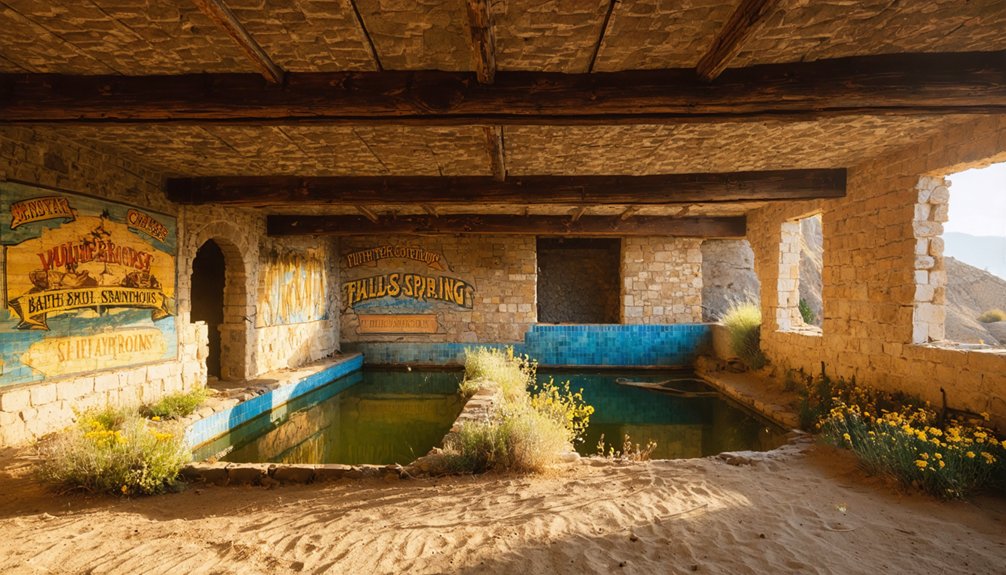
When the “impossible railroad” of magnate John Spreckels connected San Diego to Yuma in 1919, Jacumba’s natural hot springs transformed from an isolated curiosity into Southern California’s premier resort destination.
Highway 80’s completion brought 5,000 weekend visitors during peak seasons, with Clark Gable and Marlene Dietrich among the celebrity guests frequenting its four-story hotel and therapeutic bathhouses.
Golden Age Hollywood stars sought refuge in Jacumba’s desert waters, transforming the remote springs into a glamorous weekend escape.
Speculator Bert Vaughn constructed the Desert View Tower and artificial lake, capitalizing on motorists’ desire for authentic Western experiences.
Interstate 8’s late-1960s bypass devastated this prosperity—traffic vanished, the railroad ceased operations, and arson destroyed the grand hotel in 1985.
Today’s urban exploration enthusiasts and historical tourism visitors encounter remnants of this boom-bust cycle, examining how transportation infrastructure determined Jacumba’s fate as an independent resort community.
Accessibility and Preservation of San Diego’s Ghost Towns
Although San Diego County’s ghost towns survived decades of natural erosion and economic abandonment, today’s visitors face a complex patchwork of access rights that determines which sites remain explorable and which lie permanently off-limits.
Legal access depends heavily on land ownership, with many mining camps sitting on private ranches or tribal lands requiring explicit permission. Publicly managed sites within Cleveland National Forest and Anza-Borrego Desert State Park offer regulated entry but enforce strict artifact-protection laws under federal and state statutes.
Ghost town preservation faces mounting challenges as San Diego’s “Preservation and Progress” initiative proposes raising designation thresholds:
- Archaeological Resources Protection Act prohibits digging or removal
- Abandoned mines carry gated closures and criminal penalties
- County reforms may weaken protections for outlying historic resources
Navigation requires topographic maps, high-clearance vehicles, and respect for closure signs.
Planning Your Ghost Town Adventure
Before you venture into San Diego’s backcountry ghost towns, you must coordinate seasonal timing, specialized equipment, and risk-management protocols to guarantee both productive fieldwork and personal safety.
Late fall and spring offer the most favorable climatic windows for inland desert and mountain exploration, while summer heat and winter freezes at higher elevations demand modified schedules and gear sets.
Your preparation checklist should address three interdependent domains: temporal planning aligned with weather patterns, material provisions for remote environments, and procedural safeguards against structural, biological, and legal hazards.
Best Times to Visit
Key factors include:
- Winter storms creating flash-flood risks and road washouts on unpaved backcountry access
- Shoulder-season weekdays offering solitude and unobstructed photography at ruins
- Golden hour enhancing terrain visibility while illuminating structural details
You’ll maximize autonomy by arriving early, checking road conditions post-rainfall, and avoiding midday summer heat that restricts movement and threatens safety.
Essential Gear and Supplies
Successful exploration of San Diego’s ghost towns depends on methodical preparation that accounts for the region’s geographic remoteness and deteriorating infrastructure.
Your essential gear must include topographic maps, GPS devices with offline capability, and backup navigation tools for areas where cellular signals fail. Carry one gallon of water per person daily, supplemented by electrolyte replacements to counter desert heat exposure.
Survival supplies should encompass sturdy hiking boots, abrasion-resistant clothing, work gloves for handling deteriorated surfaces, and thorough first-aid provisions. Vehicle preparedness—spare tires, recovery equipment, extra fuel—proves critical on isolated dirt roads.
Two-way radios or satellite communicators enable coordination in dead zones. This systematic approach to gear selection transforms risky ventures into calculated expeditions, preserving your autonomy while respecting the unforgiving environments surrounding abandoned settlements.
Safety and Access Considerations
When planning excursions to San Diego’s abandoned settlements, you must first resolve the question of legal access—a prerequisite that transforms casual curiosity into lawful exploration.
Many structures occupy private property where trespassing laws carry enforceable penalties, while federal and state parcels impose cultural resource protections prohibiting artifact removal or structural damage.
Beyond jurisdictional boundaries lie environmental hazards demanding equal consideration:
- Structural instability: weakened floors, collapsing walls, and exposed fasteners threaten injury in abandoned buildings
- Desert conditions: extreme heat, limited shade, and scarce water sources in semi-arid backcountry elevate dehydration risk
- Wildlife encounters: rattlesnakes and scorpions inhabit rubble perimeters and foundation voids
Remote locations compound these risks through delayed emergency response and absent cellular coverage, requiring self-sufficiency and informed route planning before departure.
Frequently Asked Questions
Are There Any Ghost Towns in San Diego County With Reported Hauntings?
You’ll find multiple haunted locations in San Diego County’s ghost towns, particularly Buckman Springs, where paranormal activity draws investigators regularly. Desert way stations like Vallecito also feature persistent ghost stories from stagecoach-era deaths and isolated traveler incidents.
Just as the ghost towns near Canyonlands National Park offer a glimpse into the past, they also tantalize those searching for spectral encounters among the ruins. The eerie silence echoes tales of former residents who once thrived in these barren lands, leaving behind whispers of their stories. Adventurers often report strange sightings and unexplained phenomena, adding to the mystique of these desolate places.
What Caused Most San Diego Ghost Towns to Be Abandoned?
Economic decline from mining exhaustion and tourism downturns drove population migration away from San Diego’s backcountry settlements. You’ll find transportation route changes—particularly highway realignments bypassing older roads—accelerated abandonment by eliminating commercial traffic sustaining these remote communities.
Can You Camp Overnight Near San Diego’s Ghost Town Sites?
You’ll find overnight camping permitted near several ghost town sites on public lands, though camping regulations vary by location. Always verify current overnight safety restrictions, fire bans, and property boundaries before establishing camp in backcountry areas.
Which San Diego Ghost Town Is Easiest to Visit With Children?
Old Town San Diego’s Whaley House serves as your gateway to ghostly heritage—offering family-friendly activities within city limits, eliminating arduous kid-friendly hikes while preserving authentic historical encounters you’ll control on your own terms.
Do Any Ghost Towns Near San Diego Require Permits to Explore?
You won’t need permits for casual visits to most San Diego ghost towns, as they’re on public viewable land. However, exploration guidelines require landowner permission for private property access, and photography restrictions apply to certain structures.
References
- https://en.wikipedia.org/wiki/List_of_ghost_towns_in_California
- https://www.youtube.com/watch?v=jdUaEbj3LDs
- https://parks.sbcounty.gov/park/calico-ghost-town-regional-park/
- https://www.camp-california.com/california-ghost-towns/
- https://www.visitcalifornia.com/road-trips/ghost-towns/
- https://hiddensandiego.com/things-to-do/places/abandoned-highway-80
- https://www.tripadvisor.com/ShowTopic-g60750-i41-k4628558-Ghost_Towns-San_Diego_California.html
- https://www.ghosttowns.com/states/ca/casandiego.html
- https://www.aaroads.com/guides/us-080-ca
- https://www.eastcountymagazine.org/lost-highways-east-county-traveling-old-hwy-80-trip-down-memory-lane