You’ll find several authentic ghost towns within easy driving distance of Scottsdale, with Goldfield Ghost Town being the closest at just 40 miles northeast in the Superstition Mountains. This 1892 mining settlement offers restored buildings and daily gunfight shows. Vulture City, 60 miles northwest, features Arizona’s richest gold mine and over a dozen preserved structures from the 1860s. For copper mining history, Jerome sits 110 miles north as a thriving artistic community. Below, you’ll discover detailed information about each location’s accessibility, historical significance, and planning essentials.
Key Takeaways
- Goldfield Ghost Town is 40 miles northeast, featuring restored 1890s buildings, a museum, and hourly gunfight shows from its gold mining era.
- Vulture City lies 60 miles northwest, showcasing Arizona’s richest gold mine with over a dozen preserved 1800s structures and guided tours.
- Jerome, 110 miles north, transformed from a copper mining town into a thriving artistic community with galleries and historic sites.
- Pinal City Ruins along Queen Creek offer accessible exploration of a former silver milling town connected to the Silver King Mine.
- Swansea, 150 miles west, contains extensive copper mining ruins but requires navigating 30 miles of challenging unpaved roads to access.
Goldfield Ghost Town: The Closest Old West Experience
Located just 40 miles northeast of Scottsdale in the Superstition Mountains, Goldfield Ghost Town stands as the most accessible Old West experience for visitors exploring Arizona’s mining heritage.
Goldfield history begins in 1892 when prospectors discovered gold ore, rapidly transforming the area into a settlement of 4,000 residents. The Mammoth Mine anchored this booming community until ore depletion forced complete abandonment by 1898.
From prosperous boom town of 4,000 gold seekers to complete abandonment in just six years—Goldfield’s meteoric rise and fall defined frontier mining life.
A brief revival occurred in 1921 under Robert Young’s innovative mining techniques, lasting until 1926.
Ghost town restoration began in 1984 when Bob and Lou Ann Schoose acquired the mill site, spending two decades rebuilding mining tunnels and historic structures. The first construction project opened in December 1988, featuring a mine tunnel and snack bar.
You’ll find authentic buildings, a museum established in 1989, and immersive experiences showcasing genuine frontier life without modern restrictions. The town features hourly weekend gunfight shows performed by actors in Old West attire to enhance the visitor experience.
Vulture City: Arizona’s Richest Gold Mine Heritage
Sixty miles northwest of Scottsdale, Vulture City preserves the legacy of Arizona’s most profitable gold mine, where prospector Henry Wickenburg’s chance discovery in 1863 sparked territorial transformation.
This mining legacy produced 340,000 ounces of gold and directly funded Phoenix’s founding. At its peak, 5,000 residents inhabited this self-sufficient community.
The Vulture Mine site offers you:
- The infamous Hanging Tree where 18 men met their fate for gold theft
- Original mine structures including the mill and assay office
- Glory Hole depression marking the 1923 cave-in that killed approximately 100 miners
- Authentic territorial buildings showcasing Arizona’s roughest frontier era
You’ll explore Arizona’s richest gold operation, which generated up to $200 million before Roosevelt’s 1942 wartime closure ended production permanently.
Following meticulous restoration efforts beginning in 2017, the site now features over a dozen preserved historic structures that showcase authentic territorial architecture.
Wickenburg named the site after the many vultures that populated the area surrounding his gold discovery in the quartz outcropping.
Jerome: The Vertical Ghost Town on Cleopatra Hill
While Vulture City’s riches funded Arizona’s territorial expansion, Jerome’s copper wealth built one of the most precarious mining settlements ever conceived.
Perched on Cleopatra Hill‘s 30-degree slope at 5,200 feet, this “Vertical City” defied conventional town planning from its 1876 founding through its 1953 mining shutdown.
Jerome history reveals over $800 million in copper extracted by 15,000 residents representing 30 nationalities during the 1920s peak.
Vertical engineering challenges plagued the town—underground tunnels and blasts up to 200,000 pounds destabilized entire blocks. The famous “Sliding Jail” shifted over 200 feet downhill after repeated ground movement.
Today, you’ll find this National Historic District transformed from near-abandonment into Arizona’s premier ghost town destination, just 110 miles north of Phoenix.
Explorations often lead visitors to the abandoned mines near Prescott Arizona, where remnants of the past tell stories of hard work and perseverance. As you wander through these historic sites, you’ll discover fascinating artifacts and learn about the mining techniques that shaped the region’s economy. The eerie silence and stunning landscapes create a unique atmosphere that’s both haunting and beautiful, perfect for those seeking adventure and a glimpse into history.
Nearby, abandoned mining towns near Bisbee offer another layer of exploration, showcasing the remnants of Arizona’s rich mining history. Here, you can stroll through decaying buildings and watch the sun set over the historic remnants, casting long shadows that hint at the stories of the miners who once called this place home. Each step through these eerie landscapes allows for reflection on the challenges and triumphs that defined the lives of those who came before.
The town’s rebirth began when artists moved into empty buildings during the 1970s, establishing galleries and studios that now anchor Jerome’s thriving creative community of 450 residents.
The Jerome Artists Cooperative Gallery showcases works from 35 local artists, reflecting the town’s vibrant contemporary art scene.
Pinal City Ruins: Silver King’s Forgotten Milling Town
You’ll find Pinal City’s ruins scattered along Queen Creek, where this boom-and-bust milling town once processed ore from the legendary Silver King Mine five miles upcanyon.
The site holds particular historical significance as the final resting place of Mattie Blaylock, common-law wife of Wyatt Earp, who died here in 1888 during the town’s twilight years.
Today’s remote ruins require careful navigation through rugged terrain northeast of Superior, rewarding prepared explorers with foundation remnants, mill debris, and traces of a community that housed 2,000 residents before silver’s collapse erased it from Arizona’s map. Deep ruts from ore wagons and pack animals remain visible along the old road connecting the mill to the mine. Pinal City later transitioned to copper production after the initial silver boom ended, extending its mining operations into the early twentieth century.
Silver Mining Heritage History
Established in June 1876 as the primary reduction works for the Silver King Mine, Pinal City transformed a remote site near former Camp Picket Post on Queen Creek into one of Arizona’s most industrially sophisticated milling towns.
You’ll find remnants of what was Arizona’s richest silver production operation, yielding between 5.9 and 6.2 million ounces from 1875 to 1889.
The town’s industrial scale set new standards:
- 20 stamps, six concentrating tables, and advanced lixiviation tanks operating 24 hours daily
- Two breweries serving a thriving workforce
- Schoolhouse, doctor’s office, and assay facilities supporting roughly 100 miners plus mill workers
- $2 million in investor dividends during peak operations 1876–1887
The arrival of the Southern Pacific Railroad at Casa Grande in May 1879 dramatically reduced shipping costs for supplies and ore, further enhancing the operation’s profitability.
Pinal City’s success catalyzed regional mining development throughout neighboring districts.
By 1895, the mine played out at a depth of 1,100 feet, marking the end of the Silver King’s productive era and the gradual abandonment of its milling town.
Mattie Blaylock’s Final Rest
Beyond the industrial ruins and silent mill foundations, Pinal City cemetery holds the grave of Mattie Blaylock, Wyatt Earp’s common-law wife who spent her final days in this fading silver camp.
She died July 3, 1888, from a lethal combination of laudanum and alcohol—ruled suicide by the coroner, though some researchers suggest accidental overdose.
You’ll find her burial site on a small hilltop west of Superior, marked by a railroad-tie memorial that doesn’t pinpoint her exact resting place. The original stone marker was stolen by vandals.
Pinal City history records her working as a prostitute while battling addiction and isolation.
Mattie Blaylock’s legacy remains intertwined with this ghost town’s decline, her grave a sobering reminder of frontier hardship.
Exploring Remote Ruins Today
When the Silver King Mine shifted its milling operations away in 1888, Pinal City’s fate was sealed, and today its scattered ruins along Queen Creek offer one of the most accessible ghost town experiences near Superior.
The Legends of Superior Trails system now connects you directly to this mining legacy, with interpretive stations marking key sites.
You’ll discover:
- Stone foundations from the commercial district and residences east of the mill area
- Mill Hill terraces showing stamp-mill platforms and administrative building remnants
- Deep rock ruts carved by 20-mule-team wagons hauling ore from Silver King
- Pinal Hotel foundation near trail signage, marking a major establishment
The mill remains perch on steep, unstabilized slopes—view from designated overlooks rather than climbing the terraces themselves.
Swansea: Remote Copper Mining Ruins in Western Arizona
Swansea sits in Arizona’s remote western desert near the Bill Williams River, roughly 150 miles west of Scottsdale, where copper mining operations flourished between 1904 and 1937.
You’ll find the town developed around intensive copper extraction that produced an estimated 27 million pounds of copper, supported by a 700-ton capacity smelter that processed ore previously shipped all the way to Wales.
The site’s boom years from 1909–1912 left behind extensive ruins including smelter remnants, building foundations, and mining infrastructure accessible via unpaved desert roads through the Bill Williams River Valley.
History and Mining Operations
Although prospectors began exploring the remote western Arizona terrain around Swansea as early as 1862, the district’s silver and copper deposits remained largely untapped for over four decades.
Everything changed in 1904 when the Arizona & California Railroad made industrial-scale operations feasible.
Newton Evans and Thomas J. Carrigan transformed Swansea into a fully integrated copper center featuring:
- 350-ton capacity smelter constructed by 1908–1909 for on-site ore processing
- 3.5-mile pipeline from Bill Williams River supplying essential water resources
- Five primary mine shafts with hoists feeding underground ore to surface facilities
- Arizona & Swansea Railroad connecting operations to regional markets 25 miles away
The mining techniques employed here demonstrated western ingenuity, though economic impact suffered when operating costs exceeded copper prices by three cents per pound, ultimately triggering financial collapse.
Site Features and Access
Reaching this isolated desert ruin requires serious preparation, as the final approach follows roughly 30 miles of unpaved roads southeast of Parker through increasingly remote terrain.
You’ll need a high-clearance, off-road-capable vehicle to navigate the bumpy mining roads—standard cars won’t cut it.
The site layout sprawls across desert hillsides, featuring dozens of adobe and brick building remains, a massive smelter complex with standing brick walls, and several deep mine shafts that plunge roughly 1,000 feet.
BLM manages the area with minimal intervention: five designated campsites offer picnic tables and vault toilets, but you’re responsible for all water and waste.
Interpretive signs guide self-directed tours through worker cottages, the power plant, and two historic cemeteries, while informal trails let you explore beyond the main ruins.
Planning Your Ghost Town Day Trip From Scottsdale
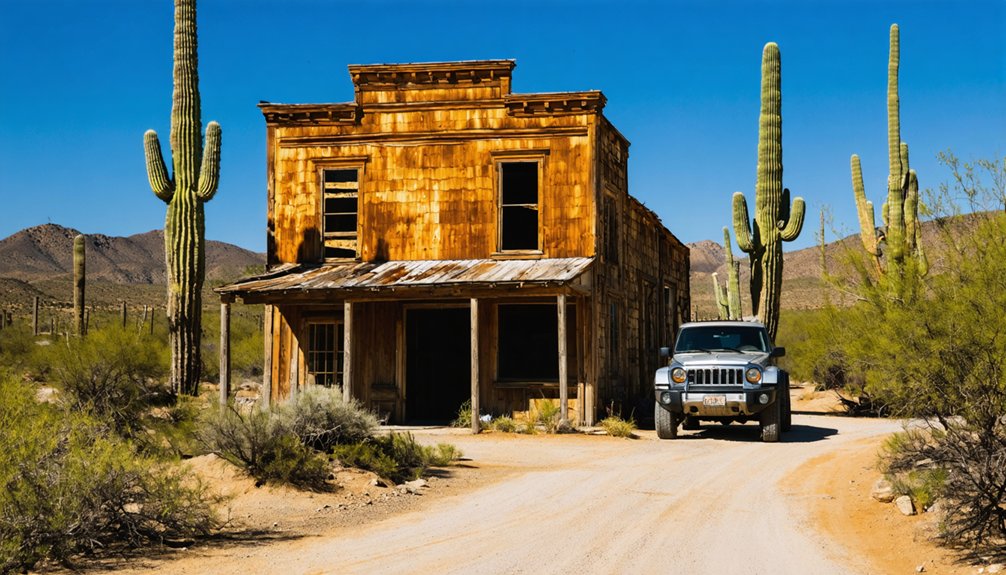
Plotting a ghost town adventure from Scottsdale starts with understanding the geographic spread of your options and the realities of desert driving. Goldfield lies 35–45 minutes east via freeways, while Vulture City requires 1.25–1.5 hours northwest through Wickenburg. Jerome sits 2.25–2.75 hours north with mountain grades.
Essential day-trip preparations:
- Fuel up in Scottsdale—rural segments offer limited services
- Pack water and sun protection for desert heat exposure
- Wear sturdy closed-toe shoes for uneven historic ground
- Check seasonal hours—Vulture City closes Wednesdays and summers
Book Vulture City tours online beforehand for guaranteed entry. Combine stops with nearby parks to maximize your freedom exploring historical artifacts and desert wildlife.
Peak weekend traffic on I-17 and SR-88 extends drive times considerably.
What to Expect at Arizona Ghost Town Sites
You’ll find Arizona ghost towns range from well-preserved attractions with museums and guided tours to remote ruins marked only by foundations and crumbling walls.
the historical significance of kingman area is evident in its rich history as a transportation hub during the early 20th century. Many travelers passed through on their way to California, leaving behind stories and relics that still capture the imagination today. Exploring the remnants of this vibrant past can offer unique insights into the development of the American West.
If you’re looking for adventure, you can explore old mining towns near Mesa that once thrived during the gold rush. These locations often feature abandoned structures and museums that tell the stories of the miners who sought their fortunes beneath the rugged Arizona landscape. Visiting these towns offers a fascinating glimpse into the challenges and triumphs of those who shaped the area’s history.
Safety protocols vary greatly—commercial sites like Goldfield maintain developed paths and clear signage, while abandoned locations near Scottsdale may have unstable structures, open mine shafts, and minimal warnings.
Your experience depends largely on whether you choose staffed destinations offering narrated tours and amenities or venture to backcountry sites requiring self-navigation through rough terrain.
Levels of Preservation Vary
When you explore ghost towns near Scottsdale, you’ll encounter a wide spectrum of preservation conditions—from fully restored, museum-quality sites with guided tours and admission fees to remote archaeological ruins marked only by stone foundations and scattered mining debris.
Preservation levels you’ll find:
- Professionally restored towns like Vulture City and Goldfield feature stabilized structures, curated interiors, and modern visitor amenities, employing restoration techniques that prioritize historical accuracy.
- BLM-managed sites such as Swansea offer selective structural shoring to address preservation challenges while maintaining authentic ruin aesthetics.
- Archaeological-style remains at Courtland and Copper Creek present collapsed buildings, tailings piles, and machinery fragments with minimal interpretation.
- Living ghost towns including Jerome and Oatman blend historic structures with active businesses and resident populations.
Each site reflects different management philosophies and funding levels, shaping your exploration experience.
Access and Safety Considerations
Before setting out to explore ghost towns near Scottsdale, understand that accessing these sites demands more preparation than visiting typical tourist attractions. Many locations require traversing unpaved dirt roads with washboards, ruts, and loose gravel—high-clearance vehicles are frequently recommended.
Monsoon storms can render remote sites temporarily inaccessible through flash floods and washouts.
Essential safety precautions include carrying ample water, as most ghost towns lack potable sources or restrooms. Extreme desert heat from late spring through early fall raises dehydration risks, while limited shade intensifies sun exposure.
Road conditions change rapidly due to seasonal weather and grading work; check current land-agency updates before departure. Watch for rattlesnakes, scorpions, and unstable structures with falling debris. Emergency services response times extend considerably in these remote areas.
Guided Tours vs. Self-Exploration
Once you’ve assessed the safety requirements for reaching these remote locations, you’ll need to decide how you want to experience them.
Guided tour benefits include professional expertise delivery through meticulously researched historical narratives, access to restricted areas like turquoise mines, and evening departures that create atmospheric exploration.
However, self exploration drawbacks involve limited interpretation without live guides and restricted access to certain locations.
Consider these key differences:
- Timing flexibility: Self-guided visits at Vulture City run 9 AM to 5 PM Thursday-Sunday, while Scottsdale ghost tours depart at 8 PM
- Cost structure: Self-exploration requires only entrance fees versus additional guide service charges
- Historical depth: Guided experiences provide multi-layered context connecting tragedies and documented events
- Personal pace: Independent exploration lets you spend unlimited time at each of 16+ original 1800s buildings
Best Times to Visit Ghost Towns Near Scottsdale
Planning your ghost town adventure around Scottsdale requires understanding the region’s distinct seasonal patterns and their impact on your exploration experience.
The best visiting times offer distinct seasonal advantages based on your priorities. Spring delivers peak blooming periods and ideal weather, though you’ll encounter maximum crowds during March and April.
Summer provides minimal tourist presence and lowest accommodation rates, but you’ll need to explore between dawn and mid-morning before extreme heat arrives.
Fall offers moderate temperatures with reduced facility congestion, while winter presents almost identical weather to spring with considerably lower costs.
June and July constitute the official off-season with special resort pricing, while December through February represent the “secret season” with comfortable conditions and minimal crowds.
Ghost Town Tours and Guided Experiences
Ghost town tours departing from Scottsdale’s historic district transform evening walks into immersive explorations of the region’s darker past, with most experiences concentrating on Old Town’s one-mile haunted corridor rather than remote desert locations.
You’ll encounter historical narratives spanning Prohibition-era secrets, unsolved murders like Bob Crane’s mysterious death, and ghostly encounters at landmarks including the Rusty Spur Saloon.
Tour options include:
- Nightly 8 PM departures with expert guides providing meticulously researched accounts
- 75-minute puzzle-solving adventures blending interactive mystery elements with paranormal storytelling
- Private group experiences customizable for bachelorette parties and special occasions
- Extended routes accessing additional supernatural sites beyond standard destinations
Tours meet at Scottsdale Historical Museum (7333 E. Scottsdale Mall), requiring identification instead of printed tickets for these exterior-only walking experiences.
Essential Tips for Exploring Abandoned Mining Towns
Before venturing into abandoned mining camps scattered across Arizona’s central desert, you’ll need to evaluate four critical factors that determine whether your expedition succeeds or ends in emergency rescue.
First, verify land status—many sites sit on active mining claims or private ranches where trespassing carries legal consequences.
Second, research road conditions and distance from services; unmaintained dirt tracks can trap vehicles in sand or mud.
Third, implement safety precautions: maintain buffer distances from unmarked shafts, avoid entering unstable structures with rotted timbers, and never explore underground workings where oxygen-deficient air and cave-ins threaten lives.
Finally, practice cultural preservation by leaving artifacts, bottles, and equipment untouched—removing items violates state and federal historic protection laws while destroying irreplaceable heritage for future generations.
Frequently Asked Questions
Are Ghost Towns Near Scottsdale Safe for Families With Young Children?
Established ghost towns like Goldfield offer family-friendly activities with supervised tours and amenities, making them safe when you follow basic safety tips: bring water, watch footing on uneven terrain, and avoid extreme heat.
Do I Need a High-Clearance Vehicle to Reach Arizona Ghost Towns?
Not always, but you’ll appreciate high clearance benefits on most routes. Vehicle recommendations vary—some ghost towns need 4WD, while others accept standard cars in dry weather. Check each site’s specific road conditions beforehand.
Can I Bring My Dog to Ghost Town Sites Near Scottsdale?
Unlike Toto staying behind, you’ll find dog-friendly policies at most ghost town sites near Scottsdale, including Goldfield and Tortilla Flat. Leash requirements apply everywhere, with some indoor attractions restricting entry.
Are There Overnight Accommodations Available at or Near Ghost Town Locations?
Ghost town accommodations aren’t typically on-site, but you’ll find overnight stays nearby. Jerome offers historic inns within town, while Goldfield and Vulture City require lodging in Apache Junction or Wickenburg respectively.
Do Ghost Towns Near Scottsdale Require Entrance Fees or Reservations?
Entrance policies vary like desert trails—Goldfield offers free street access with pay-per-activity options, while Vulture City requires paid admission. Reservation requirements apply mainly to guided tours and special events, though walk-ups work at Goldfield.
References
- https://en.wikipedia.org/wiki/List_of_ghost_towns_in_Arizona
- https://www.experiencescottsdale.com/stories/post/ghost-towns-in-arizona/
- https://www.elitevrs.com/blog/discover-these-top-10-ghost-towns-arizona
- https://www.staywithstylescottsdale.com/blog/top-ghost-towns-to-visit-in-arizona/
- https://www.visitarizona.com/like-a-local/4-arizona-ghost-towns-you-may-have-never-heard-of
- https://www.tripadvisor.com/Attractions-g28924-Activities-c47-t14-Arizona.html
- https://goldfieldghosttown.com
- https://www.youtube.com/watch?v=Kd_JwhaGDVg
- https://www.ajpl.org/building-a-dream-goldfield-ghost-town/
- https://www.legendsofamerica.com/az-goldfield/