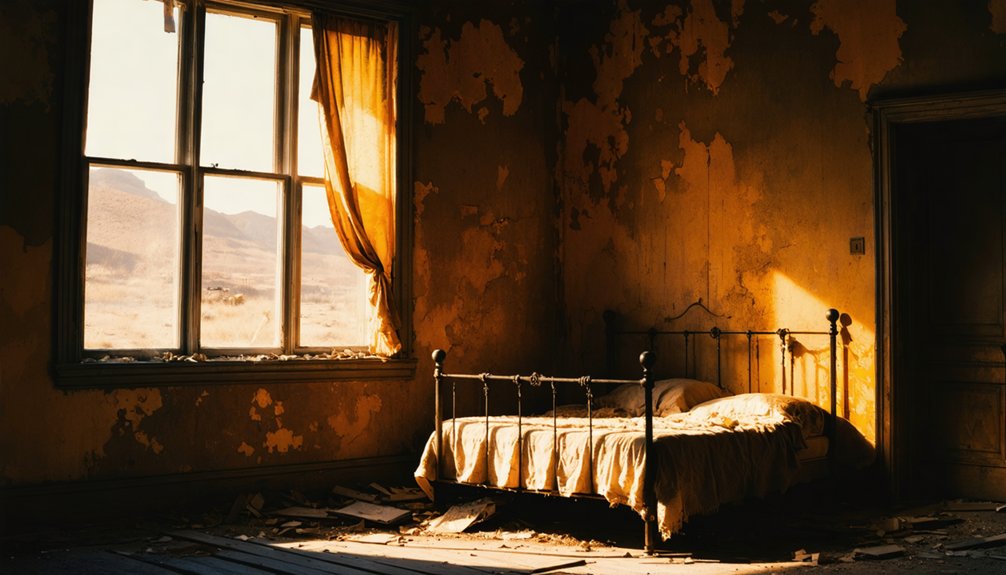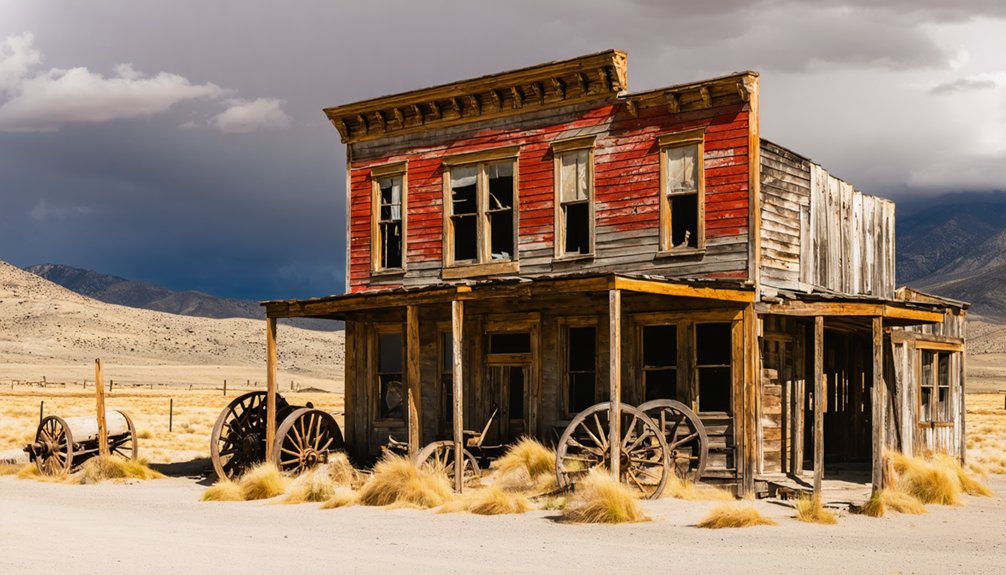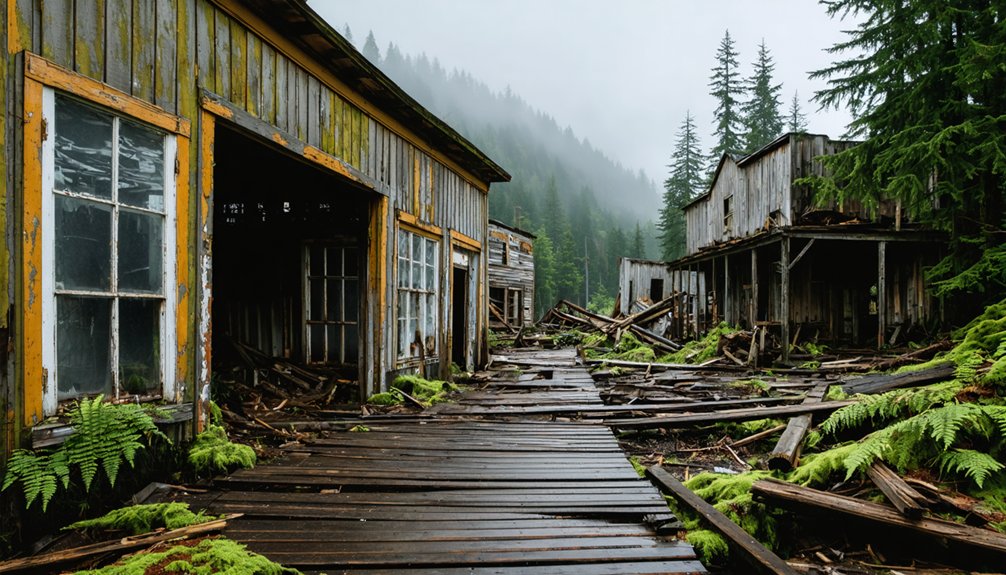
You’ll discover fascinating ghost towns within two hours of Seattle, each telling stories of Washington’s mining past. Monte Cristo’s silver boom collapsed after an 1897 flood, leaving 15 buildings accessible via a four-mile hike from Barlow Pass. Franklin’s coal mines claimed 37 lives in an 1894 fire linked to labor conflicts. Liberty, established in the 1860s, remains Washington’s oldest gold-mining townsite with preserved miners’ cabins. Meanwhile, Moncton’s submerged ruins emerge when Rattlesnake Lake’s waters recede, revealing foundations from before the 1915 flooding. Each site offers unique glimpses into frontier ambitions and tragedies.
Key Takeaways
- Monte Cristo, 40 miles from Everett, features 15 remaining buildings accessible via a four-mile trail from Barlow Pass.
- Wellington marks the deadliest U.S. avalanche site; the six-mile Iron Goat Trail preserves snow sheds and tunnel portals.
- Moncton’s submerged ruins appear at Rattlesnake Lake during low water, accessible via short trail for photography.
- Liberty, Washington’s oldest mining townsite, preserves 19th-century cabins and features a working arrastra replica and museum.
- Franklin’s coal mining history includes the 1894 fire killing 37 miners; only forest and records remain today.
Monte Cristo: A Cascade Mining Boomtown Frozen in Time
Deep in the Northern Cascades, roughly 40 miles from Everett, the remnants of Monte Cristo stand as a tribute to the feverish mining ambitions of the 1890s.
Joseph Pearsall’s 1889 silver ore discovery transformed this remote valley into a boomtown of over 1,000 souls by 1894. You’ll find echoes of John D. Rockefeller’s investments, which once controlled two-thirds of the primary mining operations here.
The 1897 flood and unpredictable ore deposits eventually crushed these ventures, driving residents away by 1907.
Today, you can hike four miles along the old mining road from Barlow Pass, where approximately 15 buildings remain. The trail follows the old railroad grade, once part of the Monte Cristo Railroad that served the mining operations. The generally level route includes a few steep sections as it traces the South Fork Sauk River. Despite vandalism and fires, these structures represent a raw piece of historical preservation—testament to ambition’s fleeting nature in unforgiving wilderness.
Franklin: Coal Mining Tragedy Along the Green River
Where the Green River carves through southeastern King County’s forested gorge, the vanished town of Franklin clings to memory through tragedy rather than triumph. Established in the 1880s after coal discovery, this company town swelled to over 1,100 residents before disaster struck.
Franklin’s ghost town history centers on the catastrophic 1894 mine fire that killed 37 miners trapped 700 feet underground. A coroner’s jury ruled arson, linking the tragedy to bitter mining conflicts between immigrant workers and company bosses.
Thirty-seven miners perished 700 feet underground when arson ignited Franklin’s deadliest tragedy amid escalating labor warfare.
Key remnants of Franklin’s volatile past include:
- Armed confrontation on June 28, 1891, when African American strikebreakers clashed with European immigrant miners
- Company-controlled housing and scrip payment systems that fueled labor unrest
- Ventilation failures that turned underground workings into death traps
The Pacific Coast Company acquired the struggling Oregon Improvement Company in 1897, stabilizing operations and producing nearly 200,000 tons of coal annually by the early 1900s. Today, nothing remains but forest and fading records. The old rail bridge now serves as a water supply conduit for the City of Black Diamond, one of the few functional traces of the once-thriving mining community.
Northern State: The Asylum Town That Housed Thousands
Four miles northeast of Sedro-Woolley, across 1,100 acres of Skagit County farmland, Northern State Hospital opened its doors in 1912 as Washington’s solution to psychiatric overcrowding.
This Spanish Colonial Revival campus became the state’s largest mental institution, housing over 2,700 patients by the 1950s.
The asylum history reveals a self-sustaining town where patient experiences ranged from therapeutic farm work to controversial treatments.
You’ll find accounts of dairy operations, canneries, and open grounds without fences—an unusually relaxed approach that allowed frequent walk-aways.
The facility housed not only the mentally ill but also epileptics, elderly residents, and social nonconformists swept up in institutional care.
Local families attended Easter egg hunts here, blurring boundaries between confinement and community until shifting attitudes toward psychiatric care began dismantling this autonomous world.
Dr. A.H. McLeish served as the institution’s first superintendent, overseeing the early development of the hospital grounds.
After funding cuts by the Washington State Legislature, Northern State closed in 1976, leaving behind a mostly abandoned campus where portions now serve local Job Corps and a drug rehabilitation center.
Liberty: Washington’s Oldest Gold Rush Settlement
You’ll find Washington’s oldest continuously surviving gold-mining townsite nestled in the Swauk Mining District, where prospectors first struck gold in 1868 and transformed wilderness into Liberty by the 1890s.
Unlike the rowdy, lawless camps that typically defined the frontier era, this settlement cultivated stable family life across three generations of miners who worked the creek beds for coarse nuggets and crystalline wire gold.
Today, the National Register-listed Liberty Historic District preserves authentic miners’ cabins and structures from the 1870s boom, offering a rare glimpse into a 19th-century mining community that never truly died. The town showcases a replica of the Virden Arrastra, rebuilt after vandals destroyed the original 1974 structure that once operated at 4,000 feet on Table Mountain. The historic Assay Office, constructed before 1895 using local materials, still stands as a testament to the district’s early mining operations before being converted into a miner’s residence.
1870s Mining Boom Origins
When prospectors first struck gold in the Swauk area in 1868, they set in motion what would become Washington’s oldest organized mining district—a distinction formalized five years later in 1873.
Those early fortune-seekers worked streambeds like Williams and Swauk Creeks with pans and sluices, chasing coarse placer deposits that occasionally yielded extraordinary returns. One legendary pan reportedly valued at $1,365 exemplified the boom’s potential.
The district’s gold mining operations and commitment to historic preservation reflect a unique character:
- Hundreds of thousands of dollars flowed from Swauk-Liberty operations during the 1880s, fueling Washington’s territorial economy.
- Miners discovered rare crystalline wire gold formations, later tumbled into distinctive “Liberty nuggets” by ancient Columbia River processes.
- Unlike typical boom-bust camps, Liberty maintained continuous occupation, preserving mining-era structures while sustaining modest permanent populations.
- The area attracts rock hounds seeking Ellensburg Blue Agates, recognized as the third rarest gemstone.
National Register Historic Buildings
Liberty’s enduring presence earned it official recognition in the National Register of Historic Places as the only surviving old-style gold mining town in Washington.
You’ll discover 19th-century cabins, commercial buildings, and mining structures that tell the story of Washington’s oldest organized district, formally established in 1873.
The Gus Nelson cabin (1891) served triple duty as dwelling, school, and post office—embodying frontier resourcefulness.
You can examine the Nicholson brothers’ historic store, an arrastra replica demonstrating ore-crushing technology, and authentic mining equipment displayed throughout this “living ghost town.”
Historic preservation efforts protect the Meagher, Virden, Jordin, and Needham family buildings, ensuring Liberty’s mining heritage remains accessible for those seeking authentic connections to territorial-era gold-camp life.
Family-Friendly Gold Rush Stop
Hidden among the forested ridges 90 miles east of Seattle, Liberty beckons families with an authentic gold rush experience that’s both educational and accessible.
Washington’s oldest mining townsite invites you to explore where gold discovery first sparked territorial economic development in 1868. You’ll wander through a living ghost town where multi-generational mining families once extracted coarse nuggets and rare crystalline wire gold from Swauk Creek.
- Working arrastra replica demonstrates how miners crushed ore using historic mining equipment powered by a horizontal undershot water wheel
- Mamie Caldwell’s restored house serves as the town’s museum, preserving artifacts from three generations of homesteading families
- Swauk Mining District trails let kids pan for gold where single findings once yielded $1,365 in historic values
This stable community never tolerated frontier lawlessness, creating a family-oriented atmosphere that persists today.
Wellington and the Iron Goat Trail: Railroad Disaster Site
Along the old Great Northern Railway grade in northeastern King County, the ghost town of Wellington stands as a somber monument to the deadliest avalanche in American history.
On March 1, 1910, a quarter-mile-wide avalanche swept two stranded passenger trains 150 feet into the Tye River Valley, killing 96 people beneath 40 feet of snow.
You’ll find this avalanche history preserved along the six-mile Iron Goat Trail, where collapsed concrete snow sheds and tunnel portals showcase early twentieth-century railroad engineering.
Great Northern Railway constructed nine miles of protective snow sheds after the disaster, then abandoned the site when the New Cascade Tunnel opened in 1929.
The town was renamed Tye to escape the tragedy’s shadow, then disappeared entirely—leaving only ruins for modern explorers.
Moncton: The Submerged Town of Cedar River
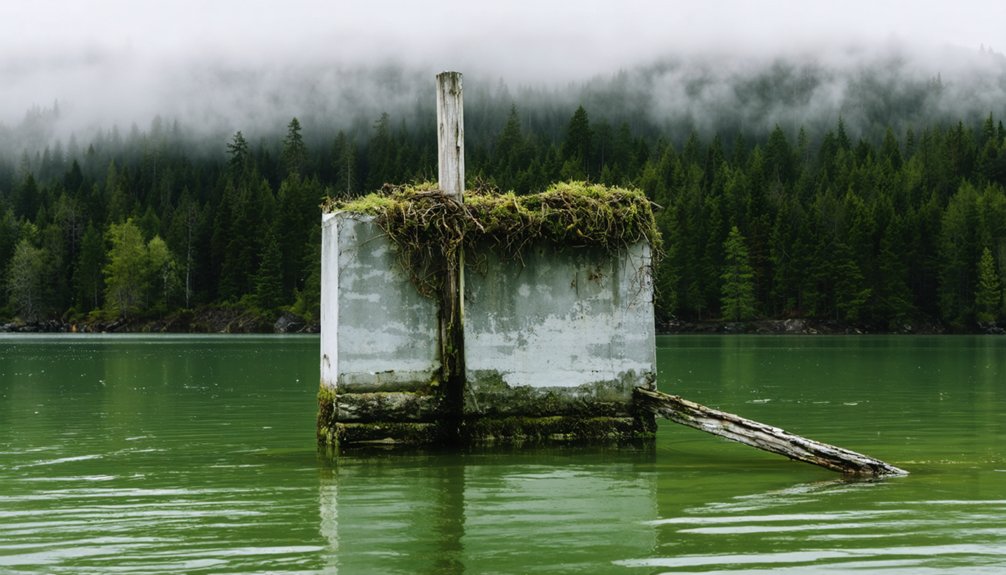
When Rattlesnake Lake‘s water levels drop during dry summer months, you’ll witness cedar stumps, foundation remnants, and occasionally complete building frames emerging from the depths—ghostly evidence of Moncton’s 1915 drowning.
The site sits on public land within the Cedar River Watershed, accessible via a short trail from the Rattlesnake Lake parking area where interpretive signs explain the town’s tragic history.
You’re free to walk the shoreline and photograph the ruins during low-water periods, though the submerged structures themselves remain off-limits to preserve what’s left of this century-old catastrophe.
Reservoir Levels Reveal Ruins
During exceptionally dry summers, Rattlesnake Lake’s receding waters expose the ghostly foundations of Cedar Falls—a town that met its demise not through fire or abandonment, but through an engineering miscalculation that turned solid ground into lakebed.
When you visit during drought conditions, you’ll witness this drowned history emerging from the depths:
- Concrete foundations and building remnants jutting from the mud, marking where homes and businesses once stood before the 1915 flooding
- Brick fragments and rotted timber scattered across the exposed lakebed, physical evidence of the 200 structures that couldn’t be salvaged
- Stumps and Depression-era artifacts creating an eerie landscape that reveals multiple layers of submerged remnants
These temporary revelations offer rare glimpses into the town that water claimed over a century ago.
Accessing the Drowned Town
The submerged ruins of Moncton lie beneath Rattlesnake Lake‘s surface, easily accessible from paved trails at the recreation area near North Bend.
You’ll find the best viewing during fall when dropping water levels expose foundations, stumps, and an old fireplace—tangible remnants of the 1906 railroad town. Drought periods offer even more dramatic reveals of this submerged history, with century-old structures emerging from the depths.
Scuba divers regularly explore the lakebed, discovering drowned artifacts that’ve rested undisturbed since 1915.
You’re free to walk the shoreline and photograph whatever the lake chooses to expose, though swimming remains prohibited due to water supply concerns.
The site requires no permits or fees—just park and wander among the ghosts of Seattle’s flooded past, visible proof of progress’s cost.
Remote Mining Camps: Copper City, Govan, and Okanogan Country Ghost Towns
Beyond the well-trodden paths of popular Washington ghost towns, remote mining camps like Copper City tell stories of ambitious ventures that tested the limits of both human determination and economic viability.
Nestled along Deep Creek in Yakima County’s Bumping Mining District, this abandoned settlement represents Washington’s mining heritage through its scattered remnants and cautionary tale of unfulfilled promises.
- Operational timeline: From James T. Cap Simmons’ 1889 claim through 1948, when equipment relocated to other mining centers
- Infrastructure peak: By 1910, the camp featured a sawmill, blacksmith shop, ore mill, cabins, and bunkhouse serving 42 active claims
- Decline factors: Failed railroad expansion and underwhelming ore production doomed the operation despite $55-per-ton assays
Today, you’ll find interpretive signs, mill ruins, and weathered timber marking this backcountry monument to frontier ambition.
Frequently Asked Questions
What Permits or Passes Are Required to Visit Ghost Towns Near Seattle?
You’ll need a Discover Pass for state-managed sites and a Northwest Forest Pass for federal trailheads. Permit requirements vary by location, so check visiting guidelines beforehand—some ghost towns remain on private property requiring owner permission.
Are Ghost Town Sites Safe for Children and Pets?
Ghost town safety varies considerably—Monte Cristo’s arsenic contamination alone requires serious child precautions. You’ll find unstable structures, hidden mine shafts, and rusty metal at most sites, so supervise closely and keep pets leashed throughout your exploration.
Can You Camp Overnight Near Any of These Ghost Towns?
You can camp overnight near several ghost towns using dispersed camping regulations in national forests, but most ghost town amenities don’t exist at the actual sites—you’ll find better infrastructure at nearby developed campgrounds along access roads.
If you’re interested in history, exploring ghost towns near White Sands can provide a fascinating glimpse into the past, with remnants of old structures and artifacts scattered throughout the area. Additionally, the stark beauty of the landscape serves as a stunning backdrop for photography and hiking. Be sure to bring plenty of water and supplies, as these locations can be quite remote.
What’s the Best Time of Year to Visit Ghost Towns Near Seattle?
Late spring through early fall offers the best weather for exploring, with July–August providing reliable road access and long daylight. Time your trip around wildflower season or fall foliage for memorable seasonal events.
Are Guided Tours Available for Any Ghost Town Locations?
Like forgotten trails waiting for wanderers, most ghost towns near Seattle offer self-guided exploration rather than daily tour options. You’ll find occasional guided experiences through hiking clubs and history groups at Franklin, Wellington, and Northern State—freedom on your schedule.
References
- https://stateofwatourism.com/ghost-towns-of-washington-state/
- https://okanogancountry.com/ghost-towns
- https://www.seattlemet.com/travel-and-outdoors/2019/09/ghost-towns-washington-state
- https://www.youtube.com/watch?v=FVveO9uJBvc
- https://www.wta.org/go-outside/seasonal-hikes/fall-destinations/hidden-history-ghost-town-hikes
- https://www.cascadeloop.com/ghost-towns-and-haunted-places-in-the-washington-cascades
- https://www.wta.org/go-hiking/hikes/monte-cristo-143
- https://www.historylink.org/file/8404
- https://westernmininghistory.com/towns/washington/monte-cristo/
- https://www.youtube.com/watch?v=uVMTCY45z3U