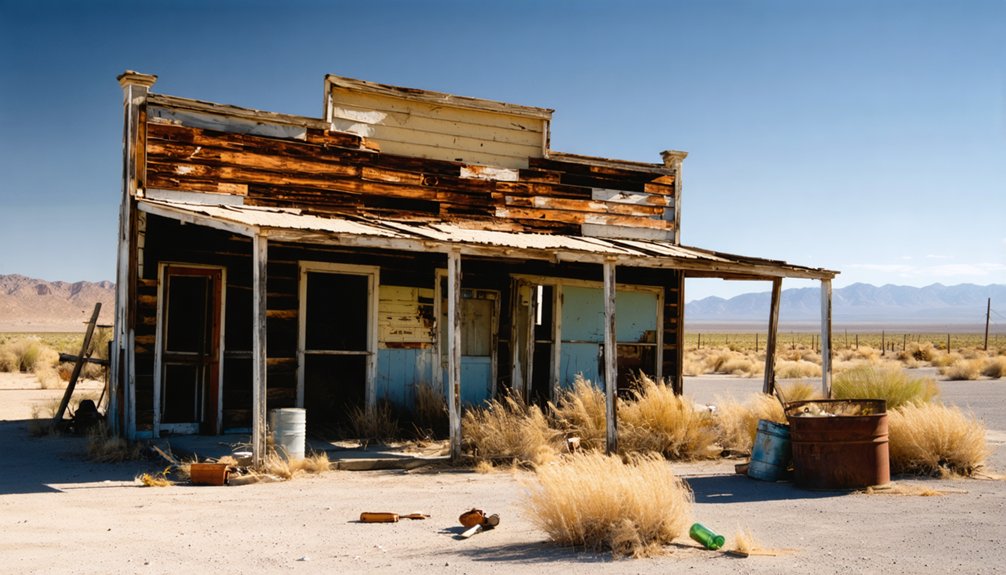
You’ll find Jerome, Arizona’s most famous ghost town, just 30 miles from Sedona—a former copper mining boomtown that produced $800 million in ore before closing in 1953. The population dropped from 15,000 to under 250, leaving intact 1890s buildings now housing galleries and restaurants. Other nearby sites include Gold King Mine Ghost Town, Chloride with its muraled cliffs, and Oatman’s burro-filled streets along Route 66. The article below covers specific attractions, ghost tours, and essential planning tips for your exploration.
Key Takeaways
- Jerome, located 30 miles from Sedona, is Arizona’s most famous ghost town with 444-500 residents and rich copper mining history.
- Once a booming mining town of 15,000 people, Jerome was declared America’s largest ghost town after mines closed in 1953.
- The town features preserved historic buildings, including the 1916 Douglas Mansion, Jerome Grand Hotel, and museums documenting mining heritage.
- Jerome offers ghost tours, over 30 galleries and restaurants, and is recognized as one of Arizona’s most haunted destinations.
- Other nearby ghost towns include Chloride, Oatman with free-roaming burros, and Route 66 sites like Two Guns and Hackberry.
Jerome: America’s Largest Ghost Town Just 30 Minutes Away
This former copper mining boomtown sits approximately 30 miles from Sedona—just a short scenic drive that makes it an ideal day trip destination.
Today’s population of roughly 444-500 residents preserves the town’s historical significance through museums, preserved mining infrastructure, and Jerome State Park, established in 1965.
Artists, musicians, and craftspeople who arrived in the 1960s transformed this near-extinct settlement into a thriving artisan community.
Throughout the year, community events showcase local artwork, glassblowing demonstrations, and live performances.
The 1938 underground blast that sent the business district sliding 225 feet downhill remains visible, offering tangible connections to Jerome’s tumultuous mining past.
Beneath the town lie 88 miles of tunnels from its mining era, which operated until the mines closed in 1953.
At its peak, Jerome was home to 15,000 residents during the prosperous mining years before becoming one of Arizona’s most fascinating ghost towns.
The Rise and Fall of Jerome’s Copper Mining Empire
Jerome’s transformation from a remote mining camp in 1876 to Arizona Territory’s largest copper producer by the early 20th century created a billion-dollar mining empire that employed hundreds of workers from across Europe and America.
The United Verde Copper Company, backed by William A. Clark’s investment in railroad infrastructure, extracted approximately 800 million dollars in copper before Phelps Dodge’s acquisition in 1935 marked the beginning of the operation’s decline.
When Phelps Dodge closed the remaining mines in 1953 after 77 years of production, Jerome’s population plummeted from thousands to less than a hundred residents, earning it the designation as America’s largest ghost town. The town’s early reputation as the “wickedest town in America” in 1899 reflected its rough mining camp culture, with saloons and bordellos dominating the wooden structures that lined Cleopatra Hill.
James S. Douglas constructed his adobe brick mansion in 1916 above the Little Daisy Mine, which he had purchased in 1912 to expand the region’s copper operations.
Copper Boom Era Begins
When prospectors discovered copper-bearing claims near Cleopatra Hill in 1875–1876, they set in motion what would become one of Arizona’s most legendary mining booms.
By 1883, the United Verde Copper Company‘s small blast furnace was processing 5,000 tons of ore and producing 200 tons of copper bullion in just four months of operation. Early smelting profits reached $1,500–$2,000 daily, establishing Jerome as a viable camp.
The economic impact accelerated dramatically after William A. Clark purchased United Verde in 1888 and built a narrow-gauge railroad that slashed transportation costs.
His new smelter facilities generated nearly $1 million in copper during the initial development phase alone. By 1890, copper mining operations employed over 300 workers, transforming Jerome from a tent camp into a permanent town with electric lighting. The town was named after financier Eugene Jerome, who helped fund the early mining operations.
Mining Operations Cease 1953
By the early 1950s, Jerome’s once-profitable copper empire faced insurmountable economic realities. High-grade ore had been exhausted, forcing reliance on lower-grade deposits that mining technology of the era couldn’t extract profitably.
Rising labor and maintenance costs, combined with devastating geologic problems from decades of blasting, made continued operations economically unfeasible. The shift to open-pit methods in 1918 had destabilized entire hillsides through massive explosions—some using over 200,000 pounds of explosives—triggering landslides that damaged infrastructure throughout town.
When operations halted in 1953, you witnessed economic decline that was swift and total. The population plummeted from several thousand to just 132 adults and 90 children within months. Essential services had relocated to the Verde Valley, leaving the town largely empty. Jerome was subsequently declared the largest ghost town in the nation, a title that reflected the dramatic transformation from Arizona Territory’s premier copper producer to an abandoned settlement.
Corporate owners predicted complete abandonment, forecasting that “grass will grow on the main street.”
Ghost Town Transformation
The 1953 closure transformed what had been Arizona’s fourth-largest city into one of the Southwest’s most improbable ghost towns. Jerome’s population plummeted from nearly 15,000 at its peak to fewer than 100 residents by the mid-1950s.
The billion-dollar copper camp—which had produced 3 billion pounds of copper, 48.3 million troy ounces of silver, and 1.3 million troy ounces of gold—sat largely abandoned on Cleopatra Hill.
You’ll find that ghost town preservation efforts began in the 1960s when artists and entrepreneurs recognized Jerome’s potential. The Jerome Historical Society, founded in 1953, collaborated with local business leaders to promote tourism and support the economic transition from mining to heritage preservation.
Today, the town stands as a monument to mining heritage, with former company buildings, the United Verde smelter ruins, and hillside structures documenting nearly a century of industrial extraction that once powered the territory’s economy.
Gold King Mine & Ghost Town in Historic Haynes
About a mile north of Jerome on present-day Perkinsville Road, the former mining camp of Haynes emerged in 1890 when the Haynes Copper Company’s exploratory shaft—sunk between 100 and 1,200 feet in search of copper—unexpectedly struck gold instead.
By 1901, the camp supported 304 residents with essential infrastructure, but ore depletion reduced the population to just 14 by 1914 before complete abandonment.
Don Robertson transformed the site into Gold King Mine & Ghost Town during the 1960s–1980s, creating what’s marketed as a “time capsule” attraction featuring:
- Original mine shaft (1,270 feet deep, now plugged)
- Early-1900s operational sawmill producing lumber
- 180+ antique vehicles including an 1902 Studebaker Electric
- Period mining equipment, winches, and ore carts
Several authentic Haynes-era structures remain, including the blacksmith shop and boarding-house buildings. Visitors can also explore an 1909 boarding house, which stands as the only original structure on the premises from the early mining camp era.
What to See and Do in Jerome’s Historic District
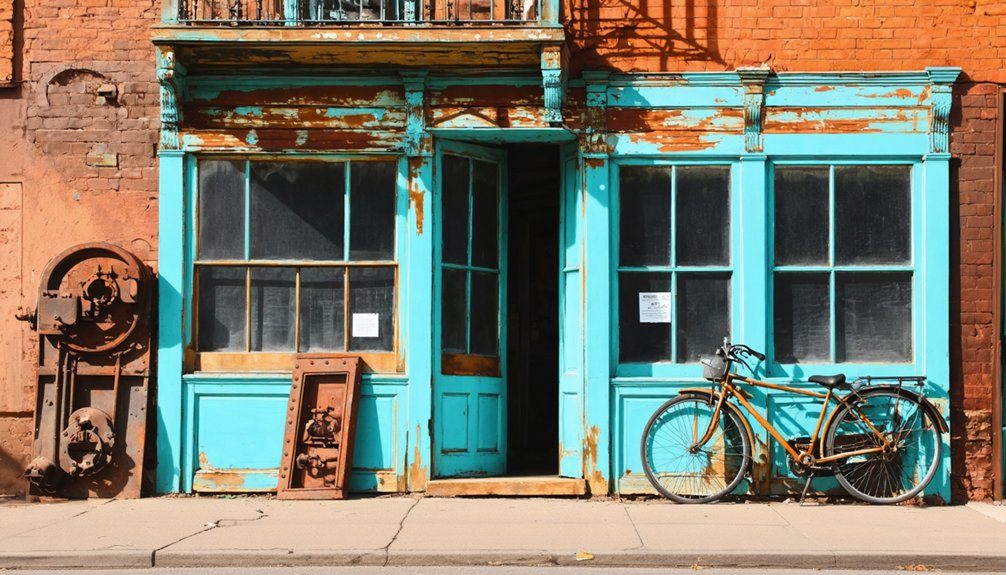
Jerome’s National Historic District, designated in 1967, preserves late-19th and early-20th-century commercial buildings that now house museums documenting the town’s copper-mining heritage, including the Mine Museum and the 1916 Douglas Mansion at Jerome State Historic Park.
You’ll find eclectic galleries and specialty shops occupying former saloons, brothels, and mercantile spaces along steep, walkable streets that cling to Cleopatra Hill at 5,200 feet elevation.
Historic plaques placed by the Jerome Historical Society mark significant landmarks throughout the downtown core, from the famous Sliding Jail to Holy Family Catholic Church, offering self-guided exploration of the town’s documented past as the “Wickedest Town in the West.”
Historic Buildings and Museums
Perched on Cleopatra Hill at 5,200 feet, Jerome’s historic district preserves more than a century of copper mining heritage through an exceptional collection of early 20th-century commercial buildings, industrial sites, and two major museums.
Jerome State Historic Park occupies the 1916 Douglas Mansion, featuring mining artifacts, a 3-D model of underground shafts, and panoramic Verde Valley overlooks.
The Jerome Historical Society Mine Museum operates from the 1917 New State Motor Building—Arizona’s first Chrysler dealership—displaying boomtown-era exhibits that earned Arizona State Parks’ 2010 “Project of the Year” recognition.
Key structures include:
- Jerome Grand Hotel (former United Verde Hospital)
- Little Daisy Hotel (miner lodging)
- Audrey Headframe Park (1918 shaft facility)
- Spook Hall (community events venue)
These adaptive reuse projects demonstrate exceptional historic preservation while maintaining authentic mining heritage accessibility.
Ghost Tours and Legends
Beyond its architectural legacy, Jerome has cultivated a reputation as one of Arizona’s most haunted destinations, with organized ghost tours now ranking among the historic district’s most popular evening activities.
You’ll find multiple operators offering 1–2 hour walking experiences ($45–$84) that blend documented history with ghost stories tied to the town’s violent mining past. Tours typically include the Jerome Grand Hotel—site of nearly 9,000 hospital-era deaths—Spook Hall, and the former red-light district off Hull Avenue.
Many provide EMF readers for detecting electromagnetic anomalies at locations linked to murders, mining accidents, and bordello tragedies. Guides emphasize both paranormal experiences and verified local history, focusing on documented incidents like the 1912 Walter Vogel murder and legends surrounding spirits of miners and sex workers.
Galleries, Shops, and Dining
While ghost tours draw evening crowds, Jerome’s daytime economy centers on a thriving arts and culinary scene concentrated along Main Street and Hull Avenue, where more than 30 galleries, boutiques, wine tasting rooms, and restaurants occupy rehabilitated mining-era storefronts.
You’ll find art experiences ranging from live glassblowing demonstrations at La Victoria Studio to curated kaleidoscope collections at Nellie Bly. Local artisans display work at Jerome Artists Cooperative Gallery, featuring paintings, ceramics, jewelry, and photography by Verde Valley creators.
Notable stops include:
- Caduceus Cellars tasting room pouring Arizona-grown wines
- The Haunted Hamburger serving casual fare with valley-view patio seating
- OJ’s Copper Country Fudge offering house-made sweets
- The Asylum Restaurant providing upscale American cuisine inside Jerome Grand Hotel
Specialty shops sell Verde Valley minerals, mining memorabilia, and regional foods throughout the compact walkable district.
Other Ghost Town Sites in Northern Arizona
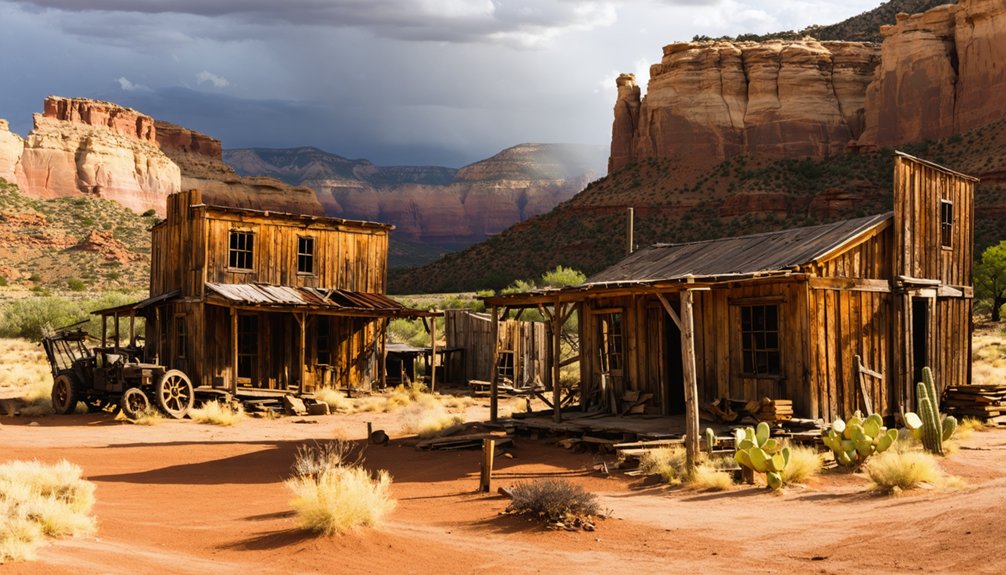
Northern Arizona’s ghost town landscape extends well beyond Sedona’s immediate vicinity, encompassing dozens of abandoned and semi-abandoned settlements scattered across the region’s high desert plateaus and mountain ranges.
Among those intriguing sites are the ghost towns around Sierra Vista, where remnants of a once-thriving mining industry tell stories of hardship and adventure. Exploring these towns offers a glimpse into Arizona’s vibrant yet tumultuous past, attracting history buffs and curious travelers alike. Each abandoned structure serves as a silent witness to the lives that once flourished in these now desolate landscapes.
You’ll find Chloride attractions include muraled rock formations and false-front buildings in Arizona’s oldest continuously inhabited mining camp. Oatman burros—descendants of miners’ pack animals—roam freely through the town’s vintage main street, where staged gunfights recreate Wild West scenes.
Route 66 corridor sites like Two Guns showcase abandoned roadside attractions with burnt stone ruins, while Hackberry functions primarily as a vintage gas station photo opportunity.
Crown King requires traversing unpaved mountain roads to reach its remote saloon and miner cabins. These settlements illustrate how railroad realignments, highway bypasses, and mine closures transformed once-thriving communities into heritage landscapes.
Planning Your Ghost Town Adventure From Sedona
Essential preparation includes:
- Refuel in Sedona or Cottonwood before departure, as fuel and services are limited near ghost-town sites.
- Verify museum and attraction hours in advance, since many maintain seasonal or restricted schedules.
- Arrive early morning or late afternoon to secure parking in Jerome’s constrained lots and avoid peak-season crowds.
- Pack layers, water, and sun protection for variable mountain temperatures and exposed outdoor exploration.
Combine Jerome with Gold King Mine Ghost Town—less than one mile north—for efficient single-day exploration.
Frequently Asked Questions
Are Jerome’s Ghost Town Tours Suitable for Young Children?
Most Jerome ghost tours aren’t suitable for young children due to intense paranormal content. You’ll find better child friendly activities at Gold King Mine, which offers historical education through gold panning, petting zoos, and family-focused exploration instead.
Can You Stay Overnight in Jerome or Nearby Ghost Town Areas?
Yes, you’ll find accommodation options in Jerome’s historic hotels like the Jerome Grand Hotel and Ghost City Inn. Nearby camping facilities include Mingus Mountain campgrounds, though dispersed camping isn’t permitted within Jerome’s town limits.
Do I Need a High-Clearance Vehicle to Visit These Ghost Towns?
No, you won’t need high clearance for Jerome or Gold King Mine; standard cars handle paved routes fine. Vehicle recommendations change only if you’re exploring unmarked mining trails—then high clearance requirements matter for safety.
Are There Guided Ghost Town Tours From Sedona That Include Transportation?
Yes, you’ll find guided tour options departing Sedona that include transportation to Jerome ghost town. Private scenic tours start around $95/hour, while ghost town experiences with shuttles and walking segments typically run 1.5–2 hours.
What’s the Best Time of Year to Photograph Jerome’s Historic Buildings?
While summer monsoons offer dramatic skies, you’ll capture Jerome’s architectural details best in spring or fall when seasonal lighting grazes weathered facades during golden hour, and cooler temperatures let you explore steep streets comfortably.
References
- https://en.wikipedia.org/wiki/List_of_ghost_towns_in_Arizona
- https://justsimplywander.com/ghost-towns-in-arizona/
- https://www.visitarizona.com/like-a-local/4-arizona-ghost-towns-you-may-have-never-heard-of
- https://goldkingmineghosttown.com
- https://www.tripadvisor.com/ShowTopic-g31352-i168-k6405474-Ghost_towns-Sedona_Arizona.html
- https://www.youtube.com/watch?v=cu9Bjomgla0
- https://www.sedona.net/jerome
- https://www.youtube.com/playlist?list=PLRXoNdo9YII4kqqtQMga2d9fjdIRmic6R
- https://www.destinationsdetoursdreams.com/2013/02/jerome-arizona/
- https://www.legendsofamerica.com/az-jeromehaunting/