You’ll find five compelling ghost towns within 90 miles of Silver City, each preserving distinct chapters of New Mexico’s mining heritage. Mogollon, once producing 70% of the state’s precious metals, sits deep in mountain terrain accessible only by high-clearance vehicles. Shakespeare offers guided tours through outlaw history where Billy the Kid roamed. Lake Valley showcases the legendary Bridal Chamber mine that yielded 2.5 million ounces of silver. Hillsboro and Chloride round out your options, each revealing stories of fortunes won and lost beneath the desert sun.
Key Takeaways
- Mogollon, discovered in 1870, produced 70% of New Mexico’s precious metals by 1909 and once housed 6,000 residents.
- Shakespeare, renamed in 1879, hosted outlaws like Billy the Kid and peaked at 3,000 residents before declining.
- Lake Valley features the legendary Bridal Chamber Mine, which yielded 2.5 million ounces of silver before the 1893 panic.
- Chloride emerged after mule skinner Harry Pye discovered high-grade silver chloride in 1879 in a remote canyon.
- Visit during spring or fall for mild weather; bring high-clearance vehicles, water, maps, and check tour schedules beforehand.
Mogollon: A Mining Camp Frozen in Time
Deep in the Mogollon Mountains, where Mineral Creek Canyon cuts through rugged terrain, a soldier named James Cooney stumbled upon New Mexico’s future while scouting for the 8th U.S. Cavalry in 1870.
His discovery of rich gold and silver deposits sparked something extraordinary.
James Cooney’s 1870 discovery transformed a remote mountain canyon into New Mexico’s glittering heart of precious metal production.
By 1909, Mogollon’s mining techniques had grown so sophisticated that they’d account for nearly 70% of New Mexico’s precious metal production—$5,500,000 worth.
You’ll find Mogollon history carved into every weathered building that remains. The town swelled to 6,000 souls chasing fortune, complete with theaters, saloons, and that essential frontier amenity: two red-light districts.
The Little Fannie mine alone produced nearly $20 million in gold and silver, making it the town’s most profitable operation.
In 1912, violence erupted at the Mogollon Mercantile when two clerks died defending the Ernestine Mining Co. payroll during a robbery that netted over $3,500.
Today, you’re free to wander among wooden structures and adobe ruins, exploring what remains when the gold runs out and dreamers move on.
Shakespeare: Where Outlaws Once Roamed
Where Mexican Spring bubbled up from the desert floor, two miles south of present-day Lordsburg, the U.S. Army established a mail station in the mid-1800s.
Shakespeare emerged here in 1870 as Ralston, riding silver dreams to 3,000 souls before crashing into scandal and dust by 1874.
Colonel William G. Boyle revived it in 1879, renaming it Shakespeare to escape financial ghosts.
You’ll find outlaw legends everywhere—Billy the Kid, John Ringo, Curly Bill—men who moved through these streets when formal law didn’t exist.
Frontier justice prevailed through one simple rule: if you killed someone, you dug the grave.
Vigilantes strung up notorious outlaws like Sandy King and Russian Bill, delivering swift justice without trials.
Picture Shakespeare’s peak:
- Three saloons pouring whiskey for desperate miners
- The Stratford Hotel where a man died fighting over an egg
- Texas gunmen hired to protect company silver
Three generations of women preserved this ghost town through tireless research, restoration, and education efforts spanning decades.
Lake Valley and the Legendary Bridal Chamber
You’ll find Lake Valley’s story begins in 1876, when prospectors George W. Lufkin and Chris Watson heard whispers of pure silver chloride lying south of Hillsboro—a discovery that would birth one of New Mexico’s most prosperous mining camps.
The legendary Bridal Chamber mine alone yielded 2.5 million ounces of silver, though its discoverer, blacksmith John Leavitt, sold his claim back to the Sierra Grande Company for just a few thousand dollars.
Within months of their initial strike, Lufkin and Watson extracted half a ton of ore and sold it to John Miller, who quickly recognized its exceptional value and became their financial partner.
In 1881, the property was split among five mining companies, and a railway was constructed to transport both miners and the precious silver ore that would sustain the community for over a decade.
Today, you can walk the quiet streets where 10 to 12 weathered buildings still stand, remnants of a town that thrived until the silver panic of 1893 sent it into the slow decline that claimed its last resident in 1994.
Discovery of Silver Riches
Although the hills around Lake Valley had been grazed by cattle for years, it wasn’t until the summer of 1878 that cowboy prospector George W. Lufkin noticed something extraordinary.
Dark iron-manganese layers at the surface led him to stake the Lincoln claim on August 12, 1878, marking Lake Valley’s transformation into a renowned silver mining district of tremendous historical significance.
The discovery sparked a chain reaction when rancher Lou McEvers independently found silver on his nearby ranch, triggering what became known as the “McEvers ranch silver deposit excitement” across national mining circles by August 1879. In 1880, John Miller purchased McEvers’ ranch and mining claims, consolidating control over these promising mineral deposits.
The region’s geological treasures included:
- Nodular, blue, crinoidal limestone hosting rich silver veins
- Stephanite, proustite, and native silver mineralization
- Surface enrichment creating extraordinarily pure ore deposits
These finds would soon culminate in the legendary Bridal Chamber discovery. The Bridal Veil Silver Mine would later showcase a silver piece worth $7,000 at the 1882 Denver World Exposition, demonstrating the extraordinary wealth extracted from Lake Valley’s underground chambers.
Town Decline and Preservation
The glittering promise of the Bridal Chamber couldn’t last forever. When the Silver Panic of 1893 crashed prices, Lake Valley’s mines became unprofitable almost overnight.
The railroad spur that connected you to commerce vanished in 1934, its tracks pulled up and hauled away. Though the tracks are gone, the railroad grade remains visible today, tracing the path of the Atchison, Topeka, and Santa Fe spur line that once hauled ore and supplies. Town infrastructure crumbled piece by piece—the post office closed in 1954, and by 1994, the last resident had locked their door for good.
Today, you’ll find only two or three houses standing among foundations and rubble where blacksmiths, saloons, and boarding houses once thrived. Leftover bottles scattered throughout the ruins hint at bootlegging during prohibition, adding another layer to Lake Valley’s colorful past.
Ghost town preservation efforts now protect what remains. Cornerstones Community Partnerships stabilizes key buildings, while a caretaker monitors visitors during open hours, ensuring Lake Valley’s story survives without modern development compromising its haunting authenticity.
Hillsboro: Gold Rush Legacy in the Black Range
- The courthouse shell, now mesquite-choked brick walls open to sky.
- The 1906 stone jail, bars still guarding empty cells.
- The Black Range Museum’s adobe, once headquarters for hydraulic operations.
A handful of free-spirited residents keep the flame alive.
Chloride: Born From a Freighter’s Silver Discovery
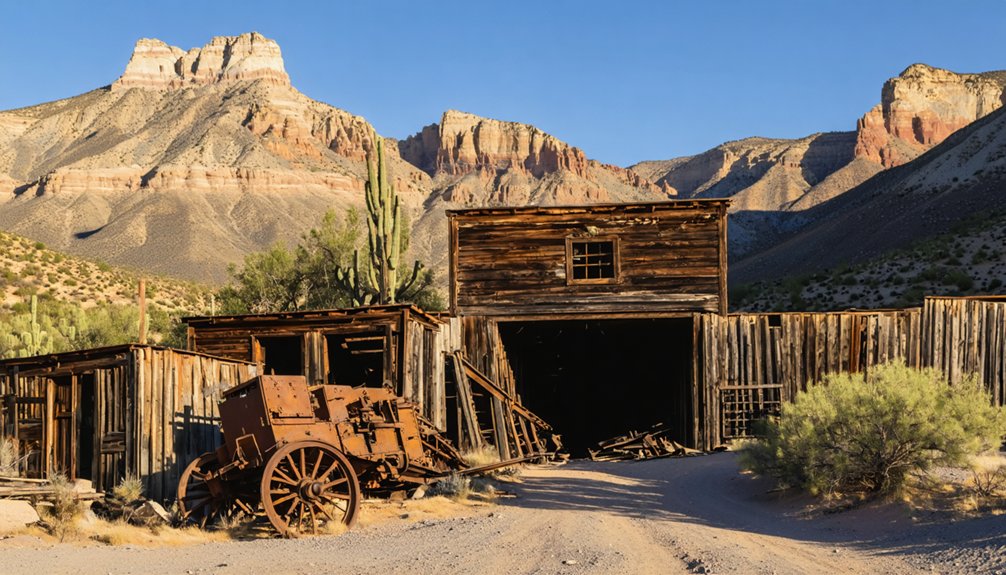
While hauling Army supplies through the Black Range toward Camp Ojo Caliente in 1879, mule skinner Harry Pye spotted something glinting in a remote canyon that would reshape the mountains around him.
That flash was high-grade silver chloride, and though Apaches killed Pye months later—denying him fortune—his discovery ignited one of New Mexico Territory’s wildest silver rushes.
Planning Your Ghost Town Adventure
You’ll want to time your ghost town expedition for spring or fall, when mild temperatures let you walk dusty streets and photograph crumbling adobe without battling 100°F heat or sudden monsoon washouts.
Pack a high-clearance vehicle, paper maps, plenty of water, sturdy boots, and a charged camera—cell towers don’t follow you up twisting mountain roads to abandoned mining camps.
Some sites like Shakespeare operate on strict tour schedules, while others in the Black Range welcome self-guided exploration if you respect private-property boundaries and skip the temptation to enter collapsing structures.
Best Seasons to Visit
Since ghost towns don’t disappear with the calendar, you can explore Silver City’s mining relics year-round—but timing your visit to the rhythm of high-desert seasons transforms a simple day trip into something memorable.
Spring wildflowers paint April–May hillsides while comfortable 70s keep you hiking through crumbling stamp mills.
Summer storms roll in after noon, so chase that morning light before monsoon clouds build.
Fall delivers the sweet spot: stable weather, golden aspens framing weathered headframes, and empty roads after Labor Day crowds vanish.
Winter? Surprisingly mild at 54°F average, though occasional snow dusts the peaks.
Best conditions unfold when you:
- Target spring’s wildflower bloom against sun-bleached mine timbers
- Photograph post-storm summer skies gilding abandoned storefronts
- Claim fall’s solitude on backroads leading to forgotten camps
Essential Supplies and Safety
Before you steer toward that first windswept foundation, understand that ghost towns don’t offer second chances when things go sideways.
Your essential gear starts with a gallon of water per person daily—more in high desert heat—plus extra nonperishable food.
Pack offline GPS maps and paper topos; cell service vanishes out here. A 4WD vehicle, full spare-tire kit, and jumper cables aren’t optional on rutted mining roads.
Safety tips that matter: closed-toe boots for broken glass and rubble, layered clothing for wild temperature swings, and a stocked first-aid kit.
Never enter mine shafts or unstable buildings. Leave your route plan with someone reliable, specifying check-in times.
The desert remembers careless wanderers differently than prepared ones.
Tour Options and Accessibility
Packing your maps and gear solves only half the puzzle—the other half lies in choosing which ghost town to visit and knowing what you’ll find when the gravel runs out.
Tour logistics vary dramatically between sites. Shakespeare requires advance booking for guided weekend tours through the foundation, while Lake Valley offers self-guided walks on posted days. Mogollon operates seasonally May through October with informal exploration.
Vehicle requirements shape your itinerary:
- Pinos Altos: Standard cars handle the paved fifteen-minute drive from Silver City
- Mogollon: High-clearance vehicles recommended for steep, winding NM-159’s two-hour climb
- Shakespeare: Any vehicle reaches Lordsburg’s access point via paved highway
Weather and fire restrictions close mountain routes without warning, so confirm conditions before departing civilization.
Frequently Asked Questions
Are Ghost Town Visits Safe for Families With Young Children?
Ghost towns can be family-friendly if you’re careful. Choose managed sites like Lake Valley, follow safety precautions around unstable structures, and stick to designated trails. Your kids will love exploring history while you maintain vigilant supervision throughout.
What’s the Best Time of Year to Explore These Ghost Towns?
Fall delivers the best weather—crisp mornings, golden aspens framing weathered cabins, and storm-free roads leading you deeper into history. Spring offers wildflower-studded trails and seasonal attractions without summer’s crowds hemming in your wanderlust.
Can You Camp Overnight Near Any of These Historic Sites?
Picture yourself under star-studded skies—you’ll find dispersed camping on nearby public lands, though camping regulations and historic preservation rules prohibit overnight stays inside most townsites. National Forest and BLM land surrounds these freedom-filled destinations.
Do Any Ghost Towns Require Entrance Fees or Reservations?
Shakespeare charges ghost town fees and requires reservations for its guided tours, while Pinos Altos and Mogollon welcome you freely to wander their weathered streets. Their reservation policies differ—only Shakespeare limits spontaneous exploration through scheduled access.
Are the Roads to These Locations Accessible by Regular Vehicles?
Most roads you’ll encounter are paved and suitable for standard cars in dry weather, though Mogollon’s winding canyon approach demands caution. Road conditions change with storms—vehicle limitations matter less than timing and preparation for your adventure.
References
- https://geronimoranch.com/blog/ghost-towns-in-nm/
- https://www.atlasobscura.com/things-to-do/new-mexico/ghost-towns
- https://www.newmexico.org/places-to-visit/ghost-towns/mogollon/
- https://www.newmexico.org/places-to-visit/ghost-towns/
- https://newmexiconomad.com/mogollon/
- https://www.newmexicoghosttowns.net/counties
- https://www.geotab.com/ghost-towns/
- https://en.wikipedia.org/wiki/List_of_ghost_towns_in_New_Mexico
- https://www.legendsofamerica.com/nm-mogollon/
- http://www.mcguiresplace.net/stories/mogollon/