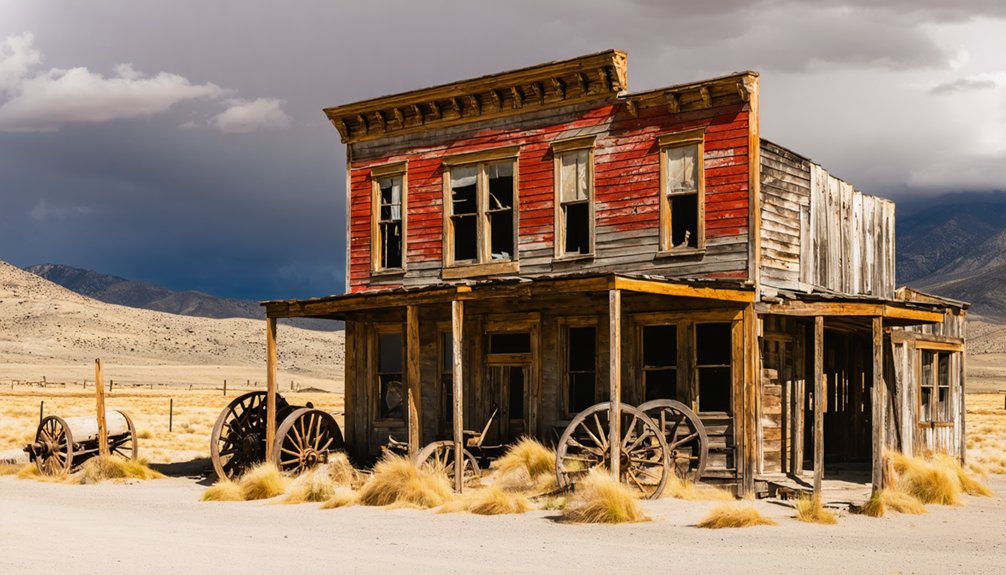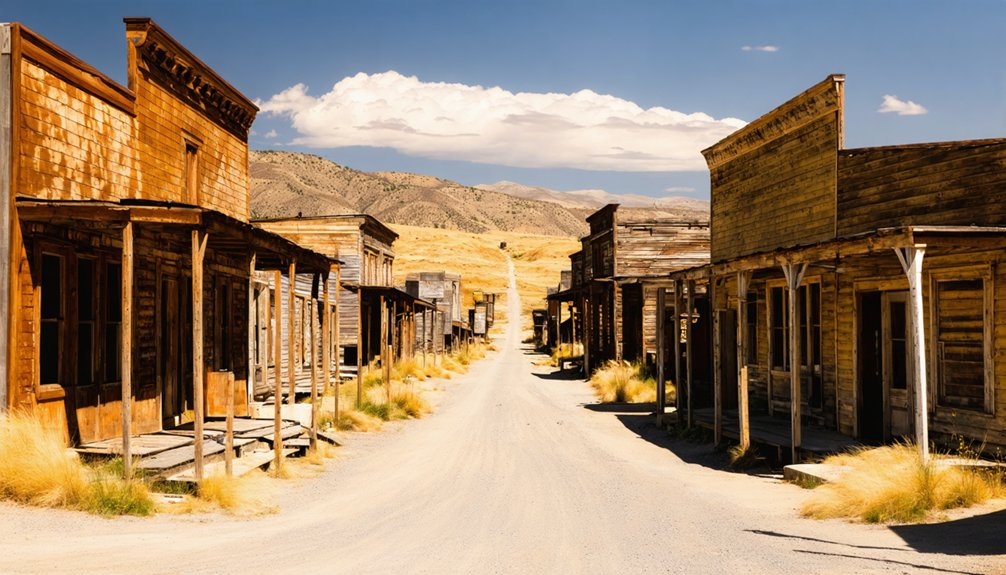
You’ll find Solano County’s most compelling ghost town without leaving the county—Cement, an industrial settlement that thrived on Cement Hill from 1902 to 1927, producing 6,500 barrels daily before limestone depletion triggered its abandonment. Nearby, Drawbridge’s 90 stilt cabins once housed 600 residents in the Bay marshlands until submersion in 1936, while Delta communities like Collinsville and Port Costa preserve waterfront commerce relics from the 1880s. Each site reveals distinct patterns of economic rise and collapse, from single-industry dependence to environmental transformation, offering tangible connections to California’s broader settlement history.
Key Takeaways
- Cement, established in 1902 on Cement Hill, was Solano County’s industrial ghost town abandoned in 1927 after limestone depletion.
- Drawbridge, founded in 1876, featured 90 stilt cabins housing 600 residents before being submerged in 1936.
- Collinsville’s cattle-shipping boom collapsed after railroad bypass, leaving fewer than 100 residents today in this Delta ghost town.
- Port Costa’s historic grain warehouses from 1879 remain as monuments to the region’s commercial past along the Delta.
- Mare Island Naval Shipyard closure resulted in significant job losses, contributing to economic decline in nearby communities.
Cement: Solano County’s Own Industrial Ghost Town
When Pacific Portland Cement Company established its company town in 1902 on what locals now call Cement Hill, it launched what would become Solano County’s most ambitious industrial experiment. This Cement History began with $500,000 backing a 900-acre complex that churned out 6,500 barrels daily by 1907.
You’ll find it remarkable that this company town—boasting Solano’s first underground utilities—actually outpaced Fairfield and Suisun in population, peaking near 1,000 residents who lived in wood-frame cottages for $12 monthly rent. Social life centered on the Golden Gate Hotel, which hosted the annual Cement Ball and accommodated 175 guests with amenities ranging from tennis courts to a swimming pool.
The Industrial Legacy ended abruptly in 1927 when limestone deposits ran dry, forcing closure after just 25 years. The facility’s Portland cement production relied on the same silicates and oxides formula that had revolutionized construction since the 19th century. Workers’ homes were auctioned and hauled to Vacaville and Fairfield, where several still stand as tangible remnants of this vanished industrial frontier.
Drawbridge and the Vanished Communities of the Bay Area Marshlands
Seven feet above the tidal marshes of the southern San Francisco Bay, the South Pacific Coast Railroad established what would become the Bay Area’s only true ghost town in 1876.
Originally called Saline City, Drawbridge thrived on Station Island as a hunting and fishing destination, drawing thousands of weekend visitors by rail through the 1920s. Up to 10 passenger trains daily serviced 90 cabins built on stilts above the wetlands, housing 600 seasonal and permanent residents who navigated sloughs by rowboat.
Ten trains daily ferried visitors to 90 stilt cabins where 600 residents rowed through sloughs in this thriving island retreat.
Drawbridge history reveals a community that operated beyond conventional law—gambling and revelry flourished in its hotels.
After 1936, salt pond development devastated marshland ecology, causing subsidence that ultimately submerged the settlement. The town’s name derived from an actual pivoting wooden bridge that once allowed boat passage through the rail line crossing the slough. Charlie Luce departed in 1976, marking the end of a century of human habitation on Station Island. You can’t legally visit this forbidden refuge today.
Delta Ghost Towns: Collinsville, Port Costa, and the Old Rio Vista Sites
When you trace the Sacramento River‘s final miles to Suisun Bay, you’ll find Collinsville clinging to the mudflats—a wharf town whose 1860s cattle-shipping boom collapsed after railroad bridges bypassed its ferry route, leaving it so diminished that a 2014 fire could destroy half the remaining structures.
Across the straits, Port Costa‘s 1879 grain warehouses still hulk above the water, monuments to the era when every Central Valley harvest funneled through Delta wharves before Oakland’s deep-water terminals made the old transfer ports obsolete.
Rio Vista itself survives, but the original townsite lies submerged beneath the river after the 1862 flood forced residents to rebuild on higher ground, erasing the first plat from everything but county surveyors’ maps. Collinsville’s commercial heart began when C.J. Collins built a wharf and store in 1861, establishing it as a primary shipping port for cattle products like hides and tallow before the town’s fortunes turned. The hamlet also supported salmon canneries during the 1800s, capitalizing on the river’s abundant fisheries before that industry faded.
Waterfront Communities in Decline
Although Collinsville sits just 40 miles from San Francisco along the Sacramento River, its current population of fewer than 100 residents reflects a dramatic reversal from its origins as a commercial fishing center.
Collinsville history demonstrates how single-industry dependence leads to abandonment—the town’s principal cannery enterprise once drove settlement and growth, supported by river transport infrastructure that never achieved sustained commercial viability. The salmon cannery established in 1873 operated day and night with 180 employees, producing approximately 20,000 cans daily at the height of the town’s prosperity.
When commercial fishing deteriorated, the community entered a long spiraling decline. This maritime decline mirrors broader patterns across Solano County’s waterfront settlements, where initial advantages from Sacramento River access couldn’t sustain economic viability without diversification. The closure of Mare Island Naval Shipyard resulted in thousands of lost jobs, exemplifying how the end of shipbuilding operations devastated Delta communities dependent on maritime industries.
Remaining infrastructure deteriorated as investment ceased, leaving behind a ghost town that exemplifies California’s abandoned maritime communities along the Delta.
Floods and Shifting Trade
The original Rio Vista settlement’s catastrophic encounter with the Sacramento River flood of January 1862 forced an entire town to abandon its site and rebuild upstream—a dramatic relocation that transformed a waterfront community’s geography while preserving its commercial ambitions.
This flood resilience reshaped Delta commerce permanently.
Trade evolution across Delta ghost towns followed distinct patterns:
- Port Costa thrived as a grain transshipment hub where trains met ocean vessels on Carquinez Strait.
- The 1879 transcontinental railroad connection linked Central Valley harvests to European markets.
- Collinsville’s canneries and ferry operations capitalized on Sacramento River access and Italian fishing fleets.
- Trucking expansion undermined rail-dependent ports, triggering Port Costa’s decline.
- Marshy terrain and limited roads constrained Collinsville’s overland growth despite maritime advantages.
- Rio Vista’s salmon cannery operations shipped internationally under Robert C. Carter and son before the community’s forced relocation.
- The Solano ferry transported entire trains across the strait until an inland bridge made it obsolete in 1930.
You’ll find these sites bear witness to commerce shaped by water, then abandoned when trade routes shifted.
Gold Rush Ghosts: Bodie, North Bloomfield, and Columbia
In 1859, William S. Bodey discovered gold north of Mono Lake, establishing a mining camp that would bear his name.
The town’s Bodie history transformed dramatically when the Standard Company struck profitable ore in 1876, swelling the population to 10,000 residents by 1879.
You’ll find that Bodie generated $70 million before its final mine closed in 1942 under wartime orders.
The railroad’s 1917 abandonment accelerated the town’s decline, earning its “ghost town” designation by 1915.
Today’s ghost town preservation efforts maintain 170 structures in “arrested decay,” showcasing authentic mining-era artifacts left behind by departing settlers.
California designated Bodie as a National Historic Landmark in 1961, preserving this tribute to gold rush independence.
Coastal Remnants: Purissima and the Half Moon Bay Backcountry
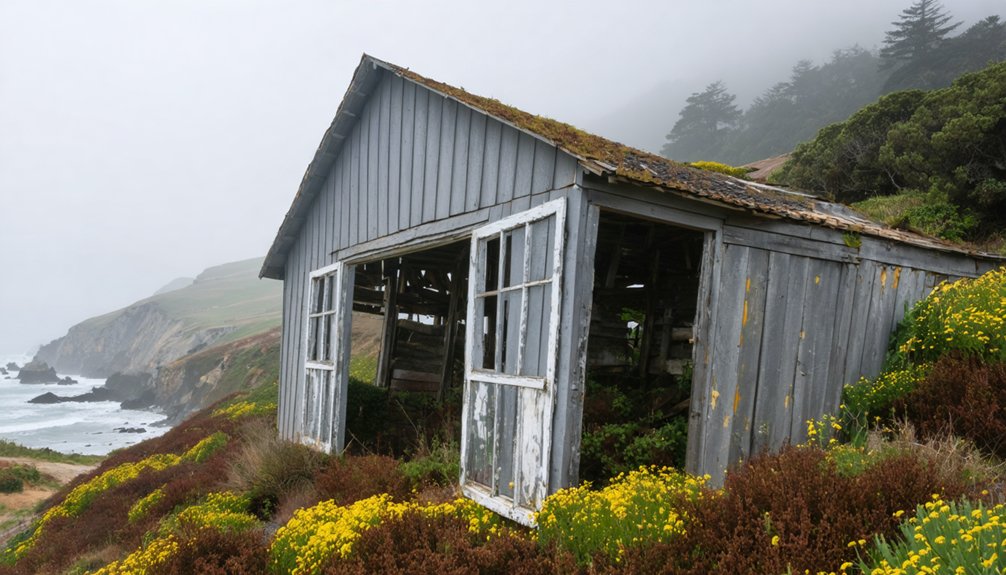
Unlike the Sierra Nevada’s gold-fueled boomtowns, Purissima emerged as one of San Mateo County‘s earliest coastal settlements on José María Alviso’s Rancho Cañada de Verde y Arroyo de la Purisima, where redwood logging rather than precious metals drove economic prosperity.
The settlement’s trajectory followed a familiar pattern:
- 1769: Juan Crespí’s Portolá expedition documented an abandoned Aloney Native American settlement.
- Early 1870s: Infrastructure included a post office, stores, schoolhouse, and Purissima House hotel.
- January 1862: Devastating flood swept away fields and buildings during California’s worst flooding event.
- 1901: Post office closure marked formal abandonment.
- Present: Purissima Cemetery (established 1868) contains nearly 60 graves beneath massive cedars.
Redwood logging operations supported Henry Husing’s general store and a lumber mill at Purissima Canyon’s mouth until the early 1900s, when residents relocated to established cities.
Planning Your Ghost Town Exploration: Access, Preservation, and Safety
Before venturing into any ghost town near Solano County, you must verify land ownership and legal access, because the majority of California’s abandoned settlements occupy private ranch parcels, active industrial sites, or utility corridors where trespassing carries legal and safety consequences.
Consult county assessor GIS maps and BLM land-ownership databases to confirm boundaries before approaching sites like Cement or Birds Landing. Access rights often require written permission from property owners or managers.
Effective safety measures include reviewing topographic maps for washed-out grades, preparing for extreme heat and limited cell coverage, and treating all structures as unstable.
Carry sturdy footwear, gloves, and adequate water. Share your route plan with a contact, maintain distance from active quarries and wind farms, and follow preservation ethics—take nothing, leave nothing—to protect archaeological context and historical integrity.
Frequently Asked Questions
Are There Any Ghost Towns in Solano County Besides Cement?
No verified ghost towns exist in Solano County beyond Cement. You’ll find historic sites and military installations documented, but formal urban exploration targets remain limited. Regional ghost town enthusiasts typically venture outside county boundaries for authentic abandoned settlements.
However, if you’re looking for a more immersive experience, consider visiting historic mining towns near Yosemite. These towns offer a glimpse into California’s rich mining history and feature well-preserved buildings. Exploring the remnants of these settlements can provide a thrilling adventure for those intrigued by the past.
What Caused Most Ghost Towns Near Solano County to Be Abandoned?
Economic decline from industry collapse drove most abandonments—you’ll find cement plants closing, mines exhausting, railroads rerouting—triggering population shifts as workers relocated to surviving towns with diversified economies and modern infrastructure throughout the corridor.
Can You Legally Visit and Explore Ghost Town Sites Near Solano County?
Legal ghost town exploration near Solano County depends on ownership and posted restrictions. You’ll need landowner permission for private sites, while publicly designated historic parks allow visitation. Always verify access rights beforehand to avoid trespassing charges.
How Long Does It Take to Drive From Solano County to Bodie?
You’ll drive approximately 5–6 hours from Solano County to explore Bodie’s history, depending on your chosen driving routes through Sacramento and Highway 395, plus final unpaved miles into California’s preserved 1880s gold-mining ghost town.
Are Any Ghost Town Buildings Near Solano County Still Standing Today?
Yes, you’ll find Cement’s power plant shell, rock crusher, and hotel foundation still standing near Fairfield, demonstrating historic preservation of industrial architecture. Several relocated worker houses retain architectural significance as private residences in Fairfield and Vacaville.
References
- https://en.wikipedia.org/wiki/List_of_ghost_towns_in_California
- https://www.visitcalifornia.com/road-trips/ghost-towns/
- https://www.youtube.com/watch?v=bz6XtozCSMg
- https://rachelsruminations.com/favorite-ghost-towns-in-california/
- https://www.solanoarticles.com/history/index.php/weblog/more/dusty_memories_and_a_castle_on_the_hill/
- https://guides.lib.berkeley.edu/mapsandmore/ghosttowns2019
- https://www.ghosttowns.com/states/ca/casolano.html
- https://en.wikipedia.org/wiki/Cement
- https://www.scgsca.org/cpage.php?pt=15
- https://www.youtube.com/watch?v=chhU6GqAnjk