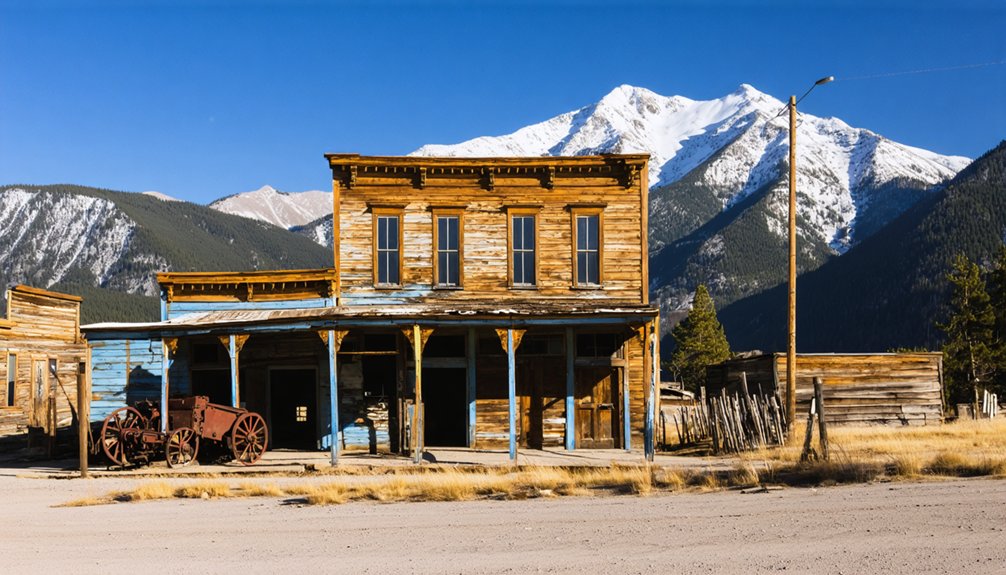
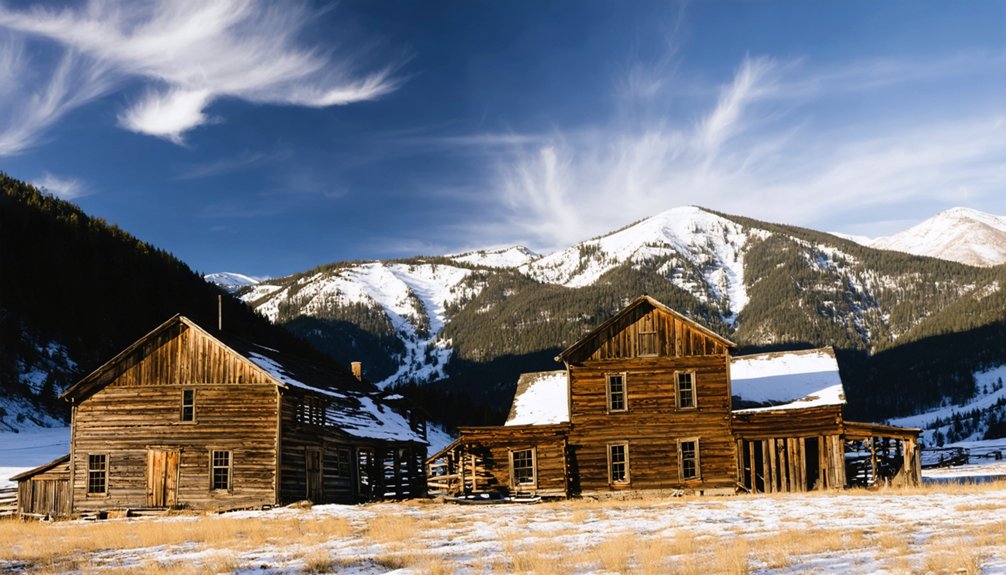
You’ll find Summitville ghost town just 35 miles southwest of South Fork—one of Colorado’s highest mining camps at 11,500 feet elevation. Accessible only late June through early September due to snow, this abandoned settlement yielded over 257,000 troy ounces of gold between 1870 and 1992. The two-hour drive from Del Norte climbs through ponderosa forests before opening into alpine meadows where fourteen saloons once served hundreds of miners. The route requires careful preparation: pack fuel, water, and offline maps since no services exist beyond the pavement, and the journey reveals why this remote corridor became essential to understanding Colorado’s boom-and-bust mining heritage.
Key Takeaways
- Summitville, at 11,500 feet in the San Juan Mountains, is one of Colorado’s highest-elevation ghost towns near South Fork.
- The town produced 257,600 troy ounces of gold between 1870 and 1992 through multiple boom-and-bust cycles.
- Access is limited to late June through early September due to snow, requiring proper vehicle preparation and supplies.
- Forest Service Road 14 from Del Norte climbs 3,600 feet over two hours through switchbacks and alpine meadows.
- Acid drainage from abandoned mines contaminated the Alamosa River, creating significant environmental legacy issues in the area.
Summitville: Colorado’s Highest Elevation Ghost Town
Perched at 11,500 feet in the San Juan Mountains, Summitville holds the stark distinction of being among Colorado’s highest-elevation ghost towns—a wind-scoured cluster of ruins where miners once endured forty feet of annual snowfall to chase gold veins through alpine rock.
Summitville history began around 1870 when prospectors first staked claims in this brutal alpine setting, ultimately extracting 257,600 troy ounces of gold before final abandonment in 1992.
Over 122 years of relentless gold extraction yielded a quarter-million ounces from mines clinging to these punishing slopes.
High elevation challenges forced seasonal operations—most miners retreated to lower valleys each winter when snowdrifts buried shafts and mills.
The Little Annie Mine ranked as the third-richest gold mine in Colorado during the camp’s heyday.
P.J. Peterson and F.H. Brandt discovered the Little Annie and Margaretta mines in 1873, with Peterson naming the Little Annie after his daughter.
Today you’ll find deforested slopes and acid-stained streams marking where heap-leach cyanide operations poisoned the Alamosa River headwaters, earning Superfund status in 1994.
It’s a cautionary monument to ambition outpacing wisdom.
The 1870s Gold Rush That Built Summitville
You’d find yourself swept up in the Del Norte gold stampede of 1873, when hundreds of prospectors flooded into the district immediately after the Brunot Treaty removed the Utes from their mountain territories.
Within months, miners threw up cabins and commercial buildings at 11,500 feet, transforming Wightman’s isolated gulch into a functioning town complete with mills, stores, and essential services.
The camp’s first amalgamation mill rose in 1875, spurring rapid expansion that brought a post office the following year.
By 1883, nine stamp mills were crushing ore from the local mines, producing substantial amounts of gold from the district’s richest lodes.
Del Norte Gold Stampede
A single fragment of gold-bearing “float” ore, casually displayed in a Del Norte saloon around 1870, ignited one of Colorado’s most unlikely stampedes—sending thousands of fortune-seekers scrambling toward what would become Summitville, perched near timberline at 11,800 feet in the remote Conejos Mountains.
That barroom tale spread like wildfire across the San Luis Valley, transforming Del Norte overnight into the “Gateway to the San Juans.”
You’d have witnessed:
- Freight wagons jamming dusty streets as blacksmiths, merchants, and outfitters raced to profit from the rush
- Stage routes connecting Alamosa to high-country camps, carrying experienced miners and greenhorns alike
- The San Juan Prospector printing claim notices and ore reports that fueled regional speculation
The Gold Discovery preceded the 1873 Brunot Treaty, making Summitville one of Colorado’s earliest hard-rock frontier camps—built entirely on rumor, ambition, and that single glittering rock.
The discovery of gold in the Summit District was officially documented in 1870, marking the beginning of Del Norte’s transformation from a quiet frontier settlement into a roaring supply hub for mountain prospectors.
While prospectors scrambled to stake claims at Summitville, the Ute Reservation legally barred most of southwestern Colorado from settlement until the treaty opened the San Juans to widespread exploration.
Rapid Camp Construction
Within days of Wightman’s party sluicing their first colors in late June 1870, word raced downslope to Del Norte—but the high country yielded no town that year, only a scattering of tents abandoned by November when waist-deep snow forced everyone out.
Spring 1871 brought hundreds of stampeding prospectors who retreated just as quickly when forty-foot snowpack made work impossible.
You’d see real progress only after the 1873 Brunot Treaty cleared Ute claims and fresh lode strikes justified permanent camp layout.
By 1875, the Little Annie’s amalgamation mill anchored Summitville’s dense footprint: boarding houses, assay offices, blacksmiths, bakeries, and lumber yards clustered tight on narrow benches.
Mining infrastructure mushroomed—stamp mills, ore tramways, powder magazines—all wedged close to portals so men could reach work through winter drifts.
The camp sat at 11,500 feet elevation in the San Juan Mountains, making it one of Colorado’s highest mining settlements.
Fourteen Saloons by 1886
The fourteen establishments you’d find by 1886 provided:
- Gambling tables where prospectors risked tomorrow’s grubstake on tonight’s cards
- Informal trading floors where mine shares changed hands over whiskey
- Winter refuge from forty-foot snowfalls that buried outdoor recreation
The Summitville Nugget chronicled this commerce weekly, advertising liquid courage alongside assay services—both essential to frontier fortune-hunting.
The town’s population fluctuated dramatically, reaching 300-600 residents during its peak years before the initial decline.
Boom Years: When 14 Saloons Served the San Juan Miners
The Denver & Rio Grande‘s rail extension from Wagon Wheel Gap that year flooded the camps with hard-rock miners, freighters, and railroad workers—predominantly single men working round-the-clock shifts.
Saloons matched this rhythm, running continuously to serve shift changes.
The mining economy thrived on volatile paydays and occasional bonanza strikes, generating receipts lucrative enough to sustain a dozen competing bars despite the boom’s brief duration.
Similar patterns emerged in the Animas District northeast of Silverton, where the railroad’s 1882 arrival triggered explosive growth in mining camps along the river valley.
The D&RG Rail Line reached Wagon Wheel Gap in 1883 before extending further to mining towns in 1891, completing the transportation network that sustained these remote operations.
Multiple Revivals: Mining Returns in 1907, 1930s, and 1948
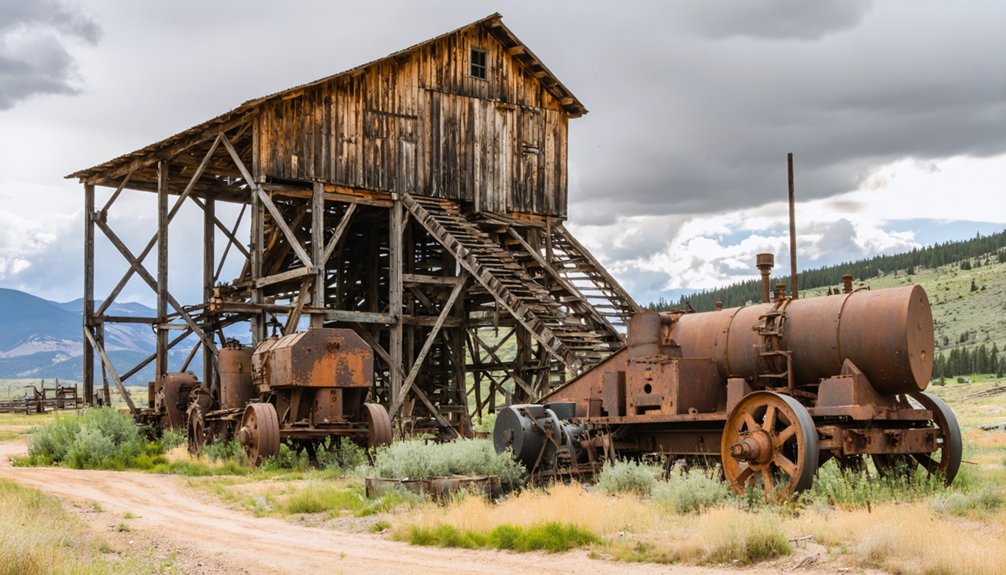
You’ll find that these ghost camps didn’t simply die after the initial boom—they stirred back to life three distinct times as economics shifted.
In 1907, better rail access and new ore-treatment methods brought fresh capital into played-out districts, while the Depression drove unemployed men back into abandoned tunnels chasing $35 gold, and postwar industrial demand sparked a final flurry in 1948.
Each revival left its own archaeological layer: a concrete foundation from the Edwardian engineers, hand-stacked waste rock from Relief Era muckers, and rusting diesel hoists that mark the last operators’ attempts.
Early 1900s Gold Boom
After Summitville’s continuous production ceased in 1906, the district entered a decades-long pattern of intermittent revivals rather than a single sustained boom.
You’ll find the 1907 restart typified these mining challenges—lessees reopened existing shafts on properties like Little Annie and Summit, testing deeper levels instead of pioneering new veins.
This ghost town evolution unfolded through:
- Small operators working old stopes and dumps under leasing arrangements
- Limited daily tonnages shipped via wagon to Denver & Rio Grande Railroad connections
- Absence of stable resident population; Summitville lacked a post office through most of 1912–1935
Rising costs and falling ore grades pushed the camp into short-lived phases.
Interwar years brought renewed filings as small companies chased higher postwar metal prices, maintaining economic viability through valley transportation infrastructure.
Depression-Era Mining Activity
Summitville’s pattern of short-lived leasing operations gave way to more sustained Depression-era activity when the 1933 gold revaluation transformed the economics of high-altitude mining.
You’ll find that raising the gold price from $20.67 to $35 per ounce suddenly made marginal veins profitable again at 11,500 feet.
Depression era challenges—brutal winters, dangerous roads, and thin air—didn’t deter experienced hard-rock miners who mixed with unemployed laborers desperate for wages.
Mining workforce dynamics evolved as these crews reactivated idle boarding houses and ran organized shifts using cyanidation mills to extract gold from refractory ores.
By 1948, two mills operated simultaneously, processing ore with mechanized handling that earlier operators couldn’t afford.
Each revival pumped seasonal payrolls through South Fork’s economy before inevitably tapering off again.
Post-War Industrial Operations
When global metal markets collapsed in the early 1950s, Summitville’s latest incarnation ended as abruptly as its predecessors, leaving those two mechanized mills silent amid the snowdrifts at 11,800 feet.
You’ll find this pattern repeated throughout Colorado’s high country, where post war mining briefly flourished before industrial decline set in.
Summitville’s remarkable resilience demonstrated the determination of operators who refused to abandon promising deposits:
- Ghost town status by 1893, followed by revival in 1907
- Second resurrection during the Depression-era 1930s
- Two functioning mills still processing ore in 1948
This boom-and-bust cycle finally ended when falling metal prices made high-altitude extraction economically unfeasible.
The harsh climate and remote location that once challenged miners became permanent guardians of Summitville’s abandoned infrastructure.
What Remains Standing at 11,800 Feet
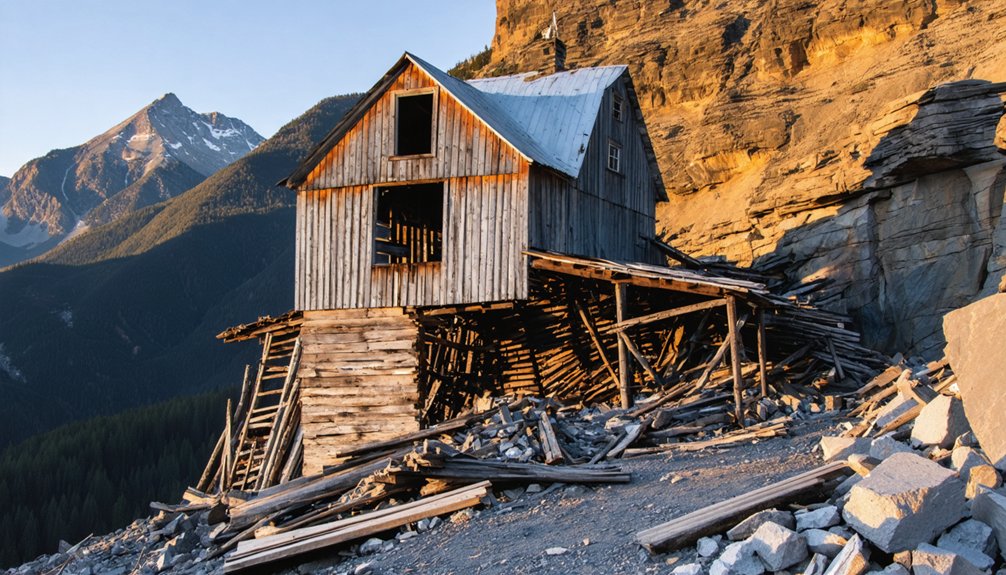
Walk the dispersed cluster of buildings strung along old mine roads, and you’re tracing the footprint of Colorado’s first AC electrical transmission system—Nikola Tesla’s technology powering drills where mules once hauled coal four miles uphill.
San Miguel County, Telluride, and private owners now debate preservation efforts, stabilizing select structures against the relentless alpine assault.
The thin air reminds you why few stayed year-round even during boom times.
Planning Your Visit: Access Roads and Vehicle Requirements
- Full-size spare, recovery strap, and shovel
- Extra coolant and oil for high-altitude strain
- Downloaded offline maps; cell service vanishes past pavement
OHV/ATV rentals offer smart alternatives for technical spurs.
Respect your rig’s limits—these mountains don’t negotiate.
Best Seasons to Explore Summitville’s Ruins
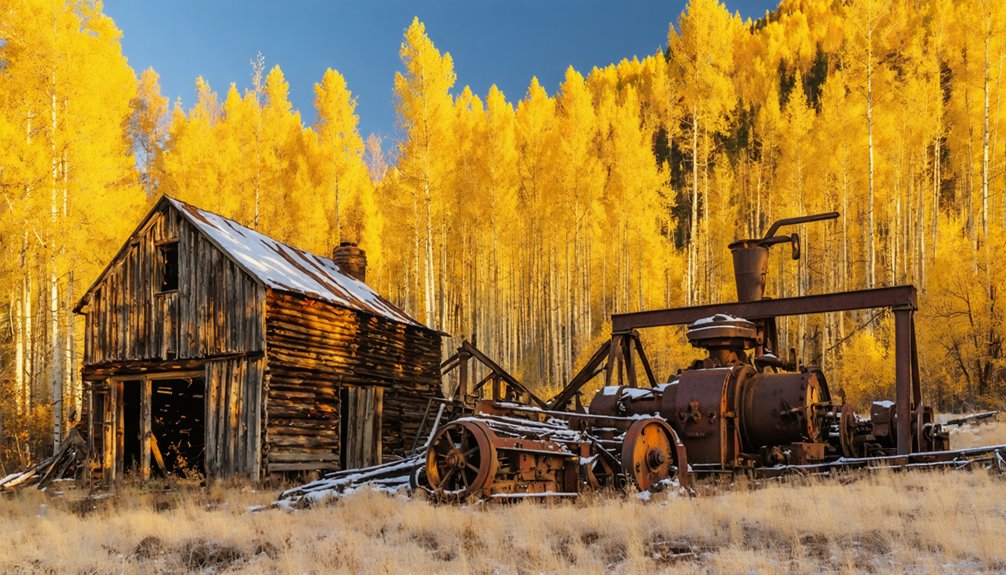
The alpine calendar governs everything at Summitville. You’ll find the ruins fully accessible only between late June and early September, when snowmelt reveals building foundations, tailings piles, and adit portals hidden beneath winter’s deep pack.
These months offer stable footing and clear sightlines across the district’s engineered landscape—waste rock embankments, mine cuts, and diversion ditches stand out sharply against dry ground. Late summer brings bonus advantages: clearer air, fewer afternoon thunderstorms, and reduced avalanche risk on steep slopes surrounding the workings.
Shoulder seasons present serious seasonal challenges—spring melt destabilizes tailings, while early snows obscure shaft openings and structural voids. For practical exploration tips, match your visit to the miners’ own schedule: they worked these heights only when nature permitted, and so should you.
The Environmental Legacy of Modern Mining Operations
Beyond the crumbling headframes and weathered timber, Summitville’s most enduring legacy flows downhill in chemical form. The mine generated acid drainage laced with copper, cadmium, zinc, and iron—turning the Alamosa River toxic enough that aquatic life simply can’t survive there today.
This environmental impact extends far beyond one ghost town:
- At least 500 of Colorado’s 23,000+ abandoned mines leak acidic, metal-rich water into watersheds.
- Contaminated irrigation water forces downstream ranchers to blend sources or abandon fields entirely.
- Orange-stained wetlands show where metal precipitates smother native vegetation.
Modern mining regulations emerged largely because places like Summitville demonstrated the true cost of extraction.
You’re witnessing what happens when profit leaves before cleanup begins—a chemical shadow that outlasts any boom-and-bust cycle.
Combining Summitville With Other San Juan Ghost Towns
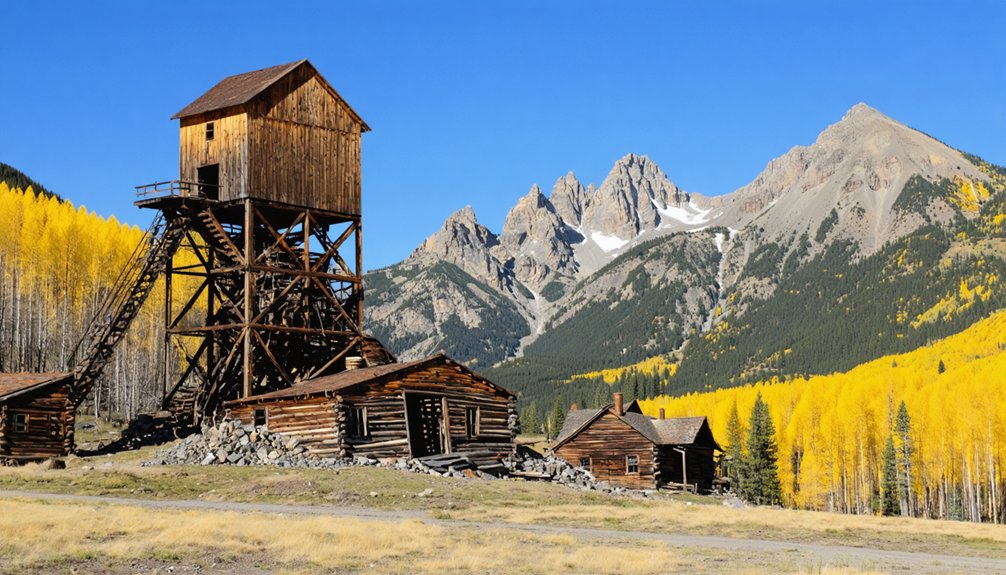
When you trace the narrow shelf road to Summitville’s 11,500-foot perch, you’re positioning yourself at the eastern anchor of the San Juans’ greatest mining theater—a staging point that makes geographic and historical sense for a multi-town ghost town route.
Summitville’s 1870 gold strike predated much of the regional rush, establishing patterns you’ll recognize in later camps. Its nine stamp mills, newspaper office, and scattered foundations let you read mining history through physical evidence—comparing timberline ruins with lower-elevation towns that retained more intact structures.
Link Summitville with camps near Silverton or Creede, and you’ll trace the boom-and-bust arc that defined Colorado’s high country: the 600-to-1,500 souls who swarmed here by 1883 vanished within a decade, leaving tailings and portals that speak louder than any historical marker about ghost town exploration‘s real lessons.
Driving Directions From South Fork and Del Norte
You’ll launch your journey to Summitville from South Fork by heading east on US-160 for roughly 17 miles until you reach Del Norte, where the real adventure begins.
Once in Del Norte‘s compact downtown, look for County Road 14 (Pinos Creek Road) heading south—this signed turn marks your departure from pavement and civilization as you climb toward the Rio Grande National Forest.
The full route spans about 40–45 miles one way from South Fork, with the final 25–30 miles beyond Del Norte evolving into graded gravel and eventually rugged 4WD track that tests both your vehicle’s clearance and your nerve as you ascend toward 11,800 feet.
South Fork Starting Point
South Fork sits at 8,200 feet where US Highway 160 meets State Highway 149, making it the natural staging point for anyone chasing ghost towns in the Upper Rio Grande country.
You’ll find paved highway access in all directions here, seventeen miles west of Del Norte, with services that matter—fuel, food, lodging—before you climb into terrain where none exist.
Vehicle preparedness becomes critical once you leave town:
- Routes quickly gain 3,000+ feet to mining camps above 11,000 feet
- Graded gravel shifts to rough 4×4 tracks near passes and mine sites
- Summer and early fall offer the only reliable access windows
The Visitor Center promotes the Summitville-Elwood Pass corridor as the premier historic-driving route.
Ghost town accessibility depends entirely on understanding what lies between pavement and those weathered structures at 11,800 feet.
Del Norte Route Details
From Del Norte, the Summitville run follows Forest Service Road 14 into terrain where the valley floor’s 7,900 feet climbs steadily toward the ghost town’s 11,500-foot perch.
You’ll navigate winding switchbacks through ponderosa forests that open into alpine meadows, the dirt-and-gravel surface demanding patience but rarely requiring 4×4 in dry conditions.
Budget two hours one-way—more if you’re stopping at scenic viewpoints where autumn aspens blaze gold against granite outcrops.
Road condition varies: spring runoff leaves ruts; summer dust coats windshields; early snow closes access by October.
Pack fuel, water, and food—there’s nothing between asphalt and the abandoned mine structures.
Most sedans handle the main route when driven deliberately, though clearance helps.
The remoteness is the point: no cell towers, no rangers, just you and the San Juans.
Frequently Asked Questions
Are There Camping Facilities or Overnight Accommodations Near Summitville Ghost Town?
Imagine waking at 11,800 feet surrounded by mining ruins—you’ll find dispersed camping options along forest roads, while Elwood Cabin offers the only nearby lodge, sleeping 4–6 guests two miles away via rough terrain.
Is Summitville Safe to Explore With Children Given Mine Hazards?
No, Summitville isn’t safe for children. Mine safety hazards include unstable ground, toxic waste rock, and acidic drainage. Strict child precautions are essential—the Superfund site has fencing and warnings for good reason.
Can I Metal Detect or Collect Artifacts at Summitville?
No, you can’t metal detect or collect artifacts at Summitville due to federal Superfund regulations and metal detecting restrictions on EPA-controlled sites. Artifact preservation guidelines prohibit disturbing contaminated areas, protecting both you and historical resources from damage.
What Wildlife Might I Encounter at This High Elevation Site?
At Summitville’s 11,300-foot elevation, you’ll encounter over 260 wildlife species. Elk herds roam September meadows, black bears forage berry patches, and marmots whistle warnings from talus slopes where miners once dynamited fortune from mountainsides.
Are Guided Tours of Summitville Available From South Fork?
No regular guided tours run to Summitville from South Fork—you’ll need to arrange a custom trip with local outfitters or drive yourself. The ghost town’s Superfund status and remote location make independent exploration your best bet for discovering its mining history.
References
- https://www.durango.com/colorado-ghost-towns/
- https://thedyrt.com/magazine/local/colorado-ghost-towns/
- https://www.colorado.com/articles/colorado-ghost-towns
- https://www.coloradolifemagazine.com/printpage/post/index/id/172
- https://www.uncovercolorado.com/ghost-towns/
- https://coloradosghosttowns.com/Summitville Colorado.html
- https://www.southfork.org/summitville-to-elwood-pass
- https://kool1079.com/colorado-ghost-town-animas-forks/
- https://www.tripadvisor.com/Attraction_Review-g33386-d6960972-Reviews-Summitville_Ghost_Town-Del_Norte_Colorado.html
- https://www.trailsoffroad.com/US/colorado/trails/8660-summitville