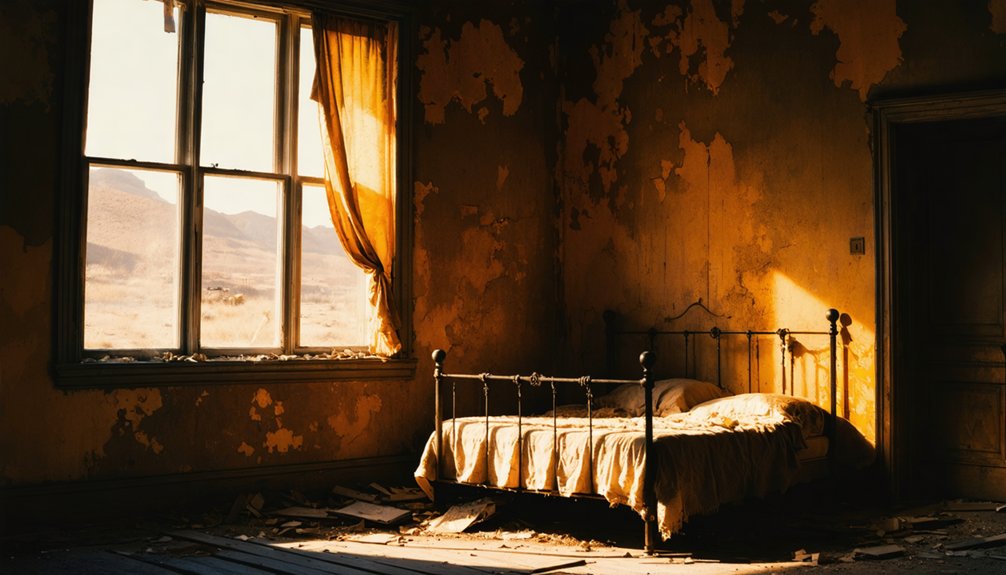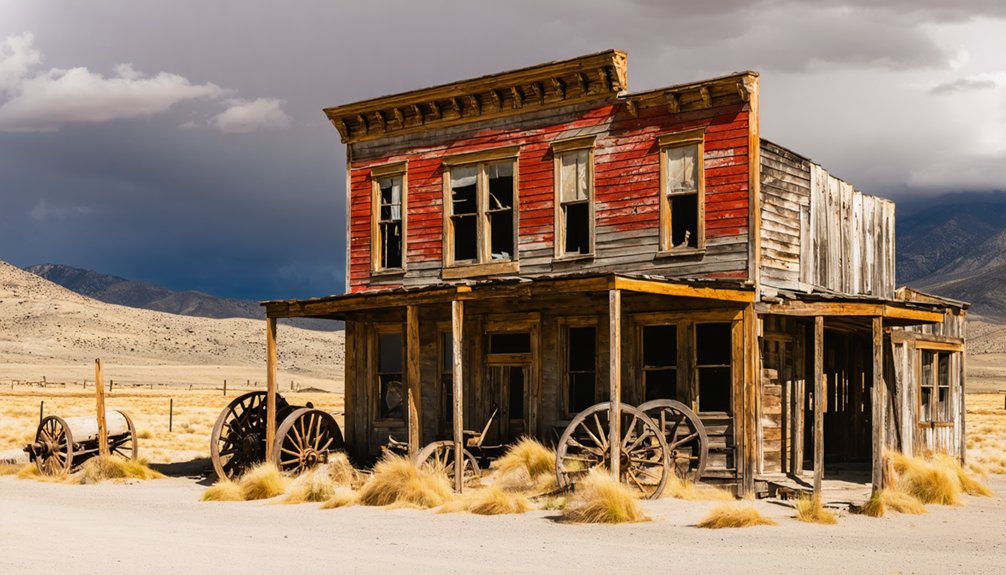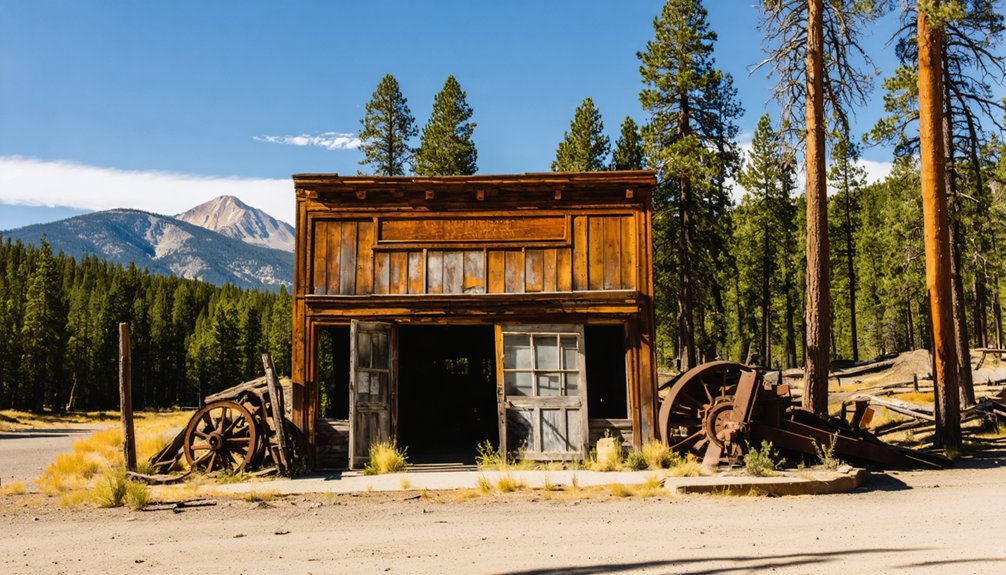
You’ll find Glen Alpine Springs just 20 minutes from South Lake Tahoe, where Nathan Gilmore’s 1863 resort once hosted John Muir and the Sierra Club’s first meeting among naturally carbonated springs. Drive an hour northeast to Virginia City, where 25,000 miners extracted $600 million in silver, or visit neighboring Silver City’s restored Victorian bottling plant. California’s premier ghost town, Bodie State Historic Park, preserves 170 weathered structures under an “arrested decay” philosophy, while over 600 Nevada ghost towns await exploration throughout Lyon, Storey, and Churchill counties—each revealing distinct chapters of Sierra mining history.
Key Takeaways
- Glen Alpine Springs is 20 minutes from South Lake Tahoe, featuring historic resort ruins and naturally carbonated springs.
- Virginia City, fifteen miles northeast of Glen Alpine, showcases preserved silver mining heritage with museums and historic buildings.
- Bodie State Historic Park maintains 170 weathered structures under “arrested decay,” with guided stamp mill tours available summers.
- Silver City, three miles from Virginia City, displays Nevada’s first iron works and Victorian-era mining operations.
- Over 600 Nevada ghost towns are accessible via day trips, best visited late spring through early fall.
Glen Alpine Springs: The Forgotten Mountain Resort in Your Backyard
In 1863, rancher Nathan Gilmore drove his livestock up into the high meadows above what’s now Fallen Leaf Lake and stumbled upon something unexpected: a naturally carbonated spring bubbling up through granite, its mineral-laden water fizzing like champagne.
By the 1870s, he’d transformed this remote wilderness into Glen Alpine Springs resort, promoting the Medicinal Springs as curative elixirs. The complex grew to 25 buildings housing 120 guests who paid $5 daily for lodging, gourmet meals served on fine china, and Nature Hikes through pristine Sierra country. In 1892, John Muir attended the formation of the first Sierra Club at the resort.
Glen Alpine Springs welcomed guests with luxurious accommodations and natural healing waters, combining wilderness adventure with Victorian-era refinement.
In 1922, architect Bernard Maybeck designed nine fire-resistant structures with distinctive metal roofs and granite buttresses. His innovative Bubble Building introduced lightweight aerated concrete to the United States for the first time.
Today, you’ll find these Historic Ruins standing as an open-air museum—no admission fee, no crowds, just weathered stone and metal whispering stories of Lake Tahoe’s first tourist destination.
Virginia City: Silver Boom Legacy Less Than an Hour Away
When Nathan Gilmore’s livestock grazed those high meadows in 1863, miners fifteen miles northeast were already four years into pulling silver from the earth at a pace that would reshape the American West.
You’ll find Virginia City’s Comstock legacy etched into every hillside—25,000 souls once crowded these slopes, financing the Union war effort while extracting $600 million in ore. The Big Bonanza alone produced $3 million monthly for three years.
Mining innovations here changed everything: square-set timbering let crews hollow out massive underground chambers, while the Washoe process revolutionized silver milling across the frontier. The Chollar Mine, established in 1859, generated $17 million in gold and silver over eight decades as one of the Comstock’s leading producers.
Drive Nevada Route 341 today and you’re retracing the path where John Mackay became the richest miner on earth, where corporate mining replaced lone prospectors forever. The Great Fire of 1875 devastated the city but couldn’t stop its momentum—investors poured money into rebuilding while mines continued producing.
Silver City: Nevada’s Best-Preserved Mining Town
Three miles down Nevada Route 341, Silver City clings to Gold Canyon‘s steep walls exactly where John Orr and Nicholas Kelly first spotted color in June 1850.
You’ll find Nevada’s first iron works still standing alongside eight mill sites that once crushed Comstock ore with ninety-five stamps. The town incorporated in 1862 specifically to dodge Virginia City’s annexation—locals wanted control of their own destiny.
Walk past the restored hotel-turned-saloon where teamsters once tied off between the mines and Carson River mills.
Silver City’s mining heritage runs deeper than most ghost towns: the Donovan Mill processed cyanide here until 1959, outlasting the railroad that killed the freight business ninety years earlier. Like many western mining settlements, most structures succumbed to arrested decay as gold dwindled and populations drifted toward newer strikes.
Twelve hundred residents called this canyon home during the boom. Today, weathered headstones in the cemetery mark the prospectors who stayed. A former bottling plant stands among the remaining structures, displaying Victorian-era beer production methods that once served the thirsty mining community.
Bodie State Historic Park: California’s Premier Ghost Town Experience
When you walk through Bodie’s 170 weathered structures, you’ll witness the park’s unique “arrested decay” philosophy—buildings are stabilized against collapse but never restored, preserving the authentic patina of abandonment exactly as the last residents left it.
The tour of the stamp mill reveals massive ore-crushing machinery frozen mid-operation, with iron camshafts, mercury amalgamation tables, and wooden ore bins still coated in gold-bearing dust from the 1880s.
Park rangers maintain this delicate balance by replacing only structural supports and roofing while leaving peeling wallpaper, rusted tools, and scattered bottles untouched inside homes and saloons. This California State Historic Park designation helps protect the site and ensures its preservation for future generations. At its peak, this boomtown stretched along Main Street with 65 saloons serving miners and fortune seekers who flocked to the area.
Arrested Decay Preservation Method
Since California State Parks assumed ownership of Bodie in 1962, the site has been managed under a distinctive “arrested decay” policy—a preservation philosophy that maintains buildings and artifacts exactly as found, preventing further deterioration without attempting full restoration to their original condition.
You’ll find approximately 200 structures frozen in time, from partially burned buildings to leaning storefronts, each stabilized just enough to prevent collapse while preserving their weathered authenticity.
Interiors remain untouched, with furnishings and merchandise still in place as miners and merchants left them. This minimal intervention approach means no cosmetic improvements or reconstructions—only targeted stabilization of foundations, roofs, and walls to combat Bodie’s harsh 8,375-foot elevation climate.
The park’s historic cemetery has undergone careful stabilization of grave markers and reproduction of deteriorated fencing, blending weathered original materials with artificially aged new components to maintain historical authenticity.
The Bodie Foundation works to raise $100,000 annually to support ongoing stabilization efforts that keep these fragile structures standing against the elements.
Walking these streets, you’re experiencing genuine abandonment rather than a sanitized recreation.
Stamp Mill Tour Highlights
Though Bodie’s self-guided streets let you wander freely among weathered storefronts and tilting cabins, the park’s crown jewel—the Standard Stamp Mill—remains locked behind guided-tour-only access.
Daily tours at 11 a.m., 1 p.m., and 3 p.m. (late May–September, $6) walk you through the stamp mill history that powered Bodie’s boom: this rebuilt 1899 facility processed over $14 million in gold and silver across twenty-five years.
You’ll witness intact batteries that crushed ore into powder, mercury amalgamation tables that separated precious metals from rock, and the thunderous industrial choreography that drew nearly 10,000 fortune-seekers to 9,000 feet.
Capacity limits strictly—buy tickets early at the museum. The ore processing demonstration reveals why miners endured deafening noise, toxic dust, and relentless danger for Bodie’s glittering promise.
Boca Townsite and Other Nearby Sierra Relics
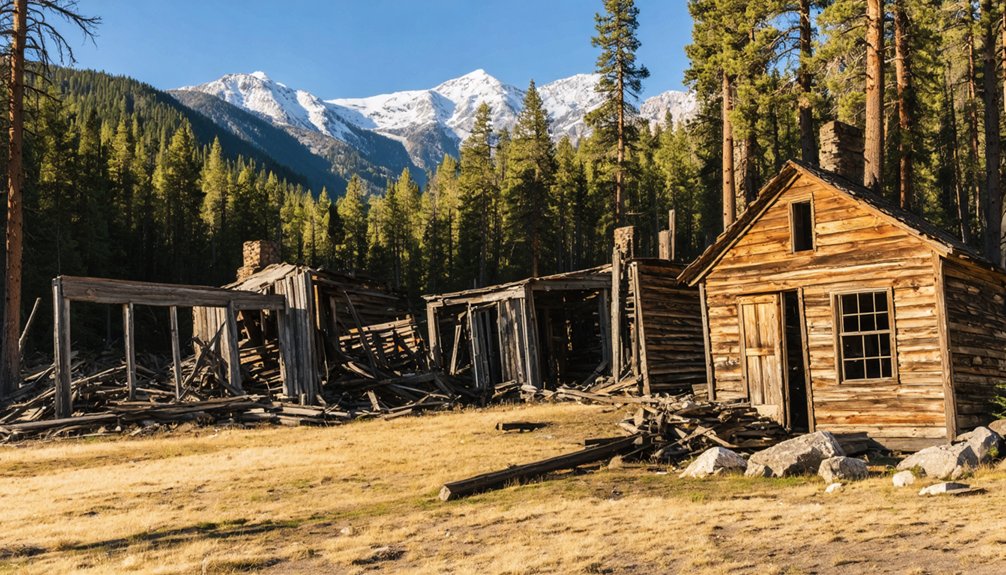
The scattered remains of Boca sit beneath cottonwoods at the mouth of the Little Truckee River, roughly 6–7 miles northeast of modern Truckee and about 45–50 driving miles from South Lake Tahoe.
You’ll find interpretive trail markers where a brewery once shipped 30,000 barrels annually and won medals at the 1883 Paris World’s Fair.
Boca history began in 1866 as railroad Camp 17, evolving into California’s premier ice and lumber hub—by 1872 it ranked largest between San Francisco and Omaha.
Industrial decline arrived through devastating fires (brewery in 1893, hotel in 1904), mechanical refrigeration, and exhausted timber stands.
Most structures vanished before Boca Dam’s 1939 completion; the reservoir later drowned what remained of this once-thriving Sierra settlement.
Nevada’s Ghost Town Belt: Day Trips Beyond the Basin
While Boca’s story unfolded along California’s Sierra spine, an even denser constellation of abandoned settlements awaited discovery across the Nevada state line.
You’ll find more than 600 ghost towns statewide, with the heaviest concentration forming a “belt” through Lyon, Storey, Mineral, Churchill, and Nye counties—all accessible in day trips from Tahoe.
In addition to those locations, explore the unique allure of ghost towns in Solano County, where remnants of the past remain etched in time. Each town tells its own story of prosperity and decline, offering a glimpse into California’s rich historical tapestry. These sites serve as a fascinating contrast to the vibrant communities that surround them, inviting curiosity and adventure.
Nevada’s arid climate preserves wood, stone, and metal structures that would’ve rotted elsewhere, turning ghost town history into a hands-on archive.
Virginia City anchors the circuit: 15,000 souls once crowded its brick blocks chasing Comstock silver.
Farther east, Hudson’s rail-grade scars mark where copper ore rolled toward Bodie.
US‑50 and US‑95 thread this mining heritage corridor together, letting you trace boom-and-bust cycles without permits or gatekeepers.
Planning Your Ghost Town Adventures From South Lake Tahoe
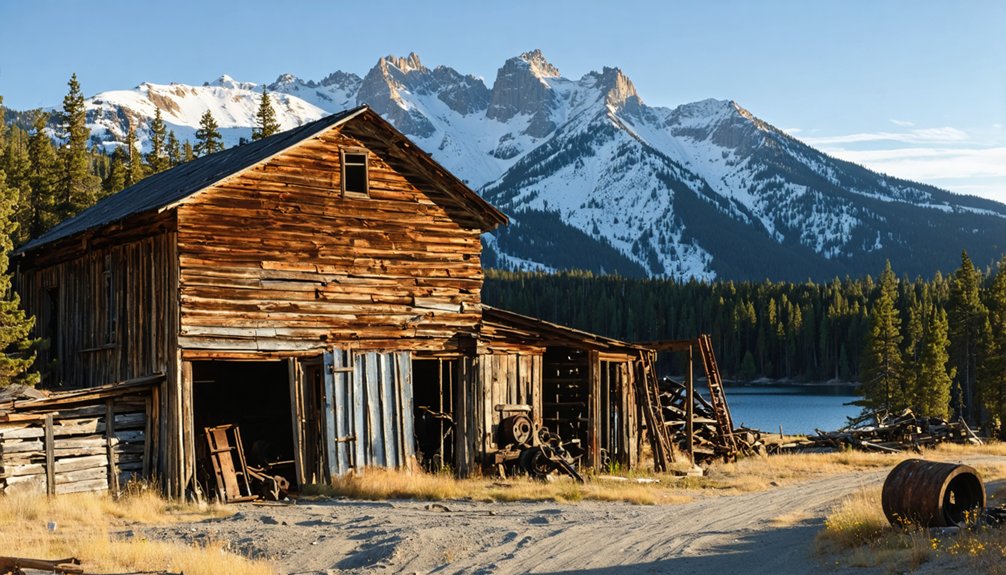
South Lake Tahoe’s lodging glut—more than 10,000 visitor beds scattered among casinos, motor courts, and vacation rentals—makes it the obvious staging ground for ghost town circuits radiating across the Sierra crest.
Your itinerary tips begin with fuel: top off in town before heading to Bodie’s 100‑mile round trip or Virginia City’s Nevada backcountry.
Travel logistics favor late spring through early fall when mountain passes stay open and Bodie’s dirt access road sheds snow.
Glen Alpine Springs sits closest—20 minutes up Fallen Leaf Lake Road—but snowpack lingers into June.
Check Caltrans and Nevada DOT chain controls before dawn departures; a few minutes online saves hours stuck at closure gates.
Altitude jumps from 6,200 feet at the lake to 8,000‑plus at Bodie warrant hydration and rest stops for acclimatization.
Frequently Asked Questions
Are Pets Allowed at Ghost Town Sites Near South Lake Tahoe?
Pet-friendly policies vary greatly: you’ll find ghost town regulations at Bodie prohibit dogs inside historic areas, while Virginia City welcomes leashed pets on boardwalks. Always verify current rules before visiting, as access changes seasonally.
Which Ghost Towns Offer Overnight Accommodations or Camping Nearby?
Like wanderers seeking shelter in yesterday’s ruins, you’ll find overnight stays at Virginia City’s historic hotels, or you can camp near Bodie and Benton Hot Springs, where camping amenities meet nearby attractions for true independence.
Do Any Ghost Towns Require Entrance Fees or Permits?
You’ll pay entrance fees at Bodie State Historic Park—$8 for adults, $5 for kids. Most remote ghost sites don’t charge anything, but commercial tours and special programs require advance reservations and separate fees.
What Photography Restrictions Apply at Preserved Ghost Town Sites?
Frozen in time, these sites demand you’ll honor photography etiquette: no disturbing artifacts, entering closed structures, or moving objects. Historical preservation laws protect everything—even nails and glass—with violations bringing hefty fines and permit revocation.
Are Ghost Town Roads Accessible by Standard Vehicles Year-Round?
No, you’ll find road conditions vary dramatically—paved routes to Virginia City work year-round, but Bodie’s washboarded dirt and elevation limit seasonal access. Winter snow blocks high-country sites; summer offers your best freedom to explore.
References
- https://nvtami.com/top-10-ghost-towns-nevada-northwest/
- https://www.alllaketahoe.com/virginia_city_attractions/silver_city_ghost_town.php
- https://www.visittheusa.com/experience/6-nevada-ghost-towns-explore-if-you-dare
- https://californiahighsierra.com/trips/explore-ghost-towns-of-the-high-sierra/
- https://usghostadventures.com/haunted-cities/top-ten-most-haunted-places-in-lake-tahoe/
- https://about-california.com/bodie.htm
- https://www.youtube.com/watch?v=YrvQKGrMix8
- https://travelnevada.com/ghost-town/
- https://tahoequarterly.com/best-of-tahoe-2020/an-oasis-of-history-high-in-the-hills
- https://visitlaketahoe.com/things-to-do/hikes/glen-alpine-springs-a-hike-into-lake-tahoes-first-tourist-destination/