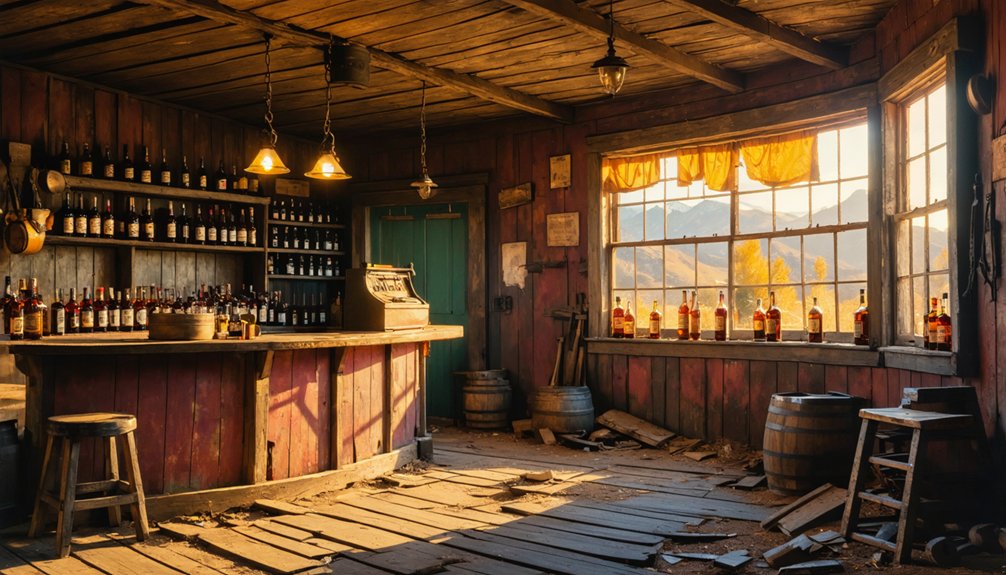
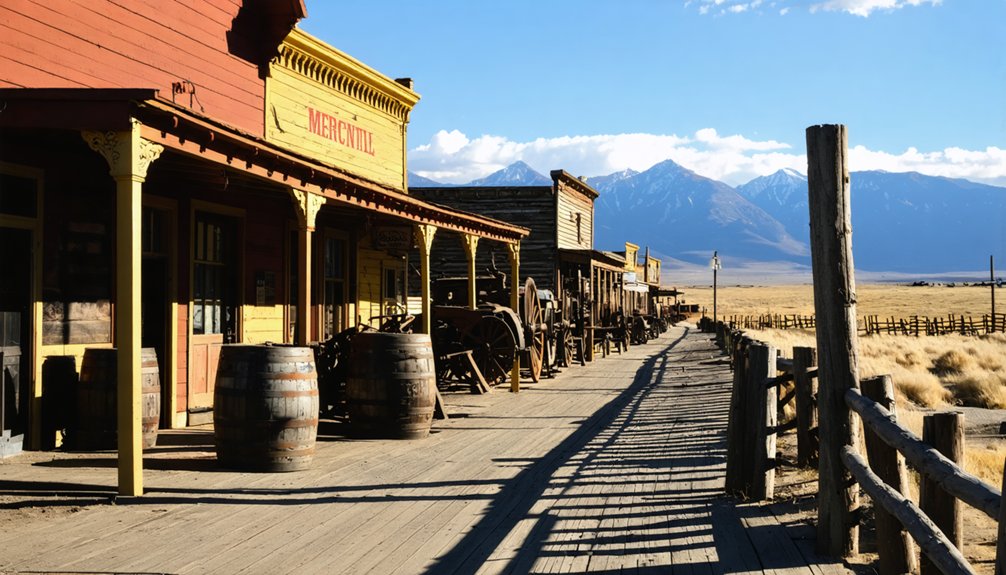
You’ll find several ghost towns within an hour’s drive of Susanville, each telling a different chapter of Lassen County’s frontier history. Hayden Hill, where gold was discovered in 1869, hosted the county’s first Masonic Lodge before a devastating 1910 fire ended its story. Richmond nearly became the county seat in the 1860s before gold ran out. Railroad towns like Termo, Wendel, and Fort Janesville thrived as livestock shipping stations along the Nevada-California-Oregon Railway, while Constantia served ranchers until the 1920s collapse. The ruins, cemeteries, and foundations waiting in these high desert valleys reveal the full story of northern California’s vanished communities.
Key Takeaways
- Hayden Hill, discovered in 1869, featured Lassen County’s first Masonic Lodge before a 1910 fire destroyed the town.
- Richmond, founded in 1856, rivaled Susanville for county seat status but declined after limited gold deposits were found.
- Termo and Wendel served as railroad stops for livestock shipping before Southern Pacific acquisition and eventual abandonment.
- Ravendale, established in 1899 at 5,305 feet elevation, functioned as a cattle and sheep shipping station along the NCO Railway.
- Fort Janesville transformed from a stockade to a railroad stop before the railway’s decline led to abandonment.
Hayden Hill: Lassen County’s First Masonic Lodge and Vanished Gold Camp
When prospectors struck gold-bearing quartz on Hayden Hill in 1869–1870, they chose an unlikely spot for a town—a high, waterless ridge in far northern Lassen County, hard against the Modoc line.
Gold fever drove miners to an improbable location: a parched, windswept summit where water—lifeblood of any camp—simply didn’t exist.
You’ll find the camp’s Masonic heritage runs deep: Lassen Lodge No. 149, F.&A.M., organized in 1861 with founders Isaac Roop and Peter Lassen, became the county’s first Masonic lodge.
Despite harsh winters and water scarcity that crippled ore milling, the settlement developed typical gold-camp mining infrastructure—boarding houses, saloons, and mills clustered near the diggings.
The 1908 discovery of new veins briefly employed over 100 miners, but a devastating 1910 fire ended the town’s story.
Today’s open-pit scars from 1990s operations mark where frontier ambition once thrived.
Richmond: The Rival Town That Almost Became County Seat
While Hayden Hill’s Masonic lodge served miners on a windswept ridge, Lassen County’s first Masonic Lodge No. 149, F.&A.M., actually organized in 1861 at Richmond—a settlement that predated most regional camps and nearly claimed the county seat itself.
Founded in 1856 after gold discovery at Diamond Mountain, Richmond boasted the valley’s largest general store, multiple hotels, a saloon with bowling alley, and even “The Richmond Times” newspaper by 1860. The settlement emerged during the same Gold Rush era that shaped Susanville’s early development in the 1850s.
Frank Drake’s 1859 log building anchored this ambitious town named for his Virginia hometown. Richmond’s county seat aspirations positioned it as Susanville’s primary rival, but limited gold deposits ended the dream. When Lassen County was established in 1864, Susanville ultimately secured the designation as county seat, cementing Richmond’s decline.
Secret Valley and the Litchfield Manor Brothel Ruins
Beyond Richmond’s failed ambitions, an even more enigmatic settlement took shape in the high-desert basin known as Secret Valley, where sagebrush steppe and wild hay meadows created an isolated corridor east of Susanville.
By the late 1860s, this secluded basin earned its name from hidden meadows bordered by higher ground. The crown jewel of this ghost-town landscape is Litchfield Manor—a sprawling brothel that served railroad workers before relocating closer to gravel highways when the rails declined.
Nearby, there are abandoned houses near Redding California, remnants of a once-thriving community that supported the railroads. These dilapidated structures stand as silent witnesses to a bygone era, their peeling paint and broken windows telling stories of the families who once called them home. Exploring these deserted sites reveals a fascinating glimpse into the past, inviting adventurers and historians alike to uncover the mysteries hidden within.
You’ll find its grand ruins standing amid unlikely shade trees, their crumbling walls and tall chimneys revealing a manor-style structure far grander than typical frontier cabins. From certain vantage points near the ruins, you can glimpse distant mountain ranges that also frame views of Susanville proper.
When concrete highways bypassed the old roads, the brothel became stranded behind grassland and marsh, eventually surrendering to abandonment and desert wind. Today, the property sits on land owned by the United States Department of Defense, adding another layer of inaccessibility to this already remote ruin.
Constantia: Ranch Settlement and St. Mary’s Chapel
You’ll find the remains of Constantia Ranch near Doyle, where Albert E. Ross first claimed the land in 1863 and later built a striking 17-room “White House” mansion in 1884 for $14,000.
The settlement flourished as a self-contained ranching community with a store, Wells Fargo office, and St. Mary’s Chapel, which Henry Butters renamed after a South African city when he purchased the property in 1898.
Though the mansion burned in the early 1960s and the post office closed in 1927, you can still spot the relocated chapel from Highway 395 in Doyle, a tangible reminder of Long Valley’s ranching heritage.
The Galeppi family acquired the ranch in 1922 following the bankruptcy of Pyramid Land & Livestock Company, though they never lived in the historic White House despite its prominence.
The ranch’s location at the foot of the Sierra provided access to productive springs and abundant water resources that sustained its agricultural operations for over a century.
Albert E. Ross Ranch
Tucked into Long Valley approximately five miles south of Doyle, the Albert E. Ross Ranch anchored what would become Constantia’s ranch history.
Albert Elijah Ross established this working ranch along the east side of Honey Lake before 1898, strategically positioning it within the N-C-O Railway corridor.
When Henry Butters purchased the property around 1898, he transformed it beyond mere cattle operations—adding multiple improvements and significantly constructing a church that sparked genuine community development.
The ranch evolved into a social and religious center under subsequent owner William Galeppi and his wife Rosa, who renamed the chapel St. Mary’s Chapel Constantia.
Their large family and visiting Catholic priests kept the settlement vibrant through the early 1900s, proving that freedom and faith flourished together in California’s remote valleys.
The chapel also served an educational function, with the school operating in the church and offering instruction for grades one through eight in a single room.
The N-C-O Railway reached nearby Wendel, California, which served as an important train station and junction for the Susanville branch, connecting the remote ranching communities to broader commerce.
St. Mary’s Chapel History
When Henry Butters acquired the property in 1896, he didn’t just rename it Constantia—he fundamentally transformed the ranch into a thriving village by constructing St. Mary’s Chapel in the late 1890s.
This modest Catholic mission church became the spiritual heart of Long Valley’s scattered ranching families. The chapel architecture reflected practical frontier design: simple rectangular frame construction with wood siding, a front-facing gable roof, and a small bell tower rising above the ranch complex.
Its community significance extended beyond Sunday Mass—whenever a traveling priest arrived, the chapel hosted baptisms, marriages, and gatherings that united isolated ranch workers and families.
Services continued until about 1920, when dwindling populations ended regular worship. By the mid-1920s, St. Mary’s stood silent and abandoned, its bell tower watching over an emptying valley.
Transportation Routes and Decline
Transportation infrastructure arrived at Constantia through Henry Butters‘ direct involvement with the Northern Electric Railroad, where he served as president while simultaneously developing the ranch settlement. The Western Pacific Railroad established a stop at the site, creating crucial connections for settlement growth.
This transportation impact enabled Butters to open a store and Wells Fargo office, serving travelers and residents who valued the remote location’s independence. The Long Valley Post Office began operations in 1898, later adopting the Constantia name in 1912.
Despite these developments, the settlement couldn’t sustain itself. The Pyramid Land & Livestock Company’s 1922 bankruptcy signaled economic collapse.
The railroad stop eventually closed, and the post office ceased operations. Without reliable transportation routes, Constantia’s isolation became a liability rather than an asset.
Termo and Wendel: Railroad Ghost Town Corridor
- Termo’s post office opened 1908, serving scattered ranches.
- Wendel operated under eight different names before final designation.
- Southern Pacific absorbed both stations after acquiring N-C-O.
- Livestock and wool shipments drove outbound freight traffic.
- Highway 395 corridor now traces the abandoned right-of-way.
Ravendale and Standish: Livestock Shipping Stations Frozen in Time
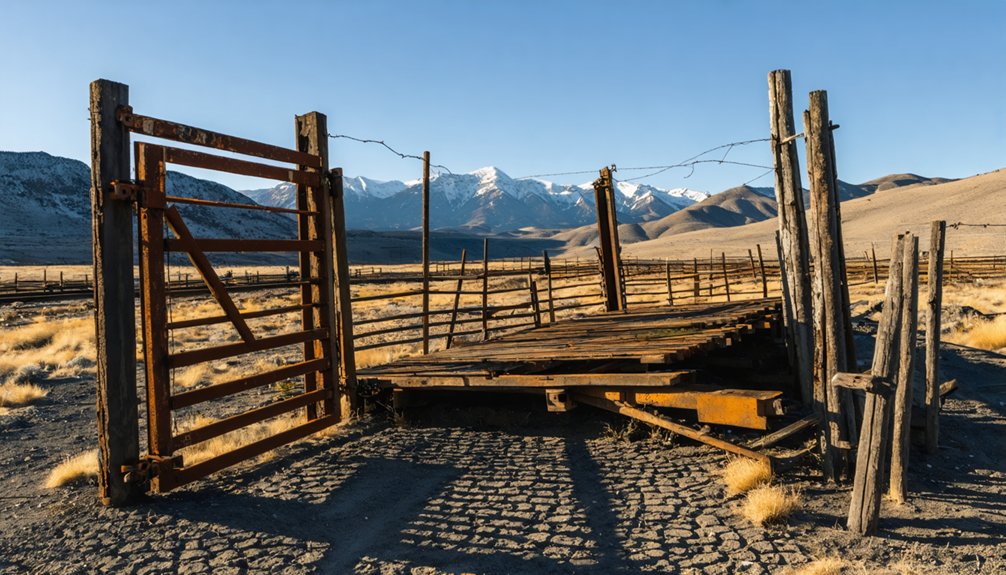
Forty miles north of Susanville, the high-desert community of Ravendale clings to existence at 5,305 feet elevation along U.S. 395, where sagebrush steppe and volcanic tablelands stretch toward the distant horizon.
Ravendale history began in 1899 as a Nevada–California–Oregon Railway station, its corrals and loading chutes funneling cattle and sheep from Madeline Plains ranches toward Reno markets.
You’ll find traces of narrow-gauge rail grades and scattered buildings—some consumed by the devastating 2012 wildfire that accelerated the town’s ghost-like appearance.
Fourteen miles east of Susanville, Standish emerged from late-19th-century agricultural colonization, its irrigated farms contrasting sharply with Ravendale’s rangeland economy.
Both communities survive as semi-active remnants, their postal identities and tiny populations preserving continuity with livestock-shipping origins that rail abandonment couldn’t completely erase.
Fort Janesville and the NCO Railroad Legacy
You’ll find Fort Janesville’s transformation from frontier stockade to railroad stop began when the Nevada-California-Oregon Railway established a station here in the early 1900s.
The NCO Railroad brought brief prosperity to this settlement that had already served as a defensive fort in 1860 and a schoolhouse through the Civil War years.
When the railroad ceased operations and the tracks were eventually removed, Janesville’s commercial significance faded, leaving behind only scattered remnants of its multi-layered past.
Railroad Station Origins
While Fort Janesville earned its place in history as a defensive stockade, the settlement’s transformation into a railroad hub would ultimately define its identity for decades to come.
The Nevada-California-Oregon Railway‘s arrival marked a pivotal shift in the community’s purpose and prosperity. This railroad history transformed the once-military outpost into a crucial transportation nexus, connecting remote Honey Lake Valley to broader commerce networks.
The station significance extended beyond mere logistics—it represented freedom of movement and economic opportunity for settlers who’d once huddled behind fortified walls.
Key Railroad Development Milestones:
- NCO Railway established Janesville as a critical stop along its northbound route
- Station facilities replaced deteriorated fort structures by the late 1860s
- Railroad employment attracted new residents to the area
- Freight operations enabled ranchers to ship livestock and goods efficiently
- Passenger service connected isolated communities throughout Lassen County
Decline and Abandonment
The very infrastructure that brought prosperity to Janesville eventually became obsolete, leaving behind layers of abandonment that define the area’s ghost-town character today.
Fort Janesville’s stockade walls collapsed by the 1870s after locals stripped doors, windows, and timbers for reuse elsewhere. What began as frontier defense became a schoolhouse, then scrap material, then memory.
The Nevada–California–Oregon Railroad faced similar decline when standard-gauge competitors and highway trucking rendered narrow-gauge service unprofitable. Rail-dependent communities withered as trains stopped running.
Today, you’ll find California Historical Landmark No. 758 marking Fort Janesville‘s site—a monument installed by Native Daughters of the Golden West in 1961. These commemorative markers preserve historical significance and community memory where physical structures vanished, transforming abandoned infrastructure into cultural touchstones of independence and self-reliance.
Amendee Lime Kiln: Industrial Relic Near Wendel
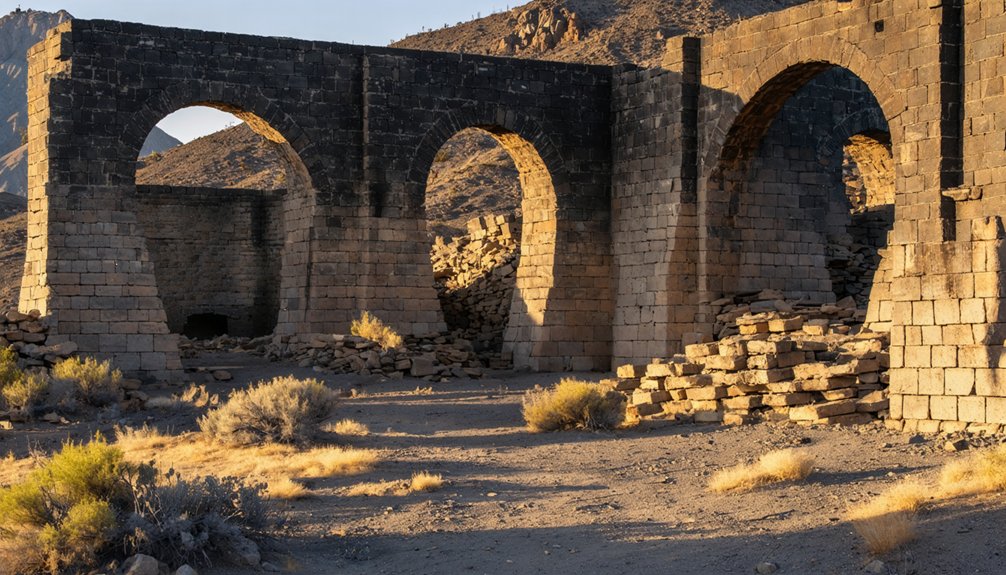
Perched on a hillside above the once-thriving settlement of Amedee, a stone lime kiln stands as a weathered monument to the region’s boom-and-bust industrial past. Built in 1893, this structure processed local limestone when construction demand justified the operation.
You’ll find its historical significance tied directly to the Nevada–California–Oregon Railroad‘s presence and Amedee’s brief role as a regional shipping hub.
Key aspects of the lime production enterprise:
- Initial operations shipped raw limestone to Reno before the kiln eliminated costly transportation
- Reactivated in 1913 when additional rail service sparked renewed investment
- Abandoned after one year when remoteness and shipping economics proved fatal
- Wendel’s emergence as the new railroad terminus diverted vital freight traffic
- High-quality travertine couldn’t overcome market access challenges
What Remains: Exploring Foundations, Cemeteries, and Abandoned Structures
Beyond the lime kiln’s solitary vigil, Susanville’s surrounding basins and hillsides harbor a scattered legacy you can still trace on foot—manor houses slumping into marshland, rail-grade depressions crossing alkali flats, and fire-blackened foundations where gold-rush optimism once ran high.
At Secret Valley Manor, you’ll find barns and sheds sheltering abandoned artifacts: rusted hardware, rotting tack, and splintered buggy frames half-buried in sage.
Flanigan’s linear townsite reveals building pads and debris fields marking vanished depots, their historical significance preserved in faint alignments across Honey Lake Valley.
Hayden Hill’s post-1910 fire left cellar depressions and stone footings beneath modern heap-leach pads, while cemetery plots anchor community memory.
Each site grants you unmediated access—no gates, no guides—inviting quiet discovery among the sagebrush.
Responsible Exploration: Legal Protection and Visitor Ethics
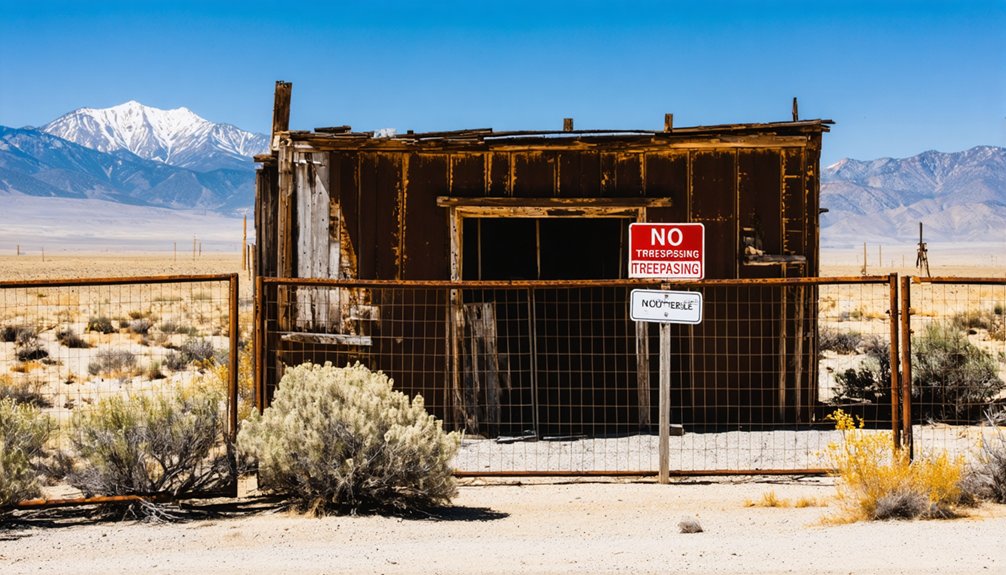
While these weathered sites invite solitary wandering, federal and state law draws a bright line around what you may take: photographs and memories, nothing more.
Even pocketing square-headed nails carries legal consequences. Trail cameras and volunteer monitors work alongside authorities to protect these archaeological treasures in Lassen County’s backcountry.
Archaeological sites in Lassen County’s backcountry remain under constant surveillance through trail cameras and dedicated volunteer monitors protecting historical resources.
Your freedom to explore depends on visitor compliance with preservation principles:
- Leave only footprints; photograph everything else
- Stick to established trails and fords when crossing streams
- Avoid sensitive wetlands, meadows, and tundra
- Report disturbances to local authorities
- Complete Tread Lightly training programs online
This collective stewardship guarantees future generations inherit these windswept remnants intact.
Your respect for both natural and historical resources keeps access open for those who’ll follow your boot prints tomorrow.
Frequently Asked Questions
Are Any Ghost Towns Near Susanville Accessible Year-Round or Closed Seasonally?
You’ll find most ghost towns near Susanville lack documented seasonal closures, though winter snow affects high desert access roads. Year-round access depends on weather conditions rather than official restrictions, giving you freedom to explore responsibly.
Which Ghost Town Sites Have the Most Intact Structures Visible Today?
The Secret Valley brothel manor offers the most intact buildings you’ll encounter, with multiple standing structures and preserved interiors of significant historical significance. Wendel and Amedee follow, retaining partial walls and recognizable layouts worth exploring.
Do I Need Permits or Permissions to Visit Private Ghost Town Sites?
Like the Old West’s unwritten codes, ghost town regulations demand you respect boundaries—you’ll need explicit landowner permission before stepping onto private property guidelines. Trespassing carries real penalties, even at seemingly abandoned sites longing for visitors.
What Wildlife or Environmental Hazards Should Visitors Expect Near These Ghost Towns?
You’ll face wildlife encounters including rattlesnakes, ticks, and bats around ruins, plus environmental risks from extreme heat, wildfires, unstable structures, hidden mine shafts, and contaminated water sources throughout Lassen County’s remote historic sites.
Are Guided Tours Available for Any Ghost Towns Around Susanville?
No formal guided tours operate around Susanville’s ghost towns like Termo or Wendel. You’ll enjoy self-guided exploration instead, discovering historical insights independently through maps and trip reports—perfect freedom for your own adventure through these nostalgic ruins.
References
- https://en.wikipedia.org/wiki/List_of_ghost_towns_in_California
- https://www.californiahauntedhouses.com/real-haunt/mount-lassen-hotel.html
- https://nvtami.com/lassen-county-california-ghost-towns/
- https://www.atlasobscura.com/places/secret-abandoned-brothel
- https://www.onlyinyourstate.com/experiences/california/ghost-towns-in-northern-california
- https://nvtami.com/2023/10/09/highway-395-explorations/
- https://www.weekendsherpa.com/issues/explore-ca-ghost-towns-gold-towns-and-an-underground-garden/
- https://www.lcoe.org/Services/Events/Curriculum-Resources/Historic-Towns-of-Lassen-County/
- https://www.nvmasons.org/history
- https://noehill.com/lassen/poi_masonic_lodge_susanville.asp