You’ll find several ghost towns within easy reach of Truckee, including Boca, which transformed from an 1868 railroad camp into a thriving ice-harvesting hub before fading away. Floriston operated as a company town for the Floriston Pulp and Paper Company until 1930, while Crystal Peak near Dog Valley once housed 1,500 residents during its 1860s mining boom. The Truckee River Canyon conceals foundations of vanished railroad settlements like Camp 24 and Hunter’s Station. Each site offers distinct insights into the region’s railroad, timber, and mining heritage that shaped the Sierra Nevada’s development.
Key Takeaways
- Boca, established in 1868, transitioned from a railroad camp to a thriving ice harvesting and timber town.
- Floriston became a complete company town in 1899 around its pulp mill, closing in 1930 before later revival.
- Crystal Peak peaked at 1,500 residents by 1868 as a mining hub before commerce shifted to Verdi.
- Temporary railroad settlements like Camp 24 and Hunter’s Station vanished after Central Pacific Railroad construction completed in 1869.
- Accessible remnants include Boca’s sawmill foundations, Floriston’s company-town layout, and Donner Summit’s historic railroad tunnels.
Boca: From Railroad Camp to Ice Harvest Capital
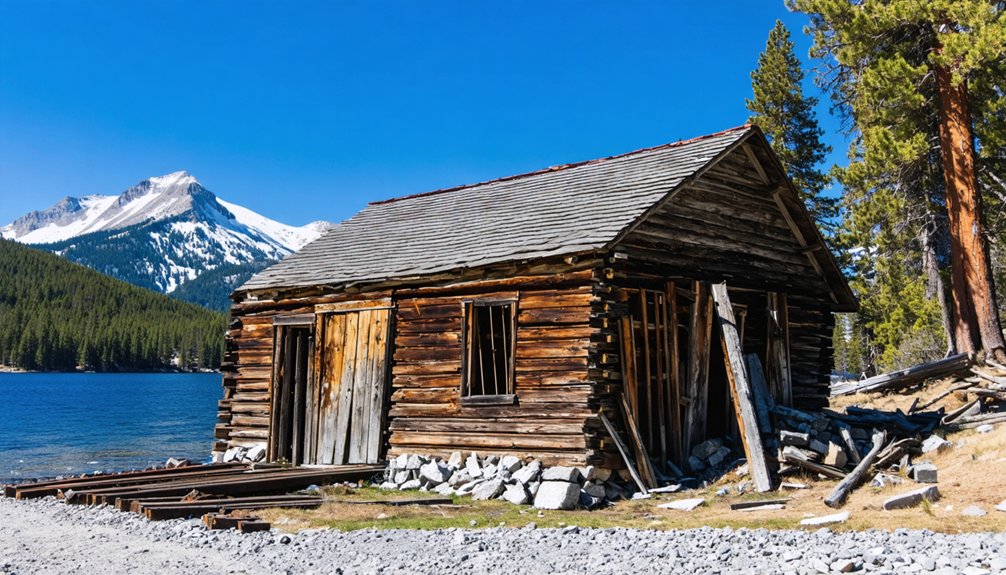
When the Central Pacific Railroad pushed through the high Sierra in 1868, construction crews established Camp 17 at the confluence of the Little Truckee and Truckee Rivers—a location that gave the settlement its enduring name, “Boca,” Spanish for “mouth.”
What began as a temporary encampment for tracklayers quickly transformed into a permanent town as the railroad’s voracious appetite for timber, fuel, and construction materials drew sawmills and logging operations to the area.
The Boca Lumber Company had been logging the Little Truckee River area since the railroad’s arrival, establishing the foundation for the town’s timber industry.
Boca’s transformation accelerated when entrepreneurs recognized the commercial potential of its brutal winters and abundant water sources.
Ice harvesting techniques perfected here exploited temperatures regularly dropping to −15 °F, producing thick, clear ice blocks shipped nationwide in refrigerated railcars.
The town’s name referenced the geographical feature where two rivers converged, a common naming convention throughout Spanish-speaking regions of the American West.
Floriston’s Rise and Fall as a Paper Mill Company Town
Just downstream from Boca’s ice harvesting operations, another industrial enterprise reshaped the Truckee River corridor when the Floriston Pulp and Paper Company formed in 1899.
This $500,000 venture opened May 22, 1900, as the world’s second-largest pulp mill, manufacturing tissue paper for California’s citrus industry. The industrial legacy powered 500 workers and spawned a complete company town with homes, a 52-room hotel, school, and stores.
Workers signed leases contingent on employment, with housing costs deducted directly from their wages, leaving them with limited means to leave the isolated community.
Environmental compliance proved impossible when officials ordered new waste disposal methods in 1930, forcing closure and abandonment. The mill’s demise transformed Floriston into a ghost town until new ownership breathed life back into the community.
Yet community resilience prevailed when attorney Preston L. Wright purchased the property in 1947, establishing the Floriston Property Owners Association.
The town transformed into a Mutual Benefit Corporation by 1995, serving 43 parcels with returning families who valued rural independence over corporate control.
Vanished Railroad Settlements of the Truckee River Canyon
As Central Pacific Railroad construction crews carved their route through the Truckee River Canyon between 1867 and 1869, a succession of temporary settlements materialized to support the transcontinental railroad’s advance into Nevada.
Coburn’s Station history centers on its role as headquarters and supply depot, where four sawmills and three thousand tons of rail enabled track-laying operations before the company renamed it Truckee.
Camp 24 significance lies in its dual function as eastern construction base and bridge engineering center, completing the second Truckee River crossing by March 1868. The settlement marked the state line position during the bridge construction period, symbolizing Nevada’s border when exact territorial boundaries remained loosely defined.
You’ll find similar vanished communities like Hunter’s Station, which served as terminus during April 1868 bridge delays, and Calvada, surveyed in 1872 as a remote watering point twenty-one miles below Truckee. The railroad’s establishment of regular traffic through the canyon led to the growth of several towns along the route, most of which now lie in ruins.
Crystal Peak and the Forgotten Dog Valley Route
While railroad construction camps drew prospectors and laborers to temporary settlements along the Truckee River, the Crystal Peak townsite emerged as a more permanent enterprise in 1864, when the Crystal Peak Company platted streets and lots near gold- and silver-bearing quartz deposits three miles downstream from present-day Truckee.
By 1868, roughly 1,500 residents inhabited this lumber and mining hub, which served overland travelers crossing Henness Pass via the Dog Valley route—an alternate pathway identified by guide Caleb Greenwood in 1844.
The sawmill supplied massive lumber volumes for Central Pacific Railroad construction, yet the railroad’s decision to establish Verdi as its official rail town redirected commerce away from Crystal Peak. The town’s fate was sealed by the checkerboard pattern of railroad land grants, which prevented the Central Pacific from acquiring certain parcels and ultimately shifted the track location away from Crystal Peak.
The post office closed in November 1869, and today only the cemetery remains clearly identifiable from the original townsite.
Among those buried in Crystal Peak Cemetery are Sgt. James Sproul, who served in Co. L, 1 Cal. Cav., and several young residents who died during the town’s brief period of prosperity.
Exploring Nearby Ghost Towns and Historic Mining Sites
Beyond Crystal Peak’s vanished streets, the Truckee River corridor shelters a remarkable concentration of ghost towns and abandoned industrial sites that chart the region’s boom-and-bust cycles from the 1860s through the early 20th century.
You’ll find Boca’s 1868 sawmill foundations and icehouse ruins accessible via interpretive trails, while Floriston preserves its 1899 company-town layout despite the pulp mill’s 1930 closure.
Between Truckee and Verdi, lost railroad camps like Hinton and Roddyville disappeared beneath Highway 40 and Interstate 80 construction, leaving only scattered foundations.
The Donner Summit tunnels showcase extraordinary Chinese labor from the 1860s transcontinental push, where crews averaged one foot of tunnel cut daily using hand drilling and explosives.
These sites represent critical historic preservation opportunities, documenting mining heritage, lumber operations, and railroad infrastructure that shaped Sierra settlement patterns before abandonment erased most traces from modern maps.
Further east, Nevada’s ghost town network includes over three hundred abandoned settlements, offering opportunities for historical exploration across the state’s mining districts and former supply centers.
Among these, ghost towns near Yosemite National Park provide a fascinating glimpse into California’s mining history. Visitors can wander through crumbling structures and learn about the lives of those who once thrived in these now-silent communities. The stark beauty of the surrounding landscape adds to the haunting allure of these forgotten places.
Frequently Asked Questions
Are Ghost Town Sites Near Truckee Safe to Explore With Children?
You’ll find sites like Boca reasonably safe with proper safety precautions—stick to marked trails, watch for rubble and river hazards, and supervise closely. Child friendly activities include walking interpretive loops and exploring foundations under your direct guidance.
What Is the Best Season to Visit Ghost Towns Near Truckee?
Fall is your best time to visit, offering comfortable temperatures, clear skies, and accessible roads. You’ll enjoy vibrant foliage and fewer crowds while engaging in seasonal activities like photography and hiking around historic sites.
Do I Need Permits to Access Ghost Town Sites Near Truckee?
You generally don’t need permits for ghost town accessibility on public trails near Truckee, but commercial photography, large groups, artifact collecting, and accessing private property or railroad easements require authorization under permit requirements.
Can I Camp Overnight at Ghost Town Locations Near Truckee?
Most ghost town sites sit on Tahoe National Forest land where dispersed camping requires staying 200 feet from water and ruins. You’ll need overnight permits for developed areas; check local camping regulations before settling in.
Are Guided Ghost Town Tours Available in the Truckee Area?
Guided tours focus on Truckee’s historic downtown hauntings rather than backcountry ghost towns. You’ll explore local history through October walking tours ($75, ages 21+) or hire private “Pick Your Posse” experiences with storytelling docents.
References
- https://nvtami.com/nevada-county-california-ghost-towns/
- https://www.dicksonrealty.com/2019/10/08/ghost-towns/
- https://travelnevada.com/ghost-town/ghost-towns-near-reno/
- https://nvtami.com/2024/08/26/truckee-travels/
- https://californiahighsierra.com/trips/explore-ghost-towns-of-the-high-sierra/
- https://www.truckeehistory.org/ghosts-of-the-truckee-river-canyon.html
- https://gonevadacounty.com/historic-sites-california-nevada-county/
- https://totalescape.com/journey/ghost-towns-in-california/
- https://en.wikipedia.org/wiki/Boca
- https://www.truckeehistory.org/tracking-the-railroad-from-boca-to-loyalton.html