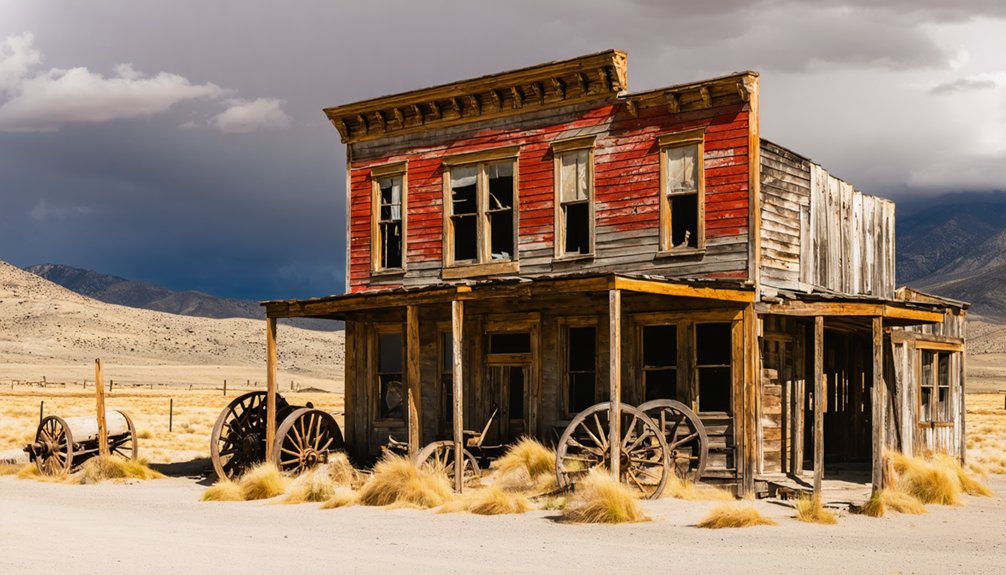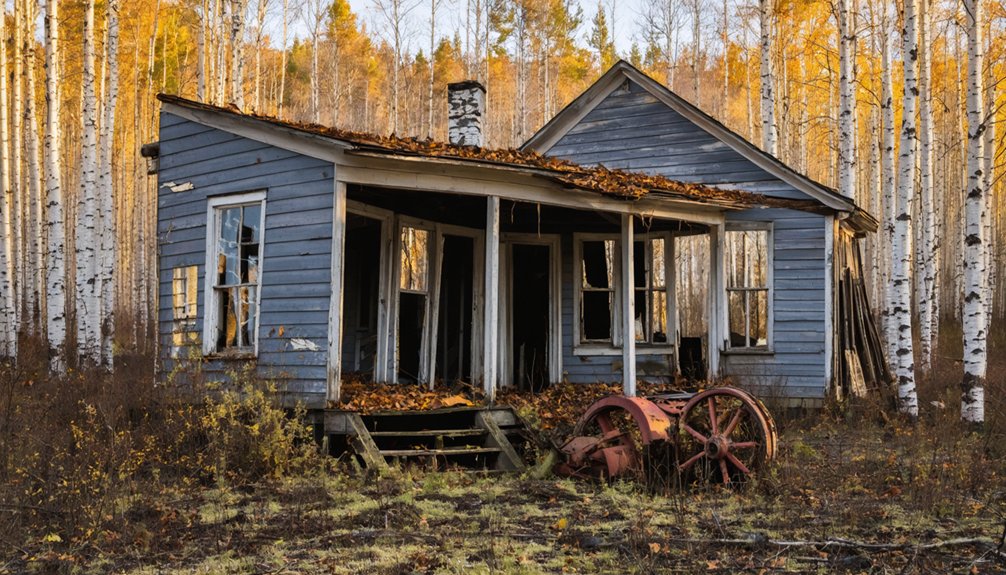
You’ll discover Rainy Lake City within Voyageurs National Park, Minnesota’s only profitable gold mining town that thrived in the 1890s with 500 residents before collapsing by 1901. The remote location requires water-based transportation to access mining remnants and preserved structures scattered across Little American Island. Nearby, the Kabetogama Peninsula holds archaeological evidence of resource-driven settlements that disappeared after gold depletion and logging decline. The park preserves over 50 historic structures from these vanished communities, offering insights into the economic forces and geographic isolation that transformed bustling frontier towns into wilderness ruins.
Key Takeaways
- Rainy Lake City, established in 1893 on Little American Island, was Minnesota’s only profitable gold mine before closing in 1898.
- Little American Island features preserved mining machinery, shafts, and remnants from the 1890s gold mining operations accessible by water.
- Kabetogama Peninsula contains over 50 preserved historic structures including log cabins reflecting settlement architecture from resource-driven communities.
- Ghost town sites require water-based transportation for access, with archaeological remnants preserved after federal park designation in 1975.
- Settlements declined due to shallow gold deposits, white pine depletion, transportation costs, and railroads bypassing lake communities.
Rainy Lake City: A Vanished Settlement in the Wilderness
When gold was discovered on Little American Island in 1893, prospectors and entrepreneurs rushed to establish Rainy Lake City on the south shore of Black Bay, roughly 12–15 miles east of present-day International Falls.
Within a year, this wilderness settlement swelled to 500 inhabitants and boasted eight dry goods stores, three hotels, two newspapers, and sixteen saloons. The town’s stamp mill processed ore averaging $30 per ton, making Little American Minnesota’s only profitable gold mine.
Yet this mining legacy proved fleeting. High transport costs, legal disputes, and management problems forced the mine to close by early 1898. The mine’s troubled history included a lawsuit in 1895 that interrupted operations and contributed to its eventual demise. Rainy Lake City’s population vanished almost immediately, leaving it a ghost town by 1901.
Today, you’ll find only a grassy clearing and two 1920s-era buildings marking where this vanished settlement once thrived. One log structure served as a blind pig speakeasy during the Prohibition Era, long after the gold rush ended.
The Rise and Fall of a Northern Minnesota Community
While Rainy Lake City flourished and collapsed within a single decade, the broader Kabetogama Peninsula supported a more dispersed network of resource-driven settlements that rose and fell across several generations.
You’ll find these lake-based communities relied on constantly shifting mining techniques—from hand-panning in shallow veins to speculative drilling—that never sustained long-term prosperity.
Community dynamics reflected seasonal labor patterns: loggers arrived for winter camps, prospectors searched summers, while Bois Forte families maintained year-round presence through trapping and fishing.
Key factors shaped this frontier’s trajectory:
- Gold deposits proved too shallow and discontinuous for industrial extraction
- White pine depletion ended timber-based employment by the 1920s
- Water-dependent transportation limited permanent settlement infrastructure
- Federal park designation in 1975 preserved archeological remnants
The abandoned buildings and infrastructure of these settlements now attract curious visitors exploring the region’s historical landscape. Similarly, steamboat passengers once disembarked at shallow rapids along Minnesota’s rivers, creating brief economic opportunities for entrepreneurial settlements that ultimately could not overcome environmental challenges.
San Francisco, Minnesota: A California Dream in the River Valley
Unlike the remote mining camps scattered across the Kabetogama Peninsula, San Francisco, Minnesota emerged from a more audacious vision—one that transplanted California Gold Rush optimism onto Minnesota River bottomland.
Founder William Foster, a Donner Party survivor, named the settlement in 1854 after the booming western city, channeling his California aspirations into a projected River Gateway hub.
You’ll find the town was strategically platted near Carver Rapids, where shallow waters forced steamboat passengers to disembark.
Foster envisioned prosperity through transfer services, hotels, and commerce. The settlement briefly claimed county seat status in 1855, but chronic flooding and competition from neighboring towns crushed these dreams.
The catastrophic 1863 flood swept away Foster’s warehouse and remaining structures, transforming California ambition into Minnesota’s most ironically named ghost town. By 1863, the town was completely abandoned, its residents relocating to higher ground and more promising settlements.
Today, only a township hall, originally a schoolhouse, stands among the farmland as a testament to the settlement’s brief existence.
Elcor and the Mining Boom of Northeastern Minnesota
You’ll find Elcor’s story represents the classic arc of Iron Range company towns, rising from wilderness to nearly 1,000 residents by 1920 before vanishing completely.
The town existed solely to serve the Elba and Corsica mines on the Mesabi Range, with workers living in company-owned housing along dirt streets that bustled with immigrant families from across Europe.
When the Corsica Mine closed in 1954, the mining company ordered the entire community abandoned, erasing decades of industry and community life in a matter of months.
Today, the Minorca mine occupies the former site where Elcor once stood, with no visible traces of the community remaining. The harsh reality of browser compatibility issues affects how modern researchers access historical mining records and archival photographs documenting Elcor’s brief existence.
Mining Community at Peak
Established in 1897 on the Mesabi Iron Range near Gilbert in St. Louis County, Elcor housed nearly 1,000 residents by 1920.
You’ll find this mining town exemplified how community dynamics evolved around iron extraction. The mining company constructed wooden board houses surrounded by four-board-high fences, while dirt roads connected immigrants from Croatia, Slovenia, Finland, Italy, Germany, Scandinavia, and Cornwall who worked the mines.
The town’s infrastructure included:
- Two churches serving diverse religious communities
- A primary school educating mining families’ children
- A general store and post office supporting daily needs
- A railroad station connecting residents to broader transportation networks
Mining techniques drove Elcor’s prosperity, with the company owning all land while residents could purchase homes, creating unique governance dependent on continued mineral extraction. The mining industry declined in the 1950s, leading to Elcor’s abandonment and leaving behind only remnants of foundations and scattered artifacts. The Corsica mine closed in 1954, prompting evacuation orders that displaced all remaining residents from their company-owned land.
Industry Collapse and Abandonment
The prosperity that drew nearly 1,000 residents to Elcor couldn’t withstand the geological and economic realities of iron mining. By mid-century, high-grade hematite reserves had declined sharply, making underground operations unprofitable.
Economic shifts toward mechanized open-pit mining and taconite processing rendered Elcor’s labor-intensive shafts obsolete. U.S. Steel’s Oliver Iron Mining consolidated investments in larger districts, abandoning smaller operations like Elcor’s Corsica Mine, which closed in 1954.
Without reinvestment in company-owned housing or infrastructure, families relocated to viable Iron Range towns. Mining technology advances bypassed the settlement entirely, leaving it without purpose.
Tax revenues evaporated, services ceased, and buildings stood vacant. By decade’s end, only foundations remained—a stark reminder that freedom to pursue opportunity also means freedom to leave when that opportunity disappears.
How Economic Decline Transformed Thriving Communities Into Ghost Towns
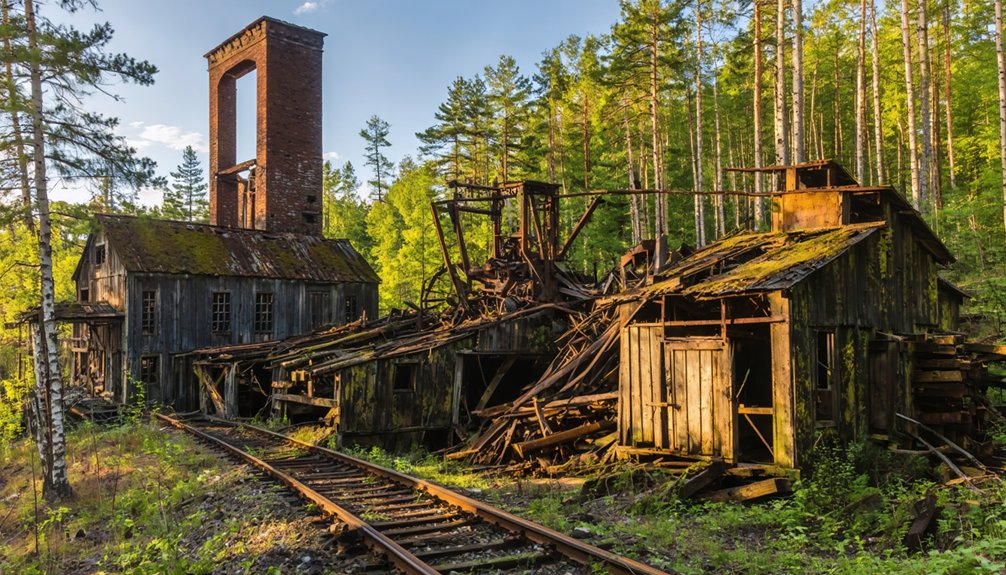
When gold was discovered in the Rainy Lake region during the early 1890s, prospectors and entrepreneurs flooded into what would become the Voyageurs National Park area, establishing settlements like Rainy Lake City almost overnight.
These bustling communities lacked economic resilience and community adaptation strategies when resources ran out.
The transformation from thriving towns to abandoned settlements followed a predictable pattern:
Boom-and-bust cycles devastated Rainy Lake settlements with ruthless efficiency, leaving empty buildings where prosperous communities once flourished.
- Resource depletion exhausted gold veins and timber stands within years, eliminating the primary employment base
- Transportation shifts redirected railroads and highways away from water-based routes, isolating lake communities from commercial networks
- Industrial consolidation centralized logging operations in regional hubs, closing local mills and camps
- Population exodus accelerated as workers relocated to diversified towns with stable job markets
You’ll find these ghost towns stand as monuments to single-industry vulnerability.
River Settlements: Strategic Locations That Couldn’t Last
Along the waterways that would become Voyageurs National Park, geography dictated prosperity—and eventual abandonment.
You’ll find that river trade corridors along Rainy, Namakan, and Kabetogama Lakes created strategic chokepoints where settlements thrived for centuries. Indigenous settlements like the Ojibwe villages at Kettle Falls and Moose River controlled portage routes essential to the fur trade from the 1600s through the 1800s.
These locations attracted trading posts, seasonal camps, and later mining-service towns that depended entirely on water transport. Yet their greatest strength—isolation by water—became their fatal weakness.
When railroads bypassed the lakes and resource booms collapsed, you couldn’t sustain communities accessible only by boat. Strategic geography that once guaranteed success ultimately sealed their fate.
When the Railroad Passed Them By: Forestville and Beyond
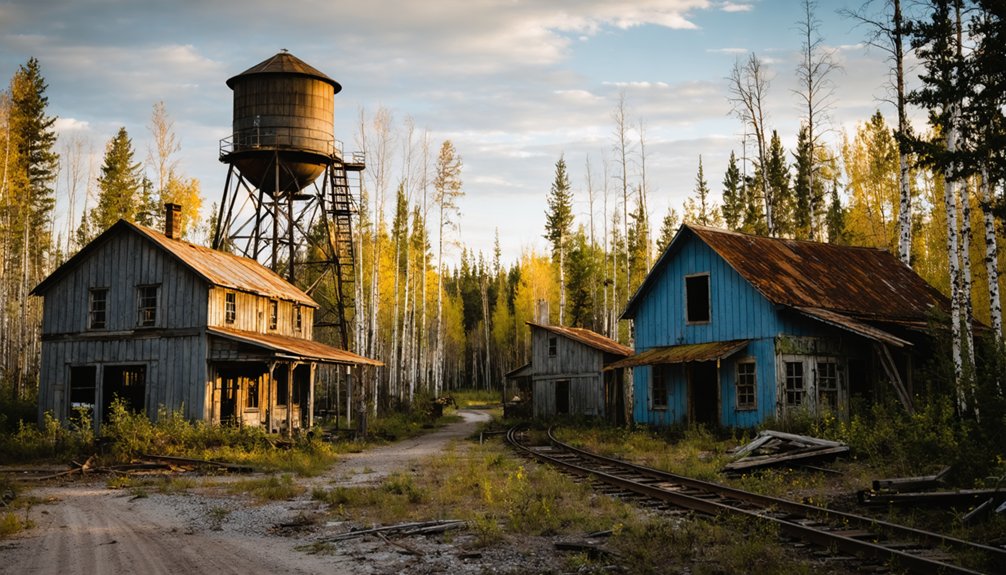
By the 1850s, Forestville had earned its prosperity as a stagecoach hub linking St. Paul and Dubuque, serving regional farm families with hotels, stores, and services.
Forestville thrived as a vital stagecoach stop connecting St. Paul and Dubuque, anchoring commerce for surrounding farm communities.
When the Southern Minnesota Railroad surveyed routes in the 1860s, everything changed. The 1868 routing decision sent tracks through Wykoff and Spring Valley instead, sealing Forestville’s fate.
Railroad impacts devastated communities like Forestville:
- Population plummeted from 150+ residents in 1860 to just 55 by 1880
- Stagecoach history ended abruptly as rail towns captured all commercial traffic
- Property values collapsed, enabling the Meighen family to buy the entire town by 1889
- Former townsite became a company town where workers were paid in store credit
You’ll find similar railroad-bypassed settlements across Minnesota, each a reflection of how corporate routing decisions determined which frontier communities survived.
The Human Cost: War and Displacement in Minnesota’s Ghost Towns
When you explore Minnesota’s ghost towns, you’re walking through landscapes shaped by violent displacement and war.
The U.S.–Dakota War of 1862 and the Civil War didn’t just claim lives—they triggered mass evacuations, labor shortages, and demographic collapses that emptied frontier settlements across the state.
Even more devastating were the forced removals of Dakota and Ojibway communities, whose villages vanished from maps entirely as their lands were seized and replatted for Euro-American towns that often failed within decades.
Civil War Impact
The Civil War and concurrent frontier violence inflicted catastrophic demographic wounds on Minnesota’s fledgling settlements, bleeding away the young men and families these towns desperately needed to survive.
When 24,000–25,000 soldiers marched off to Union regiments, frontier communities lost farmers, craftsmen, and entrepreneurs during peak development years. Approximately 2,500 never returned, leaving ghost towns in their wake.
The brutal arithmetic of Town Displacement:
- Wasioja Seminary’s recruiting station drained Dodge County of draft-age men, crippling local enterprises and tax bases.
- US–Dakota War evacuations abandoned entire townships across south-central Minnesota’s river valleys.
- New Ulm’s 2,000 refugees fled to Mankato after August 1862 attacks, leaving farms unworked for seasons.
- Speculative towns like Nininger collapsed when war diverted capital and immigration dried up completely.
Freedom requires people—something Civil War Minnesota tragically lacked.
Forced Ojibway Removal
Between 1805 and 1867, systematic treaty negotiations stripped the Ojibwe of their ancestral lands across Minnesota, transforming a sovereign people into displaced refugees confined to ever-shrinking reservations.
You’ll find the treaty implications devastating: the Old Crossing Treaty alone surrendered 11,000,000 acres for merely $20,000 annually.
The Sandy Lake Tragedy of 1850 killed approximately 400 Ojibwe through deliberate neglect during forced relocation—harsh conditions and withheld supplies turned government promises into death sentences.
By 1889, authorities broke even their limited commitments, selling remaining lands and forcing Ojibwe displacement to White Earth Reservation.
Only Red Lake resisted, maintaining tribal sovereignty by rejecting the Dawes Act.
These weren’t mere land transactions; they were calculated erasures of self-determination that turned thriving communities into ghosts.
Visiting Ghost Town Sites Near Voyageurs National Park Today
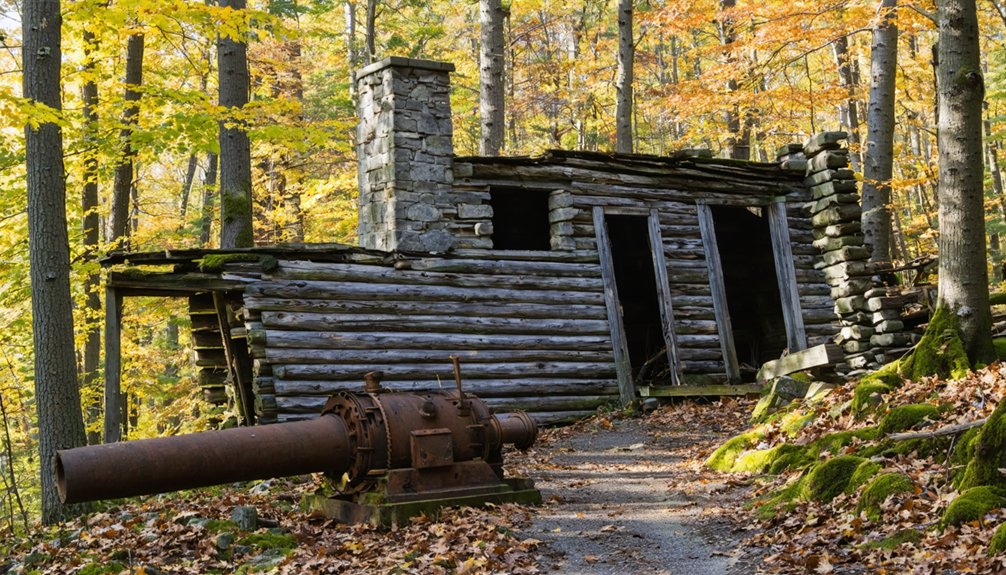
Exploring ghost town sites near Voyageurs National Park requires water-based transportation, as most remnants occupy remote islands and shorelines accessible only by canoe or kayak. Your canoeing adventures will lead you to Rainy Lake City, where gravel trails connect docking areas to partially water-filled mine shafts and metal equipment from the 1890s mining era.
As you venture further, you might also be intrigued by the abandoned sites in the Virgin Islands that tell stories of long-lost industries and settlements. Exploring these remote locations reveals fascinating remnants of history, including crumbling structures overtaken by nature. These sites provide a unique glimpse into the past, offering a different kind of adventure for those willing to paddle beyond the usual paths.
What You’ll Discover During Ghost Town Exploration:
- Little American Island features two horizontal adits, a vertical mine shaft, and preserved mining machinery from historical operations.
- Rainy Lake City presents grassy traces of streets with two later-period buildings rather than original 1890s structures.
- Historic log cabins scattered throughout the park demonstrate residential architecture from settlement periods.
- More than 50 preserved structures exist across park territory, offering tangible connections to northern Minnesota’s industrial heritage.
Frequently Asked Questions
Are There Any Ghost Towns Still Accessible by Boat on Rainy Lake?
Yes, you can reach Rainy Lake City’s abandoned settlements by boat on Black Bay. This 1894 gold rush town features a dock for canoe or boat access, with two remaining buildings and visible archaeological ruins you’ll explore.
What Artifacts Can Visitors Legally Collect From Minnesota Ghost Town Sites?
You can’t legally collect artifacts from Minnesota ghost town sites without explicit permission. Legal limitations protect resources on public lands, and artifact preservation laws require landowner consent on private property, with burials strictly prohibited everywhere.
Which Ghost Towns Near Voyageurs Have the Most Intact Structures Remaining?
Rainy Lake City retains two standing buildings plus visible street traces, offering the most intact ghost-town structures near Voyageurs. However, the park’s 50+ preserved historic cabins surpass any single townsite in structural integrity and historical significance.
Do Any Ghost Towns Require Special Permits or Fees to Visit?
You won’t need special permits or fees for most ghost town visits near Voyageurs, though crossing into Canada for Rainy Lake City requires customs compliance, and overnight camping involves standard park reservation fees.
What Safety Precautions Should Visitors Take When Exploring Abandoned Mining Sites?
Never enter underground workings or shafts—abandoned site safety demands you stay out entirely. Mining site hazards include unstable ground, toxic water, bad air, and hidden vertical drops. Observe from safe distances, respect fences, and tell someone your plans.
References
- https://en.wikipedia.org/wiki/List_of_ghost_towns_in_Minnesota
- https://www.minnesotahistory.org/post/a-complete-guide-to-the-ghost-towns-of-hennepin-county
- https://www.fws.gov/story/ghost-town-carver-rapids
- https://thievesriver.com/blogs/articles/ghost-towns-in-minnesota
- https://www.youtube.com/watch?v=5bCG6B2rzZY
- https://www.voyageurs.org/news/2017/09/18/paddling-past-rainy-lake
- https://www.exploreminnesota.com/seasons/fall/spookiest-places-minnesota
- https://www.nps.gov/voya/learn/historyculture/historicthemes.htm
- https://npshistory.com/publications/voya/index.htm
- https://www.ci.international-falls.mn.us/wp-content/uploads/2017/09/History-of-International-Falls-Revised.pdf