You’ll find Vulture City just northeast of Wickenburg, where sixteen original 1800s structures stand preserved from Arizona’s richest gold mining operation that produced $200 million worth of ore between 1863 and 1942. The ghost town once housed 5,000 residents and now offers guided tours through authentic buildings including the assay office, blacksmith shop, and boarding houses. For something quirky, visit Nothing, Arizona—a roadside settlement featuring its famous “Faith in Nothing” sign—or explore Stanton’s remote stone ruins from the 1863 mining boom, where frontier history awaits your discovery.
Key Takeaways
- Vulture City, northeast of Wickenburg, operated from 1863 to 1942, producing 340,000 ounces of gold worth $200 million.
- Sixteen original 1800s structures remain at Vulture City, including assay offices, boarding houses, and schoolhouses with restoration since 2017.
- Nothing, Arizona, founded in 1977, features crumbling remains of a gas station and All-Mart with its famous “Faith in Nothing” sign.
- Stanton began as Antelope Station in 1863, with original stone buildings still standing among modern RV trailers in backcountry terrain.
- Best visiting season is October to May; guided and self-guided tours available at Vulture City on weekends with gold panning experiences.
Vulture City: Arizona’s Richest Gold Mining Camp
The desert hills northeast of Wickenburg once echoed with the sounds of stamp mills crushing ore and miners chasing one of Arizona’s richest veins of gold.
Vulture City supported 5,000 residents at its peak, complete with saloons, boarding houses, and a thriving main street that attracted fortune seekers from across the territory.
The mine’s economic impact transformed the entire region—producing 340,000 ounces of gold worth $200 million and directly funding the establishment of Wickenburg and Phoenix.
You’ll find remnants of this prosperity in the two-story rock-walled assay office and scattered structures that witnessed both incredible wealth and tragedy, including the notorious Hanging Tree where eighteen accused thieves met their end.
Henry Wickenburg discovered the gold deposit in 1863 after finding gold in a quartz outcropping, launching what would become Arizona’s largest and richest gold mine by the late 1860s.
The town became a ghost town by the early 2000s after decades of deterioration following its abandonment when the mine closed in 1942.
The Legendary Vulture Mine and Its Discovery
Behind all that wealth and those weathered buildings stands one of Arizona’s greatest fortune-hunting stories—the discovery that started it all in 1863.
When Henry Wickenburg spotted a conspicuous quartz outcropping near the Hassayampa River, he’d stumbled upon what would become the most productive gold mine in Arizona history.
The Vulture Mine’s historic significance can’t be overstated—it shaped an entire territory.
Key facts about the legendary discovery:
- Wickenburg and companions Isaac Van Bibber and Theodore Green first staked their claim in November 1863
- The mine produced 340,000 ounces of gold and 260,000 ounces of silver between 1863-1942
- Mining groups extracted up to $700 in gold daily by late 1864
- The strike attracted over 5,000 fortune-seekers to the area
- Legal disputes plagued early ownership before full development began
The mine was eventually sold to Benjamin Phelps and the Vulture Mining Company, marking a new chapter in its operational history.
Wickenburg initially found surface gold at Rick Hill before discovering the main Vulture deposit.
Exploring Vulture City’s Preserved 1800s Buildings
You’ll find over sixteen original 1800s structures still standing at Vulture City, each one meticulously stabilized to preserve its historic adobe, stone, and wood framing.
Walking through the assay office, blacksmith shop, brothel, cookhouse, and schoolhouse transports you directly into the dust and determination of a late-19th-century mining camp.
The privately led restoration since 2017 has transformed these weathered ruins into Arizona’s most authentic ghost town experience, where self-guided tours let you trace the exact routes miners once walked between their homes and the mine’s economic heart. Founded in 1863 by prospector Henry Wickenburg after his discovery of gold, the town grew into a thriving community that would eventually house nearly 5,000 residents at its peak.
The settlement was abandoned in 1942 when the War Production Board ordered the mine’s closure, bringing an abrupt end to nearly eight decades of continuous operation.
Original Structures Still Standing
You’ll encounter authentic frontier life through:
- Assay office where ore samples determined fortunes
- Blacksmith shop rebuilt on its original footprint
- Boarding houses with stabilized adobe and masonry walls
- General store serving 5,000 boomtown residents
- Schoolhouse representing frontier education
Each building contains recovered artifacts, reinforcing the settlement’s genuine 1880s character. The community also featured stamping mills that processed ore extracted from the mine below.
Guided Tours and Activities
When you step onto Vulture City’s dusty streets, you’re choosing between two distinct ways to experience Arizona’s most authentic gold-rush ghost town.
Guided exploration runs October through May, with knowledgeable interpreters leading you through 17 curated 1800s buildings while explaining the boomtown’s rise and 1942 decline. You’ll hear tales of miners, outlaws, and pioneers who built this remote settlement.
Alternatively, self-guided tours let you wander freely through preserved structures—assay offices, brothels, blacksmith shops—at your own pace, reading interpretive signage along original dirt paths.
The historical significance comes alive through specialty experiences too: hands-on blacksmithing workshops, atmospheric night tours by flashlight, vintage baseball games, and Old West gunfight reenactments.
Schools and homeschool families particularly value the outdoor classroom setting. All tours are handicap accessible, ensuring visitors of varying abilities can explore this piece of Arizona history. Leashed, well-behaved dogs are welcome to accompany you on your adventure through the ghost town at no additional fee.
Nothing, Arizona: A Quirky Roadside Ghost Settlement
Heading northwest from Wickenburg on U.S. Route 93, you’ll encounter one of Arizona’s most eccentric roadside relics at milepost 148.5—the ghost settlement of Nothing.
Founded in 1977 as a tongue-in-cheek micro-community, this six-acre patch of desert once featured a gas station, the tiny “All-Mart” market, and a bar beneath that famous sign proclaiming “Faith in Nothing.” The town sits at an elevation of 3269 ft, perched in the high desert between Wikieup and Wickenburg.
Today, only crumbling concrete foundations, boarded-up structures, and a weathered billboard mark where four residents briefly built Arizona’s smallest—and most ironically named—town.
Highway 93 Roadside Remnants
Along the sun-bleached stretch of U.S. Highway 93, you’ll discover authentic ghost settlement history frozen in desert time. Nothing’s remaining structures tell the raw story of frontier entrepreneurship and inevitable decline.
These highway relics stand as weathered monuments to travelers who once stopped for gas, cold drinks, and roadside conversation.
What remains today:
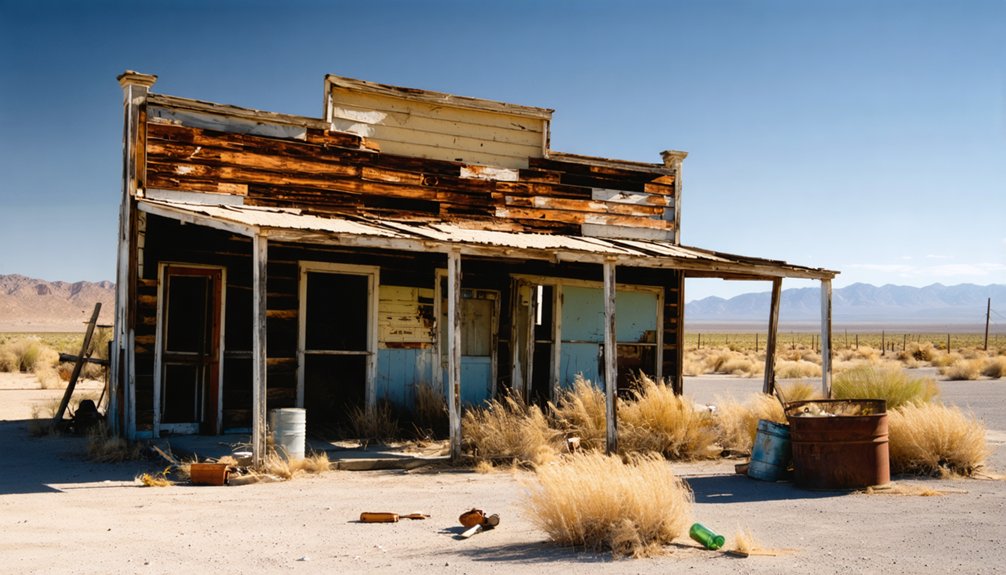
- Concrete foundations where the rock shop and gas station once welcomed Phoenix-to-Vegas travelers
- Boarded-up walls of the general store, partially collapsed and ringed with barbed wire
- Faded roadside signs marking the settlement’s quirky identity against endless desert backdrop
- Scattered debris piles of rusted barrels, abandoned furniture, and construction rubble
- Empty desert plots where homes and the “Taint Much Ado” bar served miners and gamblers
No services operate here—only photo opportunities and memories.
Famous “Faith in Nothing” Sign
The weathered sign that once greeted travelers on Highway 93 transformed a desert crossroads into Arizona’s most philosophical joke.
Mounted high on a metal tower near milepost 148.5, it declared: “The staunch citizens of Nothing are full of Hope, Faith, and Believe in the work ethic… these dedicated people had faith in Nothing, hoped for Nothing, worked at Nothing, for Nothing.”
This sign’s significance extended beyond mere wayfinding—founder Buddy Kenworthy’s tongue-in-cheek proclamation turned existential wordplay into roadside humor that stopped Phoenix-to-Vegas travelers for decades.
You’ll find only remnants today; the original motto plaque vanished by the early 2010s, leaving just scattered warning signs.
Yet Nothing’s deliberate paradox earned it legendary status among Arizona’s quirky place-names, embodying self-aware defiance of conventional civic boosterism.
Abandoned All-Mart and Station
Buddy Kenworthy’s audacious 1977 vision materialized as Nothing’s All-Mart general store and gas station—two modest structures that briefly transformed barren Mohave County desert into Arizona’s smallest incorporated community.
These abandoned structures stand as weathered monuments along U.S. Route 93, their boarded windows and faded paint telling stories of entrepreneurial dreams in America’s forgotten corners.
What You’ll Discover at Nothing’s Ruins:
- All-Mart’s deteriorating building still displays its original sign proclaiming a population of four
- Collapsed gas station frame slowly surrendering to desert elements since 2008
- Concrete foundations and scattered rubble marking former business locations
- Historical significance as testimony to roadside commerce between Phoenix and Las Vegas
- Barbed wire fencing surrounding remnants of Kenworthy’s 1977 settlement experiment
These skeletal remains represent ultimate freedom—building something from nothing.
Stanton and Other Backcountry Mining Ruins
Gold fever gripped Arizona’s central highlands in the 1860s, and nowhere did it burn hotter than around Rich Hill, where prospectors found nuggets scattered on the surface like gravel.
Stanton history began as Antelope Station in 1863, evolving into a notorious boomtown under Charles P. Stanton’s control. You’ll find the site today operating as a private RV camp, with original stone buildings still standing among modern trailers—a peculiar blend of preservation and practicality.
Nearby Weaver’s lawlessness made even Stanton look tame; newspapers demanded its closure after murders became routine.
Octave rounded out this violent triangle as a company mining town. All three settlements now lie scattered across backcountry ridges, their ruins accessible only to those willing to navigate rough roads and respect private property boundaries.
Gold Panning and Living History Experiences
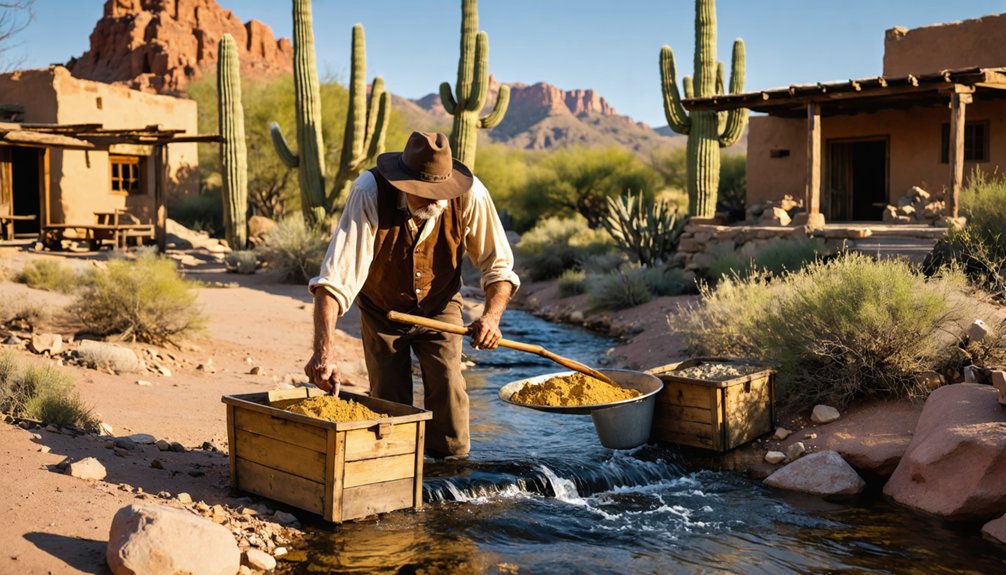
- Pan “flour gold” at Gold Mine Experience’s historic tailings on 187 acres
- Search river gravels and crevices where fine flakes still accumulate
- Watch blacksmithing demonstrations at Vulture City Forge
- Join guided tours through Arizona’s richest gold camp
- Experience period gunfights and frontier skits in authentic settings
Planning Your Ghost Town Visit: Season and Access
After you’ve planned which historic experiences to enjoy, timing your visit correctly will make all the difference between a memorable desert adventure and an uncomfortable ordeal under Arizona’s relentless sun.
Timing your desert ghost town visit separates unforgettable adventures from dangerous encounters with Arizona’s unforgiving heat.
The best visiting season runs October through May, when Vulture City opens its gates and temperatures stay tolerable for exploring exposed mining sites. Summer’s brutal heat—often exceeding 100°F—triggers closures and creates genuine danger in shadeless ghost towns.
Seasonal considerations include monsoon flash-flood risks from July through early September, which can render dirt access roads impassable. Spring and late fall offer the sweet spot: longer daylight, stable weather, and prime touring conditions.
Vulture City typically operates weekends between October and June, closing around 3–4 p.m., so confirm hours before heading out.
The Mining Legacy That Shaped Wickenburg
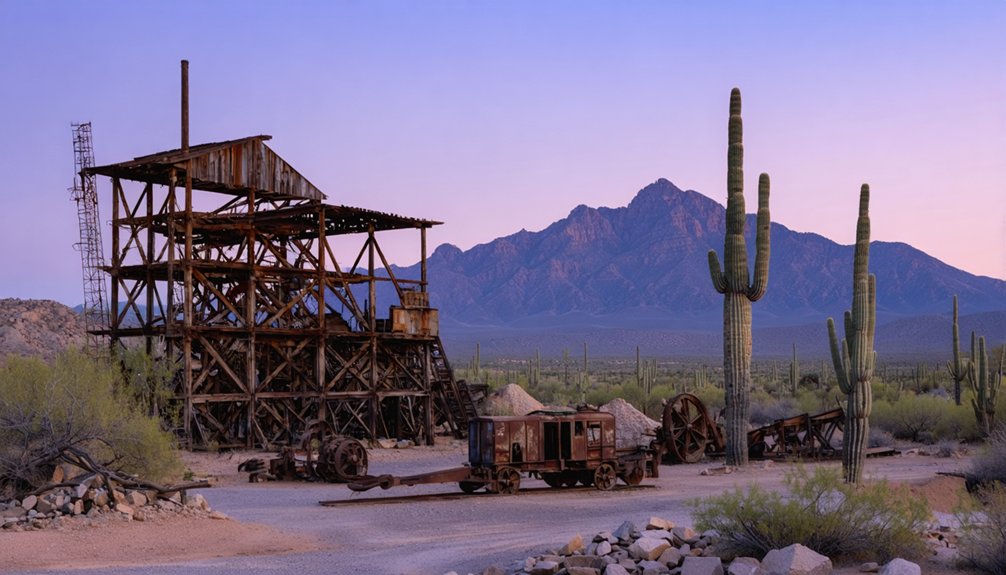
- 15 cords of wood consumed daily by 1883, stripping hillsides for miles
- 150-mile freight routes from the Colorado River anchored territorial commerce
- Hispanic ranchers from Sonora settled the Hassayampa, creating a bi-cultural frontier
- $30–200 million in historic production fueling eight decades of prosperity
- Abandoned shafts and ghost towns now marking the landscape
This community evolution from boom camp to enduring settlement shaped everything you’ll explore today.
Frequently Asked Questions
Are Ghost Town Tours Near Wickenburg Safe for Young Children?
Yes, ghost town tours near Wickenburg prioritize ghost town safety with handicap-accessible paths and cart transportation. You’ll find family friendly activities like guided tours and gold mining education, though you should avoid extreme summer heat with young ones.
Can You Camp Overnight at Vulture City or Other Ghost Towns?
Don’t pitch your tent inside history’s walls—Vulture City doesn’t allow public overnight camping. You’ll need camping regulations compliance and overnight permits for nearby State Trust Land dispersed sites, where freedom rings under desert stars instead.
Do I Need a Four-Wheel-Drive Vehicle to Reach These Ghost Towns?
You won’t need four-wheel drive for Vulture City’s main access, but exploring remote ghost towns and dispersed camping areas demands high-clearance vehicles. Your best vehicle recommendations include capable SUVs or trucks for authentic backcountry freedom.
Are There Restrooms and Water Available at the Ghost Town Sites?
Better safe than sorry—Vulture City offers restroom facilities and water sources during operating season, but you’ll find nothing at backcountry sites. Pack your own supplies when exploring remote ruins to maintain complete independence on your desert adventures.
What Wildlife or Safety Hazards Should I Watch for While Exploring?
Watch for rattlesnakes, scorpions, and Africanized bees in abandoned structures and mine shafts. Desert wildlife poses real danger—take safety precautions seriously. Unstable buildings, hidden shafts, extreme heat, and flash floods demand constant vigilance during your exploration.
References
- https://www.arizonahighways.com/article/arizona-ghost-towns
- https://www.youtube.com/watch?v=FheZDDo_Nx0
- https://www.atlasobscura.com/places/nothing-ghost-town
- https://www.visitarizona.com/directory/vulture-city-ghost-town
- https://vulturecityghosttown.com
- https://www.tripadvisor.com/Attractions-g31405-Activities-c47-t14-Wickenburg_Arizona.html
- https://en.wikipedia.org/wiki/List_of_historic_properties_in_Wickenburg
- https://www.legendsofamerica.com/vulture-city-arizona/
- https://vulturecityghosttown.com/history/
- https://events.thehistorylist.com/organizations/vulture-city-ghost-town