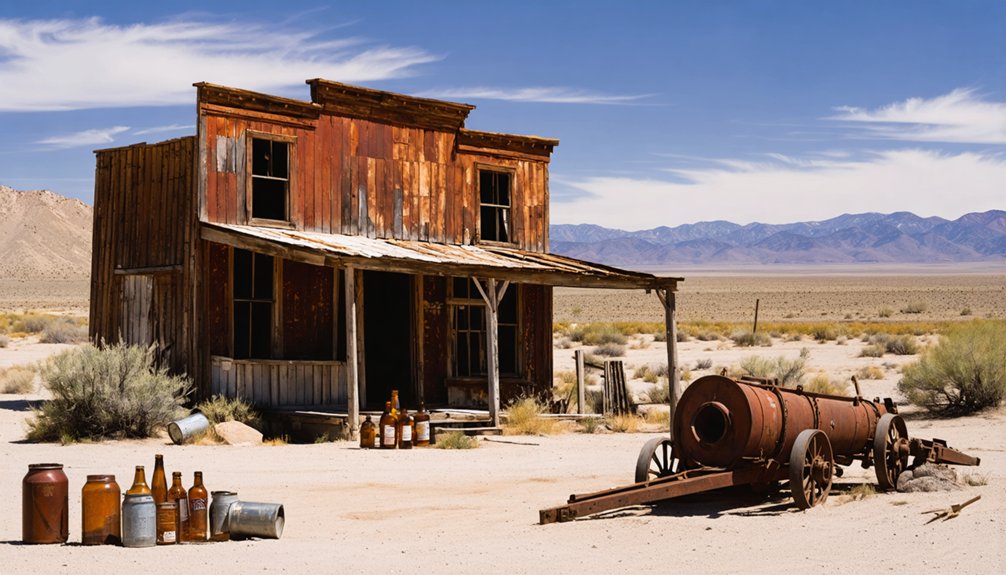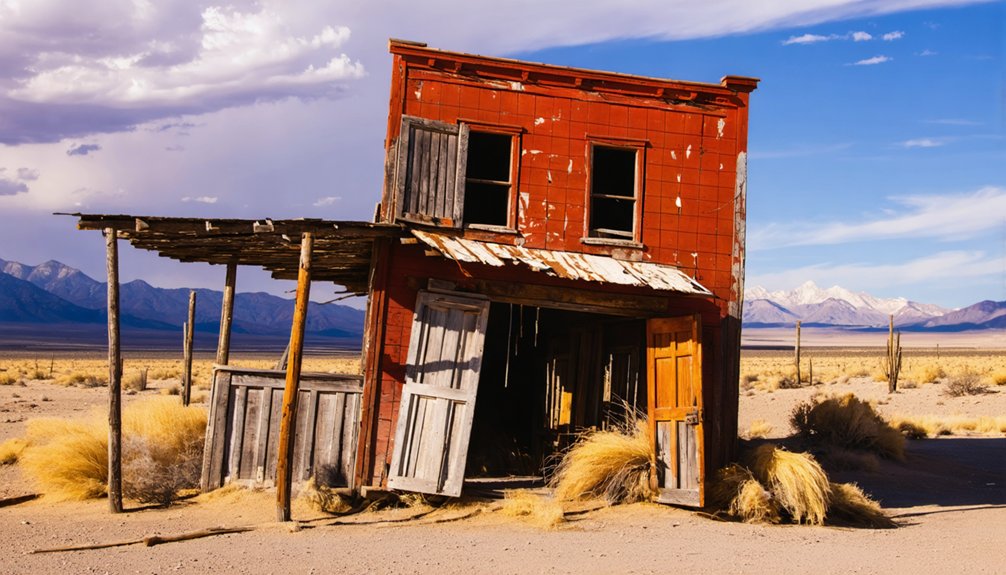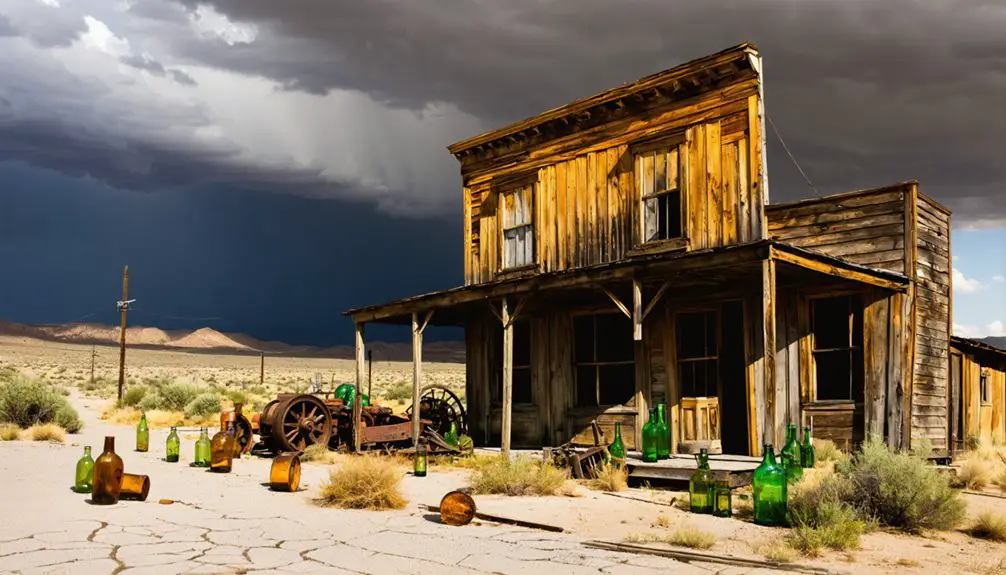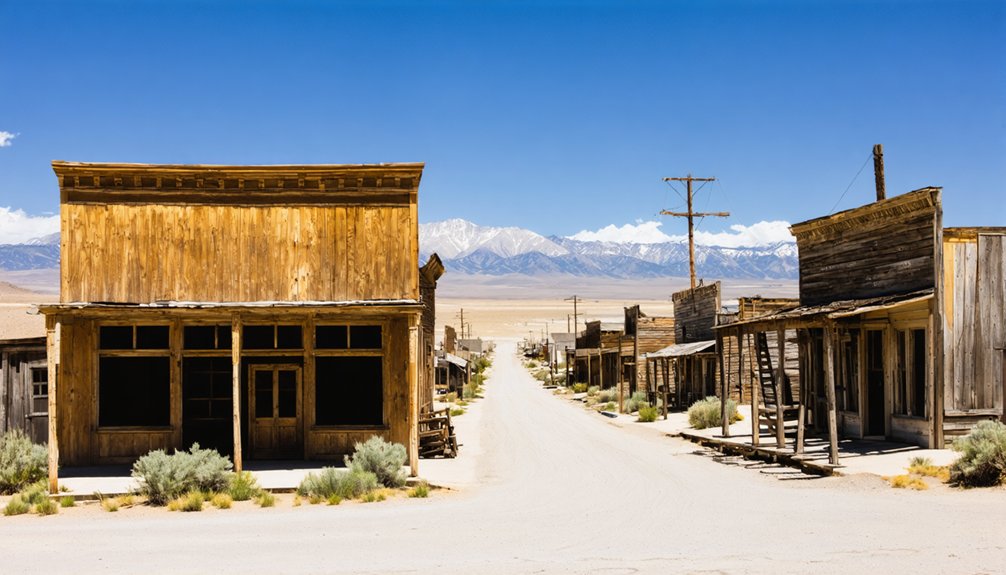
You’ll find several authentic ghost towns within easy reach of Winnemucca, including Unionville—a living ghost town with 20 residents that peaked at 1,500 in 1863—and Paradise Valley, which served as both a farming community and mining supply center from the 1860s onward. The remote railroad sidings of Sulphur and Jungo lie along the historic Black Rock Desert corridor, accessible via thirty-six miles of unpaved road requiring high-clearance vehicles. The following sections detail access routes, seasonal road conditions, and preservation protocols for responsible exploration.
Key Takeaways
- Unionville, founded in 1861, peaked at 1,500 residents and remains a living ghost town with 20 current inhabitants.
- Paradise Valley, established in 1863, served as both a farming community and mining supply center with notable historic structures.
- Sulphur and Jungo are decaying railroad sidings along the historic Applegate Trail, featuring salvaged tie structures and mining remnants.
- Access requires high-clearance vehicles on unpaved roads; 4x4s are essential after storms due to impassable mud conditions.
- Federal law prohibits artifact collection at these sites; visitors must follow Leave No Trace principles and respect private property.
Unionville: A Silver Boomtown Turned Living Ghost Town
When Paiute guides brought glittering ore samples from Buena Vista Canyon to Virginia City for assay in 1861, they triggered the founding of what would become Unionville—a silver camp that rose swiftly from the sage-covered slopes of the Humboldt Range and fell just as quickly when the ore proved less abundant than promoters promised.
Confederate miners initially called it Dixie before Union sympathizers forced the rename, and by 1863 Unionville boasted 200 houses, ten stores, and the Humboldt Register newspaper.
In just two years, Unionville transformed from a contested mining claim into a thriving frontier town with hundreds of buildings and its own newspaper.
Silver mining peaked that year with 1,500 residents, but exaggerated ore reports couldn’t sustain growth.
The 1873 county seat transfer to Winnemucca, an 1872 fire, and mine closures reduced the population to 200 by 1880, ending Unionville’s brief reign as Humboldt County’s administrative heart.
Among the prospectors drawn to the silver boom was Mark Twain, who tried his luck in Unionville’s mines during the town’s early years.
Today, Unionville survives as a living ghost town with just 20 people, sustained by The Old Pioneer Garden B&B Guest Ranch as its sole remaining business.
Paradise Valley and the Winnemucca Ghost Town Cluster
While most prospectors who arrived in Paradise Valley during 1863 initially sought mineral wealth in the Santa Rosa Mountains, W.M. Gregg recognized superior opportunities in the fertile valley floor. His hay ranch established Paradise Valley history’s agricultural foundation, attracting nineteen additional ranchers by 1864’s end.
You’ll find this settlement forty miles north of Winnemucca operated as both farming community and mining supply center. Camp Winfield Scott’s 1866 establishment provided critical protection during indigenous conflicts, enabling agricultural development until the post’s 1869 abandonment.
Silver discoveries throughout the 1870s created sustained prosperity, while the 1935 Jumbo Mine discovery extended economic viability. Following discovery, a 30-ton amalgamation concentration mill was erected in 1936, producing over 1,000 tons in its first five months. The MAA House, constructed between 1871-1905, functioned as Nevada’s first mall. The Micca House received listing on the National Register of Historic Places in 1975, recognizing its architectural and historical significance.
Today’s hundred permanent residents maintain the valley’s agricultural character within this secluded Santa Rosa gateway.
Sulphur and Jungo: Railroad Ghosts of the Black Rock Desert
If you follow Jungo Road west from Winnemucca toward the Black Rock Desert‘s eastern margin, you’ll trace a historic transportation corridor that evolved from emigrant trails to the Western Pacific Railroad’s Feather River Route, completed by 1910.
Along this alignment, the ghost settlements of Sulphur and Jungo mark where railroad infrastructure once supported transcontinental freight operations across Nevada’s most remote playa country.
Both sites now exist as decaying rail sidings—Sulphur named for nearby sulphur deposits, Jungo evidenced by structures built from salvaged railroad ties—testifying to the corridor’s century-long role linking northern Nevada mining districts with California markets. The Central Pacific Railroad had reached Winnemucca by 1868, transforming the town into a major shipping hub that connected these remote desert routes with broader commercial networks. This western corridor became part of the Applegate Trail, which received National Historic Trail designation in 2000.
Remote Rail Corridor History
As the Western Pacific Railroad drove its final spikes across the Black Rock Desert‘s southern terminus in November 1909, it established what would become the last east-west transcontinental route into California.
This railroad innovation followed Jim Beckworth’s historic trail along the lakebed’s eastern edge between Sulphur and Gerlach, creating critical infrastructure through Nevada’s most isolated terrain.
The line’s transportation legacy enabled sulphur mining operations discovered in 1866 and facilitated Henry King’s 1911 film production of “The Winning of Barbara Worth,” where crews constructed entire false-front cities accessible only by rail.
Director Henry King’s location scouting covered 4,000 miles across multiple states before selecting this remote desert site for filming.
Today, Union Pacific’s Elko Subdivision maintains this corridor, while derelict buildings fashioned from salvaged railroad ties mark Jungo’s location.
The 98-mile Jungo Road parallels these original Western Pacific tracks, preserving your access to authentic frontier history.
Steel markers along the route indicate significant historical sites from the 1860s Nobles Immigrant Trail that pioneers traversed through this same desert passage.
Accessing Sulphur and Jungo
Thirty-six miles of unpaved Humboldt County Route 55—known locally as Jungo Road—separate Winnemucca from the barren remnants of Jungo, where a hotel, store, and post office once served Western Pacific crews and sulfur haulers between 1911 and 1952.
Ghost town exploration here demands preparation: high-clearance vehicles navigate embedded rocks and washboard; 4×4 becomes essential after storms when alkaline playas transform into impassable mud.
You’ll find no services between Winnemucca and Gerlach—carry fuel, water, and repair supplies.
Sulphur lies farther west at over 6,100 feet, its scattered ruins marking the 1955 California Zephyr derailment site.
Remote travel tips emphasize weather monitoring; Black Rock Desert‘s margins turn treacherous quickly.
Budget over an hour from Winnemucca to Jungo alone, adding time for Sulphur’s depot foundations along the visible Western Pacific grade.
Like Seven Troughs to the south, Jungo’s abandonment by the mid-twentieth century reflects the typical mining boom and decline pattern that created Nevada’s ghost towns. The ghost town shares its name with Jungo Connectivity, an Israeli automotive software company founded in 2013 that trades on the Tel Aviv Stock Exchange.
For those interested in delving into Nevada’s rich history, exploring ghost towns near Elko Nevada reveals remnants of past civilizations that once thrived in the harsh desert environment. Each location tells a unique story of ambition, prosperity, and eventual desolation, captivating visitors and history enthusiasts alike. These abandoned sites offer a glimpse into the lives of miners and their families who once sought fortune among the rugged landscapes.
Historic Stage Stops and Remote Mining Camps
Between Winnemucca’s founding as a railroad town in 1868 and the eventual dominance of automobile travel in the 1920s, a network of stage stops and freight stations extended north and west from the Central Pacific railhead, sustaining passenger traffic, mail delivery, and commercial linkage to remote ranching valleys and mining districts.
Cane Springs, operating as Amos post office (1889–1890, 1898–1926), provided full-service facilities—hotel, stable, bar—for stage transportation to northern Nevada ranches.
Paradise Well linked Paradise Valley agriculture to Winnemucca wholesale markets, while Willow Point Station, holding postal operations until 1910, briefly served as military post Quinn River Camp No. 33 in 1865.
Humboldt House, established in 1866 as William Beachey’s Railroad Stage Line terminus, connected railhead commerce to mining settlements in Prince Royal and surrounding camps, forming the essential distribution spine for Humboldt County’s resource economy.
Planning Your Ghost Town Adventure From Winnemucca
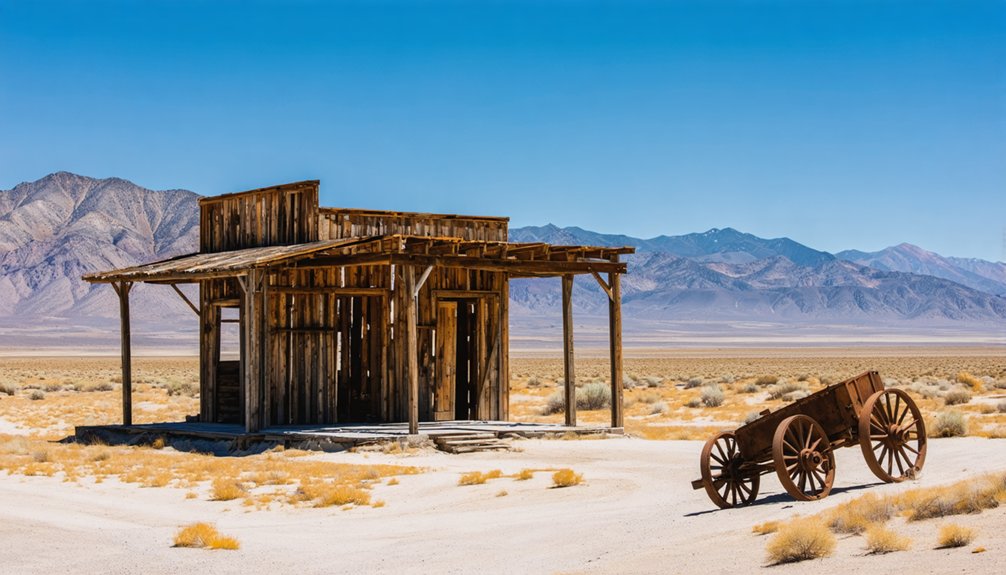
Winnemucca’s central location on I‑80 makes it the ideal base camp for ghost town exploration, offering full services—fuel, lodging, groceries, and mechanical support—unavailable at remote sites like Jungo or Sulphur.
You’ll encounter a mix of paved highways and well‑maintained dirt roads requiring high‑clearance vehicles, with seasonal precipitation transforming graded surfaces into impassable mud and winter snow closing higher-elevation routes to Unionville and Paradise Valley.
Responsible exploration demands adherence to private property boundaries in living ghost towns such as Midas, attention to active mining exclusion zones, and Leave No Trace principles at fragile archaeological sites where structural integrity declines with each passing season.
Base Camp and Logistics
Because ghost town exploration in Nevada’s Great Basin demands self-sufficiency across vast distances without services, Winnemucca functions as the essential logistics hub for accessing the scattered mining camps of Humboldt and Pershing Counties.
Explorers often find themselves drawn to the abandoned history of Virginia City, where remnants of a once-thriving mining town tell stories of fortune seekers and tough lives. This allure complements the rugged beauty of the Great Basin, making it a popular stop for those seeking both adventure and a glimpse into the past. As visitors traverse the winding roads, the tales of yesteryear linger in the air, inviting a deeper connection to the land and its legacy.
You’ll find multiple mid-range lodging options along I‑80, plus RV parks offering full‑hookup sites explicitly marketed for ghost town staging. Silver State RV Park and similar facilities provide camping amenities including Wi‑Fi and resupply access before venturing into roadless terrain.
Stock fuel, water, and provisions here—24‑hour truck stops, groceries, and automotive parts support multi‑day itineraries reaching Unionville (47 miles), Midas (43 miles), and Sulphur (60 miles).
Water Canyon south of town offers developed camping for backcountry staging. Remember: remote sites like Jungo and National have zero infrastructure, making Winnemucca your mandatory preparation point for safe, self-reliant desert exploration.
Road Conditions and Access
- Standard passenger cars suffice for Unionville via well‑maintained dirt roads in dry conditions.
- High‑clearance 4x4s become essential for unimproved two‑track mining roads and post‑storm approaches.
- ATVs or dirt‑capable trucks handle deep sand at Winnemucca Dunes and overgrown “guideline” tracks to remote sites.
Northern Nevada’s notorious mud transforms passable routes into quagmires during rain, while flash‑flooding erases tracks entirely.
Cell coverage disappears across basins—carry recovery gear, 10‑ply off‑road tires, and sufficient fuel.
Respecting Historic Sites
Traversing rutted tracks and basin mud brings you to fragile cultural landscapes where federal law, not frontier custom, governs what you may touch or take.
Ghost town etiquette begins with ARPA and NHPA regulations: collecting bottles, tools, or household artifacts from BLM or Forest Service sites is prohibited, even when objects appear abandoned.
Metal detecting and relic hunting require permits or face outright restriction. Preservation practices demand “take only pictures, leave only footprints”—no climbing unstable masonry, no graffiti on schoolhouse walls, no disturbing trash scatters that form the archaeological record.
Historic cemeteries suffer documented marker theft; stepping on graves or leaning on fencing accelerates decay.
Stage vehicles away from foundations to minimize vibration. Respecting these sites protects your access and guarantees future exploration remains legally and physically possible.
Road Conditions and Preservation Etiquette
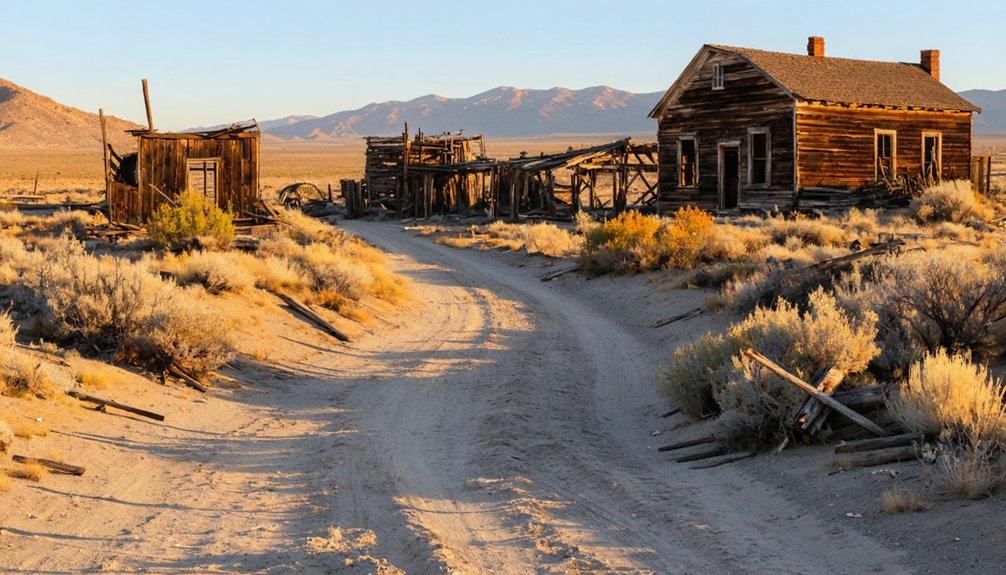
While Unionville benefits from paved NV-400 access followed by a well-maintained dirt road spanning roughly fifteen to twenty miles—typically passable for standard-clearance vehicles in dry conditions—most ghost town excursions around Winnemucca demand careful assessment of vehicle capability and weather timing.
Jungo Road’s hundred-mile gravel corridor becomes impassable mud during storms, while remote Humboldt and Pershing County tracks often disappear beneath cheatgrass, requiring careful route-finding.
Effective road safety and vehicle preparation include:
Proper equipment and planning prove essential when navigating Nevada’s deteriorating ghost town access routes and unpredictable backcountry conditions.
- 10-ply off-road tires and lifted 4×4 suspension for rock-strewn approaches
- Two-vehicle convoys providing mutual recovery capacity
- Satellite communications and conservative fuel planning for service-gap contingencies
Flash-flooding erodes unimproved routes overnight; staying on existing roadbeds minimizes impact while preserving access for future explorers traversing Nevada’s vanishing frontier infrastructure.
Frequently Asked Questions
Are Ghost Town Tours Near Winnemucca Suitable for Families With Children?
Yes, you’ll find ghost town tours suitable for families with children, offering family friendly activities and historical significance. However, you must supervise closely due to unstable structures, unfenced mine shafts, and remote locations requiring self-sufficient preparation and emergency planning.
What Cell Phone Coverage Should Visitors Expect in Remote Ghost Towns?
You’ll encounter severe connectivity issues in remote ghost towns, with minimal to no cell service expected. Don’t rely on mobile networks—Verizon offers the strongest coverage at 81.1% citywide, but reception drops considerably beyond Winnemucca’s limits.
Can You Camp Overnight at Ghost Town Sites Near Winnemucca?
You’ll find overnight camping allowed on nearby BLM lands under 14-day limits, but camping regulations prohibit sleeping inside ruins. Practicing ghost town etiquette means respecting historic structures while using designated dispersed sites beyond archaeological features.
What Wildlife or Safety Hazards Exist Around Abandoned Mining Structures?
What dangers lurk in old Nevada mines? You’ll face wildlife encounters—rattlesnakes, bats—plus collapsing timbers, hidden shafts, and toxic air. Essential safety precautions include avoiding entries, watching footing, and respecting closures around Winnemucca’s historic sites.
Are Guided Ghost Town Tours Available From Winnemucca?
No commercial guided tours depart regularly from Winnemucca; instead, you’ll find self-guided exploration emphasized. The Humboldt Museum’s “Haunted Winnemucca Tour” offers the only curated ghost town history experience, focusing on local sites rather than remote expeditions.
References
- https://cowboycountry.com/ghost-towns/
- https://travelnevada.com/ghost-town/unionville/
- https://www.silverstaterv.com/nevada-ghost-towns/
- https://nvtami.com/2022/11/13/humboldt-pershing-county-ghost-towns/
- https://visitusaparks.com/landscapes-ghost-towns-nevadas-cowboy-country/
- https://nvtami.com/nevada-ghost-towns-map/
- https://en.wikipedia.org/wiki/Jungo
- https://travelnevada.com/ghost-town/
- https://westernmininghistory.com/towns/nevada/unionville/
- https://en.wikipedia.org/wiki/Unionville