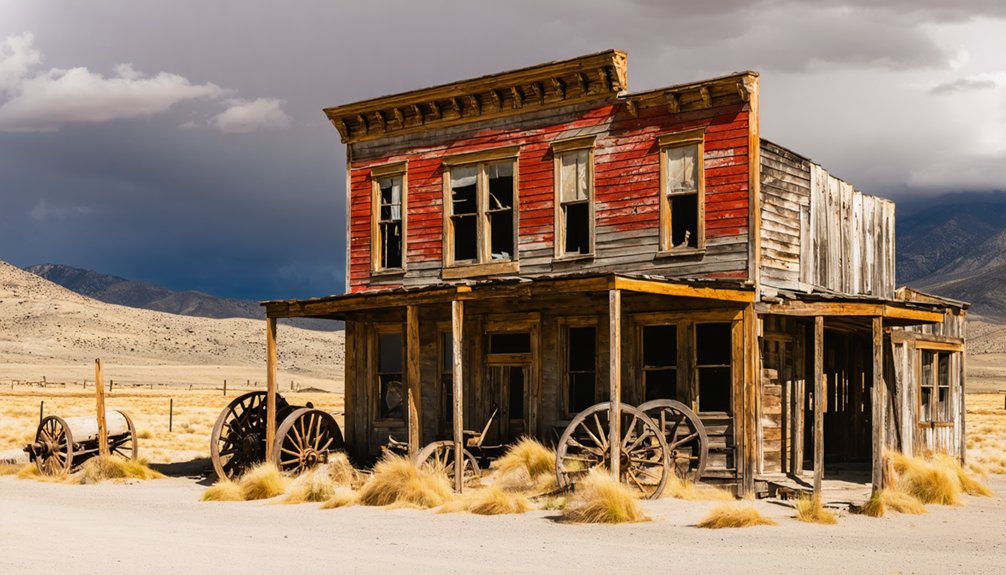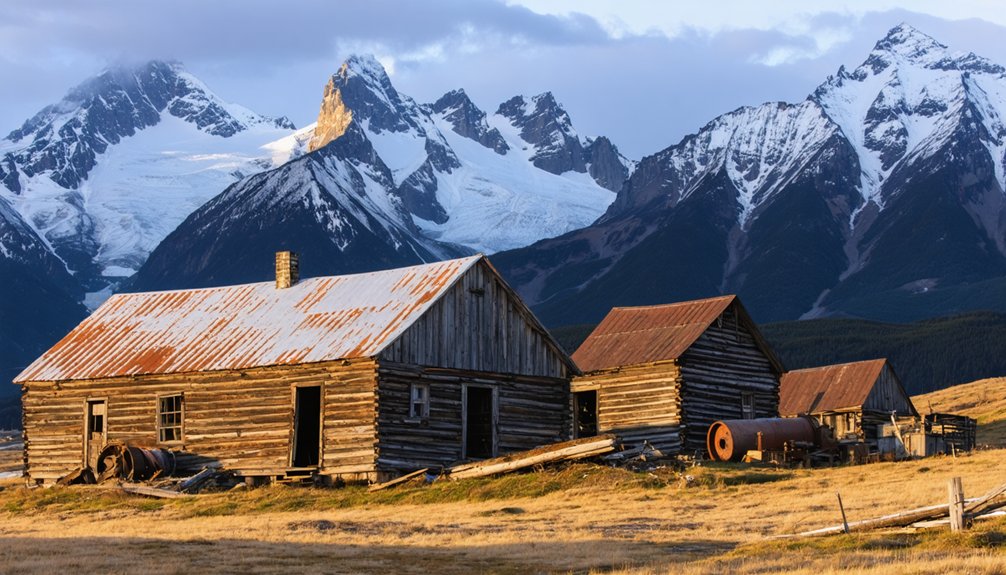
You’ll find Alaska’s most significant mining ghost towns within Wrangell-St. Elias National Park, where early twentieth-century copper wealth created thriving communities before economic collapse. Kennecott, frozen since 1938, stands as the premier industrial ruin—a National Historic Landmark where fourteen-story mills and workers’ quarters remain intact. Four miles away, McCarthy served as the rowdy supply hub where miners spent their wages. Further east, the Nabesna Mining District preserves Depression-era gold operations in raw, unrestored condition. These remote sites reveal the region’s extractive past and the dramatic forces that shaped Alaska’s frontier economy.
Key Takeaways
- Kennecott Copper Mining Ghost Town, frozen in 1938, is a National Historic Landmark with preserved buildings including a fourteen-story concentration mill.
- McCarthy, located four miles from Kennecott, served as the miners’ entertainment hub and remains inhabited despite Kennecott’s closure.
- Nabesna Mining District features unrestored Depression-era gold rush structures, including a 35-ton mill and collapsing cabins from 1942.
- Access requires navigating 62-mile McCarthy Road or Nabesna Road from Slana, both demanding high-clearance vehicles and self-reliance.
- Visitor activities include ranger-guided mill tours, interpretive exhibits on WWI copper economics, and glacier treks combining history and nature.
Kennecott Copper Mining Ghost Town: Alaska’s Premier Industrial Ruin
Deep in the heart of Wrangell-St. Elias National Park, you’ll find Kennecott—a copper mining ghost town frozen in 1938.
The Kennecott history began when prospectors discovered rich chalcocite ore in 1900, leading to formation of the Kennecott Copper Corporation (misspelled by a clerical worker).
After the railroad connected this remote operation to Cordova in 1911, mining technology transformed raw mountains into nearly $200 million worth of copper by 1938.
Between 1911 and 1938, railroad-connected mining operations extracted nearly $200 million in copper from these remote Alaskan mountains.
At its peak, 500 workers operated sophisticated mills processing 600,000 tons of high-grade ore.
When corporations determined profitable deposits were exhausted, residents received stark orders: evacuate immediately.
They abandoned everything—meals half-eaten, clothes still hanging.
Today, this National Historic Landmark stands as the world’s finest preserved early 20th-century copper mining site.
The town flourished with businesses, shops, and a train connection for workers until the mine’s closure.
The name’s spelling variation has led to confusion, as the town differs from the Kennicott Glacier it overlooks.
McCarthy: The Rowdy Frontier Town That Serviced the Mines
While Kennecott’s company town enforced strict moral codes, McCarthy—four miles down the valley—emerged as its unruly twin. Founded on John Barrett’s homestead along McCarthy Creek, this frontier life outpost became the essential supply hub where the Copper River & Northwestern Railway terminated.
You’ll find McCarthy served as more than a freight stop—it was the “vice town” where Kennecott’s miners spent their wages on brothels, gambling halls, and imported liquor. Merchants extracted premium prices for everything from caviar to entertainment.
When railroad personnel spotted U.S. marshals during Prohibition, they’d blow special whistle signals to warn saloon owners. This mining culture hotspot thrived until 1938, when Kennecott’s closure transformed McCarthy into a ghost town virtually overnight. Yet contrary to popular belief, many residents remained even after the economic collapse. The Copper River and its drainages had made the entire operation possible with their rich copper deposits that attracted thousands of prospectors and investors at the turn of the 20th century.
Nabesna Mining District: Raw and Unrestored Ghost Settlements
Far beyond McCarthy’s saloons and Kennecott’s company housing, the Nabesna Mining District sprawls across the eastern Alaska Range at the head of the Nabesna River—a raw collection of weathered structures that the National Park Service deliberately left untouched.
Listed on the National Register in 1979 for its unrestored integrity, this ghost settlement documents mining history from the 1920s through World War II.
You’ll find a 35-ton mill filled with rusting machinery, scattered prospect adits, cabins collapsing under snowpack, and an overgrown airstrip where pack trains once transferred high-grade ore for the 170-mile journey to Tacoma smelters.
The Nabesna infrastructure remains exactly as workers abandoned it in 1942, offering you an unfiltered encounter with Alaska’s Depression-era gold rush—no interpretive panels, no guardrails, just honest decay.
Developer Carl F. Whitham constructed approximately 40 miles of narrow road into the wilderness to reach the deposits, a remarkable feat of individual persistence in an era before widespread car availability or national park designations.
Inside the cabins, ore samples and mining documents from 1935 lie undisturbed, creating an artifact-rich setting that transports visitors directly into the lives of the Nabesna miners.
The Industrial Legacy of America’s Richest Copper Deposits
Between 1911 and 1938, the mountain mines above Kennicott Glacier yielded 591,535 short tons of copper from 4.5 million tons of ore—a production run valued at $200 million in Depression-era dollars and fed by ore bodies grading as high as 72% pure copper with 18 ounces of silver per ton.
You’re looking at copper extraction on a scale that built a multinational corporation from wilderness bedrock. The vertically stacked mill complex employed specialized mining technology—Hancock jigs, shaker tables, and an innovative ammonia leaching plant that pushed recovery rates beyond 80%.
High-grade ore traveled 196 miles via the Copper River & Northwestern Railway to Cordova, then shipped to Tacoma smelters. Barges transported the ore from Cordova to Tacoma for final smelting. When eastern financiers shuttered operations in 1938, they’d already extracted what they needed and moved capital elsewhere. The Kennecott mines now stand listed on the National Register of Historic Places, preserving evidence of Alaska’s early 1900s copper boom.
Reaching the Remote Ghost Towns: Access Routes and Challenges
You’ll find that the McCarthy Road remains the primary corridor for reaching Kennicott and McCarthy, extending 62 gravel miles from Chitina to the footbridge where vehicle access ends and a 20-minute walk into the townsite begins.
If you’re targeting the northern historic mining district near Nabesna, the unpaved Nabesna Road branches roughly 20 miles into the park from Slana at mile 60 of the Glenn Highway, threading toward remnants of early twentieth-century copper operations in the Nutzotin and Mentasta ranges.
Both routes demand high-clearance vehicles, careful timing around seasonal washouts and creek crossings, and acceptance of minimal services—fuel, towing, and cell coverage are absent or extremely limited throughout these corridors. For those departing from Anchorage, expect a five-hour drive to reach the start of the McCarthy Road before beginning the additional 60-mile dirt road journey. Small aircraft provide an alternative means of access to McCarthy and the surrounding wilderness areas, bypassing the lengthy overland routes entirely.
McCarthy Road: Main Gateway
The 60-mile McCarthy Road represents the sole overland route to Alaska’s most significant copper mining ghost towns, beginning at mile 33 of the Edgerton Highway in Chitina and terminating at a footbridge across the Kennicott River.
Traveling along this road, visitors can also explore abandoned mining towns near Jasper that were once bustling with activity. These remnants of history offer a glimpse into the past, showcasing the challenges and triumphs of those who sought their fortunes in the rugged landscape. Each town has its own unique story, waiting to be uncovered by intrepid explorers.
You’ll navigate the 1909 Copper River & Northwestern Railroad bed, where road conditions include unpaved gravel, washboarded surfaces, and exposed railroad ties. The National Park Service recommends allocating two hours each direction, though travel tips suggest planning three hours to accommodate the rough terrain.
No services exist along this route—you’ll need fuel from Glennallen or Chitina beforehand. Cell service remains nonexistent throughout.
The Alaska Department of Transportation maintains the corridor mid-May through mid-September, making summer your ideal window for accessing McCarthy and Kennecott’s abandoned mining operations.
Nabesna Road: Northern Alternative
Stretching 42 miles from near Slana at Mile 60 of the Glenn Highway, Nabesna Road delivers you to Wrangell–St. Elias’s north side—a 1930s ore-haul route built for the Nabesna gold mine.
You’ll encounter scenic views of the Wrangell, Mentasta, and Nutzotin ranges across boreal forest and volcanic cinder cones, with minimal traffic reinforcing your solitude.
Road conditions deteriorate beyond Mile 28; expect washboards, potholes, and creek crossings at Trail, Lost, and Boyden creeks.
Vehicle requirements escalate accordingly—high-clearance or four-wheel drive becomes essential when snowmelt or rain floods crossings.
The Nabesna history you’re chasing lies at Mile 42, where maintained road ends near toxic mine tailings.
No fuel, food, or repair services exist along the corridor, so self-reliance isn’t optional—it’s mandatory for accessing these ghost-mining remnants.
Preservation Efforts and Visiting Today’s Historic Sites
When the National Park Service assumed stewardship of Kennecott in 1986, designating it a National Historic Landmark, preservation staff confronted a stark choice: restore the ghost town to pristine 1930s appearance or stabilize what remained in its weathered state.
They chose arrested decay—preservation techniques that halt collapse without erasing time’s marks. Today you’ll find the fourteen-story concentration mill undergoing phased stabilization, its industrial silhouette anchoring the landscape while roofs, foundations, and walls receive targeted repairs on structures like Blackburn School and Recreation Hall.
Your visitor experience centers on the McCarthy Road approach: footbridge crossing, then shuttle or five-mile walk to the townsite.
Summer brings ranger-guided mill tours ascending multiple levels, interpretive exhibits connecting copper demand to World War I economics, and glacier treks threading natural grandeur through corporate-frontier history.
Frequently Asked Questions
Are There Any Other Ghost Towns in Wrangell-St. Elias Besides Kennecott and Mccarthy?
Like prospectors chasing El Dorado’s promise, you’ll discover Nabesna Mining District’s abandoned copper mining cabins and structures. This ghost town offers raw historical significance—unrestored, unguided, and untamed—unlike Kennecott’s polished preservation, beckoning those seeking authentic frontier exploration.
What Wildlife Might Visitors Encounter While Exploring the Ghost Town Areas?
You’ll encounter bears, moose, caribou, wolves, eagles, and smaller mammals during wildlife spotting near ghost towns. Understanding animal behavior around salmon runs, berry patches, and historic corridors helps you explore safely while respecting their habitat.
As you venture through the ghost towns around Yellowstone National Park, keep an eye out for the remnants of human history intertwined with the natural landscape. Each abandoned structure tells a unique story of resilience and change, providing a fascinating backdrop to the diverse wildlife that thrives in the area. Remember to carry your camera to capture both the haunting beauty of these towns and the breathtaking scenery that surrounds them.
Can You Stay Overnight in Any of the Historic Buildings at Kennecott?
You can’t stay overnight in original Kennecott buildings—historic preservation rules protect these 1910s structures. Your Kennecott lodging option is the nearby replica lodge, built in 1987, where you’re free to sleep beside mining history.
Were There Any Fatal Accidents During Kennecott’s Copper Mining Operations?
While specific fatal accident records from Kennecott’s 1911-1938 operations aren’t documented here, mining hazards were severe. Today’s Kennecott safety regulations exist because abandoned mines present deadly risks: unstable structures, toxic gases, cave-ins, and dangerous drop-offs threaten your exploration.
How Do Winter Conditions Affect Access to the Ghost Towns?
Winter access becomes severely restricted—you’ll face snow-covered roads, limited daylight, and seasonal challenges including closed lodges and shuttles. The 60-mile McCarthy Road turns treacherous, forcing self-sufficient ski or snowshoe travel through Kennecott’s frozen isolation.
References
- https://www.islands.com/1891808/abandoned-mine-town-kennicott-chitina-alaska-copper-camp-ghost-town-tours-hikes-icy-views/
- http://www.terragalleria.com/blog/stumbling-into-alaskas-mining-past-in-nabesna-wrangell-st-elias-national-park/
- https://www.travelalaska.com/destinations/cities-towns/kennicott-mccarthy
- https://www.nps.gov/wrst/learn/historyculture/kennecott-mines-national-historic-landmark.htm
- https://www.frommers.com/destinations/wrangell-st-elias-national-park/regions-in-brief/the-towns/
- https://www.atlasobscura.com/places/kennicott-ghost-town
- https://en.wikipedia.org/wiki/Kennecott
- https://www.jasonchapmanphoto.com/kennecott
- https://www.ultimathulelodge.com/blog/169452
- https://www.youtube.com/watch?v=Cz0IGc2Uy0E