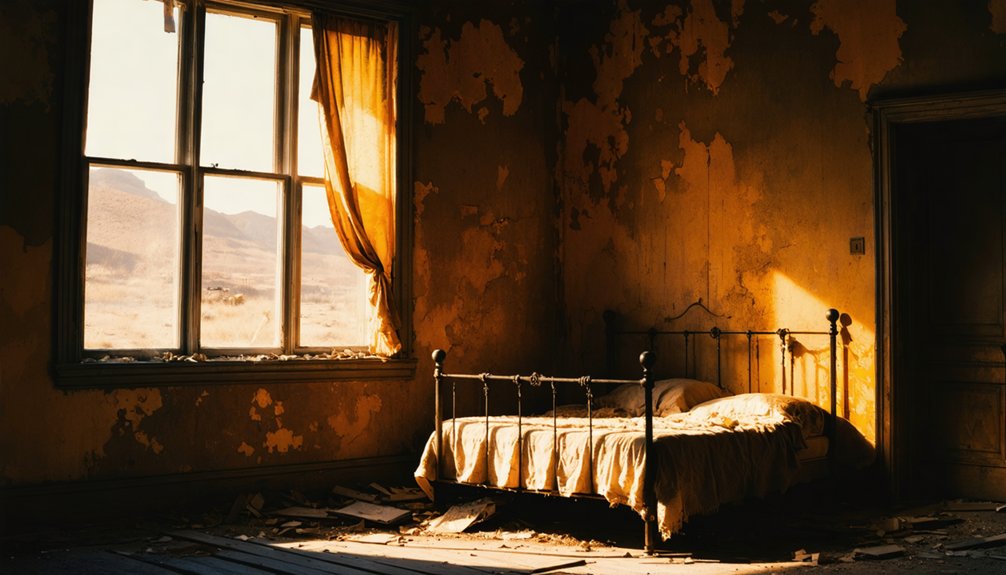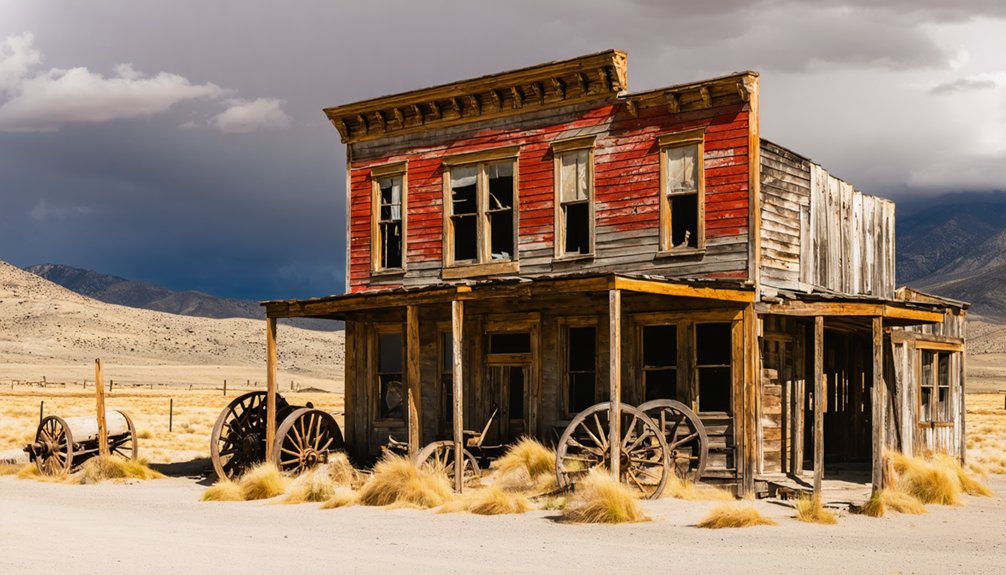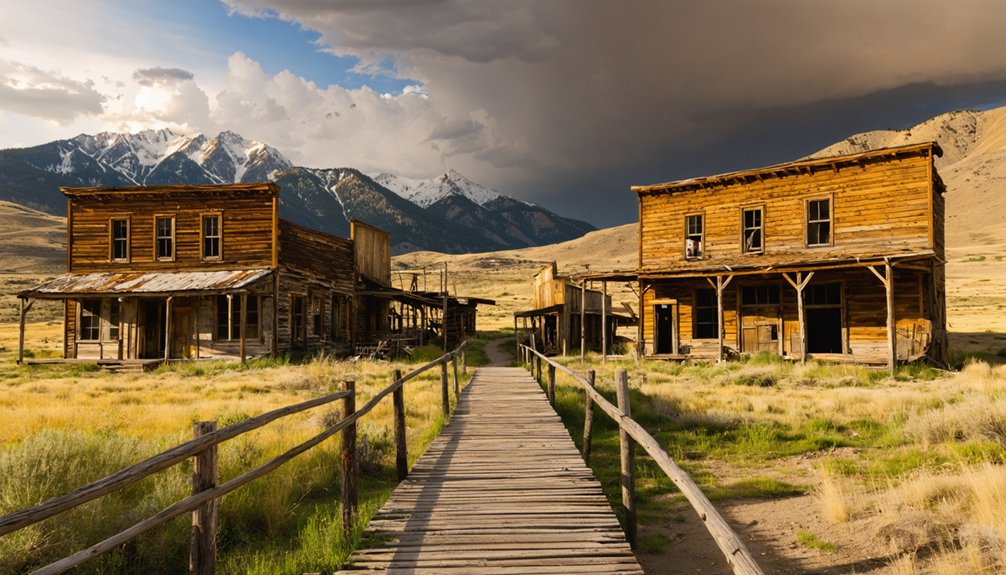
You’ll find remarkable ghost towns within a few hours of Yellowstone that preserve Montana and Wyoming’s 1860s-1880s mining heritage. Virginia City and Bannack showcase Montana’s gold rush era, with Bannack’s 50+ unrestored structures offering an authentic glimpse into frontier justice and mining life. Wyoming’s South Pass City tells stories of both mineral wealth and women’s suffrage, while remote Kirwin sits abandoned in the Absaroka Mountains after brutal winters defeated ambitious miners. Each site reveals how quickly fortune-seeking transformed—and then emptied—these mountain valleys, with preserved buildings and artifacts waiting to share their complete narratives.
Key Takeaways
- Virginia City and Nevada City in Montana preserve mining boomtowns from the 1863 Alder Gulch gold rush near Yellowstone’s north entrance.
- Bannack State Park features over 50 original structures from Montana’s first territorial capital with uncommercial preservation spanning 1,154 acres.
- South Pass City in Wyoming showcases 1867 gold rush history and women’s suffrage heritage as a National Register site.
- Kirwin ghost town sits in Wyoming’s Absaroka Mountains, accessible only by foot or horseback with stabilized mining-era cabins.
- Old Trail Town near Cody displays 26 authentic frontier buildings including Butch Cassidy’s hideout, open seasonally May through September.
Virginia City and Nevada City: Montana’s Living Gold Rush Legacy
On May 26, 1863, prospector William Fairweather and his partners struck placer gold along a remote Montana creek they called Alder Gulch, setting off one of the most explosive mining rushes in American history.
Within months, 10,000 fortune-seekers poured into an 11-mile chain of boomtowns—Virginia City, Nevada City, Junction, Highland—that extracted $30 million in just three seasons.
In three frenzied seasons, 10,000 fortune-seekers transformed a remote Montana gulch into a chain of roaring boomtowns worth $30 million.
This gold rush created Montana Territory itself in 1864, with Virginia City serving as territorial capital until 1875.
The early settlement was notorious for violence and lawlessness, prompting residents to form the Montana Vigilantes to establish order in the remote mining camps.
When the boom faded, both towns avoided demolition and sprawl, preserving false-front saloons, Victorian homes, and miner’s cabins exactly where stampeders left them.
Modern estimates suggest the total gold extracted from Alder Gulch would be worth approximately $2.5 billion today.
Today you’ll walk authentic boardwalks past structures protected as a National Historic Landmark—living proof that historic preservation can freeze an entire era in place.
Bannack State Park: Montana’s Best-Preserved Ghost Town
The town’s dark legacy centers on vigilante justice—Sheriff Henry Plummer, secretly accused of leading road agents, was hanged alongside two deputies by Montana Vigilantes on January 10, 1864.
Though contemporary accounts claimed over 100 murders, historians document only eight killings, raising questions about the gang’s actual existence.
Today you’ll find over 50 original structures standing in arrested decay at Bannack State Park, preserved exactly as miners left them—unrestored, uncommercial, and authentically free. The park spans 1,154 acres at an elevation of 5,800 feet, offering visitors a campground with 28 sites and access to Grasshopper Creek for fishing. Among the preserved buildings, the Bannack Jail stands as the first jail in Montana, featuring three cramped cells where the largest measures only 12 square feet.
South Pass City: Wyoming’s Frontier Mining Camp and Suffrage Landmark
Gold fever brought fortune-seekers flooding into Willow Creek valley in 1867, transforming a remote gulch at the southeast end of the Wind River Mountains into Wyoming’s second incorporated city within a year.
By 1870, roughly 1,000 residents supported 250 buildings serving the Carissa Mine and surrounding gold mining operations that ultimately yielded $7 million in precious metals.
Beyond extracting wealth from stone, South Pass City witnessed Esther Hobart Morris‘s appointment as justice of the peace in 1870—the nation’s first woman to hold such judicial office.
This followed Wyoming Territory’s groundbreaking women’s suffrage law of 1869, establishing the camp as a testing ground where frontier independence met political reform.
Today’s preserved stamp mills and territorial-era structures commemorate both mining ambition and the civic rights movement that earned Wyoming its “Equality State” identity. The site was added to the National Register of Historic Places in 1970, a century after its founding. Visitors can explore the site from late May to mid-October, with guided tours of the historic Carissa Mine available Thursday through Sunday afternoons.
Kirwin: Remote Alpine Ruins in the Absaroka Mountains
While prospectors scoured accessible gulches across Wyoming Territory in the 1860s and 1870s, the Absaroka Mountains’ alpine fastness remained largely unexplored until William Kirwin and Harry Adams stumbled upon rich mineral veins on Spar Mountain during an 1880s hunting expedition.
Their discovery sparked corporate investment exceeding $1 million and drew 200 residents to a remote camp 38 miles from Meeteetse.
You’ll find Kirwin’s mining history intertwined with its brutal alpine climate—long winters and short operating seasons undermined profitability despite gold, silver, and copper deposits. At 9,500 feet elevation, Kirwin emerged as the heart of the Wood River Mining District, featuring modern amenities including electricity and telephone connections that earned it recognition as a “model mining camp.”
The February 5, 1907 avalanche—dubbed the “White Death of the Rockies”—killed three and buried buildings, accelerating abandonment already underway.
Today, stabilized cabins and mine workings mark this high-country ghost town accessible only by foot or horseback. Visitors navigate 40 miles from Meeteetse along rugged terrain featuring steep grades and creek beds to reach the atmospheric ruins.
Exploring the area yields further surprises, including ghost towns near Great Basin National Park that tell tales of bygone eras. These remnants of human endeavor are often intertwined with stunning natural landscapes, creating a hauntingly beautiful experience for adventurous travelers. Each visit can spark your imagination about the lives once lived in these now-silent places.
Old Trail Town: Cody’s Curated Collection of Western History
Unlike remote mining camps that moldered in wilderness obscurity, Old Trail Town emerged in 1967 as western historian Bob Edgar’s deliberate preservation project**—26 authentic frontier buildings dating 1879–1901, salvaged from collapsing sites** across Wyoming and Montana and meticulously reassembled on Buffalo Bill Cody’s original 1895 townsite.
You’ll walk boardwalks past Butch Cassidy’s hideout cabin, Curley’s dwelling (the Crow scout who rode with Custer), and a saloon door still bearing original bullet holes.
The frontier architecture stands fully furnished with period historical artifacts: roughly 100 horse-drawn vehicles, firearms, trade goods, and Native American objects that document unfiltered territorial life.
Open May through September along Yellowstone’s east corridor, this curated streetscape—complete with mountain man Jeremiah Johnston’s grave—offers concentrated access to Wyoming’s outlaw, settler, and Indigenous past without backcountry navigation. Admission costs $9 for adults, with reduced rates for seniors and children ages 6-12. The museum houses the grave of Phillip Vetter, a German immigrant killed by a grizzly bear encounter in 1892, marked by a simple wooden cross.
Frequently Asked Questions
Are Pets Allowed at Ghost Town Sites Near Yellowstone?
You’ll find most ghost towns allow leashed pets outdoors, but pet regulations vary by site—state parks like Bannack restrict interior access, while remote ruins demand stricter ghost town etiquette to protect fragile structures and wildlife.
What Is the Best Time of Year to Visit These Ghost Towns?
Ready to explore without crowds limiting your freedom? Visit mid-May through September for ideal access and seasonal activities. Weather considerations favor summer months when mountain passes clear, offering comfortable temperatures for unrestricted wandering through preserved structures.
Do Any Ghost Towns Offer Overnight Lodging or Camping Facilities?
Yes, you’ll find overnight options at Virginia City’s historic hotels and cabins, Silver City’s rustic Idaho Hotel, and Bannack State Park’s developed campground with camping amenities—each preserving authentic frontier character while welcoming independent travelers.
Are Guided Tours Available at These Historic Sites?
Yes, you’ll find guided exploration at Virginia City, Nevada City, and Bannack State Park during summer months. Staff-led tours reveal the historical significance of these preserved mining camps through interpretive walks and archival storytelling programs.
Which Ghost Towns Are Accessible for Visitors With Mobility Limitations?
Bannack State Park offers ADA-designated accessible trails and visitor centers, while Virginia City’s heritage district provides maintained boardwalks. You’ll find Old Trail Town’s compact layout near Cody minimizes walking distances, preserving your independence exploring Montana’s frontier past.
References
- https://www.yellowstonepark.com/things-to-do/attractions/ghost-town/
- https://en.wikipedia.org/wiki/List_of_ghost_towns_in_Montana
- https://www.roamingnearandfar.com/montana-ghost-towns-near-helena/
- https://www.tripadvisor.com/ShowTopic-g60999-i481-k1416081-Ghost_towns_near_Yellowstone-Yellowstone_National_Park_Wyoming.html
- https://destinationyellowstone.com/day-trip-ghost-towns-virginia-nevada-city-montana/
- https://destinationyellowstone.com/ghost-towns-and-hidden-history-near-yellowstone/
- https://visitmt.com/things-to-do/ghost-towns
- https://westernmininghistory.com/towns/montana/virginia-city/
- https://virginiacitymt.com/Experience-The-Old-West/Mining-History
- https://virginiacitymt.com/Preservation/Area-History