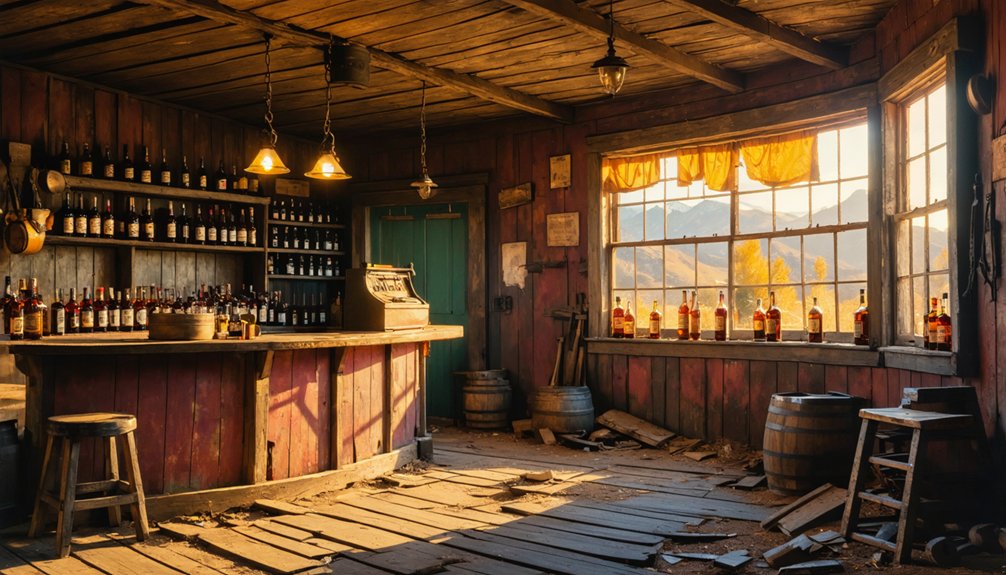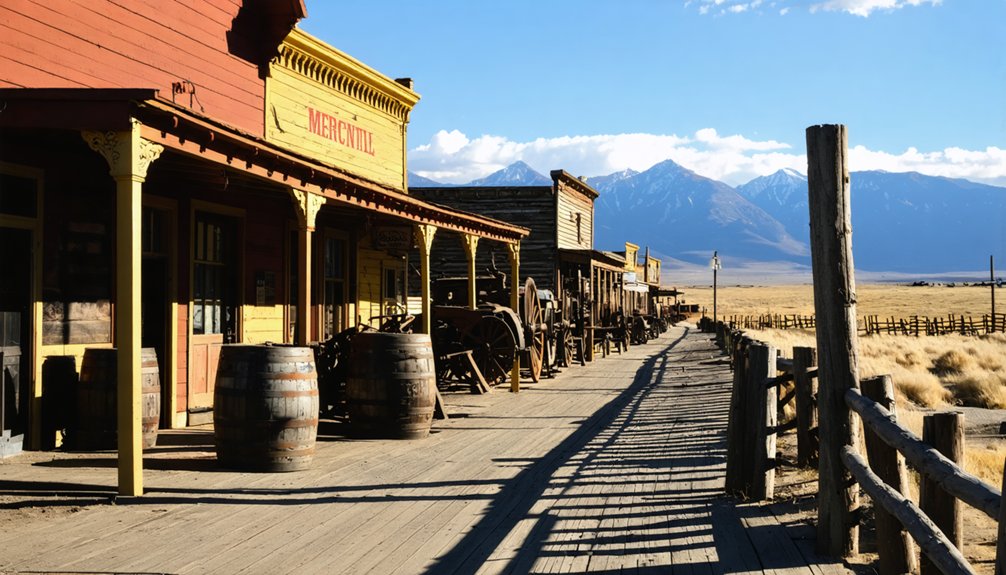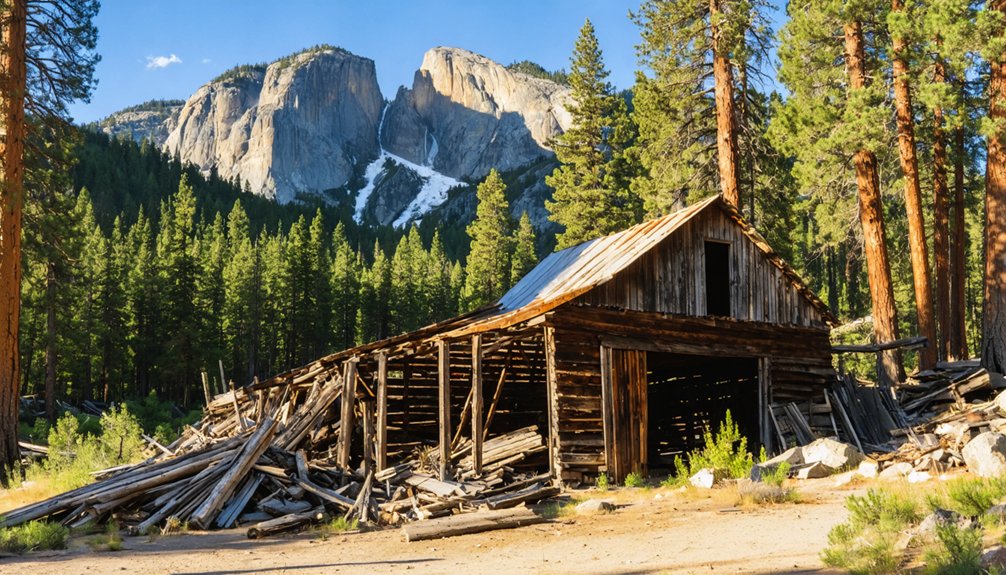
You’ll discover five remarkable ghost towns within 90 miles of Yosemite, each preserving the Sierra Nevada’s mining legacy. Hornitos, once home to 15,000 residents, still showcases its 1856 Masonic Hall and original Ghirardelli store wall. High-altitude sites like Bennettville (10,000 feet) and Dana Village feature hand-forged structures from the 1880s silver boom, while Bodie State Historic Park maintains 110 buildings in “arrested decay.” Golden Crown Mine’s whitebark pine cabins perch at 10,640 feet, representing California’s most extreme mining operations. The complete story reveals access routes, seasonal considerations, and preservation details that’ll transform your visit.
Key Takeaways
- Bodie State Historic Park, the best-preserved gold rush ghost town, features 110 original structures and attracts 200,000 annual visitors.
- Hornitos peaked at 15,000 residents during the 1850s gold rush and still has 75 residents today with historic landmarks.
- Bennettville and Dana Village sit at 10,000 feet near Tioga Pass, showcasing high-altitude silver mining from the 1880s.
- Golden Crown Mine operated at 10,640 feet with five log cabins, representing the challenging alpine mining conditions of the era.
- Best visiting times are late May through October, with advance reservations necessary and layered clothing essential for high-elevation sites.
Hornitos: From Boom to Near-Ghost Status
Around 1850, Mexican miners expelled from nearby Quartzburg pitched their tents along a dusty ridge and founded what would become one of the Mother Lode‘s most notorious camps.
Named “Hornitos” for the dome-shaped ovens dotting the landscape, this settlement exploded to 10,000–15,000 residents within a decade. Daily gold shipments of $40,000 fueled a reputation for violence and vice—locals claimed blood marked every doorstep.
Within ten years, Hornitos swelled to 15,000 souls shipping $40,000 in gold daily—where locals swore every threshold bore bloodstains.
The Hornitos history reflects raw mining culture: fandango halls, gambling dens, and bandit hideouts where Joaquin Murrieta reportedly took refuge. Buildings still bear bullet holes from its lawless era.
Today, you’ll find just 75 residents among stone ruins, including Ghirardelli’s original store wall and the 1856 Masonic Hall. St. Catherine’s Catholic Church remains standing and still hosts services for special occasions.
It’s California Historical Landmark No. 333—a living archive of gold-rush liberty and lawlessness.
Bennettville: A High Sierra Mining Camp Frozen in Time
Perched at 10,000 feet near Tioga Pass—just across a creek from Mount Dana—Bennettville stands as one of the Sierra Nevada’s most ambitious failures.
You’ll find fourteen weathered buildings marking where investors burned through $350,000 chasing the Sheepherder lode‘s silver between 1882 and 1884.
Bennettville history reveals a brutal calculus: $56,000 spent on road construction, a 1,784-foot tunnel driven through granite, and avalanches that buried twenty men in a single lodging house.
The mining challenges proved insurmountable—severe winters, impossible logistics hauling supplies seven miles from Lundy, and ore that yielded “not a penny’s worth” of marketable metal.
The settlement included a boarding house, mine office, assay office, stable, Chinese laundry, and utility buildings scattered along Mine Creek at the base of the hill.
Originally named Bennett City, the town was renamed after Thomas Bennett, whose vision for a metropolis of 50,000 inhabitants dissolved into snow and silence.
Operations ceased July 3, 1884. The post office closed four months later, abandoning what they’d once called Bennett City to endless snow.
Dana Village: Stone Ruins at Tioga Pass
Eight hundred feet south of Bennettville’s failed tunnels, Dana Village clings to Tioga Hill’s crest above Gaylor Lake—a cluster of five stone cabins that tell a different story of the same doomed silver rush.
You’ll find exceptional dry-rock masonry here, slate walls filled with dirt for winter insulation, hand-forged doors still hanging on massive hinges. The Great Sierra Consolidated Silver Mining Company built this camp in 1881, sinking shafts 100 feet deep while hundreds of prospectors chased phantom silver ledges.
Slate walls packed with dirt, hand-forged doors on iron hinges—1881 craftsmanship built to survive Sierra winters at 10,000 feet.
What makes Dana Village remarkable is its Historic Architecture—these structures represent rare high-altitude construction techniques that few Sierra camps achieved.
The National Park Service now controls access to water-filled shafts and rusting winches, preserving Dana Village as tangible evidence of Yosemite’s forgotten mining past.
Golden Crown Mine: Ghost Town Above the Clouds
While most Sierra mining camps struggled at 8,000 feet, Orlando Fuller’s Golden Crown claim operated at 10,640 feet—higher than any permanent settlement in Yosemite’s mining history. Established in 1879 during the Tioga silver boom, this “above the clouds” operation tested human endurance against brutal alpine conditions.
Today’s Golden Crown Mining Legacy reveals itself through:
- Five whitebark pine log cabins built to withstand crushing snowloads and relentless wind
- Sled-road traces carved across granite linking scattered claim workings
- Cross-district boundaries spanning Mono and Tioga counties at the pass
- Minimal ore extraction despite investor enthusiasm and repeated exploration
You’ll find these weathered structures near Mono Pass, forming Yosemite’s highest ghost town—a reflection of prospectors who chose isolation and hardship chasing antimonial silver veins that never materialized. The adjacent Ella Bloss mine shared the site with Golden Crown, and both operations were abandoned around 1890 despite early predictions of substantial mineral wealth. The cabins’ whitebark pine stumps still display old axe marks from their original construction over a century ago.
Bodie State Historic Park: California’s Most Famous Ghost Town
Twenty miles northeast of Mono Lake, Bodie sprawls across a windswept basin at 8,375 feet—California’s best-preserved gold rush ghost town and the state’s official monument to Sierra mining ambition.
You’ll find roughly 110 original structures maintained in “arrested decay,” interiors frozen with furnishings exactly where miners left them after the 1942 shutdown.
Bodie history traces from William Bodey’s 1859 discovery through explosive growth to 7,000–10,000 residents by 1880, when 2,000 buildings lined these streets.
Fire consumed much of downtown in 1932, yet isolation prevented the wholesale looting that gutted other camps.
California’s preservation efforts since the 1962 park designation protect what remains without restoration—no polished facades, just authentic weathered boards and rusting machinery.
The town featured the first long-distance hydroelectric transmission line that powered its stamp mill, representing a significant technological advancement for remote mining operations.
The name “Bodie” serves as a place name disambiguation on Wikipedia, reflecting the town’s significance among multiple geographic locations sharing this designation.
This National Historic Landmark draws 200,000 annual visitors seeking unvarnished Western reality.
The Gold and Silver Rush That Built These Towns
You’ll find the 1880 Tioga Pass boom marks the high-water mark of silver speculation in Yosemite’s high country, when the Great Sierra Consolidated Silver Company poured capital into remote camps like Bennettville at 10,000 feet.
That summer alone saw more than 400 miners and investors flood the eastern Sierra crest, erecting cabins, stamp mills, and the ambitious Great Sierra Wagon Road to haul ore across the range.
Within three years the veins proved far less rich than assays promised, capital evaporated, and these alpine settlements emptied as swiftly as they’d risen.
1880 Tioga Pass Boom
The discovery of gold and silver at Tioga Pass in 1880 transformed a remote Sierra Nevada corridor into a magnet for speculators, miners, and infrastructure builders.
You’ll find remnants of this boom scattered across the high country, where entrepreneurs like Orlando Fuller staked claims that promised fortunes.
Mining operations drew investors who poured $300,000 into ventures like the Sheepherder Mine, driving tunnels 1,784 feet into mountains.
Key operations that defined this era:
- Golden Crown Mine – produced $709,184 in gold bullion over two years
- Great Sierra Consolidated Silver Company – controlled the deepest tunneling operations
- Mount Dana Mining Company – managed smaller extraction sites
- Great Sierra Wagon Road – connected isolated claims to supply routes
Mining’s Economic Golden Era
While Tioga Pass drew fortune-seekers to Yosemite’s high country in 1880, the region’s economic foundation had been poured three decades earlier when James Marshall’s 1848 discovery at Sutter’s Mill released 300,000 gold-hungry migrants into California’s Sierra Nevada.
By 1849, placer mining operations spread east from camps like Big Oak Flat and Garrote, where simple pan-and-sluice methods pulled fortunes from streambeds without corporate oversight or government interference.
The economic impacts transformed wilderness into commerce: Big Oak Flat swelled to 3,000 residents, Grub Gulch extracted nearly $1 million in gold, and entire supply chains—freight lines, saloons, blacksmith shops—emerged to serve independent prospectors.
When surface deposits vanished by the 1870s, capital-intensive hard-rock mining replaced the freewheeling placer era, requiring mills, shafts, and investors rather than lone prospectors with pans.
What Remains: Exploring Historic Structures and Mining Relics
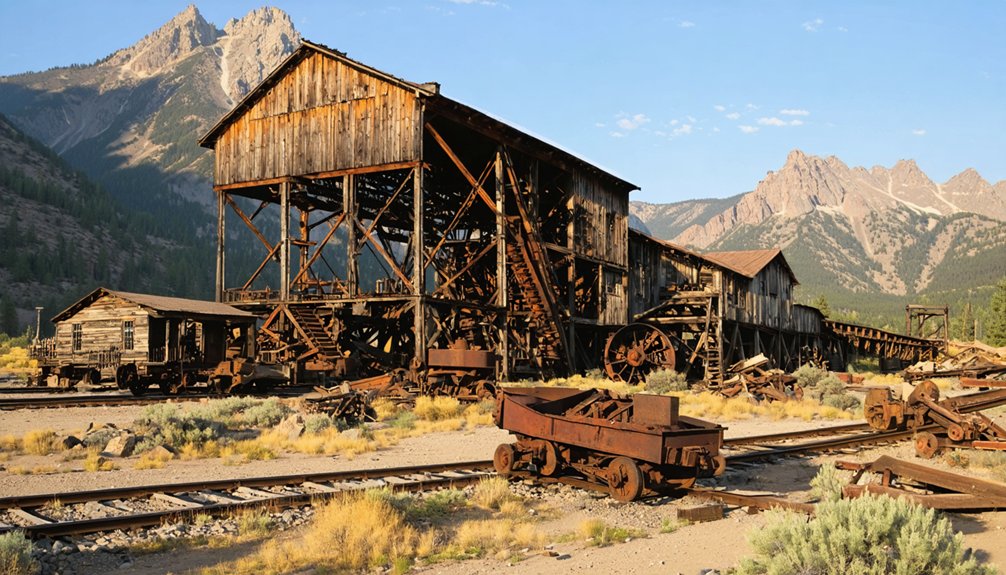
Weathered timber frames, rusting machinery, and sun-bleached facades stand as tangible witnesses to the mining era that once drove thousands of fortune-seekers into the Sierra Nevada foothills.
These weathered relics of California’s mining past speak silently of the fortune-seekers who once flooded these mountain valleys.
You’ll discover authentic mining artifacts scattered across multiple sites, each offering unique insights into 19th-century operations.
Key Historic Structures to Explore:
- Bodie’s “arrested decay” buildings—dozens of original structures with period furnishings left untouched, plus the Standard Mill that processed $35 million in gold
- Bennettville’s log cabins and rusting boilers near Tioga Pass, marking failed silver ventures
- Coulterville’s Jeffrey Hotel and commercial facades from Mother Lode trading days
- Stone foundations at Dana Village and Hornitos showing original town layouts
This historic preservation approach lets you experience authentic ghost-town atmospheres without reconstruction interfering with original craftsmanship.
Planning Your Ghost Town Adventure Near Yosemite
Standing before weathered cabins and rusted mill wheels sparks wonder—but turning that inspiration into a successful ghost-town expedition requires careful groundwork.
Ghost town logistics begin with choosing a base in Mariposa, Oakhurst, Groveland, or Lee Vining, where advance reservations prevent peak-season sellouts. You’ll need layered clothing for high-country sites like Bennettville at 10,000 feet, plus water and first-aid supplies since services are nonexistent.
Exploring ghost towns in California history offers a glimpse into the past, revealing fascinating stories of abandoned places and the people who once thrived there. Visitors can wander through remnants of old mining camps and dusty streets, each telling tales of hardship and hope. Make sure to bring your camera; these eerie landscapes provide unforgettable photo opportunities and a chance to connect with California’s rich heritage.
Budget time carefully: Bodie demands 1–1.5 hours plus dirt-road travel, while Coulterville and Hornitos combine well into a Highway 49 loop.
Respect historical preservation by following state park and wilderness regulations—artifact removal is prohibited.
Finally, secure your Yosemite pass and any special permits before departure, ensuring access to Tioga Road’s remote mining relics without regulatory surprises.
Best Times and Routes to Visit Yosemite’s Ghost Towns
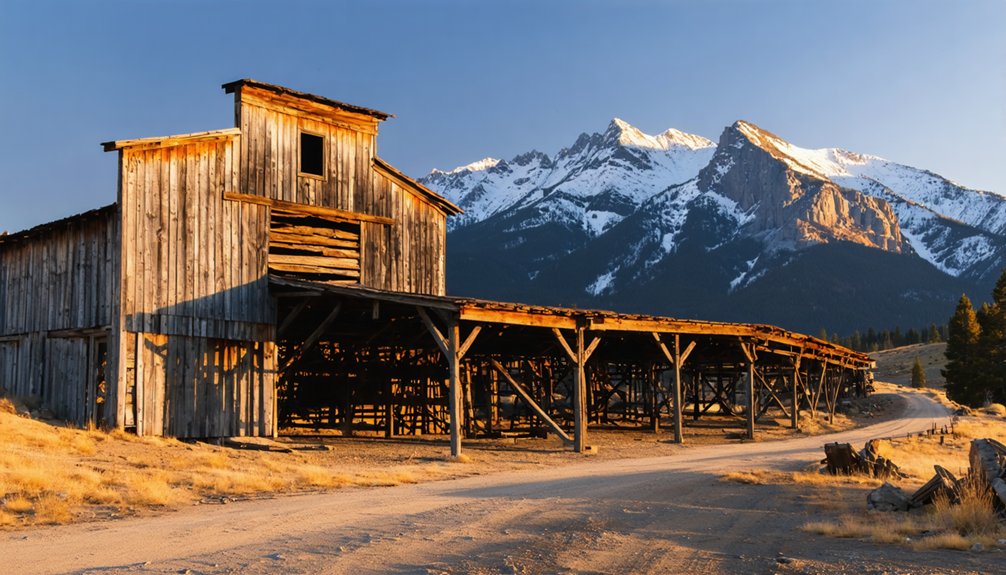
Plan around these windows:
Time your visit strategically to avoid crowds and catch optimal weather windows for exploring both Yosemite’s high country and Eastern Sierra ghost towns.
- Late May–June: Most reliable access once plows clear Tioga Road
- Mid-June–September: Longest daylight and dry dirt roads to high-desert sites
- Late September–October: Cooler temps, fewer crowds, ideal photography light
- Early morning departures: Beat traffic and maximize same-day exploration of both park and ghost towns
Midweek visits dramatically reduce congestion on US-395 corridor.
Frequently Asked Questions
Are Overnight Stays Allowed at Any Ghost Town Sites Near Yosemite?
No, you absolutely can’t camp overnight at ghost town sites near Yosemite—camping regulations strictly prohibit it due to historical significance and safety concerns. You’ll find lodging outside park boundaries where freedom meets responsible preservation of fragile ruins.
What Permits Are Required to Explore Ghost Towns in the Area?
Most ghost towns require only standard park entry fees for casual exploration. However, you’ll need special permits for commercial photography, organized tours, metal detecting, or artifact collection—activities tightly controlled under exploration guidelines and photography restrictions.
Can You Take Artifacts or Souvenirs From These Ghost Towns?
No, you can’t take souvenirs—artifact preservation laws strictly prohibit removing items from Bodie, Bennettville, and other protected sites. Souvenir regulations carry steep fines and criminal charges, safeguarding these irreplaceable Gold Rush remnants for everyone.
Are These Ghost Towns Accessible During Winter Months?
Winter accessibility varies considerably by elevation and location. You’ll find lower-elevation sites like Coulterville and Hornitos remain reachable, while high-altitude ghost towns face severe snow conditions requiring specialized equipment and seasonal road closures.
Which Ghost Towns Are Family-Friendly for Children to Visit?
Columbia’s your best choice with kid-friendly activities like stagecoach rides and candle-making. Bodie offers guided tours suitable for families. Both sites preserve historical significance while letting children explore authentic Gold Rush-era buildings and experiences independently.
References
- https://www.yosemite.com/yosemite-mariposa-county-region/southern-mariposa-county/hornitos-ca/
- https://www.youtube.com/watch?v=1aHRUpZvNdU
- https://www.nationalparkstraveler.org/2014/11/ghost-towns-yosemite-national-parks-high-country25937
- https://www.youtube.com/watch?v=rCpq-o7egVc
- https://californiahighsierra.com/trips/explore-ghost-towns-of-the-high-sierra/
- https://www.sfgate.com/travel/article/trip-to-hornitos-california-ghost-town-17268461.php
- https://www.parks.ca.gov/bodie
- https://mercedcountytimes.com/planning-an-escape-to-hornitos-ghost-town-of-gold-rush-era/
- https://abc30.com/archive/9181341/
- https://noehill.com/mariposa/cal0333.asp