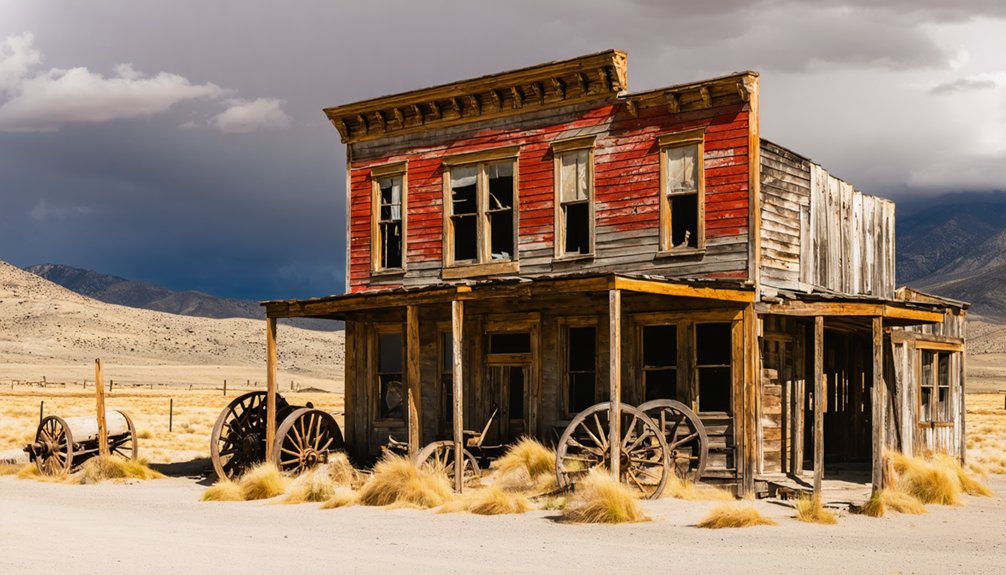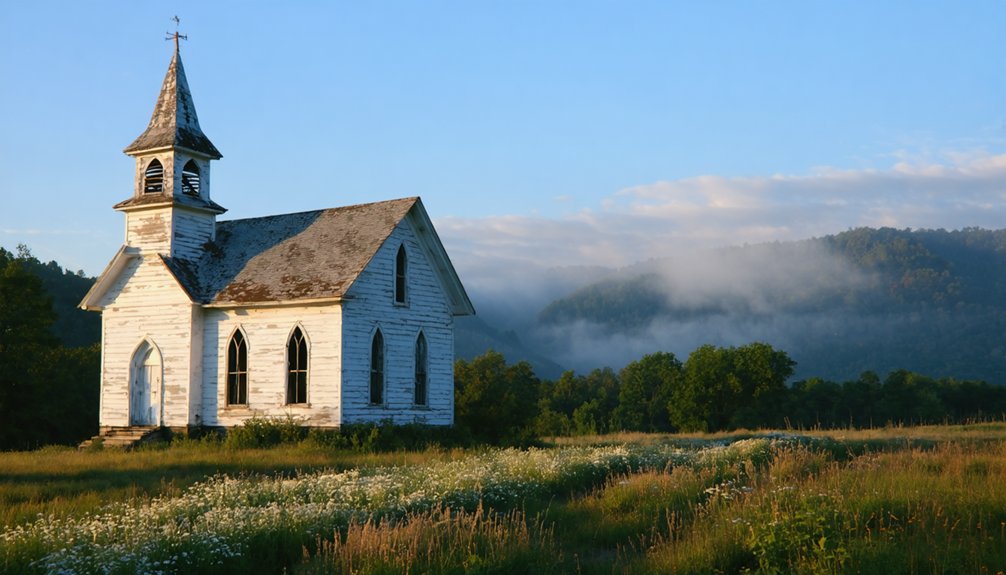
You’ll find Appalachia’s ghost towns emerged through three distinct paths: reservoir projects like Summersville Lake (1966) and Norris Dam (1935) submerged entire communities overnight, while coal company towns slowly emptied after mechanization reduced mining jobs by half between 2011-2020. Logging camps that stripped 17 acres daily from 1880-1920 vanished once timber ran out. Today, these abandoned settlements—from underwater Cherokee sites beneath Tellico Lake to West Virginia’s hollowed coal towns—reveal how industrial progress reshaped mountain communities, and preservation efforts now document what remains.
Key Takeaways
- Dams like Summersville and Norris submerged entire towns, displacing thousands of families and leaving underwater ruins visible during drainages.
- Coal industry decline from mechanization and mine closures created abandoned company towns, with populations dropping drastically across Appalachian communities.
- Logging operations between 1880-1920 created temporary camps that vanished after forests were stripped and timber resources exhausted.
- Ghost towns feature preserved mining structures, walkable streets, and heritage sites now serving as tourism destinations with guided tours.
- Environmental degradation from abandoned mines and collapsed infrastructure compound economic struggles in formerly prosperous industrial communities.
Submerged Beneath the Waters: Communities Lost to Progress
When the U.S. government prioritized flood control and hydroelectric power, entire Appalachian communities vanished beneath engineered lakes. You’ll find Gad, West Virginia submerged under Summersville Lake since 1966, its foundations emerging during decade-long drainages.
Tennessee Valley Authority documented Loyston extensively before Norris Dam displaced 3,000 families in 1935—Lewis Hine’s photographs preserving what federal progress erased.
Duke Energy’s Lake Jocassee swallowed South Carolina’s valley in 1973, where divers navigate standing forests and Attakulla Lodge’s intact structure. The valley was flooded over more than 20 years, erasing entire towns and way of life.
Ancient artifacts and underwater archaeology reveal Cherokee townsites—Chota, Tanasi, Toqua—drowned beneath Tellico Lake.
Fontana Dam submerged Proctor and Judson for WWII aluminum production. The dam supplied electricity to Oak Ridge, a critical component of wartime military operations.
Relocated cemeteries dot lakeshores, though unmarked graves remain below.
These weren’t abandoned settlements—they were claimed, sacrificed for distant industrial demands over generational rootedness.
The Rise and Fall of Coal Mining Boomtowns
Long before federal dams swallowed Appalachian valleys, coal corporations engineered their own erasures—building, extracting, and abandoning entire communities according to seam depletion rather than flooding schedules.
You’ll find evidence throughout West Virginia, where company towns housed 80% of miners by 1925. Corporations like U.S. Steel constructed Gary and countless camps along rail lines, controlling everything from housing to purchasing rights.
Nearly 700,000 men worked 12,000 mines at the post-WWI peak.
Then mechanization arrived in the 1940s, eliminating manual labor needs. Economic decline accelerated through the Great Depression as oil and gas replaced coal.
Miners organized through unions like UMWA to fight for their rights, facing intimidation and violence from company enforcers throughout the region.
Population migration emptied these camps—families forced to abandon communities built entirely around extraction. These abandoned areas experienced unequal environmental law enforcement, leaving residents to contend with degradation long after corporations departed.
What remains documents a deliberate pattern: corporations profited, then departed, leaving ghost towns as Appalachia’s industrial scars.
Logging Camps and Lumber Towns of the Mountains
Between 1880 and 1920, outside capital transformed Appalachia’s mountains into an industrial logging frontier that rivaled coal’s devastation. You’d find thousands working in temporary camps like Cherry River’s 1902 settlement—places that vanished after timber companies stripped 17 acres of virgin forest daily.
Pennsylvania and Michigan crews joined local men who’d balance seasonal camp work with maintaining family farms.
West Virginia’s 1,524 mills cut over 20 billion board feet by 1912, using Lima Shay locomotives that conquered rough terrain.
Rabun County lost 40 percent of its farmland in one decade as land values skyrocketed beyond mountaineers’ reach.
Locomotive sparks ignited 71 percent of fires, destroying timber equivalent to two-thirds of 1907’s mill production. Forest conservation and sustainable logging weren’t considerations—only profit mattered before these boomtowns disappeared.
Over 600 company towns emerged by 1910, including permanent mill centers like Fontana, Bryson City, and Townsend, alongside countless temporary worker camps that operated for years before abandonment. Large timber companies like Gennett, Ritter, Little River, and Champion eventually transferred their culled and cutover tracts to the federal government after exhausting accessible timber.
When the Industry Left: The Slow Decline of Company Towns
As World War II ended with 100,000 coal miners working Appalachia’s seams, few imagined the industry would shed nearly all those jobs within a generation.
Mechanization slashed Gary, West Virginia’s workforce by 38% between 1955 and 1960.
By 2011-2020, over half of Central Appalachia’s mining jobs vanished while production plunged 80%.
The exodus hollowed out company towns—schools closed, stores shuttered, populations fled.
Gary dwindled to 772 residents by 2020.
McDowell County now has less than a third of residents in the labor force.
Environmental degradation from abandoned mines compounds the crisis, while cultural erosion strips communities of identity.
Over 1,300 facilities sit idle, their tax bases collapsed.
The region’s median age approaches 50, signaling a community with few young families to sustain local institutions.
Deindustrialization and globalization reduced U.S. manufacturing and resource extraction, accelerating the collapse of these isolated communities.
Central Appalachia’s coal counties face losing half their populations by 2050—a slow-motion abandonment decades in the making.
Remembering the Past: Preservation and Heritage Tourism
While abandoned company towns crumble across Appalachia’s ridges, a network of preservationists races to salvage what remains of this vanishing industrial heritage. You’ll find organizations like Southern Appalachian Highlands Conservancy protecting sites such as Lost Cove’s 95 acres, ensuring future generations can walk these historic grounds.
Historical commemorations now transform ghost towns into heritage destinations—Thurmond’s walkable streets and Kennicott’s mining structures draw thousands seeking authentic connections to America’s industrial past.
Local historians document what buildings can’t preserve: oral histories capturing voices of former residents, digital archives storing community memories. These communities often thrived on timber and railroad employment that sustained families through generations before eventual abandonment.
Cultural celebrations through guided hikes and walking tours let you experience these landscapes firsthand. Descendants visit these silent sites, sharing stories and preserving their Appalachian heritage through family gatherings and community remembrance. Yet harsh weather, rugged terrain, and limited funding constantly threaten preservation efforts.
These sites aren’t just tourist attractions—they’re proof of labor and perseverance that built modern America.
Frequently Asked Questions
Can You Legally Explore or Metal Detect in Appalachian Ghost Towns?
You’ll need written permission from property owners before exploring or metal detecting. Legal requirements vary by site—public ghost towns allow access, but private Appalachian locations demand documentation. Always verify property ownership first to avoid trespassing charges and respect local heritage.
Are Any Ghost Towns in Appalachia Considered Haunted or Have Paranormal Activity?
Shadows whisper through Appalachia’s forgotten places. You’ll find haunted legends at Chestnut Hill’s headless specter site, Bell Witch Cave, Point Pleasant’s Mothman territory, and Thurman’s burned hotel ruins—all documented with paranormal sightings that’ll challenge your skepticism and reward your curiosity.
What Items Are Most Commonly Found in Abandoned Appalachian Ghost Towns?
You’ll discover rusted mining tools, household remnants, and personal artifacts like old photos documenting cultural history. Beyond physical items, haunted legends surround these spaces—stories of miners and families who shaped Appalachia’s coal-town heritage before disappearing.
How Do I Find Maps or Directions to Remote Ghost Towns?
You’ll find remote ghost towns using interactive maps like Appalachian GhostWalks or Geotab’s database, combined with GPS navigation apps. Historical maps from local societies help locate sites, while satellite imagery reveals ruins before you venture into backcountry areas.
Exploring these ghost towns with modern amenities allows you to step back in time while enjoying contemporary comforts. Many have been revitalized, offering unique lodging and dining experiences that blend history with luxury. Additionally, engaging with local tours brings the stories of these communities to life, enhancing your journey through forgotten landscapes.
Are There Safety Risks When Visiting Abandoned Coal Mines or Structures?
Yes—at Coal Mountain Surface Mine’s 2024 highwall collapse, unstable rock killed a 59-year-old operator. You’ll face serious mine safety threats: unsupported roofs, deteriorating ribs, and toxic air. Structural stability can’t be assumed in abandoned Appalachian sites.
References
- https://www.thewanderingappalachian.com/post/underwater-ghost-towns-of-appalachia
- https://www.geotab.com/ghost-towns/
- https://appalachianmemories.org/2025/10/16/the-lost-towns-of-appalachia-the-forgotten-mountain-communities/
- https://www.wvnews.com/news/wvnews/echoes-of-the-past-exploring-west-virginias-ghost-towns/article_2ec39746-1214-11ef-9af7-bbe4e62e6509.html
- https://www.richmondfed.org/-/media/richmondfedorg/publications/research/econ_focus/2011/q3/pdf/feature2.pdf
- https://appalachianhistorian.org/category/abandoned-appalachia/
- https://www.thewanderingappalachian.com/post/the-underwater-towns-of-appalachia
- https://wvtourism.com/did-you-know-there-is-an-underwater-ghost-town-in-west-virginia/
- https://www.blueridgeoutdoors.com/go-outside/sunken-secrets-the-underwater-ghost-towns-of-the-blue-ridge/
- https://www.youtube.com/watch?v=tdWL4s8klbo