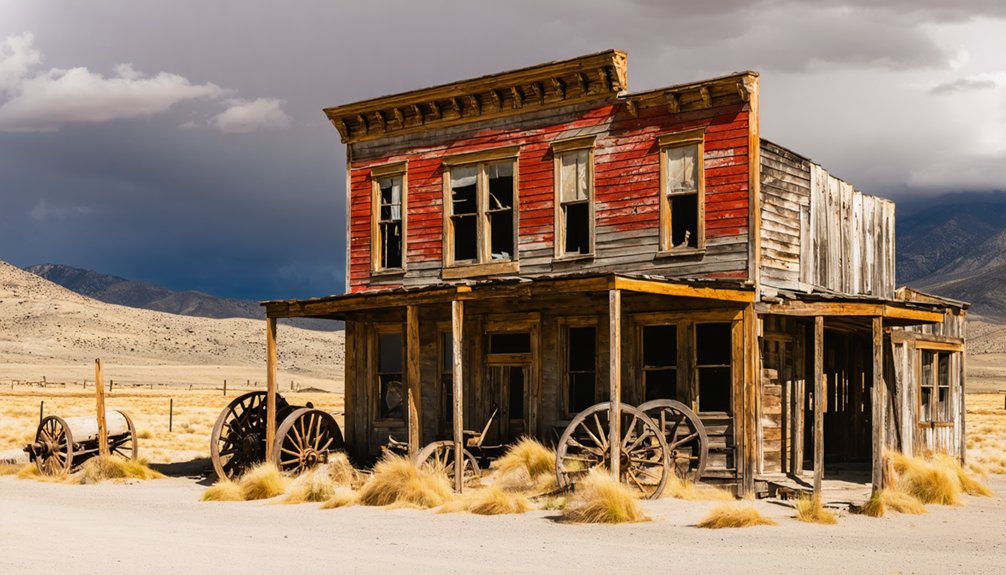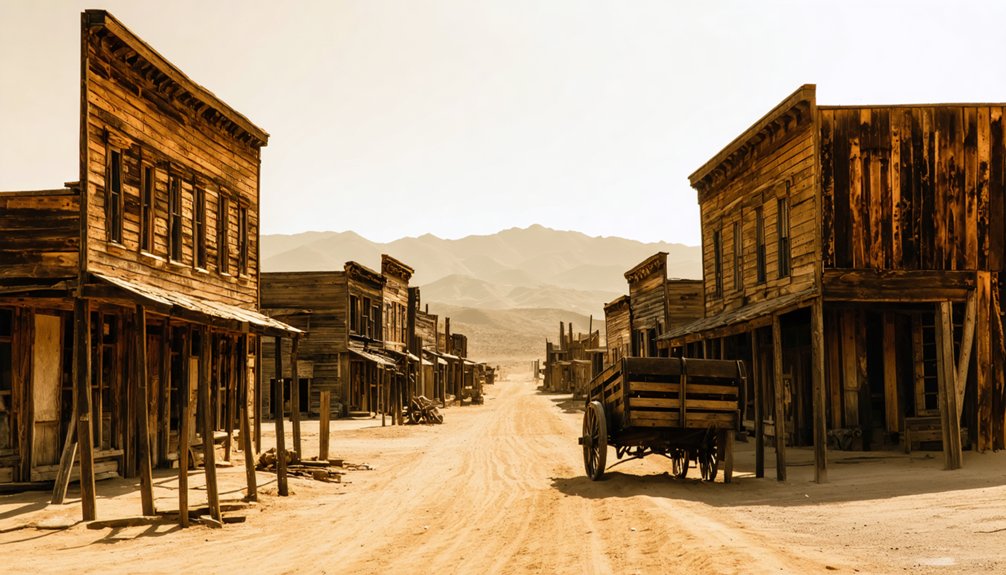
California’s Gold Rush spawned over 400 towns across the Sierra Nevada foothills, most now abandoned after mineral deposits exhausted. You’ll find preserved sites like Bodie, frozen in “arrested decay” with 65 former saloons intact, and Coloma, where gold’s 1848 discovery at Sutter’s Mill triggered mass migration. Towns like Sonora extracted $11 million in placer gold before adapting to lumber industries, while others like Empire City vanished in the catastrophic 1862 flood. Some settlements now lie submerged beneath reservoirs like Folsom Lake, their remnants occasionally surfacing when water levels drop to reveal California’s explosive mining heritage.
Key Takeaways
- Over 400 ghost towns emerged during California’s Gold Rush (1848–1860s), rapidly declining after mineral resources were exhausted.
- Bodie grew to 10,000 residents by 1879 with 65 saloons, now preserved in “arrested decay” as a historic site.
- Coloma, site of gold’s 1848 discovery at Sutter’s Mill, is now a 576-acre state park with replicas and exhibits.
- Natural disasters and dam construction destroyed towns like Empire City (1862 flood) and submerged Salmon Falls under Folsom Lake.
- Towns attracted diverse international populations, with U.S.-born residents forming a minority in 1860 mining communities.
Bodie: The Preserved Mining Town in Arrested Decay
How did a remote mining camp named after a prospector who froze to death become one of America’s best-preserved ghost towns? You’ll find answers in Bodie’s remarkable trajectory from 1859 discovery to protected landmark.
William Bodey’s fatal snowstorm didn’t stop his mining camp from exploding to 10,000 residents by 1879, fueled by $38 million in extracted wealth and advanced mining technology.
Death in a blizzard couldn’t prevent William Bodey’s discovery from spawning a 10,000-person boomtown worth millions.
The Standard Company’s 1876 ore discovery transformed desolate hills into a bustling hub with 65 saloons and 2,000 buildings. At its peak, Bodie operated 30 gold mines alongside gambling halls, brothels, and opium dens.
After devastating fires and wartime closure in 1942, Bodie entered “arrested decay”—preserved exactly as abandonment left it. Inside the structures, bottles, desks, and relics remain visible where they were left, offering an unfiltered glimpse into daily life during the gold rush era.
Today’s Bodie State Historic Park maintains 200 weathered structures, allowing you to explore authentic ghost town legends without Disney-style restoration compromising historical integrity.
Empire Mine: A Century of Gold Production
While Bodie captivates visitors with its frozen-in-time streetscapes, the Empire Mine tells a different story of California gold—one measured not in boom-and-bust cycles but in sustained industrial extraction. From George Roberts’ 1850 discovery through 1956 closure, this operation evolved from artisanal mining into sophisticated corporate enterprise, producing 5.8 million ounces worth over $10 billion today.
The mine’s achievements reflected systematic innovation:
- 367 miles of underground passages carved through Nevada County’s richest deposits
- Cornish expertise transformed operations with steam-powered pumps processing 18,000 gallons per minute
- Cyanide leaching adoption (1905) revolutionized refractory gold extraction from quartz
- Six decades under Bourn family management established deep mining as legitimate business
The Empire Vein’s remarkable gold concentrations of 3–7 ounces per ton made it one of California’s richest deposits, justifying the extraordinary depths miners pursued. The main shaft extended over 11,000 feet deep, with the highest working level positioned at 8,000 feet beneath the surface. Today’s Empire Mine State Historic Park ensures cultural preservation of California’s hard-rock mining heritage.
Shasta: Queen City of the Northern Mines
Though separated by hundreds of miles from the Mother Lode’s famed camps, Shasta emerged as northern California’s preeminent gold mining hub through sheer geographic necessity.
Gold discovery near the site in spring 1849 transformed wilderness into Reading’s Springs, a tent city housing 500 miners by October.
Renamed Shasta in 1850, it became the county seat and gateway to Trinity’s backcountry diggings.
During its 1852-1857 peak, you’d witness over $100,000 in gold dust passing through weekly, with 100 freight wagons and 2,000 pack mules arriving daily.
The town’s 3,500 residents developed sophisticated mining techniques to extract wealth from quartz ledges.
Mule trains connected Shasta to Sacramento, making it an essential supply link for northern mining operations.
By the 1880s, the transition from placer to quartz mining marked a watershed moment as surface gold deposits became exhausted.
When mines exhausted and railroads bypassed Shasta around 1888, abandonment was swift.
Today’s brick ruins preserve this Queen City’s fierce independence.
Coloma and the Site Where It All Began
On January 24, 1848, James W. Marshall discovered gold at Sutter’s Mill in Coloma Valley, igniting history’s greatest Western Hemisphere migration. This Gold discovery transformed California from Mexican territory to an American powerhouse, yet the site’s significance extends beyond the rush itself.
Today’s 576-acre state park preserves this pivotal location where Marshall’s find sparked civilization-altering change. You’ll find:
- Replica of Sutter’s sawmill where fortune-seekers’ dreams began
- Monument to Marshall, California’s first state-funded memorial (1890)
- Historic Chinese stores and mining exhibits documenting diverse communities
- Expanding interpretation of Indigenous histories through Nisenan tribal consultations
The park now confronts overlooked narratives. Archaeological excavations reveal how 1890s miners demolished Gold Rush structures, quite literally erasing history while chasing overlooked veins—a metaphor for stories yet unearthed. The town’s population declined dramatically from its Gold Rush peak to about 200 by 1870, mirroring current numbers and reflecting the transient nature of boom-town prosperity. Modern preservation efforts include security measures that protect the site’s integrity from vandalism and ensure genuine visitor interactions with this irreplaceable historical landscape.
Sonora: Queen of the Southern Mines
Mexican and Chilean miners founded Sonoranian Camp in March 1849 along Wood’s Creek, establishing what would become the commercial heart of the southern mines. The settlement’s extraordinary placer deposits attracted over 10,000 Mexican and 4,000 American miners by late 1849, transforming it into Tuolumne County’s most important supply center.
However, California’s 1850 Foreign Miners Tax—a punitive $20 monthly levy—sparked violent expulsions that halved Sonora’s population by September and ended its multicultural boom period. The town earned its reputation as the “largest, wickedest, and richest” settlement in the Southern Mines, hosting an extremely diverse population of gamblers, miners, and fortune seekers from across the globe.
The lawless mining camp initially operated under makeshift rules and old Mexican Alcalde systems due to the absence of formal law enforcement.
Mexican Miners Establish Sonora
When experienced miners from Mexico’s Sonora province arrived in Tuolumne County during the 1849 Gold Rush, they brought sophisticated mining techniques that would transform the region into one of California’s richest gold-producing areas. These veterans of both mining and the Mexican War established their camp at Wood’s Creek on March 17, 1849.
They utilized advanced extraction methods like the arrastra—an animal-driven device that pulverized quartz ore and captured gold with quicksilver.
Their expertise yielded extraordinary results:
- The Bonanza Mine produced 990 pounds of gold in one week
- Placers generated over $11 million in total gold
- The Holden Chispa nugget weighed 28 pounds
- Population swelled to 5,000 miners by year’s end
However, the 1850 Foreign Miners’ Tax sparked violent resistance, ultimately driving these skilled pioneers from the wealth they’d discovered, leaving Indigenous contributions largely unrecognized in Modern tourism narratives.
From Boom to Decline
Following their exodus in 1850, the town those Mexican miners established evolved into “Queen of the Southern Mines”—a title Sonora earned through sheer productivity and strategic positioning. You’ll find evidence of this dominance in the $11 million extracted from placer operations and the Bonanza Mine’s staggering 990-pound weekly haul.
As Washington Street transformed from Indian trail to commercial artery, pack trains and stage lines funneled supplies to southern camps through Sonora’s hub.
When placer gold depleted in the late 1800s, the town adapted—lumber and hard-rock mining sustained its 5,000 residents.
Today’s cultural revival preserves 1850s architecture while modern tourism capitalizes on Gold Rush heritage. You’re witnessing economic resilience: from violent displacement to enduring prosperity through strategic reinvention.
Cerro Gordo: High Desert Mining Legacy
High in the Inyo Mountains above Owens Lake, silver ore discoveries in 1865 transformed a remote desert peak into California’s most productive lead-silver mining district. You’ll find Cerro Gordo‘s story reflects how independent prospectors built fortunes through innovation rather than corporate control.
Mining technology evolved rapidly from crude adobe smelters to Mortimer Belshaw’s advanced facilities, enabling extraction of ores worth $300 per ton.
Belshaw’s revolutionary smelting technology turned Cerro Gordo’s raw ore into $300-per-ton profits, proving innovation could triumph over primitive methods.
Key developments that shaped Cerro Gordo:
- Over 4,000 miners worked independently across 30 miles of tunnels during peak operations
- Daily production reached 1,000 tons during the 1911-1919 zinc revival
- Total output exceeded $17 million (nearly $500 million today) without major corporate backing
- Water scarcity and market fluctuations—not resource depletion—ended major operations
Labor unions rarely formed here; miners preferred individual claims over collective bargaining.
Empire City: Lost to the Great Flood of 1862
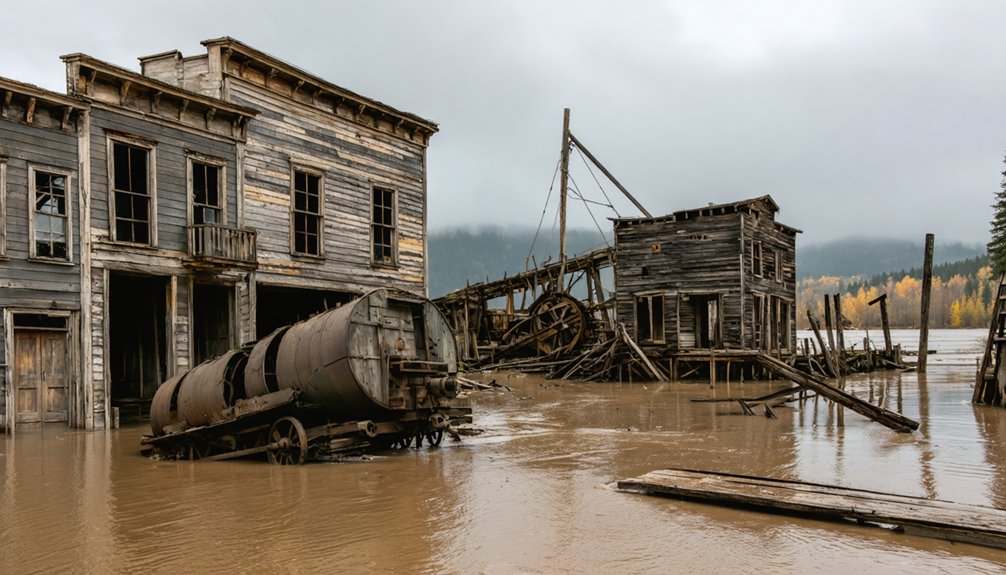
You’ll find Empire City’s story stands apart from typical gold rush ghost towns—it didn’t fade from exhausted mines or economic decline, but vanished overnight in California’s catastrophic 1862 flood.
This Sacramento River settlement thrived briefly during the early 1850s as miners extracted placer gold from nearby deposits, establishing the infrastructure that supported hundreds of residents.
When the Great Flood swept through in January 1862, the deluge completely erased Empire City from the landscape, leaving behind only scattered archaeological evidence of a community that geological forces destroyed rather than economic ones.
Empire City’s Mining Origins
- American, Chinese, and European miners competed for claims along productive stretches.
- Merchants and service providers established businesses to support the mining economy.
- Population fluctuated seasonally as miners followed water availability and productive strikes.
- Women remained scarce, comprising less than 5% of residents.
- Accelerated urban decay: Survivors abandoned the site permanently, unlike other partially-damaged mining towns that rebuilt
- Hydraulic mining consequences: Upstream operations destabilized watersheds, magnifying flood destruction
- Economic migration: Displaced residents scattered to Sacramento and San Francisco, redistributing capital and expertise
- Historical erasure: No archaeological remains exist—the town vanished from physical reality, preserved only in written records
- Population surged from scattered huts to 3,000 residents within months
- Town lots sold rapidly by summer 1850 as miners flooded the region
- Development stretched three miles along the river as Sweetwater Creek and adjacent waterways yielded fortunes
- El Dorado County: Bucks, Budeville, Kelley, Todds near Sutter’s Mill
- Calaveras County: Pine Crossing, Portuguese Flat, Double Springs
- Trinity County: Weaverville area camps along Trinity River
- Northern routes: Shasta region settlements
- https://faroutmagazine.co.uk/visit-the-ghost-town-california-gold-rush/
- https://www.legendsofamerica.com/ca-deathvalleyghosttowns/
- https://en.wikipedia.org/wiki/List_of_ghost_towns_in_California
- https://jjandthebug.com/gold-rush-towns-in-california/
- https://www.atlasobscura.com/itineraries/the-wildest-west
- https://storymaps.arcgis.com/stories/124e04142d3147078fb4519a6b9a5c64
- https://www.visittuolumne.com/gold-panning
- https://en.wikipedia.org/wiki/Category:Mining_communities_of_the_California_Gold_Rush
- https://www.monocounty.org/places-to-go/bodie/
- https://www.snowcreekresort.com/blog/bone-chilling-history-bodie-ghost-town/
The town’s prosperity depended entirely on extracting gold from the river’s edge—a vulnerability that would prove catastrophic when nature reclaimed its floodplain.
The 1862 Flood Disaster
For forty-three days beginning December 9, 1861, relentless rain pounded California’s mining districts as a series of atmospheric rivers released what would become the state’s most catastrophic flood in recorded history.
Empire City vanished entirely when the Yuba River transformed into a raging torrent, erasing the settlement from earth. You’d witness California’s Central Valley becoming an inland sea 300 miles long, drowning hundreds of thousands of cattle and destroying agricultural impacts across the region.
The deluge peaked January 31, 1862, after depositing over 10 feet of precipitation. Climate change researchers now study this event to understand atmospheric river patterns and flood risk.
The disaster bankrupted California, destroying 25% of taxable property and killing an estimated 4,000 people—forever altering the state’s mining landscape.
Complete Destruction and Legacy
When Empire City met its fate on January 31, 1862, the Yuba River‘s unprecedented surge didn’t simply damage the settlement—it erased every structure, street, and trace of human habitation within hours.
You’ll find no remnants today because the floodwaters carried everything downstream, leaving behind only geological scars. This catastrophic event demonstrated nature’s power to override human ambition completely.
The legacy reveals critical lessons about settlement patterns and environmental impact:
Timbuctoo: Remnants of a Forgotten Camp
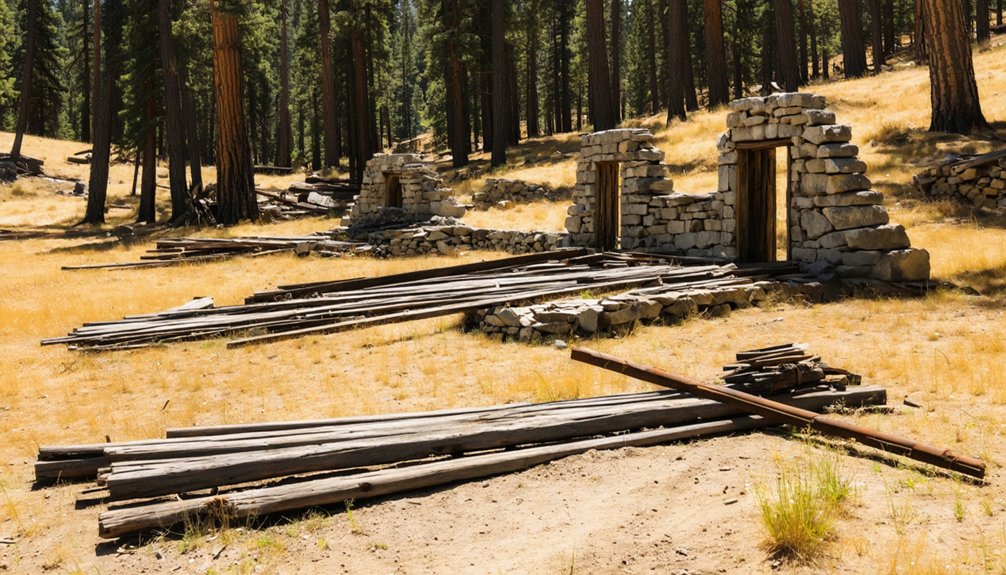
In 1855, prospectors established Timbuctoo on a strategic bluff 397 feet above the Yuba River, where they could access gold-bearing sandbars below while remaining safe from seasonal flooding. The camp’s unusual name reportedly honored an African American miner who claimed Timbuktu, Mali as his origin—possibly an escaped or freed slave seeking fortune in California’s foothills.
At its peak, 1,200 residents supported a Wells Fargo office, an 800-seat theater, and thriving hydraulic operations that extracted fabulous wealth from the Sierra’s lowest-elevation diggings. Today, you’ll find only collapsed brick ruins where looters once searched for rumored gold hoards.
The 1980s highway realignment erased Timbuctoo’s potential as a historic waypoint, leaving mounds of hydraulic waste and a historic marker located five miles distant—testaments to freedom’s impermanence.
Salmon Falls: Submerged Beneath the Waters
Salmon Falls emerged in 1849 along Sweetwater Creek as miners flooded the region during the Gold Rush.
This event established a crucial waypoint on the Georgetown Road where prospectors like Civil War veteran Arthur G. Moore and ranching families such as the Crooks sustained the community through the late 1800s.
The town’s transformation from a bustling mining hub to a rural settlement followed the predictable pattern of declining ore yields.
Yet, its physical remnants—documented in an 1873 map and 1890s photographs—survived until the mid-20th century.
When Folsom Dam’s completion in 1955 created Folsom Lake, the entire townsite and surrounding areas including New York Ravine disappeared beneath the reservoir’s waters.
This event preserved this Gold Rush settlement in submerged silence.
Historic Mining Community Origins
The promise of instant wealth drew Mormon miners to Higgins’ Point in early 1849, where they discovered rich diggings that would spawn one of the Gold Rush’s most vibrant communities. Located eight miles above Mormon Island on the South Fork American River, the site took its name from abundant salmon fishing at the falls—a resource featured in Native American legends and sustaining local tribes for decades before miners arrived.
The settlement’s explosive growth reflected California’s gold fever:
The 1860 census revealed U.S.-born residents comprised a minority, demonstrating the rush’s international appeal
Reservoir Flooding and Preservation
By 1955, when Folsom Dam’s gates finally closed, Salmon Falls joined dozens of other Gold Rush communities beneath the rising waters of Folsom Reservoir.
You’ll find that flood mitigation projects often exact a steep price on historical memory. The dam builders blasted away the falls’ rocks decades earlier during 1920s logging operations, erasing the landmark that gave this town its name.
While flood control became paramount for California’s growing population, sixty-two graves from the pioneer cemetery required exhumation and relocation to Mormon Island Memorial Cemetery at El Dorado Hills.
Cultural preservation efforts now depend on drought years, when low water levels briefly expose town remnants for documentation.
This submerged ghost town reminds you that infrastructure demands frequently override heritage conservation, leaving commemorative placards as insufficient substitutes for authentic places.
The Geography of Abandonment: Mapping California’s 400 Ghost Towns
Scattered across California’s Sierra Nevada foothills, over 400 ghost towns mark the frenzied expansion and swift collapse of Gold Rush settlements between 1848 and the 1860s. You’ll find these abandoned camps concentrated along Route 49, which connects surviving towns like Placerville and Nevada City with vanished settlements that appear only on early maps.
In addition to the historic ghost towns in California, enthusiasts can also engage in exploring abandoned sites near Fort Worth. This region offers intriguing remnants of the past, with decaying buildings and relics that tell stories of once-thriving communities. Every visit reveals a new layer of history, captivating those who dare to venture off the beaten path.
Over 400 ghost towns dot the Sierra Nevada foothills, remnants of Gold Rush settlements that boomed and vanished within decades.
Mining technology drove this geography—placer deposits depleted rapidly, forcing miners onward. Hydraulic operations at sites like Malakoff Diggins devastated landscapes, leaving uninhabitable terrain.
Indigenous influence shaped initial discoveries, though native populations faced displacement as 300,000 forty-niners arrived between 1849-1855.
Key abandoned settlement clusters include:
Frequently Asked Questions
What Safety Precautions Should Visitors Take When Exploring Ghost Towns?
You’ll need proper safety gear including sturdy boots, water, and communication devices when exploring. Watch for environmental hazards like unstable structures, rattlesnakes, toxic mine gases, and extreme heat. Respect closure signs while maintaining your adventurous independence.
Are Ghost Town Artifacts Legally Protected From Removal by Visitors?
Before you pocket that rusty nail as a souvenir, know this: legal protections shield historic artifacts on public lands. Artifact removal violates federal and state laws, carrying serious penalties. You’re free to explore, photograph—but leave history untouched.
Which Ghost Towns Offer Camping or Overnight Accommodation Nearby?
You’ll find camping at Calico Ghost Town ($35-$55 nightly) and bunkhouses ($160/night), while Bodie requires staying in nearby Bridgeport. These tourist attractions balance historical preservation with visitor access, letting you explore authentically while maintaining overnight flexibility.
How Did Miners Typically Stake and Register Their Claims?
Though it seems chaotic, you’d follow structured claim staking by placing corner markers and posting notices with your name. Then you’d register with your district’s elected recorder, establishing your mining registration rights through this community-enforced system.
What Role Did Chinese Immigrants Play in Gold Rush Mining?
Chinese labor transformed gold mining through persistent work on abandoned claims and immigrant contributions spanning laundries, restaurants, and services. You’d find they faced discriminatory taxes and violence, yet built protective communities while recovering gold others overlooked.