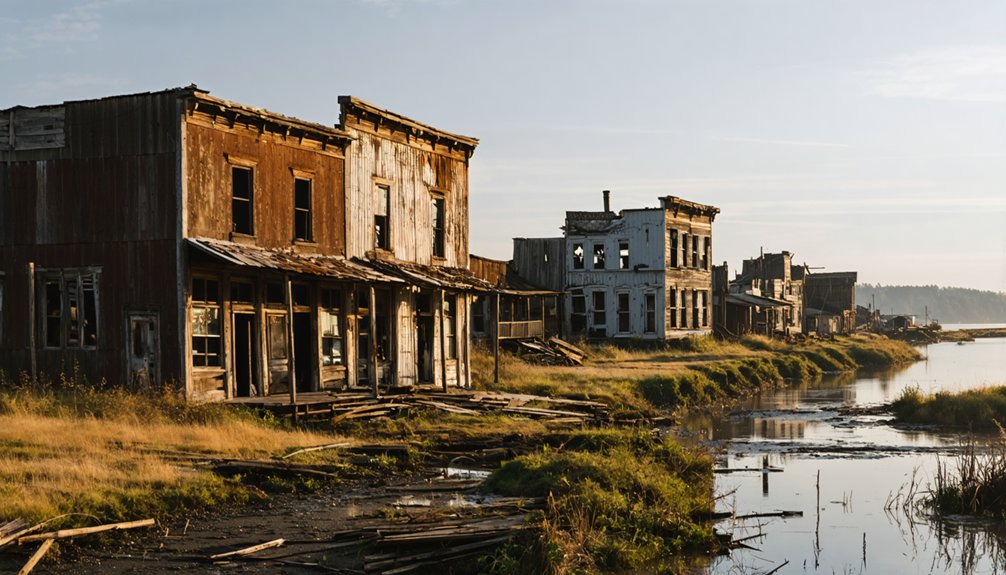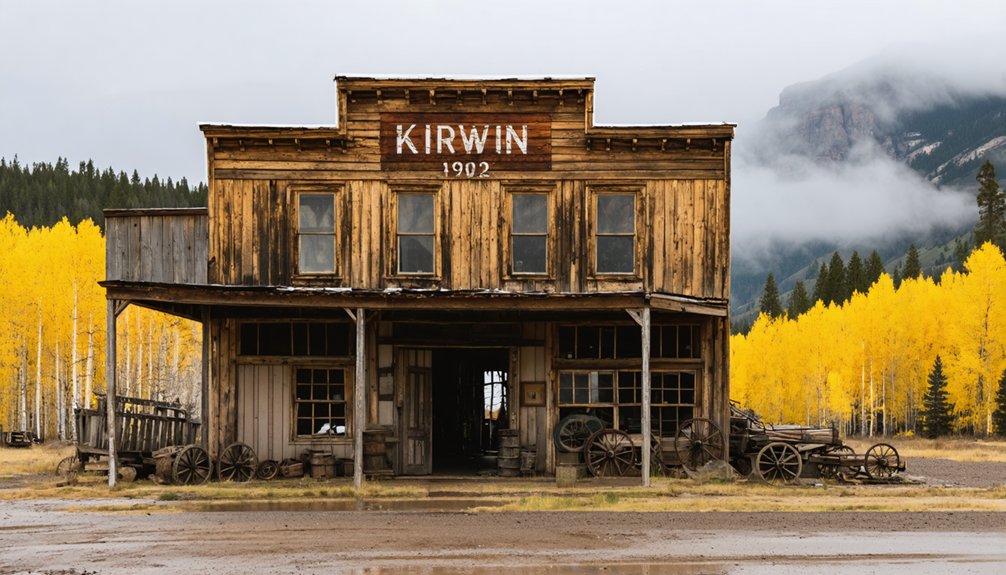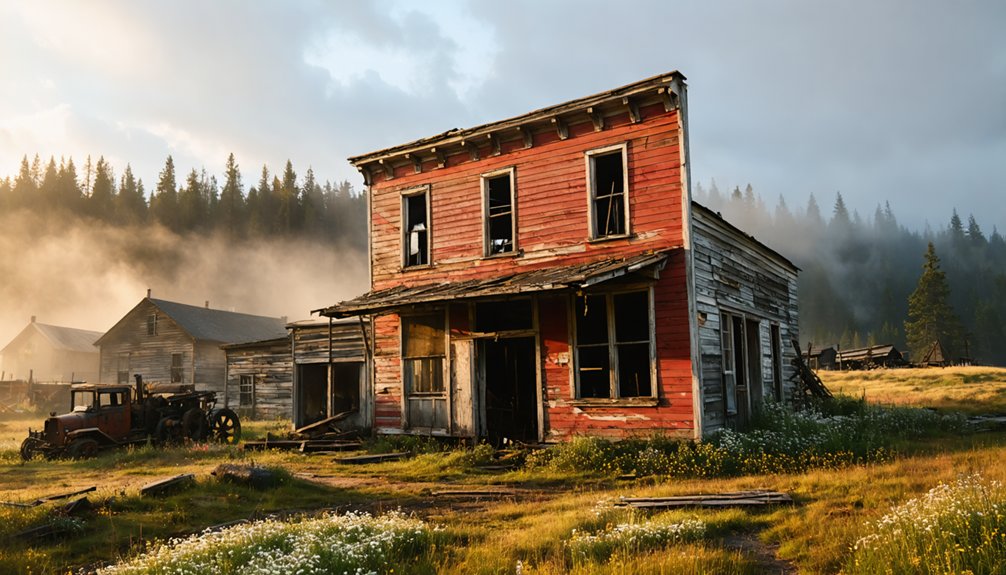
The Pacific Northwest’s ghost towns tell stories of boom-and-bust cycles driven by mining rushes, lumber depletion, and railroad abandonments. You’ll find over 250 abandoned settlements in Oregon alone, with Washington and British Columbia offering their own forgotten communities. Natural disasters like floods and fires accelerated many towns’ demises. Sites like Monte Cristo, Shaniko, and Barkerville preserve these haunting histories today. Beyond weathered buildings lies a complex tale of resource exploitation and fleeting prosperity.
Key Takeaways
- Pacific Northwest ghost towns emerged from resource-based boom-bust cycles in mining, lumber, and railroad industries.
- Washington’s ghost towns include Govan (known for unsolved axe murders) and Liberty (a preserved gold-mining community).
- Oregon contains over 250 abandoned settlements, with estimates suggesting up to 1,600 former communities throughout the state.
- Natural disasters accelerated town abandonments through mine collapses, fires, floods, and coastal erosion.
- Preservation efforts balance historical integrity with tourism, while responsible visitation practices protect these fragile historical resources.
The Rise and Fall of Mining Empires in the Pacific Northwest

When gold was first discovered in the Pacific Northwest during the early 1850s, it triggered a series of mining rushes that would transform the region’s economy and settlement patterns for decades to come.
You can trace this mining prosperity from the Rogue River Valley in 1851 to the Clearwater River in 1860, as prospectors pushed relentlessly eastward.
Boomtowns materialized almost overnight, with merchants like Thomas G. Richards capitalizing on the influx of fortune-seekers.
By 1858, nearly 10,000 miners flooded Bellingham Bay alone after the Fraser River strike.
The Klondike Rush of 1898 further fueled regional economies, with Seattle merchants selling over $325,000 in supplies in just one month.
These frenzied periods of wealth extraction have left ghostly legacies across the landscape—abandoned settlements that once bustled with ambition.
Coal mining became a significant industry after William Fraser Tolmie’s 1833 discovery near the Cowlitz River, eventually supplying fuel to San Francisco at premium prices.
The Oregon Steam Navigation Company gained control of Columbia River transportation, moving 6,290 tons of freight upriver in 1861 to support the mining operations.
Abandoned Lumber Towns: When the Trees Ran Out
Throughout the lush, evergreen landscape of the Pacific Northwest, the skeletal remains of once-thriving lumber towns stand as stark reminders of an industry that consumed itself.
Abandoned mill towns haunt Pacific Northwest forests—monuments to humanity’s appetite for resources that exceeded nature’s capacity to renew.
The lumber industry decline followed a predictable pattern you can still trace in these timber ghost towns:
- Economic devastation – When Bowman-Hicks closed in 1933, Maxville fell from being Wallowa County’s largest settlement to abandonment.
- Resource depletion – Accessible forests vanished, making remote operations financially unsustainable.
- Infrastructure collapse – Storms and fires destroyed buildings while metal pipes, foundations, and broken china remain as artifacts.
- Population exodus – Residents migrated to nearby towns seeking work as their company-built communities disintegrated.
You’ll find only scattered concrete chunks and overgrown railroad grades where once-mighty lumber empires operated for generations before the trees ran out. Maxville uniquely housed both races of loggers, with African American and white workers sharing the community during a time of widespread segregation. Many of these towns were originally established with steam-powered machinery that revolutionized logging by enabling access to remote timber areas once considered inaccessible.
Tales From Washington’s Forgotten Communities
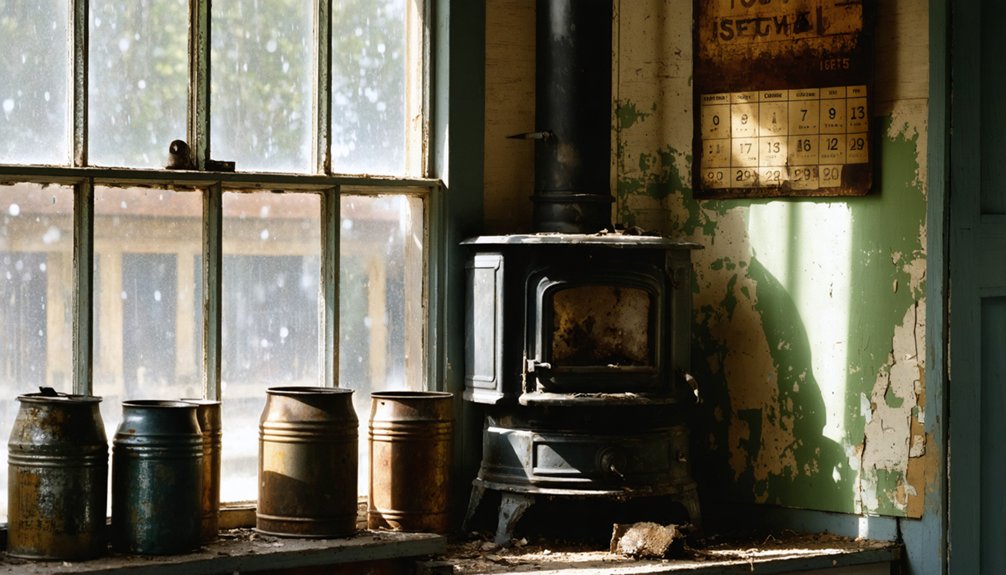
Washington’s forgotten communities tell stories that extend beyond the timber industry’s rise and fall.
You’ll find Govan’s unsettling history marked by brutal unsolved murders, including the infamous 1902 axe killings that still inspire eerie encounters among visitors exploring its minimal remains.
Liberty preserves Washington’s gold-mining heritage as a “living” ghost town, while Monte Cristo’s decaying structures rust amid mountain scenery, evidence of fleeting prosperity.
Both offer windows into forgotten legends of frontier ambition.
In Okanogan County, the remains of Molson, Ruby, Loomis, and Nighthawk form a constellation of abandoned settlements where mining dreams collapsed. Nighthawk once supported six concentration mills at its peak in 1903 before declining due to increasing operational costs.
Though Molson faced bulldozing in 2019, foundations still whisper stories of boom-and-bust cycles that defined Washington’s early economic development—narratives waiting for your discovery.
At Washaway Beach, the relentless coastal erosion has claimed over 1,000 feet of land since the late 1800s, swallowing entire communities in the process.
Oregon’s 250+ Ghost Towns: A Legacy of Frontier Life
Oregon’s landscape harbors an astonishing 250+ ghost towns—physical remnants of a complex frontier past that far exceeds Washington’s abandoned settlements in both quantity and diversity.
Historian Stephen Arndt’s research suggests the actual number could approach 1,600 former communities, reflecting Oregon’s dramatic boom-and-bust cycles.
These settlements declined through four distinct economic patterns:
- Mining exhaustion – Gold boomtowns like Sumpter collapsed when minerals depleted.
- Lumber depletion – Communities like Snooseville vanished as timber resources disappeared.
- Railroad redirection – Shaniko withered when new rail lines diverted commerce elsewhere.
- Agricultural shifts – Changing farming economics gradually emptied rural communities.
Towns like Bayocean demonstrate nature’s role in abandonment, with the last structure falling into the sea in 1971 due to coastal erosion.
Ghost town preservation now balances historical integrity with tourism’s economic impact, transforming these abandoned places into meaningful cultural assets while protecting their authentic frontier character.
Many of these abandoned towns were founded during the Gold Rush era, reflecting the independent spirit that characterized America’s westward expansion.
British Columbia’s Remarkably Preserved Historical Settlements
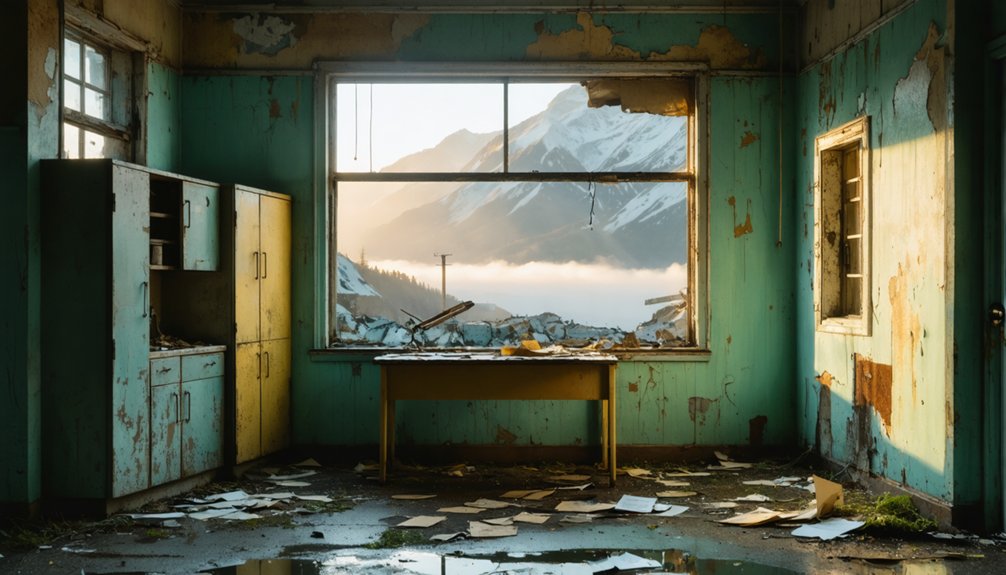
British Columbia’s ghost towns present a remarkably different preservation story than their American counterparts to the south. While examining sites like 3 Valley Gap Heritage Ghost Town, you’ll discover a reconstructed amalgamation of authentic structures relocated from various frontier settlements rather than preserved in-situ locations.
The Kootenay Rockies region showcases railway-influenced communities like Kuskonook and Waneta, where economic fluctuations tied to infrastructure projects created boom-and-bust cycles. The extensive effort included acquiring and relocating original structures from abandoned towns rather than creating replicas. Sandon’s silver mining legacy earned it the nickname “North America’s Monte Carlo” before inevitable decline.
Heritage preservation efforts vary considerably across these sites. While Barkerville maintains original structures, 3 Valley Gap curates relocated buildings of historical significance.
Northern BC’s ghost towns, particularly abandoned canneries and mining settlements, represent the final chapter of industrial operations that once defined British Columbia’s economic landscape. Several communities like Coal Creek once housed up to 1,000 residents before being abandoned due to resource depletion.
The Role of Railroads in Creating and Destroying Towns
You’ll find that railroad towns throughout the Pacific Northwest flourished only as long as the rails connecting them remained active and profitable.
When these crucial transportation arteries were severed—whether through technological obsolescence, route changes, or disaster damage—communities quickly withered as their economic lifelines disappeared.
The abandoned tracks stretching to nowhere now serve as poignant reminders of once-thriving settlements whose fortunes were inextricably linked to the railroad companies that both created and ultimately destroyed them.
Railroad Lifelines Severed
While the expansion of railway networks breathed life into countless communities across the Pacific Northwest during the late 19th and early 20th centuries, the subsequent abandonment of these steel lifelines often spelled doom for the towns they once sustained.
When your town lost its railroad connection, economic decline followed swiftly and mercilessly.
The patterns of railroad abandonment followed predictable stages:
- Freight service reduction as industries like timber exhausted local resources
- Passenger service termination when automobile travel gained popularity
- Track maintenance deterioration making routes unsafe or unusable
- Complete abandonment leaving communities isolated from crucial supply chains
You’ll find these ghost towns scattered across Washington, Oregon, and Montana—skeletal remains of once-vibrant communities whose fortunes were irrevocably tied to decisions made in distant railroad boardrooms.
Among these sunken ghost towns in America, you can almost hear the whispers of the lives that once thrived there, echoing through the empty streets and crumbling buildings. Each town tells a unique story of boom and bust, reminding us of the transient nature of prosperity and the inevitable passage of time. As nature reclaims these lost places, they serve as poignant reminders of a bygone era and the dreams that faded into history.
Tracks To Nowhere
As railroads carved their iron pathways through the untamed Pacific Northwest, they simultaneously created and destroyed the very communities that depended on them.
You’ll find this paradox embodied in places like Melmont, Washington, where the Northern Pacific’s Northwest Improvement Company built a town that vanished once coal demand declined.
These forgotten routes tell stories of boom and bust economics. Towns like Termo, California initially thrived as railway terminals, only to fade when lines extended elsewhere.
Railroad companies wielded tremendous power—they controlled where settlements emerged and ultimately, which would survive.
The nostalgia surrounding these ghost towns masks a harsher reality: when railroads realigned or highways bypassed rail-dependent communities, economic isolation followed.
What once represented progress became obsolete, leaving only abandoned tracks to nowhere.
Natural Disasters That Wiped Communities Off the Map
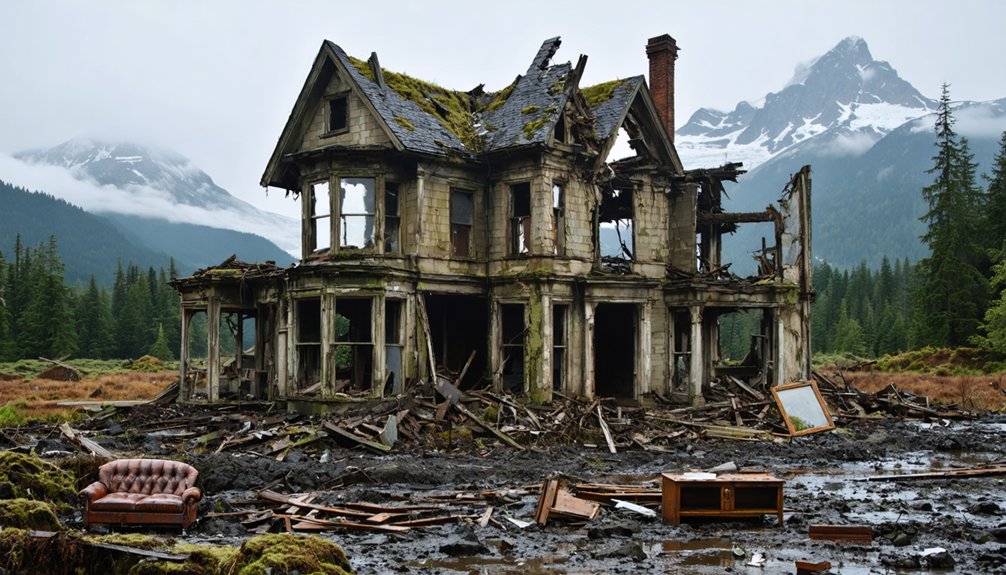
Throughout the Pacific Northwest, natural disasters have obliterated once-thriving communities, transforming bustling towns into mere footnotes in history.
You’ll find numerous examples of nature’s devastating power reshaping the region’s settlement patterns:
- Flooded communities like Moncton disappeared beneath Rattlesnake Lake in 1915 when dam construction submerged the original townsite.
- Volcanic devastation completely erased Todoque during the 2021 Cumbre Vieja eruption, destroying the parish church, health center, and hundreds of buildings.
- Mine disasters in Franklin killed over 30 miners in 1896, accelerating the town’s demise.
- Devastating fires consumed Govan’s business center in 1927 and destroyed nearly 100 buildings in Sumpter in 1917.
These catastrophes remind us how quickly civilization’s footprint can be erased by nature’s fury.
Walking Through Time: Best Ghost Towns to Visit Today
For those seeking to experience the haunting allure of abandoned settlements firsthand, the Pacific Northwest offers remarkable ghost towns where history stands frozen in time.
Monte Cristo awaits after a 4-mile hike, revealing mining equipment amid ghostly legends of prospectors who sought fortune in the 1890s. In Oregon, Shaniko preserves its wool-shipping past through intact civic buildings, while Sumpter’s gold rush architecture stands as a symbol of historical preservation efforts.
History whispers through these forgotten towns, where abandoned dreams linger among weathered structures and rusted remnants.
Washington’s Bodie features well-preserved log structures from its mining heyday, while Molson showcases pioneer buildings near the Canadian border.
For those craving freedom and exploration, these destinations combine outdoor adventure with historical immersion. Many sites are accessible via hiking trails through Mount Baker Snoqualmie National Forest, offering glimpses into communities abandoned when dreams of prosperity faded.
Preservation Challenges and Efforts to Save Vanishing History
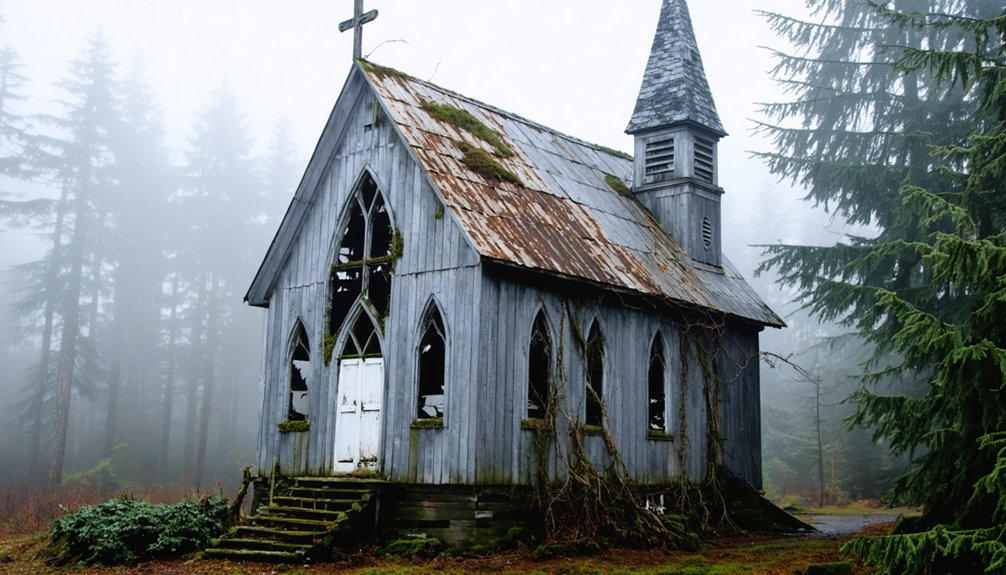
The crumbling facades and weathered structures of Pacific Northwest ghost towns face an existential battle against time, nature, and human interference. Your role in preservation extends beyond mere visitation—it requires active stewardship of these fragile historical resources.
Four critical preservation techniques currently employed include:
- Adaptive reuse converting abandoned structures into living museums
- Community involvement through volunteer monitoring programs and restoration projects
- Digital documentation creating virtual access while minimizing physical impact
- Strategic partnerships between government agencies and preservation associations
These efforts balance conservation with accessibility, allowing you to experience history without contributing to its demise.
Despite legal protections, the greatest threat remains human activity—from looting to vandalism. Remote locations and environmental contamination further complicate preservation efforts, making your responsible visitation practices essential to ensuring these historical treasures survive for future generations.
Frequently Asked Questions
Are There Documented Paranormal Activities in Pacific Northwest Ghost Towns?
Like whispers in abandoned halls, yes, you’ll find extensive documented paranormal activities. Paranormal investigations confirm ghostly encounters at Oregon Caves Chateau, Port Gamble, Monte Cristo, Fort Stevens, and Port Townsend.
How Do Local Native American Tribes View These Abandoned Settlements?
You’ll find many Native tribes view these sites with mixed emotions—as sacred places with cultural perspectives tied to displacement and as landscapes retaining historical significance despite colonial disruption of their traditional territories.
What Wildlife Has Reclaimed These Ghost Towns?
You’ll observe complex wildlife interactions as mammals, birds, reptiles, and invertebrates reclaim ghost towns. Deer browse abandoned structures while raptors nest in buildings, contributing to remarkable ecosystem restoration in these human-free zones.
Can I Legally Collect Artifacts From These Historic Sites?
No, you can’t legally collect artifacts without proper authorization. Legal regulations strictly prohibit collection on federal and state lands. Private land requires written permission from owners who hold artifact ownership rights.
How Have Ghost Towns Influenced Pacific Northwest Art and Literature?
Where one door closes, another opens. You’ll find ghostly inspiration permeates Pacific Northwest creative work, fueling artistic expression through photography, paintings, literature, and poetry that methodically documents decay, isolation, and transient human endeavors.
References
- https://en.wikipedia.org/wiki/List_of_ghost_towns_in_Washington
- https://secure2.pbase.com/mad_monte1/ghost_towns_of_the_pacific_northwest
- https://www.deviantart.com/austinsptd1996/journal/Six-Iconic-Ghost-Towns-Within-Oregon-1109696435
- http://pnwphotoblog.com/ghost-towns/
- https://stateofwatourism.com/ghost-towns-of-washington-state/
- https://www.wta.org/go-outside/seasonal-hikes/fall-destinations/hidden-history-ghost-town-hikes
- https://grassrootsbookstore.com/lists/XByJlZqPrWU
- https://www.nationaldaycalendar.com/lists/12-oregon-ghost-towns
- https://siris-libraries.si.edu/ipac20/ipac.jsp?profile=liball&uri=link=3100009~!2578817~!3100001~!3100002&aspect=subtab103&menu=search&ri=2073&term=Ghost+towns+–+Northwest,+Pacific+–+Guidebooks.&index=PSUBJ
- https://www.historylink.org/File/5158