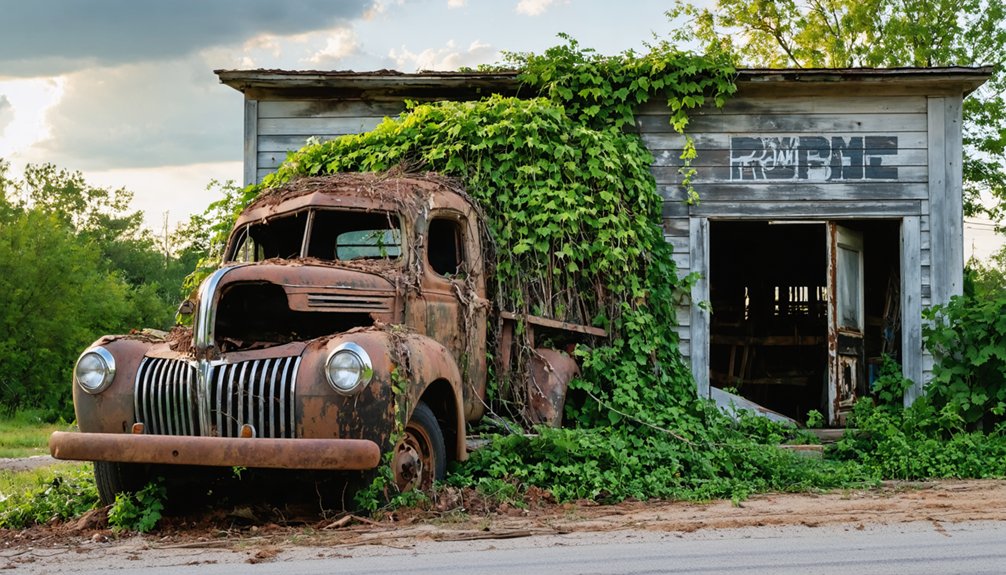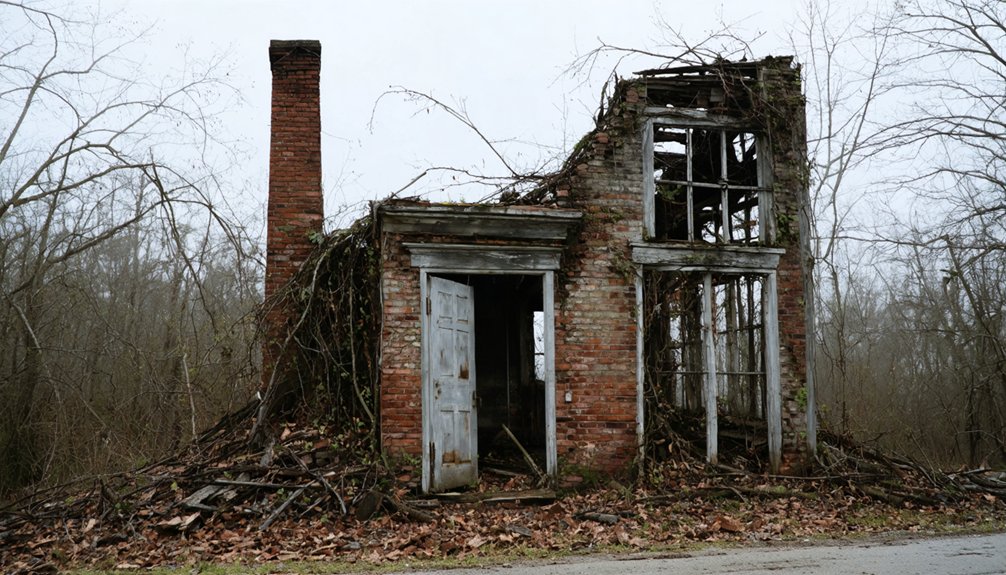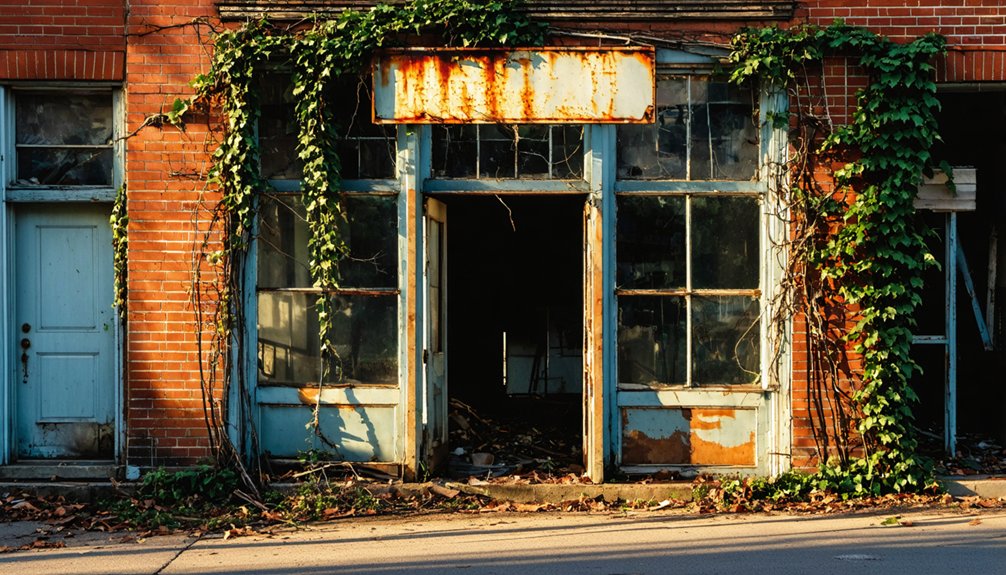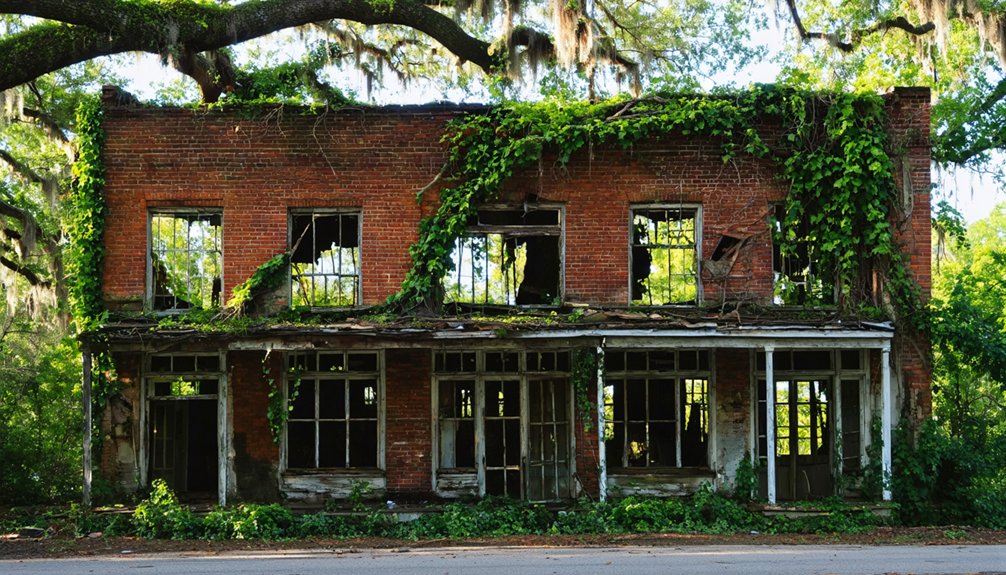
Alabama’s ghost towns are disappearing beneath subtropical wilderness as nature reclaims former state capitals and cotton ports. You’ll find Old Cahawba’s grid streets vanishing into vegetation, while Blakeley’s fortifications have become nature-covered hills in the Mobile-Tensaw Delta. Claiborne, once hosting 6,000 residents, has vanished entirely except for a roadside marker. Yellow fever epidemics that devastated these river settlements created ideal conditions for archaeological preservation, even as vines and Spanish moss now obscure brick foundations and pioneer-era structures that reveal how environmental forces reshaped Alabama’s geography.
Key Takeaways
- Spectre’s Styrofoam film set has weathered two decades with Spanish moss and vines overtaking Tim Burton’s abandoned structures.
- Historic Blakeley’s Civil War fort now appears as a nature-covered hill, concealing its strategic military past beneath vegetation.
- Seale displays atmospheric ruins with remnants like drugstore tiles and hardware shelving visible among the natural overgrowth.
- Fort Mims’ National Register site is obscured by encroaching wilderness, challenging preservation efforts at the 1813 massacre location.
- Old Cahawba Archaeological Park preserves nature-reclaimed evidence of Alabama’s first capital amid riverside ruins and flooding history.
Blakeley: Where the Delta Swallowed a Shipbuilding Rival
When Josiah Blakeley purchased 7,000 acres along the Mobile-Tensaw Delta in 1813, he envisioned a port city that would eclipse Mobile itself.
You’ll find evidence of this ambition in surveyor James Magoffin’s town plots from May 1813, where lots commanded $1,000 within weeks. The Blakeley history reveals rapid success—by the 1820s, its 4,000 residents outnumbered Mobile’s 2,800, establishing Baldwin County’s seat with courthouse, jail, and newspaper.
Delta rivalries intensified until yellow fever struck in 1822, followed by devastating epidemics in 1826 and 1828.
Mass graves in the cemetery document nature’s brutal verdict. While Mobile improved its harbor, Blakeley’s population collapsed to 100 by the Civil War. The county seat eventually moved to Daphne following the war’s conclusion, completing the town’s abandonment.
Today, Historic Blakeley State Park‘s 3,800 acres preserve foundation remnants where delta mosquitoes claimed what human ambition built. The site contains Confederate and Union fortifications from the Battle of Fort Blakeley fought in April 1865.
Old St. Stephens: The Birthplace of Alabama Returns to Earth
You’ll find Old St. Stephens perched on a Tombigbee River bluff where strategic geography once dictated Alabama’s political center—the navigable terminus from Mobile Bay that drew Spanish fortification in 1789 and territorial capital status by 1817.
The site’s archaeological record reveals how rapidly prosperity abandoned this location: from several thousand residents and 500 homes in 1819 to virtual ruins within three decades, leaving only undisturbed strata documenting pioneer commerce, legislative activity, and epidemic devastation. Early 1800s observers, including Ephraim Kirby in correspondence to Thomas Jefferson, characterized the settlement’s inhabitants as illiterate and wild, cementing a reputation that accelerated the town’s decline.
Today’s Historical Park preserves these 200-year-old remains through systematic excavation and interpretive reconstruction, offering direct material evidence of how environmental limitations and infrastructure shifts erased Alabama’s founding settlement from the landscape. The first territorial assembly convened in the Douglass Hotel during January 1818, conducting legislative business without benefit of a permanent capitol building.
Strategic River Settlement Site
Perched atop a limestone bluff overlooking the Tombigbee River, Old St. Stephens commanded the frontier 67 miles north of Mobile.
You’ll find this wasn’t accidental—Spanish forces recognized its defensive advantages before ceding the territory to Americans in 1799.
The site’s historical significance emerged from its natural fortifications and direct river access, enabling control over inland commerce routes.
When the U.S. established a factory here in 1803, river trade with Choctaw, Cherokee, and Creek nations flourished under factor George Strother Gaines.
The limestone elevation provided protection while the Tombigbee offered economic lifelines—a combination that attracted French, Spanish, English, and American settlers seeking opportunity beyond governmental constraints.
This geographic advantage transformed a simple blockhouse into Alabama’s territorial birthplace.
From 1817 to 1819, the settlement served as Alabama’s territorial capital before the government relocated to Cahaba, initiating the town’s gradual decline into abandonment.
In January 1818, the territorial legislature met at St. Stephens to select Alabama’s first congressional representative and establish new counties.
Archaeological Preservation and Remains
Unlike most Alabama settlement sites that suffered continuous redevelopment and disturbance, Old St. Stephens’ complete abandonment created ideal conditions for archaeological significance.
You’ll find artifacts that remained virtually untouched for over a century, preserved within limestone bluff formations that protected military buttons, animal bones, and structural remains from decay.
The site’s 70-acre expanse represents one of Alabama’s greatest archaeological assets precisely because nobody rebuilt over it—no modern foundations destroying evidence, no parking lots obliterating pioneer footprints.
This absence of interference enables artifact conservation at levels rarely achieved elsewhere. You can participate in active digs that continue revealing glimpses into early 1800s frontier life, uncovering material culture that speaks to self-sufficient settlement patterns before governmental centralization reshaped Alabama’s territorial landscape. Regular public digs make the site accessible to visitors interested in experiencing archaeological exploration firsthand. The site’s director has maintained continuity in preservation efforts, ensuring consistent stewardship of this historically significant location.
Old Cahawba: Alabama’s First Capital Fades Into the Grid
Alabama’s political ambitions converged at the confluence of the Alabama and Cahaba rivers in Dallas County, where territorial commissioners selected the site for the state’s first capital on February 13, 1818.
You’ll find Old Cahawba embodied the young state’s aspirations through its Philadelphia-inspired grid pattern and two-story brick statehouse.
When capital relocation to Tuscaloosa occurred in 1826, most residents abandoned the town within weeks, though it later rebounded as a cotton distribution center with over 3,000 inhabitants.
Civil War devastation and catastrophic floods ultimately reduced Cahawba to ruins by 1900.
The town’s low-lying location made it vulnerable to seasonal flooding and diseases like malaria, yellow fever, and cholera, which plagued residents due to miasma from wetlands.
During the Civil War, Castle Morgan served as a prison facility for captured Union soldiers.
The archaeological significance extends beyond its political legacy—Mississippian village remains reveal centuries of human occupation.
Today’s Old Cahawba Archaeological Park preserves scattered evidence of Alabama’s vanished first capital.
Claiborne: South Alabama’s Largest Ghost Town Vanishes Completely
General Ferdinand Leigh Claiborne established Fort Claiborne on a strategic bluff above the Alabama River in 1813, creating what would become the largest ghost town in southern Alabama’s history.
Claiborne history reveals a dramatic arc from frontier protection to thriving port city, where 5,000-6,000 residents shipped cotton via steamboat by 1820. This prosperous community produced three governors and hosted Lafayette in 1825.
Yet disease epidemics, Union occupation, railroad bypasses, and the county seat’s 1832 relocation triggered complete abandonment. By 1872, only 350 souls remained.
Today’s ghost town significance lies in its total disappearance—no residents survive where Alabama’s largest antebellum city once stood. You’ll find only the Dellet House, overgrown cemeteries, and historical markers commemorating this vanished metropolis.
Spectre: A Hollywood Set Becomes a Real Ghost Town
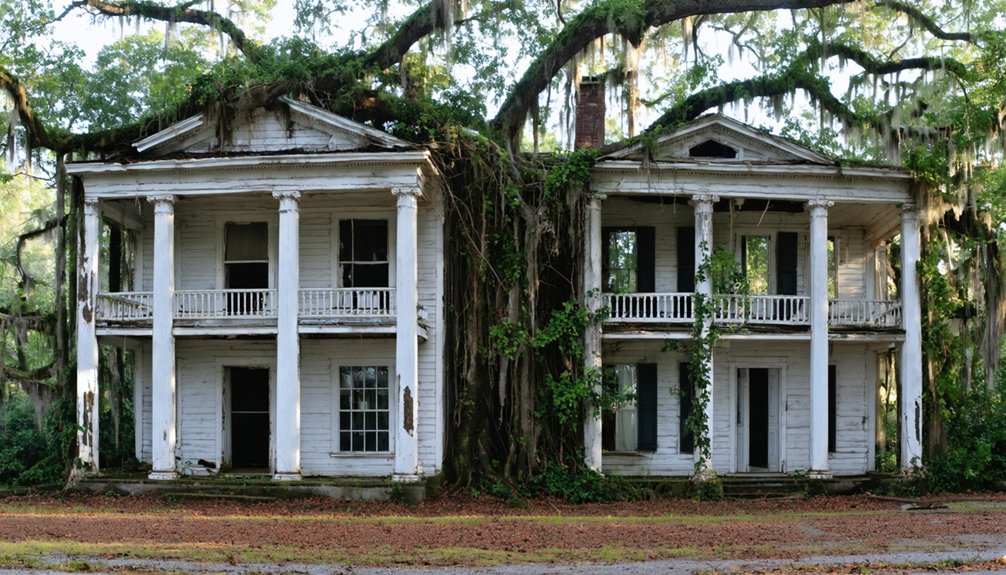
You’ll find Spectre’s origins uniquely documented in film production records from 2003, when Tim Burton’s crew transformed Jackson Lake Island into a fictional Alabama town that would outlast its cinematic purpose.
The set’s survival past filming—a deliberate decision by the Bright family landowners—created an accidental experiment in architectural decay, as styrofoam structures designed for weeks of use have weathered two decades of storms, fires, and floods.
What remains now isn’t just deteriorating movie props but a documented case study in how quickly nature reclaims human construction when buildings lack structural integrity and maintenance.
Big Fish Movie Origins
When Tim Burton needed a fantastical Southern town for his 2003 adaptation of Daniel Wallace’s novel *Big Fish*, he discovered Gun Island Chute along the Alabama River—a remote, shaded island north of Montgomery that would become the fictional town of Spectre.
The Spectre set rose from temporary materials on Jackson Lake Island in Millbrook, capturing the magical realism central to Edward Bloom’s tales of a barefoot town hidden from the world.
Burton shot the entire production near Alabama’s capital, using the island for pivotal sequences including the bridge crossing and Will’s visit to Jenny’s house.
The film earned nominations across Academy Awards, Golden Globes, and BAFTAs, cementing Spectre’s place in cinematic history while exploring father-son relationships through fantastical storytelling.
Nature’s Takeover of Sets
After principal photography wrapped in 2003, the property owners made an unusual request: leave Spectre standing.
What you’ll find today is nature’s reclamation in its purest form—Spanish moss draping crumbling facades, vines snaking through window frames, trees pushing through roofs.
The film set decay accelerated because Burton’s crew intentionally distressed the structures during final shoots, leaving them weathered before abandonment even began.
Storms collapsed roofs. Fire consumed storefronts. Floods claimed Jenny’s riverside house.
Yet two styrofoam trees from the Enchanted Forest remain standing after seventeen years, defying expectations.
Goats now inhabit the leaning chapel, peering out like spectral congregants.
You’re witnessing Hollywood artifice surrendering to Alabama wilderness—a manufactured myth becoming genuine ruin.
Fort Mims: A Historic Battlefield Buried Beneath Overgrowth
Beneath the tangled vegetation of Baldwin County lies one of Alabama’s most haunting historical sites—a place where the deadliest attack on American soil during the Creek War unfolded in brutal finality.
On August 30, 1813, 700 Red Stick warriors overwhelmed Fort Mims‘s 400 defenders, killing up to 550 people within five hours.
Today, you’ll find the original fort location buried beneath overgrowth, virtually invisible despite its National Register designation. While reconstructed walls and structures mark the site, nature’s reclamation obscures what battlefield archaeology could reveal about this pivotal moment.
The massacre sparked Andrew Jackson‘s brutal campaign, ultimately forcing Creeks to surrender 21 million acres.
Historic preservation efforts struggle against encroaching wilderness, leaving this somber memorial as testimony to freedom’s violent contests on America’s frontier.
The Role of Yellow Fever in Abandoning Alabama’s River Towns
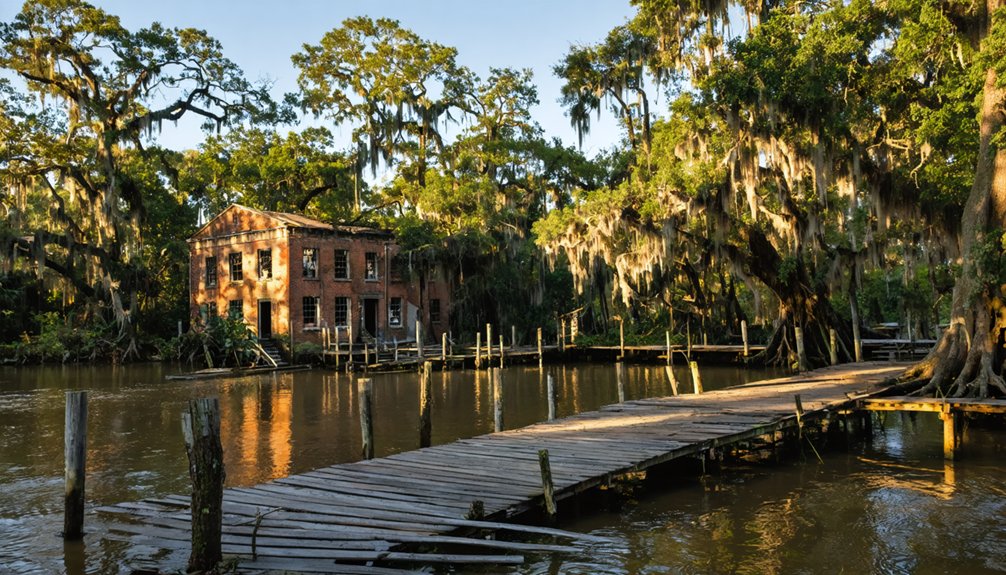
Along Alabama’s river corridors, yellow fever transformed prosperous trading towns into ghost settlements with a swiftness that fire or flood couldn’t match.
You’ll find Blakeley’s story particularly striking—this river port fell below 2,000 residents and simply ceased to exist after repeated epidemics drove survivors away permanently.
The yellow fever impact devastated Mobile in 1853, killing 1,191 of 25,000 residents while 8,000 fled upriver, inadvertently spreading disease to Cahawba, Demopolis, and Fulton.
Steamboats and railroads that once brought prosperity now carried infected refugees and mosquitoes along waterways.
By 1905, when the final cases appeared, river town abandonment had already reshaped Alabama’s geography.
These settlements couldn’t recover what epidemics stole—their populations, their commerce, their future.
Visiting Alabama’s Ghost Towns: What Remains to Explore
The epidemics that emptied these settlements left behind scattered physical evidence that rewards determined visitors today.
At Cahawba, you’ll find converted slave quarters serving as interpretive center, surrounded by archaeological remnants across the park.
Slave quarters transformed into museum space, where archaeology meets uncomfortable history amid Alabama’s abandoned capital.
Blakeley’s fort has become a nature-shrouded hill—underwhelming yet offering ghostly echoes of strategic importance.
Claiborne exists only as a roadside marker; its buildings were relocated to Perdue Hill decades ago.
Seale presents atmospheric ruins: drugstore tile work, hardware store shelving, and cornmeal advertisements from the 1850s, all succumbing to nature’s reclamation.
Prairie Bluff offers an 1860s cemetery gated within modern subdivision—so obscure that local attendants don’t acknowledge its existence.
Each site demands your navigation skills and historical imagination to reconstruct vanished communities from fragmentary remains.
Frequently Asked Questions
Are There Any Guided Tours Available for Alabama’s Ghost Towns?
You’ll find guided tours at ghost towns like Old Cahawba, offering walking and wagon experiences. Orrville’s nighttime shuttle provides rare haunted access. These tours preserve historical narratives while letting you explore Alabama’s reclaimed landscapes independently.
What Safety Precautions Should Visitors Take When Exploring These Abandoned Sites?
You’ll need rigorous exploration safety protocols: obtain property permissions, test structural integrity before entering, watch for wildlife awareness in overgrown areas, and bring emergency contacts. Historical evidence shows contamination and collapses pose genuine risks requiring preparation.
Can You Camp Overnight at Any of Alabama’s Ghost Towns?
You can’t legally camp overnight at Alabama’s ghost towns without landowner permission, as camping regulations prohibit unauthorized use of private property despite their historical significance. Public land ghost towns require following dispersed camping rules and distance restrictions.
Are There Admission Fees to Visit These Ghost Town Locations?
Yes, you’ll encounter varied admission policies across Alabama’s ghost town sites. Ghost town access ranges from $2 at Old Cahawba to $3 at Spectre Island, while some locations remain free, preserving your autonomy to explore.
What Is the Best Time of Year to Visit Alabama’s Ghost Towns?
Fall offers you the best visiting conditions, with cooler temperatures for hiking ruins, reduced crowds enabling unrestricted exploration, vibrant fall foliage enhancing photography, and seasonal events like reenactments providing historical context without summer’s oppressive heat.
References
- https://www.travelawaits.com/2814768/best-historic-ghost-tours-alabama/
- https://deepsouthurbex.com/2020/01/02/6-south-alabama-ghost-towns/
- https://ahc.alabama.gov/properties/cahawba/cahawba.aspx
- https://www.youtube.com/watch?v=9Yl24smCFAI
- https://www.loveproperty.com/gallerylist/129046/explore-alabamas-most-incredible-abandoned-buildings
- https://www.ezhomesearch.com/blog/11-ghost-towns-in-alabama-that-bridge-the-distance-between-yesterday-and-today/
- https://en.wikipedia.org/wiki/List_of_ghost_towns_in_Alabama
- https://midwestwanderer.com/article/historic-blakeley-state-park-ghost-town-and-battlefield/
- https://kids.kiddle.co/Blakeley
- https://www.exploresouthernhistory.com/blakeley2.html