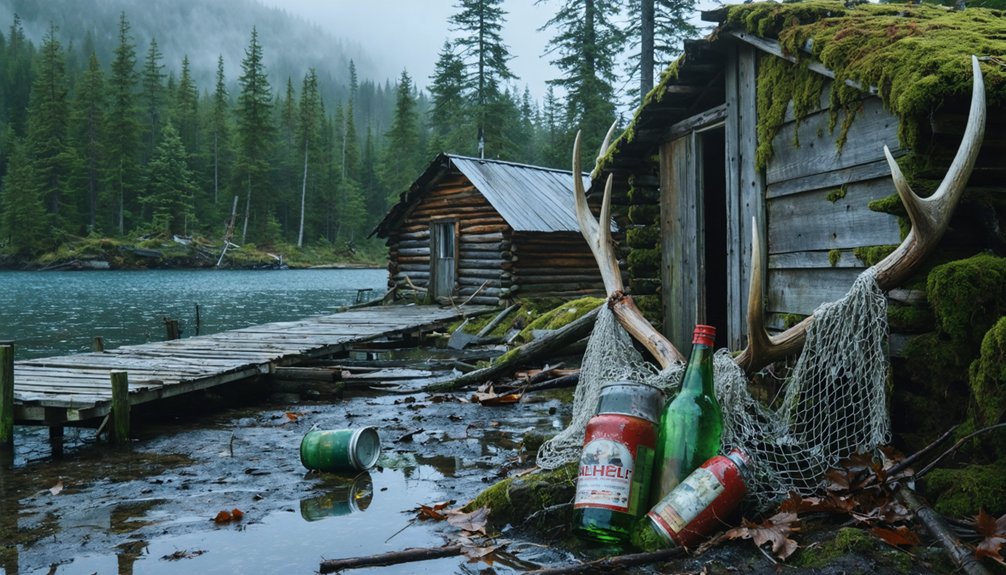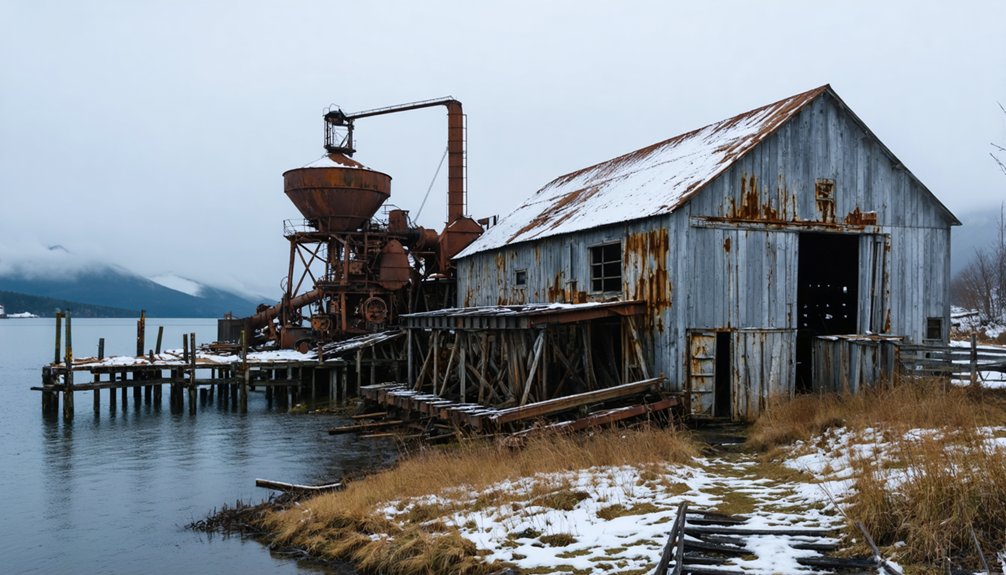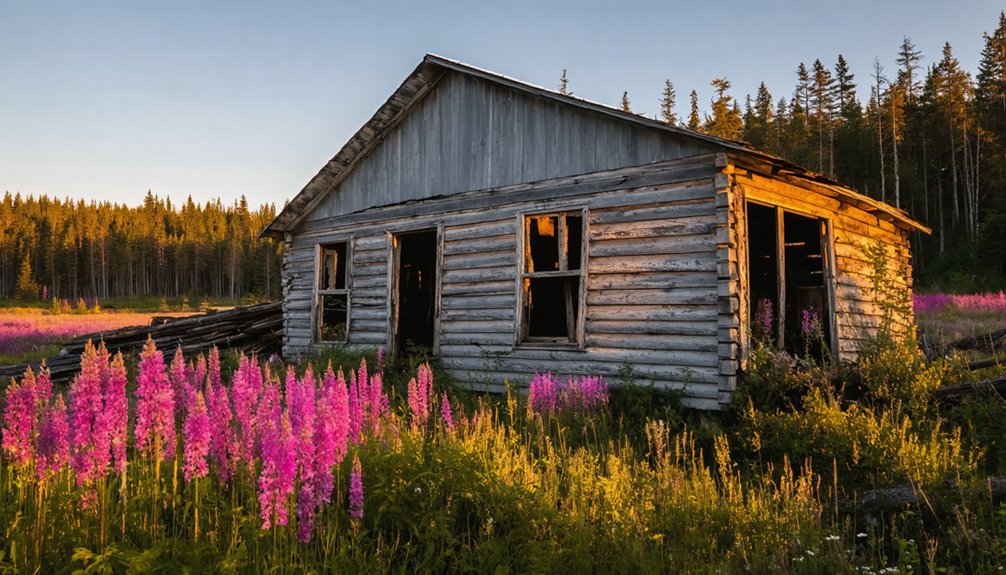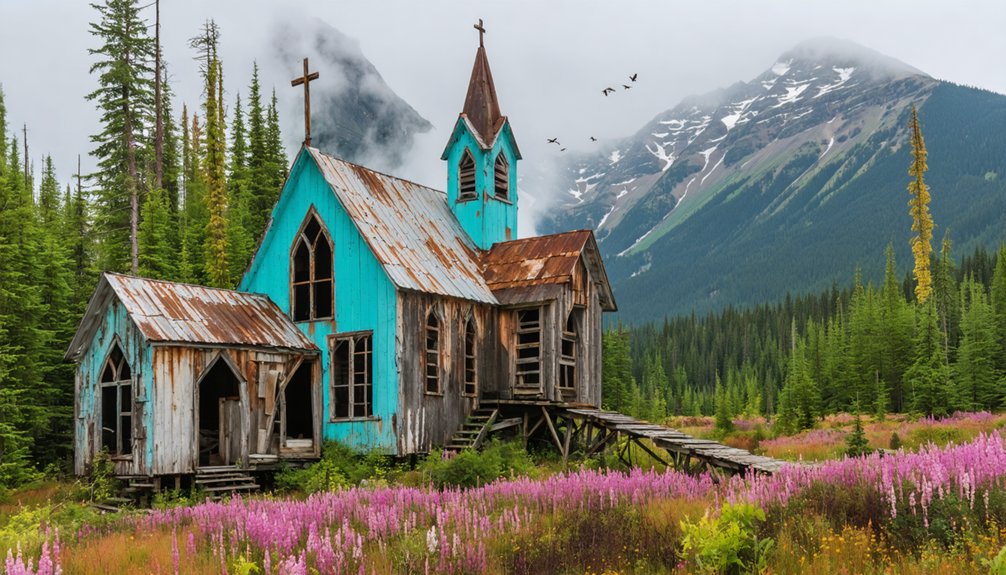
Alaska’s ghost towns showcase nature’s reclamation in measurable stages. You’ll find willow shoots piercing boardwalks within months of abandonment, while permafrost thaw destabilizes entire structures within decades. Over 100 abandoned communities document this ecological succession, from Kennicott’s preserved mill buildings to Dyea’s forest-overtaken streets. Thawing permafrost transforms tundra into unstable substrates, accelerating infrastructure collapse across 85% of Alaska’s landmass. The following sections explore specific forces—from magnitude 9.2 earthquakes to school closures—that transformed thriving settlements into ecological case studies.
Key Takeaways
- Alaska has over 100 abandoned communities experiencing nature’s reclamation, with patterns documented across diverse climatic zones.
- Thawing permafrost destabilizes infrastructure and converts tundra to quicksand-like substrates, accelerating ecological succession in abandoned settlements.
- Kennicott, Treadwell, Dyea, and McCarthy offer accessible examples of forest succession overtaking former mining and frontier communities.
- Natural disasters like the 1964 earthquake and 1912 Mount Katmai eruption forced complete abandonments, enabling rapid ecological reclamation.
- Climate-driven permafrost changes impact 85% of Alaska’s landmass, with 144 communities facing similar natural reclamation trajectories.
How Natural Disasters Transformed Thriving Settlements Into Abandoned Ruins
While Alaska’s stunning landscapes attract adventurers and settlers alike, the same geological forces that shaped this dramatic terrain have repeatedly erased human communities from the map.
The 1964 magnitude 9.2 earthquake exemplifies how disaster impacts transformed thriving settlements—Portage sunk 6-10 feet, forcing complete settlement abandonment when residents found rebuilding impossible.
When the ground beneath Portage dropped up to 10 feet in 1964, an entire community vanished—rebuilt elsewhere, never to return.
You’ll find similar patterns across Alaska’s ghost towns: the 1912 Mount Katmai eruption buried Afognak under three feet of ash, while the 1788 tsunami obliterated Three Saints Bay’s Russian settlement.
Even smaller-scale events proved catastrophic—the 1898 Palm Sunday Avalanche killed over 70 people, accelerating Dyea’s decline as travelers sought safer routes.
The earthquake also devastated Seward, where the Jesse Lee Home sustained significant structural damage, prompting its eventual relocation to Anchorage.
These disasters demonstrate nature’s ultimate authority over human habitation in seismically active regions.
Dyea once boomed with a population of 8,000 during the Klondike Gold Rush before tragedy struck on April 3, 1898.
The Rise and Fall of Alaska’s Mining Boom Towns
When prospectors extracted gold from placers southeast of Juneau in 1870, they initiated a resource extraction cycle that would reshape Alaska’s human geography for the next seven decades.
The mining dynamics followed predictable patterns: strikes triggered rapid population influxes, then inevitable declines. Nome’s Cape Nome district yielded over 5 million ounces, while Fairbanks produced 8 million troy ounces from placers alone.
You’ll find that economic fluctuations determined settlement survival—Sunrise peaked at 2,000 residents in 1898, briefly becoming Alaska’s largest city, before miners relocated to more promising strikes. The 1896 gold rush to Turnagain Arm represented the first major settlement rush in the Cook Inlet region, drawing prospectors who would soon abandon their claims for richer deposits elsewhere. The Porcupine district near Haines saw gold discovery in 1898, with miners extracting over 81,000 troy ounces from creeks including Glacier, Nugget, and Cottonwood through intermittent operations.
When Schools Close, Communities Disappear
The cyclical abandonment that characterized Alaska’s mining settlements now manifests through different mechanisms—educational infrastructure collapse rather than resource depletion.
You’re witnessing 32 school closures statewide over 25 years, with Fairbanks North Star Borough shouldering two-thirds of Alaska’s 3,600-student enrollment loss. Anchorage hemorrhaged 7,487 students since 2010—a 15% decline driving systematic facility elimination.
These school closures accelerate community decline through measurable pathways: deteriorating tax bases, professional workforce exodus, and reduced municipal services. Districts frame this as “right-sizing,” but you’re observing ecological succession in human settlements.
When Seward Middle or Paul Banks Elementary close, they’re removing the organizational nuclei around which communities coalesce. The state owns nearly half of 128 rural schools, yet over 135 rural school projects have awaited funding for five years or more—infrastructure neglect that predetermines community viability.
Rural Alaska faces compounded impacts—135 projects languishing unfunded since 1998, facilities contaminated with mold and sewage, creating uninhabitable conditions that guarantee population dispersal. Meanwhile, 10,000 students have migrated from neighborhood schools to correspondence programs, fundamentally altering Alaska’s educational landscape and community cohesion.
Nature’s Silent Takeover of Abandoned Alaskan Villages
As permafrost thaws beneath Alaska’s most vulnerable settlements, you’re observing accelerated ecological succession that transforms inhabited spaces into uninhabitable terrain within decades rather than centuries.
Over 100 abandoned Alaska communities now document nature reclamation patterns, where thawing ground destabilizes abandoned infrastructure—airstrips buckle, building foundations collapse, and pipeline networks rupture.
Tundra converts solid surfaces into quicksand-like substrates, consuming structures at rates matching coastal erosion’s 45 feet annually.
You’ll find methane-releasing permafrost accelerating vegetation shifts across 85 percent of Alaska’s landmass.
This ecological takeover doesn’t wait for human decisions—villages like Newtok watch ancestral lands vanish as climate-driven forces erase cultural footprints.
Shakhtulik ranks highest for combined hazards of erosion, flooding, and thawing permafrost among affected communities.
The data reveals 144 communities facing similar trajectories, where natural processes reclaim what warming renders untenable.
Rising waters force villages like Napakiak to measure land loss regularly, documenting approximately one foot disappearing in just 10 days during severe erosion events.
Ghost Towns You Can Visit Today in Alaska
Five accessible ghost towns across Alaska offer visitors direct encounters with abandonment ecology, where measurable rates of structural decay intersect with documented patterns of ecosystem recovery.
Documented Ghost Town Landscapes for Historical Tourism:
- Kennicott – National Historic Landmark featuring preserved 14-story mill buildings; accessible via 60-mile McCarthy Road with guided structural tours documenting copper mining operations from 1903-1938. The site became a technological leader following railroad completion in 1911.
- Treadwell – Mine complex near Douglas accessible via 2-mile loop trail; abandoned 1922 following catastrophic flooding events. During its peak, the site featured Alaska’s first indoor swimming pool, demonstrating the prosperity and modern amenities that characterized this mineral extraction hub.
- Dyea – Former Klondike staging area near Skagway where forest succession has overtaken urban infrastructure at quantifiable rates.
- McCarthy – Wild West settlement within Wrangell-St. Elias National Park; tools remain from 1938 overnight abandonment.
You’ll witness unregulated ecological succession patterns across these sites, documenting nature’s systematic reclamation of human infrastructure.
Frequently Asked Questions
Are There Any Safety Concerns When Visiting Alaska’s Abandoned Ghost Towns?
Like explorers traversing unmarked wilderness, you’ll face significant risks from structural collapse, contaminated mining sites, and absent emergency services. Environmental hazards and remote locations demand strict safety precautions before you venture into these decaying settlements.
What Wildlife Commonly Inhabits These Abandoned Settlements Today?
You’ll encounter diverse wildlife species including moose, black bears, eagles, sea otters, and puffins across these sites. The ecological impact shows nature’s resilience, as abandoned structures now shelter foxes, rodents, seabirds, and marine mammals thriving independently.
Can Artifacts Be Legally Collected From Alaska’s Ghost Towns?
No, you can’t legally collect artifacts from Alaska’s ghost towns without permits. Legal regulations protect archaeological sites on federal and state lands, while artifact ownership laws require proper authorization before any collection or excavation occurs.
How Do Indigenous Communities View the Abandonment of Traditional Villages?
You’ll find indigenous communities view village abandonment as profound cultural loss, threatening identity and traditional practices. They’re increasingly pursuing village revitalization initiatives that preserve cultural significance while addressing climate-driven displacement through community-led relocation planning.
What Preservation Efforts Exist for Alaska’s Historic Ghost Towns?
You’ll find restoration projects actively stabilizing structures like Kennecott’s mining buildings and Coal Creek’s gold dredge, preserving their historical significance through foundation repairs, hazardous material removal, and National Register designations that protect Alaska’s cultural heritage.
References
- https://everafterinthewoods.com/forgotten-ghost-towns-in-alaska-that-are-as-isolated-as-they-are-stunning/
- https://thealaskafrontier.com/ghost-towns-in-alaska/
- https://www.youtube.com/watch?v=TC_KPrhDByY
- https://www.gi.alaska.edu/alaska-science-forum/ghost-towns-scattered-across-alaska-map
- https://live.laborstats.alaska.gov/sites/default/files/trends/may24art2_0.pdf
- https://www.blm.gov/sites/default/files/uploads/AML_PUB_DecadeProgress.pdf
- https://www.mentalfloss.com/article/606626/abandoned-islands
- https://storymaps.arcgis.com/stories/8a5cd1545a0c439f81ab8b36a6f2f273
- https://www.thealaskalife.com/blogs/news/alaska-ghost-towns-youve-probably-never-heard-of
- https://www.uaf.edu/news/one-big-earthquake-two-alaska-ghost-towns.php