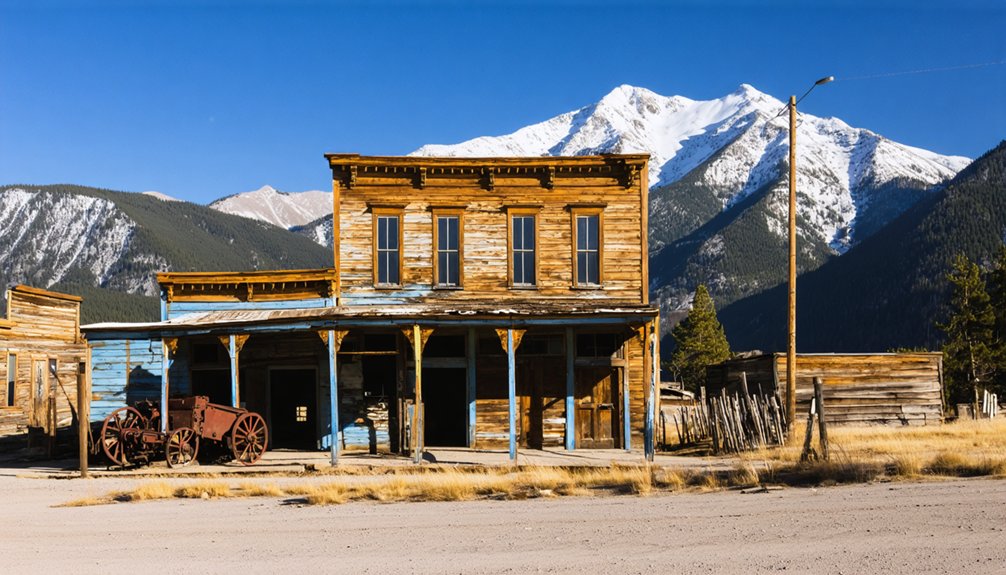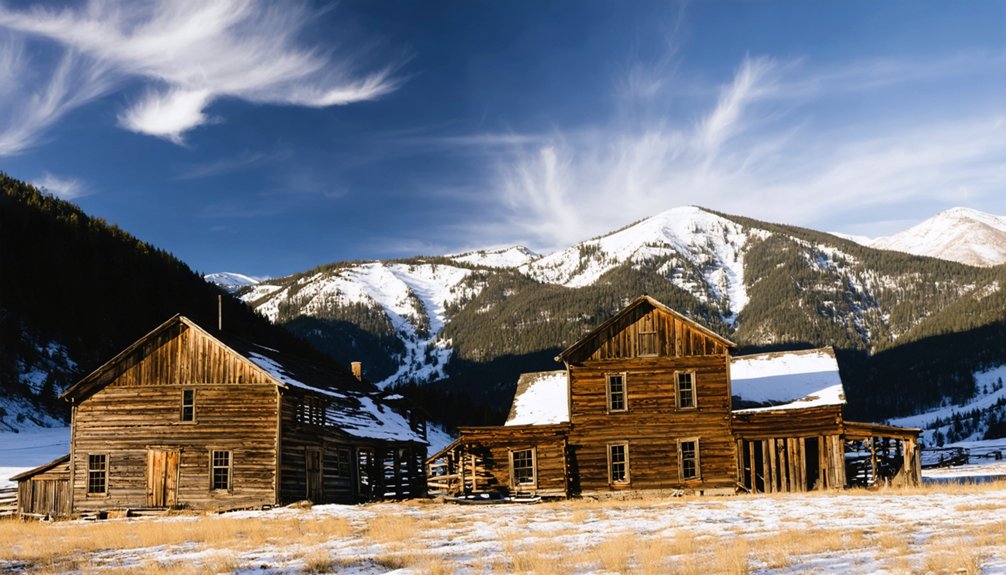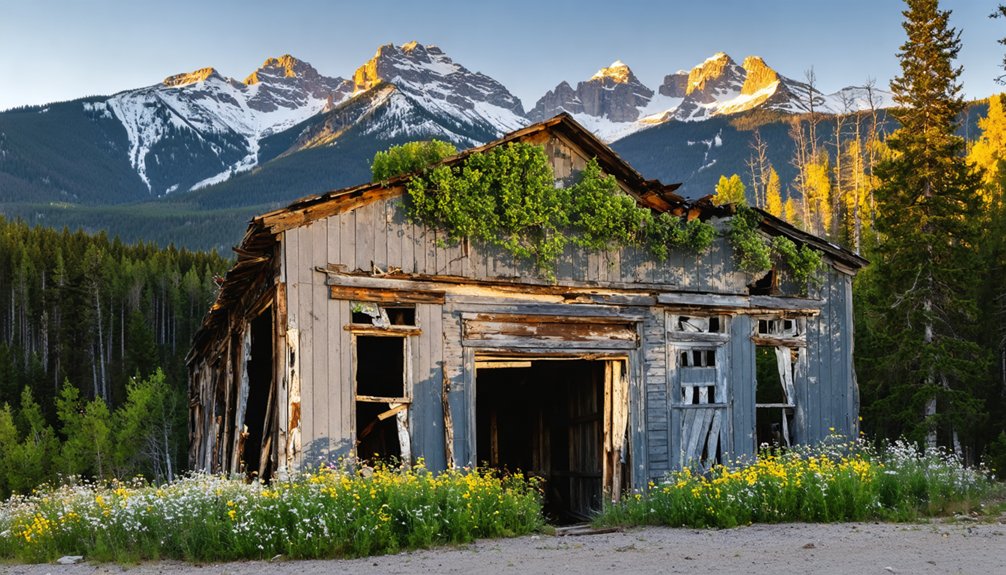
Colorado’s 1,500+ ghost towns showcase nature’s varying reclamation speeds—while St. Elmo’s 1880s buildings remarkably endure at high altitude, Teller City disappeared so completely after 1902 that you’d never know 1,500 residents once occupied North Park’s wilderness. You’re witnessing a dual legacy: weathered saloons and Masonic lodges that defy mountain elements, alongside 23,000 abandoned mines poisoning 1,800 stream miles with acid drainage, creating environmental challenges that affect 40 million people downstream and demand billion-dollar restoration efforts spanning decades.
Key Takeaways
- Teller City, abandoned by 1902 after an 1884 silver crash, exemplifies rapid wilderness reclamation erasing human infrastructure in North Park.
- Over 1,500 ghost towns exist across Colorado, with nature accelerating reclamation after mining booms ended in the late 1800s.
- St. Elmo declined after mining ceased in 1925, though some structures remain unlike completely reclaimed towns like Teller City.
- Nevadaville’s weathered buildings stand amidst collapsing mine shafts and sinkholes at over 9,000 feet elevation above Central City.
- Abandoned mines create environmental contamination affecting 1,800 stream miles, complicating preservation efforts as nature reclaims mining communities.
St. Elmo: A Frozen Snapshot of Colorado’s Mining Past
In Chalk Creek Canyon‘s high alpine terrain, the settlement that would become St. Elmo emerged when prospectors discovered silver in 1875.
You’ll find this ghost town represents authentic mining heritage—originally Forest City, it transformed into a thriving community of nearly 2,000 residents by the 1880s.
The St. Elmo history reveals remarkable prosperity: five hotels, multiple saloons, newspapers, and the Mary Murphy Mine shipping 70-100 tons of ore daily.
The Denver, South Park and Pacific Railroad arrived in 1881, making St. Elmo a primary supply source for nearby settlers.
However, nature’s reclamation began after an 1890 fire devastated the business district.
When the Alpine Tunnel closed in 1910 and mining ceased by 1925, residents abandoned their mountain stronghold.
Despite its decline, St. Elmo attracts an estimated 50,000 visitors each summer who explore its preserved buildings and mining history.
Today, you can explore this preserved landscape where human ambition met alpine reality, its original structures standing as proof of both enterprise and inevitable surrender.
Nevadaville: Where History Still Gathers Monthly
You’ll find Nevadaville perched above 9,000 feet along a precarious gravel road, where original 1870s structures document how mining communities adapted their built environment to steep mountain terrain.
The Masonic Lodge, constructed in 1879, remains Colorado’s only ghost town lodge conducting monthly meetings—a rare continuity of institutional practice spanning 145 years in a settlement otherwise abandoned to nature’s encroachment.
These weathered buildings stand amid collapsing mine shafts and sinkholes, physical evidence of how underground extraction networks eventually destabilize the surface landscapes that once sustained 4,000 residents. Predominantly Irish miners extracted gold from the Burroughs and Kansas Lodes, operating approximately 30 mills by 1860 before near-surface veins depleted. The town’s trajectory mirrors that of over 1,500 ghost towns scattered across Colorado, each marking locations where mining fortunes rose and fell with equal intensity.
Many of these once-thriving communities now serve as poignant reminders of the past, each telling its own story of ambition and decline. Exploring the ghost towns of Colorado history reveals the dreams and struggles of those who sought fortune in the rugged mountains. With time, nature has reclaimed these sites, transforming the remnants of human endeavor into hauntingly beautiful landscapes.
Original Buildings Still Stand
Perched at 9,050 feet in the Colorado Rockies, Nevadaville’s collection of 1860s structures tells an uncommon story of architectural endurance against high-altitude decay.
You’ll find the Kramer Saloon history preserved in weathered wood facing Main Street, while the Bon-Ton Saloon stands alongside it—testaments to mining-era commerce.
The Masonic Lodge architecture showcases exceptional preservation, its detailed craftsmanship surviving 160 Colorado winters.
Built in 1879, the lodge defies ghost town conventions by hosting regular meetings among its members to this day.
City Hall’s dual function as fire department remains evident, with jail cells hidden in its basement.
Residential survivors include the Gest House and Henry Richards House, their frameworks resisting nature’s reclamation.
The Bald Mountain Trading Post anchors commercial memory.
East of downtown, Dogtown’s single stone structure emerges from mining-scarred hillsides—a solitary witness to vanished neighborhoods.
Beneath the town’s surface, unstable ground conceals mine shafts and the Glory Hold sinkhole, a 1,450-foot void capable of consuming entire structures.
These privately-owned buildings stand closed but visible, frozen monuments you can observe while strolling the accessible dirt streets.
Freemasons’ Active Monthly Meetings
While most ghost towns surrender entirely to silence, Nevadaville’s Masonic Lodge resists through sustained human ritual. Nevada Lodge #4 maintains Colorado’s only floating charter, migrating seasonally from Central City to Nevadaville each May through September since 1972.
You’ll find members gathering on second and fourth Saturdays during fair weather months, practicing freemason rituals rooted in medieval stonemason fraternities within their 1870s building. The lodge hall, purchased in February 1862, stands just west of the current structure that replaced it.
The lodge’s community engagement extends beyond its fourteen members through events like the annual Miners’ Breakfast. Without cell reception, these gatherings enforce genuine face-to-face connection—a deliberate contrast to digital isolation. Initiations often involve blindfolding candidates as part of the ceremonial tradition.
Worshipful Master Tony Clark emphasizes leadership and mentoring, preserving practices that once provided Old West miners with essential brotherly aid worth a month’s wages in annual dues.
Gravel Road Mountain Access
A 3.6-mile graded dirt loop delivers you into Colorado’s most accessible high-altitude ghost town, where passenger cars navigate year-round what once required ore wagons and determination.
Nevadaville Road’s gravel road access transforms from Central City Parkway into Main Street, climbing to 9,460 feet through twenty preserved mine remnants. You’ll traverse single-lane sections where mountain terrain still dictates movement, just as it did when 4,000 souls extracted fortunes from these slopes.
The mining heritage persists in structures standing open to wind and time, their foundations yielding incrementally to encroaching wilderness. Six residents maintain tenuous human presence among dirt streets where nature steadily reclaims what extraction economics abandoned. The Masonic Lodge still stands, where town meetings convened before most residents departed by 1900 following devastating fires. Cyclists seeking Gold Hill’s refueling point during the Sunshine Canyon route find similar high-altitude mining history, where a General Store still serves riders climbing 3,500 feet from Boulder.
Park respectfully, walk quietly through history dissolving into landscape—this convergence of preservation and decay exists without admission gates or restricted hours.
Teller City: Vanishing Into North Park’s Wilderness
Deep in Colorado’s North Park, Teller City’s remnants tell a familiar story of extractive ambition meeting ecological persistence.
Teller City history reveals how quickly wilderness reclaims human infrastructure—1879’s silver discovery brought 1,500 residents by 1884, complete with a 40-room hotel and 27 saloons. The 1884 silver crash triggered immediate collapse; abandonment was total by 1902.
Silver’s promise drew 1,500 souls to remote Colorado wilderness in just five years, only to vanish completely within two decades.
Nature reclamation accelerated over 120 years at 8,200 feet elevation. Pine forests steadily consumed hundreds of log cabins, leaving scattered stone foundations beneath dense vegetation.
You’ll find only two intact structures amid obscuring timber. Even Forest Service interventions—spraying against pine beetles, managing logging operations—can’t halt the inevitable return.
The 10-12 mile journey southwest of Gould requires 4×4 capability, limiting access to those willing to traverse Roosevelt National Forest’s demanding terrain for this vanishing monument.
The Staggering Scale of Abandoned Mining Operations
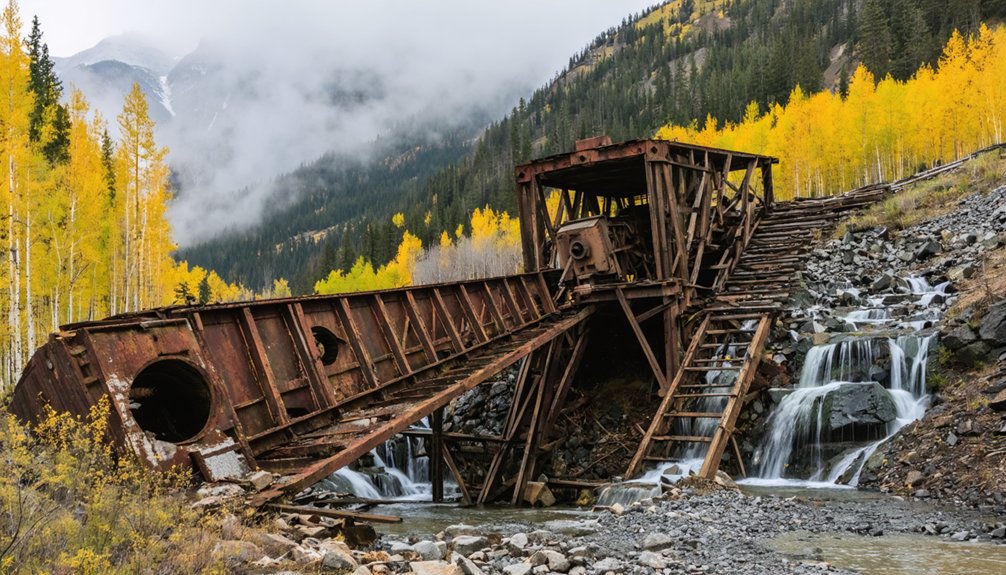
You’ll find over 23,000 inactive and abandoned mines scattered across Colorado’s landscape, each representing a point where human ambition pierced the earth and then retreated, leaving wounds that continue to bleed into the environment.
These abandoned operations have contaminated 1,800 miles of streams through acid mine drainage, a chemical process that transforms dormant rock into sulfuric acid and dissolves heavy metals like copper, lead, and mercury into waterways.
The sheer magnitude of this legacy—from the 2015 Gold King Mine spill that turned the Animas River orange to countless unnamed sites leaching toxins decades after closure—reveals how thoroughly Colorado’s natural systems have been rewritten by extraction.
Thousands of Mine Sites
Colorado’s mining legacy sprawls across an almost incomprehensible landscape of abandonment—23,000 inactive sites scattered throughout the state, with federal estimates suggesting between 27,000 and 39,000 additional locations on public land alone.
Between 1991 and 1998, surveyors documented 18,382 mine-related features on Forest Service property, revealing the magnitude of work ahead for mine reclamation efforts. These sites span from the 1790s to present day, their geographic coordinates now cataloged in repositories tracking elevation, county, and contamination patterns.
You’ll find them concentrated where mineral wealth once fueled economic expansion, now polluting headwater streams that feed downstream communities. The challenge of environmental restoration confronts both public agencies and private landowners throughout mineral-rich corridors, where extraction ceased but consequences persist across generations.
Massive Environmental Contamination Legacy
When pyrite-laden rock meets oxygen and water in abandoned mine shafts, it triggers a chemical reaction that’s transformed 1,800 miles of Colorado’s streams into acidic corridors of dissolved heavy metals.
You’re witnessing a pollution legacy spanning critical watersheds—from the Arkansas Headwaters to the Rio Grande—that feeds water to 40 million Americans downstream in the Colorado River system.
The numbers reveal abandonment’s true cost: ten active treatment sites processing 4.7 billion gallons of contaminated water annually, while Leadville’s Superfund site alone discharges 694 gallons per minute.
Environmental restoration faces a $50 billion national price tag, with 26 Colorado mines showing extreme degradation.
You’re left shouldering cleanup costs through taxpayer funding, addressing contamination from an era when profit outweighed ecological accountability.
How Mining Legacy Continues to Poison Colorado’s Environment
Beneath Colorado’s picturesque mountain landscapes lies a toxic inheritance that continues to contaminate watersheds more than a century after the last pickaxe struck stone.
Colorado’s abandoned mines continue their century-long poisoning of mountain watersheds, a toxic legacy left by inadequate regulations and unfinished environmental responsibility.
You’ll find over 23,000 abandoned mines poisoning 1,800 miles of streams, where pH levels plummet below 4.5 and heavy metals dissolve into water supplies serving millions.
The scale of ongoing contamination reveals how inadequate mining regulations were:
- 694 gallons per minute of untreated water flows from Leadville’s Superfund site alone, carrying six tons of toxic metals annually.
- 245 billion tons of tailings piles globally threaten groundwater as they leach arsenic, lead, and mercury.
- 63% of headwater streams show minimal disturbance, yet metal pollution has already degraded 23%.
Without effective pollution prevention, these abandoned operations continue poisoning ecosystems that sustain your freedom to fish, farm, and drink clean water.
The Silent Threat: Ongoing Contamination From Deserted Mines
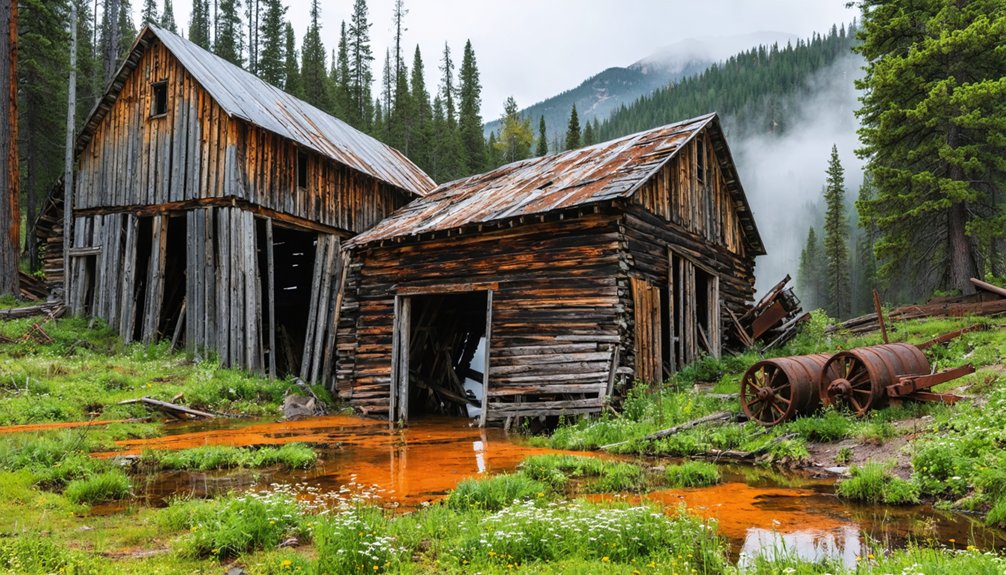
Long after the last miners departed, water continues flowing through thousands of abandoned shafts and tunnels, silently transforming Colorado’s geology into a chemical factory.
You’ll find over 23,000 contamination sources across the state, producing more than 50 million gallons of polluted water daily. When pyrite contacts air and water, it creates sulfuric acid that dissolves heavy metals—zinc, arsenic, copper, and lead—into 1,800 miles of streams.
The Summitville mine alone generates 235 million gallons annually, requiring constant treatment. While portable systems offer effective remediation strategies, they’re expensive and perpetual.
This toxic legacy persists because oxidation won’t stop. The headwater tributaries feeding the Upper Colorado River Basin remain particularly vulnerable, threatening your access to clean water and agricultural resources across multiple watersheds.
Restoration Progress in the Animas River Watershed
Since 1993, collaborative restoration efforts in the Animas River watershed have transformed what could’ve become a federal Superfund battleground into a model of community-driven environmental recovery.
The Animas River Stakeholders Group‘s persistence raised over $35 million, completing approximately 50 mining remediations that prevented federal designation until 2016.
Animas Restoration milestones include:
- Brook trout populations now thrive between Maggie Gulch and Cement Creek’s mouth
- Nearly six of 23 high-risk sites approaching completion with improved metal-capture systems
- $90 million settlement secured for continued watershed recovery following the 2015 Gold King spill
You’ll find Water Quality improvements evidenced through expanded fish populations and invertebrate communities.
Real-time USGS monitoring tracks ongoing recovery, while the Animas Watershed Partnership coordinates community-driven planning across contaminated segments.
The Billion-Dollar Challenge of Reclaiming Mining Sites
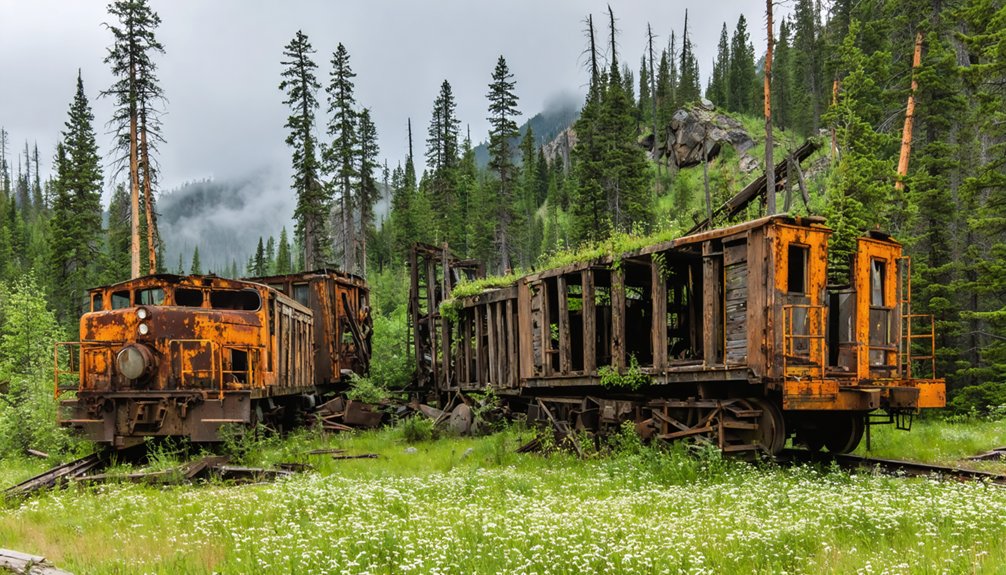
The Animas River’s recovery represents one watershed’s success story, but Colorado’s mining legacy extends across thousands of sites that still await intervention.
You’re looking at cleanup costs between $492.8 million and $1.08 billion for approximately 5,105 abandoned mines on public lands alone.
That’s 23,000 hazardous features requiring attention, yet the state receives just $2 million annually for safeguarding work.
Modern reclamation techniques can restore contaminated watersheds and stabilize dangerous openings, but funding challenges create a massive gap between what’s needed and what’s available.
These aren’t just environmental concerns—18 lives have been lost to abandoned mines since 1955.
While restoration spending generates $1.28 in local economic activity per dollar invested, Colorado’s mining inheritance demands resources that dwarf current allocations.
Frequently Asked Questions
Can Visitors Legally Enter the Old Buildings in These Ghost Towns?
You can’t legally enter most old buildings without permission since they’re privately owned. Legal access requires owner consent, and building safety hazards make unauthorized entry dangerous. Respect property rights while exploring nature’s reclamation of these historic sites.
What Wildlife Species Now Inhabit Abandoned Mining Areas in Colorado?
You’ll find wildlife adaptation thriving—carnivores prowling, bats roosting, ungulates foraging—across abandoned mines. Fourteen bat species, eleven carnivore species, and beavers driving ecological restoration now reclaim these industrial remnants, demonstrating nature’s resilience through human-nature interconnections.
Are There Camping Facilities Near Ghost Towns Like St. Elmo?
Yes, you’ll find diverse camping options near St. Elmo, from Iron City’s shaded sites to dispersed roadside spots. These bases let you explore nearby attractions while experiencing the wilderness reclaiming Colorado’s mining heritage firsthand.
Which Ghost Town Is Closest to Denver for Day Trips?
Highland and St. Charles offer you the closest historic sites for day trips from Denver. Both 1858 placer camps evolved within the city itself, where nature and urban development now intertwine where prospectors once sought freedom and fortune.
Do Any Ghost Towns Offer Guided Tours or Visitor Centers?
Gothic’s Rocky Mountain Biological Laboratory offers guided experiences through donation-based tours, where you’ll discover historical significance intertwined with ongoing alpine research. You’re free to explore how abandoned mining settlements transform into essential ecological study sites.
References
- https://www.colorado.com/articles/colorado-ghost-towns
- https://www.blm.gov/sites/default/files/uploads/AML_PUB_DecadeProgress.pdf
- https://coloradogeologicalsurvey.org/hazards/aml/
- https://earthworks.org/wp-content/uploads/2021/09/REPORT-Burden-of-Gilt.pdf
- https://coyotegulch.blog/2024/09/25/
- https://www.nature.org/content/dam/tnc/nature/en/documents/1/1/11.3.25_TNC_Mining_the_Sun_Report.pdf
- https://westernmininghistory.com/towns/colorado/st-elmo/
- https://www.legendsofamerica.com/co-stelmo/
- https://getlostinamerica.com/history-st-elmo-and-iron-city-colorado/
- https://en.wikipedia.org/wiki/Saint_Elmo