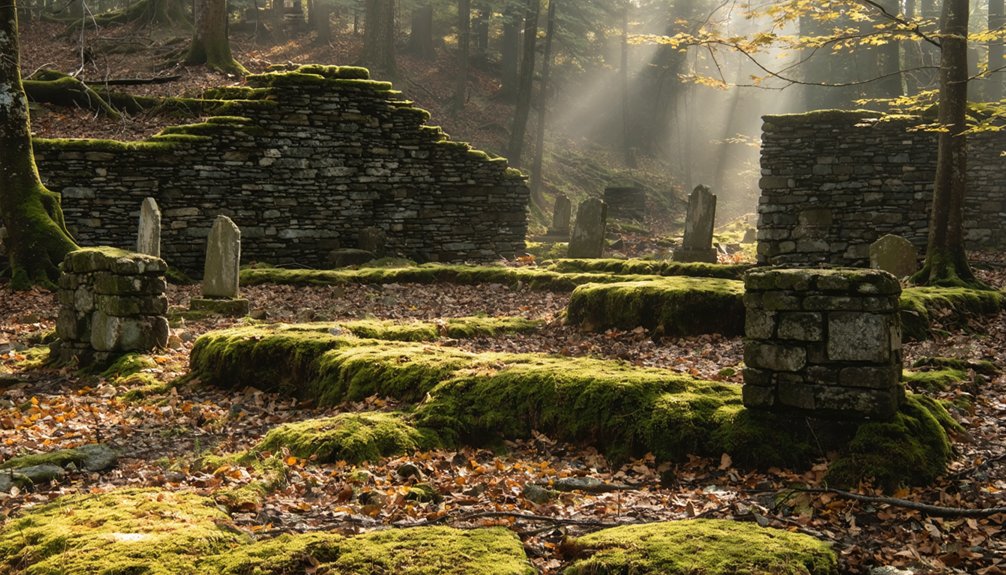
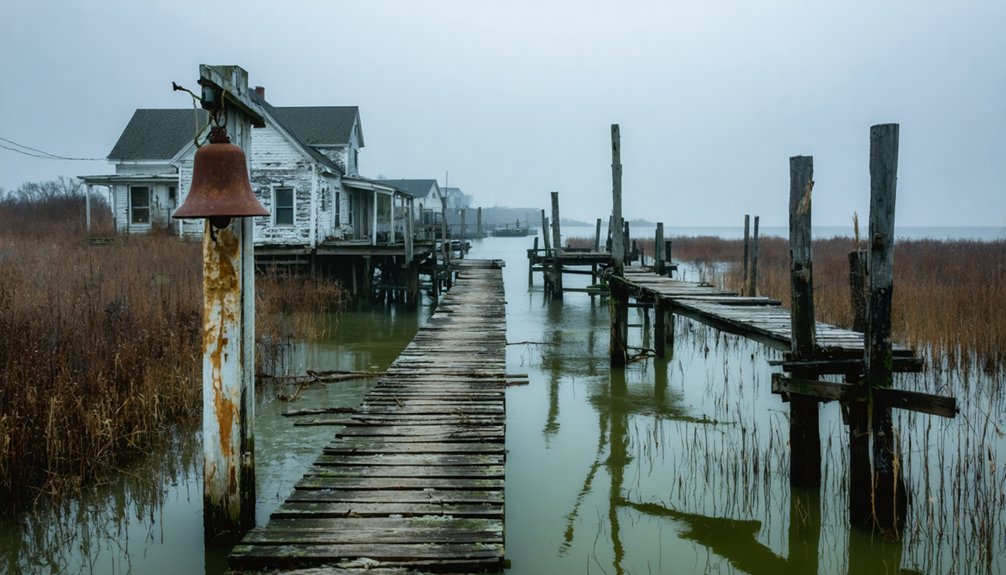
You’ll find Connecticut’s ghost towns undergoing systematic erasure by forest succession, where settlements like Gay City (abandoned 1879) and Bara-Hack (1890s) now exist as barely-visible stone foundations beneath canopy cover. Johnsonville’s twelve industrial mills sit deteriorating along the Salmon River, while Dudleytown remains completely inaccessible as woodland reclaims what plague and economic collapse left behind. These sites demonstrate how temperate forests convert human infrastructure into self-sustaining ecosystems within decades—though documentation reveals the haunting temporal layers where community memory persists through paranormal folklore even as physical evidence vanishes beneath vegetation.
Key Takeaways
- Johnsonville Village, abandoned in 1998 after fires and failed developments, now faces ongoing restoration debates following its 2017 acquisition.
- Gay City State Park preserves Factory Hollow’s 18th-century mill town ruins, where forests actively reclaim stone foundations and cellar holes.
- Bara-Hack’s Welsh settlement from the 1780s features forest-engulfed foundations, bridges, and mills abandoned by 1890 due to economic pressures.
- Pioneer species and ecological succession rapidly convert abandoned Connecticut settlements into self-sustaining ecosystems, obscuring archaeological evidence.
- Conservation policies balance historical preservation with nature reclamation, restricting access to sites like Dudleytown while maintaining limited trails elsewhere.
Johnsonville Village: A Victorian Mill Town Frozen in Time
Along the Salmon River in East Haddam, the remnants of Johnsonville Village stand as evidence to Connecticut’s industrial past and the fragility of economic revitalization.
You’ll find Neptune Mill‘s charred foundation where twelve water-powered facilities once dominated the region’s twine manufacturing during the Industrial Revolution.
Ray Schmitt purchased the village in 1965, attempting to transform decaying structures into a Victorian tourist destination by relocating historic buildings and creating museum displays.
His vision collapsed after Neptune Mill burned in 1972, triggering disputes with officials that led to abandonment in 1998.
Through decades of failed hotel developments and auction cycles, nature reclaimed the Victorian architecture.
The village had previously experienced tragedy when the Triton Mill was destroyed by fire in 1924, foreshadowing the later devastation that would seal Johnsonville’s fate.
The 64-acre property changed hands multiple times, including a 2001 purchase by a hotel development company whose ambitious plans ultimately fell through.
The Iglesia ni Cristo’s 2017 acquisition promises restoration, yet the site remains a reflection of industrial America’s impermanence.
Gay City State Park: Forest-Swallowed Textile Community
When you walk Gay City’s trails today, you’re tracing paths that once connected thriving mills, homesteads, and a community that descended from religious refuge into violent dissolution before nature reclaimed it entirely.
The hollow’s transformation from Factory Hollow’s industrial ambitions in 1796 to complete abandonment by 1879 left behind stone foundations and cellar holes that now mark where families feuded, mills burned, and at least two violent deaths stained the settlement’s history.
These physical remnants anchor persistent legends of supernatural activity—stories that emerge not from folklore alone but from documented accounts of decapitation, mysterious disappearances, and the community’s rumored practice of alcohol-fueled religious rites that isolated them from neighboring towns throughout the 19th century. The settlement was founded by religious leader Elijah Andrus and his followers who sought to establish their own community in the wilderness.
Today, the park features hiking trails and campsites among the ruins, with Emma Foster’s donation ensuring the preservation of these haunting remnants for future generations to explore.
Vanished Mill Town Ruins
Deep within Gay City State Park’s 1,569 acres, stone foundations and crumbling cellar holes mark where a self-sufficient religious community called Factory Hollow thrived for nearly a century before vanishing into Connecticut’s forest.
You’ll discover the mill town’s skeleton along 10 miles of trails—massive chimney stacks, stone canals, and basement remnants consumed by undergrowth.
The woolen textile mill burned in 1830, triggering the first exodus. Civil War casualties depleted the population further, and when Charles Sumner’s paper mill burned between 1879 and 1885, the final residents abandoned their homes.
The settlement began in 1796 when Elijah Andrus and followers established what would become a mill town of approximately 25 families along the Blackledge River.
Emma Foster, last descendant, sold the land to Connecticut in 1943 with strict preservation terms.
Today, nature reclamation continues uninterrupted—trees sprouting from cellars, forest reclaiming what industry once commanded, offering you evidence of civilization’s impermanence. A small cemetery adorned with gifts from passing hikers serves as one of the most haunting remnants of the abandoned community.
Paranormal Tales and Legends
The murdered peddler’s skeleton, discovered in a charcoal burner’s pit sometime in the 1800s, established Gay City’s reputation for unexplained deaths that transcend historical record into spectral folklore.
You’ll find the charcoal burner was never prosecuted, leaving justice unresolved for over a century. The decapitated apprentice, allegedly killed by his blacksmith employer for tardiness, now reportedly flits through moonlit woods clutching his severed head—forever rushing to that fatal appointment.
These unsolved murders bred persistent supernatural encounters. You might hear drunken voices rising from the hollow near the burial ground, where feuding families like the Gays and Sumners rest in deliberate separation. The community once thrived with twenty-five families operating woolen mills and gristmills before discord and migration emptied Factory Hollow. Visitors frequently leave offerings at burial sites, adding to the location’s unsettling atmosphere.
Civil War depopulation left crumbling homes where overnight campers report spectral visitors. Even the 2010 drowning reinforces this landscape’s reputation as territory where violent death refuses burial.
Bara-Hack: Mysterious Stone Foundations in the Wilderness
Forsaken homesteads emerge from Connecticut’s northeastern woodlands where Welsh settlers Obadiah Higginbotham and Jonathan Randall established Bara-Hack around the 1780s.
Welsh pioneers carved Bara-Hack from Connecticut wilderness in the 1780s, leaving stone remnants that now whisper forgotten stories through reclaimed forest.
You’ll find stone foundations, cellar holes, and an intact arched bridge reclaimed by forest in Pomfret’s Ragged Hills. Bara Hack history reveals a once-thriving settlement with waterwheel-powered mills and flax wheel production that prospered until economic pressures triggered complete abandonment by 1890.
The wilderness now dominates fields where livestock once grazed. Bara Hack legends speak of phantom voices—children’s laughter, mill wheels grinding, livestock sounds echoing through trees where the Randall-Botham Cemetery holds marked and unmarked graves. Visitors have reported streaking lights and orbs at the site, adding to its reputation among paranormal investigators. The area’s original inhabitants, the Nipmuc people, were gradually displaced as the settlement expanded.
You can’t freely explore these ruins; authorities restrict access after paranormal seekers overran the site, requiring permits to witness nature’s patient reclamation of human ambition.
Dudleytown: The Cursed Settlement Guarded by Secrecy
Between three darkening hills, farmers struggled with barren soil while tragedy accumulated—murders, madness, unexplained deaths.
By 1900, all twenty-six families had fled.
Today’s Dudleytown mysteries blend documented hardship with fabricated horror: Ed Warren’s 1970s possession claims and fictional accounts transformed ecological failure into supernatural legend.
You can’t visit—private landowners closed these cellar holes to ghost hunters decades ago.
Holy Land USA: A Biblical Theme Park Lost to Decay
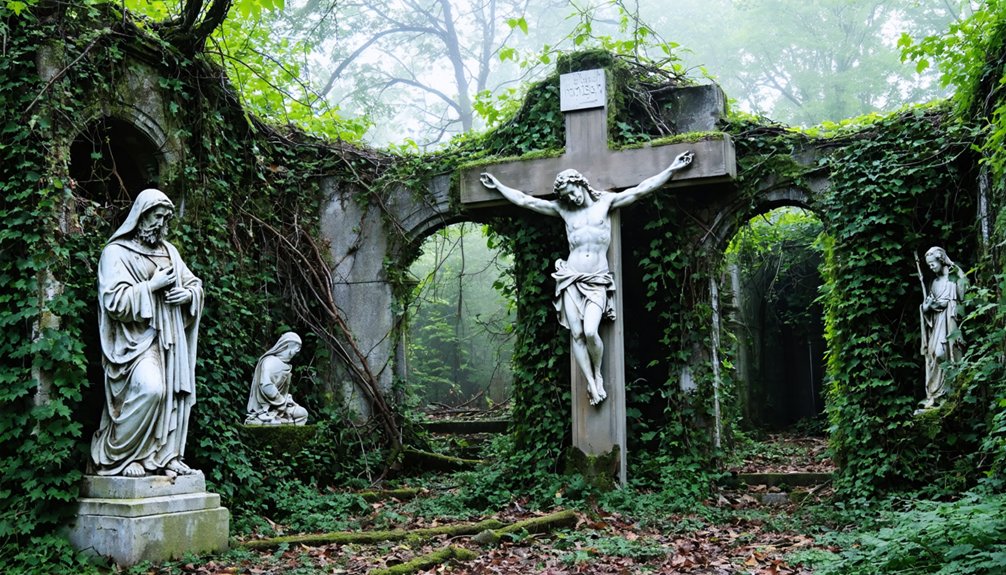
From Interstate 84, drivers spot a massive illuminated cross crowning Pine Hill—the last monument of Holy Land USA, a biblical theme park that drew 40,000 annual pilgrims before collapsing into ruin.
Lawyer John Baptist Greco built this 18-acre recreation of Jerusalem in 1958, constructing over 200 plywood structures depicting Christ’s life.
After Greco’s death in 1986, weather and vandals transformed the attraction into a landscape of crumbling concrete and exposed chicken wire—urban decay claiming religious significance.
Two murders cemented its haunted reputation.
Yet restoration efforts emerged in 2013 when local buyers established nonprofit protections, rebuilt the 57-foot cross, and reopened grounds for worship.
You’ll find it half-revived: a peculiar monument where faith confronts nature’s reclamation, accessible but unfinished.
Pleasure Beach: Forgotten Amusement Area Overtaken by Growth
Across Bridgeport Harbor’s waters sits a 37-acre barrier island where nature now commands what human ambition abandoned—Pleasure Beach, Connecticut’s most ambitious coastal amusement park reduced to foundations and overgrowth.
You’ll find scant evidence of the Jazz Age ballroom where Glenn Miller once performed, or the mechanical Steeplechase ride that drew thousands in 1905. Fires repeatedly gutted this landscape—1907, 1953, 1957, 1973—each blaze erasing another layer of boardwalk entertainment.
By 1959, bankruptcy closed the gates permanently. The 1957 bridge fire particularly sealed its isolation, cutting access that once welcomed beachgoers via ferry and causeway.
Today’s natural reclamation accelerates unchecked. Demolished pavilions from 2009-2011 left only scattered structures amid advancing vegetation, creating an accidental wilderness where carousel horses once spun and roller coasters thundered.
The Process of Natural Reclamation in Abandoned Settlements
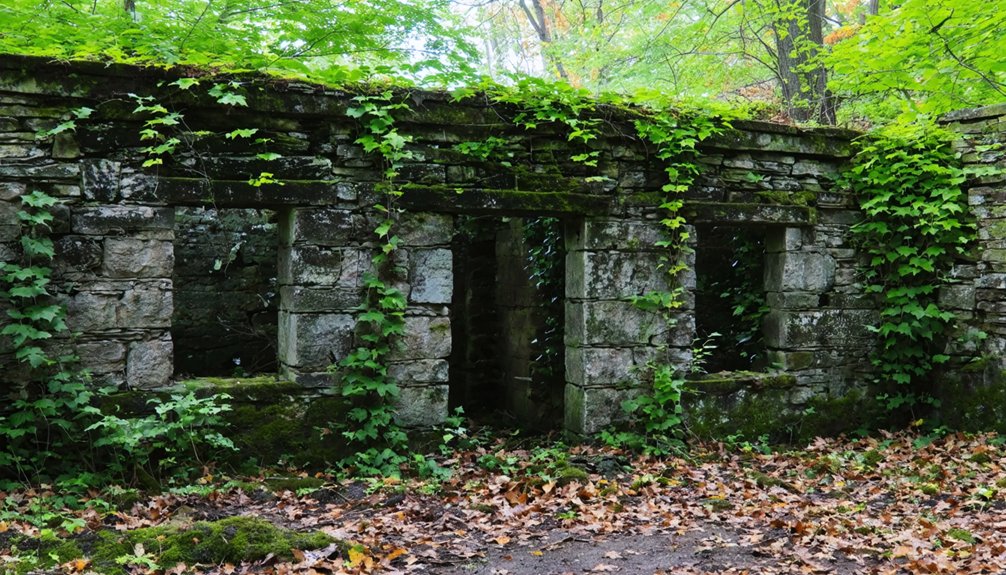
When human settlement contracts from Connecticut’s landscape, ecological succession advances through predictable stages that transform abandoned communities into forest within decades.
You’ll observe natural succession beginning immediately after human departure, as pioneer species colonize cleared land. At Gay City State Park, this process systematically erases an 18th-century town as vegetation overtakes foundations and roadways.
Conservation organizations like the Dark Entry Forest Association actively accelerate ecological recovery at sites including Dudleytown, prioritizing ecosystem restoration over historical preservation.
Trees penetrate stone foundations while understory plants obscure archaeological evidence. Seasonal growth cycles affect visibility—summer overgrowth conceals what autumn reveals.
This reclamation isn’t passive deterioration but active regeneration. Connecticut’s forests reclaim their territory with remarkable efficiency, converting human spaces into self-sustaining ecosystems.
Legends and Paranormal Tales Surrounding Connecticut’s Ghost Towns
As Connecticut’s forests reclaim their physical territory from abandoned settlements, folklore fills the vacuum left by departed communities.
Where nature erases human presence, paranormal narratives persist across generations. These ghost towns harbor distinctive supernatural phenomena:
- Bara-Hack’s disembodied voices echo through Pomfret’s wilderness, earning its reputation as the “village of ghostly voices” among crumbling foundations.
- Dudleytown’s cursed lineage manifests through haunted whispers in Dark Entry Forest, where Ed and Lorraine Warren documented demonic energy.
- Union Cemetery’s White Lady glides between tombstones before vanishing on nearby highways, accompanied by the shadow-dwelling Red Eyes entity.
- Gay City’s restless spirits permeate abandoned ruins reclaimed by Hebron’s encroaching forest.
These spectral sightings document how wilderness and memory intertwine, creating landscapes where past tragedies resist complete erasure.
Preserving History While Nature Takes Its Course
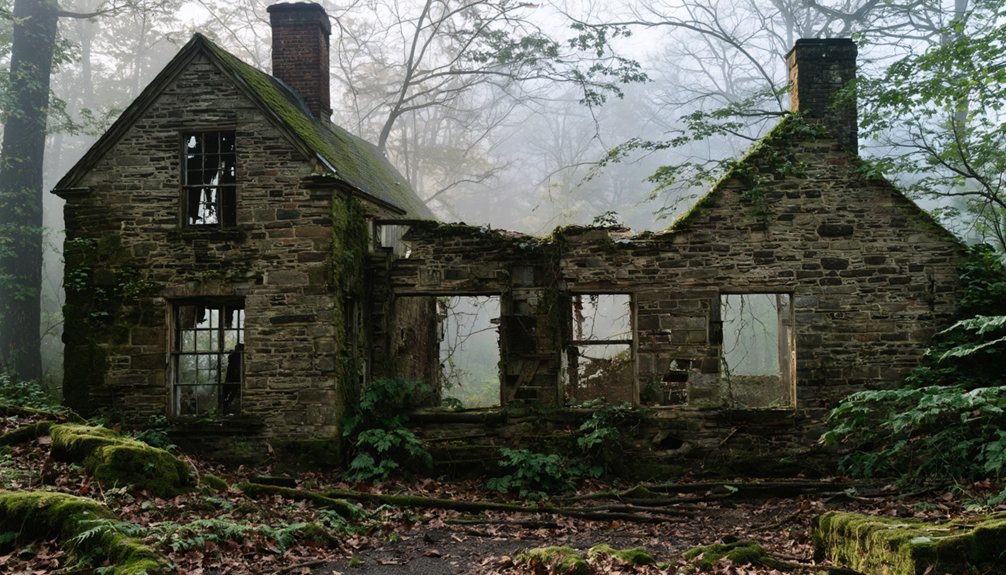
You’ll find Connecticut’s abandoned sites caught between competing priorities: Dark Entry Forest Association restricts Dudleytown access to prevent vandalism, while Spiderweed Preserve welcomes visitors to witness nature reclaiming Solomon Hubbard’s 1700s homestead.
The tension intensifies as structures deteriorate—what Connecticut Landmarks can document and stabilize today may become indecipherable cellar holes within decades, much like Dudleytown’s transformation since 1900.
This race against decay forces preservationists to decide whether protection means controlled public engagement or complete closure before historical evidence vanishes entirely.
Conservation Versus Historical Access
Connecticut’s ghost towns exist in a perpetual tension between historical preservation and ecological restoration, where state agencies and conservationists must choose whether nature’s reclamation serves as the best form of protection or represents an erasure of cultural memory.
You’ll find conservation strategies manifesting across abandoned sites:
- Dudleytown’s complete access prohibition prioritizes ecological recovery over your exploration rights.
- Gay City State Park balances forest reclamation with limited trail access to stone foundations.
- Pleasure Beach faces decisions between reopening, nature preserve designation, or continued restriction.
- Johnsonville’s photogenic ruins spark debates about restoration viability versus natural overtaking.
State policies increasingly favor wildlife corridors and wetland restoration, reflecting historical losses from 1800-1940.
This shift challenges traditional historical preservation, leaving you to witness these sites only through enforced distance.
Documentation Before Complete Decay
Before these settlements vanish entirely into forest canopy, documentation techniques race against accelerating decay cycles that weren’t present when these towns first emptied.
You’ll find preservationists employing historical photography at sites like Johnsonville and Gay City, capturing architectural details before vines obscure them permanently.
At Bara-Hack, visitors document stone walls and foundations while they’re still identifiable, though photographic anomalies sometimes complicate the record.
Dudleytown’s restricted access has created gaps in archival documentation, with photos from permitted entries mysteriously failing to develop.
Holy Land USA’s restoration team compares current decay against original designs, creating temporal records of nature’s progression.
These efforts aren’t about stopping the inevitable—they’re about ensuring future generations can access what existed before Connecticut’s forests reclaim their territory completely.
Frequently Asked Questions
Can Visitors Legally Explore These Ghost Towns in Connecticut?
You’ll find legal access varies dramatically—state parks like Gay City welcome exploration following visitor guidelines, while private properties such as Johnsonville and Bara-Hack strictly prohibit entry, forcing you to respect ownership boundaries despite nature’s reclamation.
What Safety Precautions Should Be Taken When Visiting Abandoned Sites?
You’ll need sturdy safety gear—respirators, boots, gloves—before traversing these temporal ruins. Maintain wildlife awareness as nature reclaims man’s forgotten structures. Test floors carefully, avoid hazardous materials, and never explore alone in these liberated spaces.
Are Guided Tours Available for Any Connecticut Ghost Towns?
No dedicated ghost town tours exist for Connecticut’s nature-reclaimed settlements. You’ll find ghost tours emphasizing paranormal activity and historical significance in active communities like Mystic and New Haven, but abandoned sites lack commercial guided experiences respecting your exploratory independence.
How Long Does Nature Typically Take to Reclaim Abandoned Structures?
You’ll witness nature’s resilience overtaking structures within months—weeds crack pavement immediately, vines blanket buildings within years, and forests reclaim entire cities after a century, demonstrating how urban decay accelerates humanity’s architectural impermanence.
What Caused Most of These Connecticut Settlements to Be Abandoned?
Economic decline following failed industrial growth drove most abandonments. You’ll find mill fires, reservoir flooding, and harsh business conditions repeatedly uprooted these communities, forcing residents to seek opportunity elsewhere when their livelihoods vanished.
References
- https://www.onlyinyourstate.com/experiences/connecticut/nature-reclaims-ct
- https://www.atlasobscura.com/things-to-do/connecticut/ghost-towns
- https://www.youtube.com/watch?v=V3k1shmJqeU
- https://www.youtube.com/watch?v=J9TIc7cqXNo
- https://abandonedwonders.com/tag/connecticut/
- https://en.wikipedia.org/wiki/List_of_ghost_towns_in_Connecticut
- https://i95rock.com/mystery-of-dudleytown-ct/
- https://www.ctinsider.com/projects/2025/lost-ct-towns/
- https://i95rock.com/the-abandoned-ghost-town-of-johnsonville-ct-then-now/
- https://www.atlasobscura.com/places/johnsonville-village