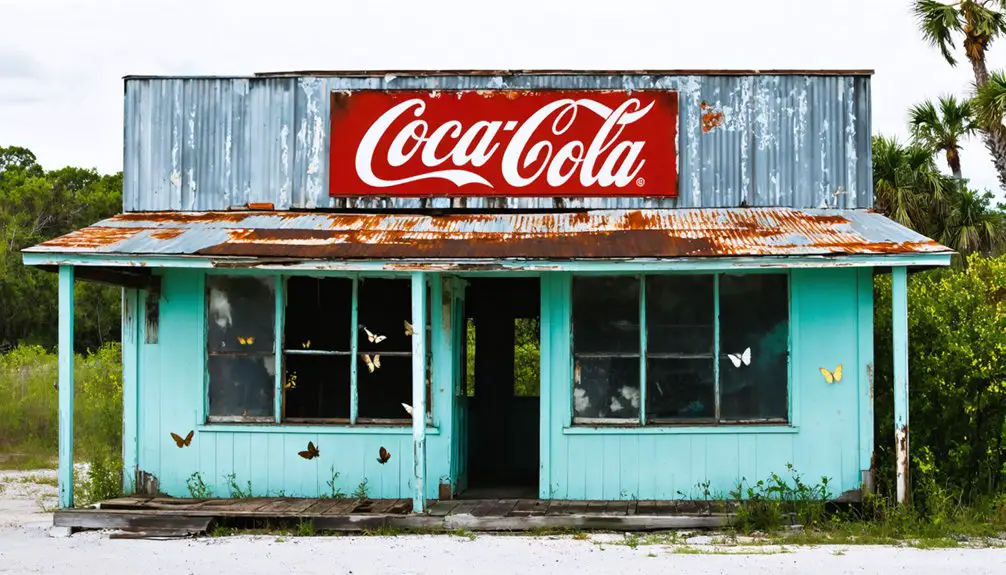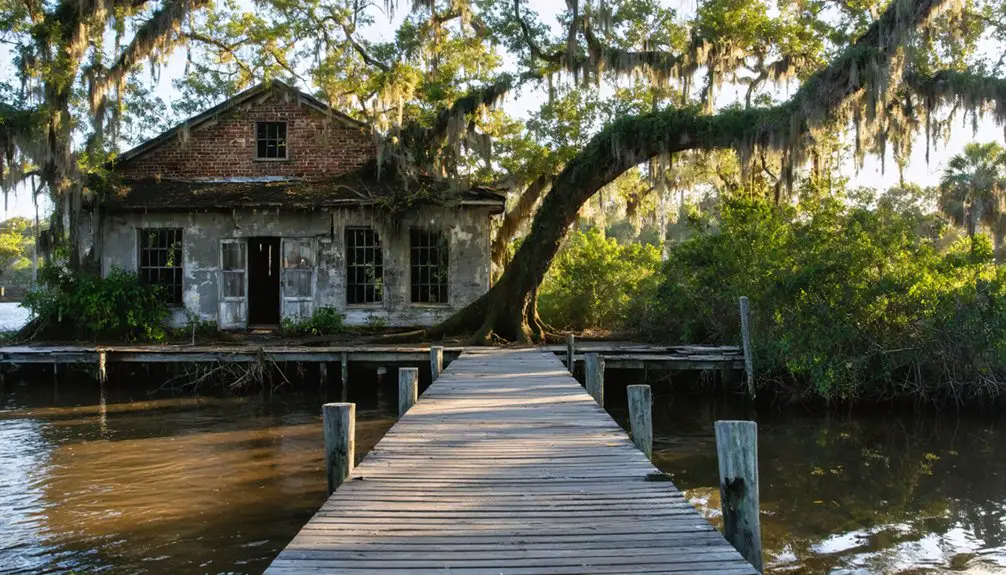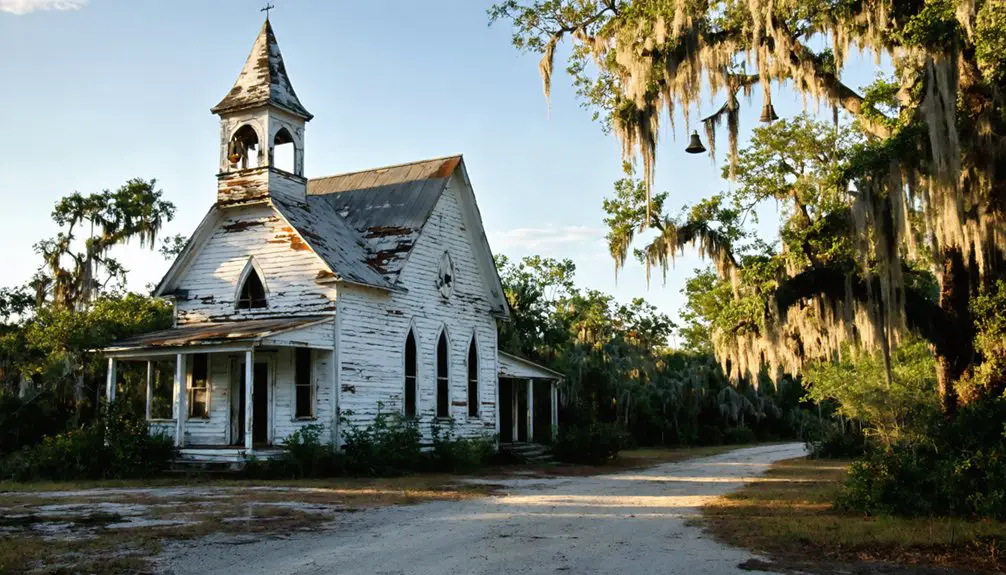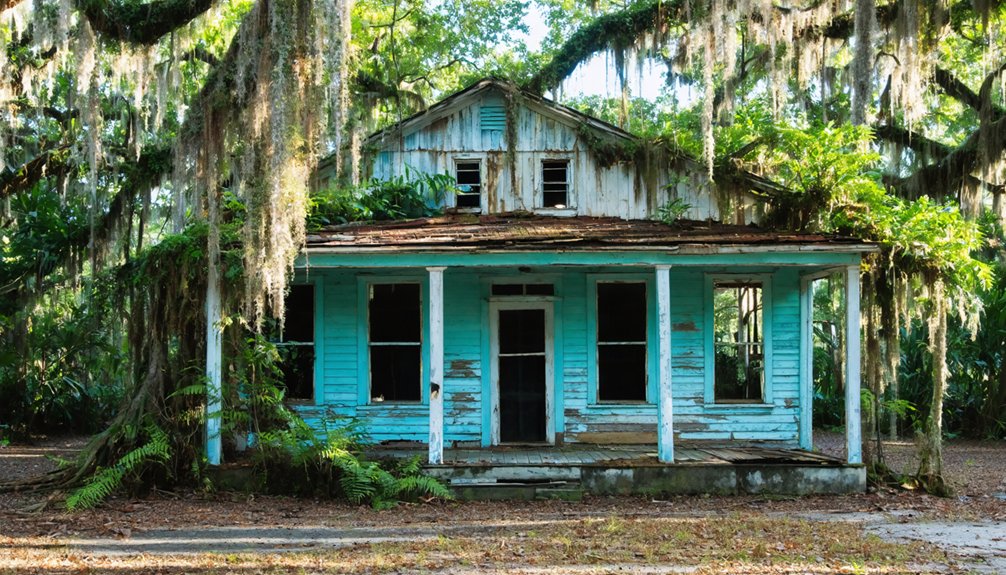
Florida’s wilderness methodically erases abandoned settlements like Sumica, where a 1917 French timber operation that produced 35,000 board feet daily now exists as a 4,031-acre preserve. You’ll find Centralia’s sawmill foundations vanishing beneath vegetation after processing 100,000 board feet of cypress until 1922, while Kerr City’s citrus groves succumbed to the devastating 1895 freeze. Humidity, corrosive sea air, and mangrove invasion accelerate structural decay across these sites. The state’s protected preserves now harbor these temporal records, where elevated railroad beds and concrete foundations reveal Florida’s industrial past.
Key Takeaways
- Florida’s humidity, sea air, and dense vegetation methodically reclaim abandoned settlements, engulfing structures and erasing human presence through accelerated deterioration.
- Sumica and Centralia, once-thriving lumber towns, are now wilderness preserves where sawmill foundations and infrastructure disappear beneath thick forest growth.
- The catastrophic 1894-95 freeze destroyed Florida’s citrus industry, causing towns like Kerr City to be abandoned and consumed by nature.
- Protected areas like Chassahowitzka and Canaveral National Seashore preserve ghost towns, allowing exploration of reclaimed logging camps and citrus settlements.
- Former industrial sites show mangrove invasion, palmetto thickets, and wildlife inhabiting areas where mills, railroads, and communities once operated.
How Nature Swallows Abandoned Settlements in the Sunshine State
When settlers first carved clearings from Florida’s wilderness, they underestimated the land’s relentless capacity to reclaim what had been taken. Dense saw palmettos, scrub pines, and mangroves advance through abandoned streets where families once lived.
Humidity rots wooden structures while sea air corrodes metal remnants. What you’ll find during urban exploration reveals nature’s methodical erasure—vegetation swallows Victorian-era homes, bugs and reptiles accelerate decomposition, and jungle thickets consume former farms and developments.
Nature dismantles what humans build—wood rots, metal corrodes, and vegetation methodically erases all traces of civilization’s presence.
This ecological restoration occurs without human intervention. Atsena Otie Key’s mill ruins now shelter wildlife within Cedar Keys National Wildlife Refuge.
Centralia’s sawmill sites disappear beneath forest canopy in Chassahowitzka Wildlife Management Area. Towns like Smica, which operated a sawmill producing 35,000 feet of lumber daily until timber depletion forced abandonment in 1927, now exist only as scattered foundations beneath pine forests. Unlike the preserved ghost towns of Nevada and Colorado, Florida’s abandoned settlements face rapid deterioration with minimal preservation efforts. The wilderness reclaims its territory with patient, unstoppable force, transforming once-bustling settlements into silent monuments overtaken by Florida’s primal landscape.
SUMICA: From Bustling Sawmill to 4,031-Acre Wilderness Preserve
Among Florida’s reclaimed settlements, SUMICA stands as a particularly well-documented example of industrial ambition erased by ecological succession. Established in 1917 by a French timber conglomerate, you’ll find SUMICA’s history reveals an operation producing 35,000 board feet daily through four miles of logging trails.
The timber industry erected complete infrastructure—50 houses, commissary, school, and railroad depot—supporting workers who depleted longleaf and slash pine forests within a decade. The community operated with its own currency, using aluminum pieces inscribed with “SUMICA” for transactions. By June 1927, the post office closed and residents vanished entirely.
Today, you can explore 4,031 acres acquired in 1999 as Polk County’s largest Environmental Land. Concrete piers, rail beds, and shallow wells mark where commerce thrived. The 1.7 mile trail and 3.5 mile loop traverse scrubs and oak hammock where extraction once dominated. Twelve rare species now inhabit trails traversing what extraction destroyed.
Centralia’s Vanished Lumber Empire and the Cypress Tree Depletion
You’ll find Centralia’s remarkable industrial scale documented in its 1910-1922 operation records, where twin 53.5-inch band saws processed 100,000 board feet daily while employing over 1,000 workers in what became one of the South’s largest sawmills.
The Tampa Northern Railroad (later Seaboard Airline) hauled this output from Hernando County’s cypress swamps, leaving behind a rail corridor that remains traceable through today’s Chassahowitzka Wildlife Management Area.
The extensive logging operations ultimately depleted the surrounding cypress forests, causing the town to vanish after the natural resources were exhausted. Today, nature has reclaimed the abandoned site, with vegetation overgrowing the scattered pillars and foundations that once supported this thriving lumber community.
Old-Growth Cypress Exhaustion
Within twelve years of operation, Centralia’s sawmill consumed an entire ancient forest that had stood for centuries.
You’re looking at logging history that harvested monster-sized red Tidewater cypress growing for hundreds to thousands of years. The mill’s double band saw processed 100,000 board feet daily, targeting 15,000 acres of virgin forest. By 1926, every accessible old-growth tree had vanished.
The scale of depletion reveals itself through:
- The 1912 record cypress yielding 5,476 board feet from a single tree
- Steam-powered skidders extracting deep swamp timber previously unreachable
- Complete forest exhaustion forcing the company’s relocation up Florida’s coast
Today’s cypress conservation efforts within Chassahowitzka Wildlife Management Area protect what remains, though you’ll find mostly mill foundations where ancient giants once dominated the landscape. The railroad line transported the harvested timber and enabled the massive scale of extraction that made Centralia one of Hernando County’s most significant operations. The remains of Centralia disappeared during the Great Depression, erasing the final traces of the logging town.
Railroad Infrastructure Remnants
Centralia’s railroad infrastructure vanished as completely as the cypress forests it once served, leaving behind only fragmentary evidence of the 1910s logging boom.
You’ll find similar disappearances across Florida’s wilderness, where railroad history reveals the state’s extractive past. The Deep Lake Railroad‘s swampy route to Everglades City succumbed to flooding and vegetation within decades—you can still spot rusted spikes and rail fragments buried beneath Fakahatchee Strand’s sawgrass.
Flagler’s ambitious Key West Extension faced hurricane destruction in 1935, though infrastructure preservation efforts converted surviving bridges into today’s Overseas Heritage Trail.
The Overseas Railroad’s 128-mile stretch over the ocean represented an engineering marvel when it opened in 1912, connecting the mainland to Key West before the hurricane ultimately sealed its fate.
Even Florida’s first cross-state line, completed in 1861, suffered Civil War raids that pulled up rails for Confederate Georgia routes, erasing critical transportation corridors. The Florida Railroad from Fernandina to Cedar Key became the state’s longest railroad before the war, only to have Union forces systematically destroy its infrastructure and rolling stock during the conflict.
Kerr City and Eldora: When Catastrophic Freezes Killed the Citrus Dream
You’ll find that Kerr City’s evolution from cotton plantation to thriving citrus hub in the 1880s created a prosperity that census records and postal documentation confirm peaked at over 100 residents.
The back-to-back freezes of 1894-1895 destroyed these entire groves within a span of weeks, collapsing the local economy that agricultural reports had documented as the region’s primary revenue source.
Thriving Agricultural Hubs
While many Florida ghost towns vanished due to economic shifts or transportation changes, Kerr City’s abandonment tells a starker story: nature’s capacity to erase human ambition in a single night.
Founded in 1884, this Marion County settlement thrived on citrus cultivation. Northern settlers transformed Williamson’s former cotton plantation into productive orange groves stretching north of Beulah Avenue and around Lake Kerr.
By the 1890s, you’d find a community of 100 residents shipping fruit regionwide.
The 1895 freeze devastated this citrus legacy:
- Entire groves died overnight, eliminating the town’s economic foundation
- Families abandoned homes, closing the school, pharmacy, and church by 1905
- Agricultural decline rendered stagecoach routes obsolete as railroads found nothing to transport
Though briefly reoccupied in the 1920s, another freeze in 1985 guaranteed the groves never returned.
The Great Freeze
The winter of 1894-95 delivered a one-two punch that obliterated Florida’s citrus heartland.
December’s freeze plunged temperatures into the teens, then February struck again with devastating cold that killed trees to their roots.
You’d have witnessed bark splitting, fruit dropping, and snow falling as far south as Tampa.
The Great Freeze wiped out Kerr City and Eldora’s groves completely—thousands of acres abandoned overnight.
Florida’s Citrus Industry collapsed from five million boxes annually to near-zero production.
Growers fled south or left the state entirely as packing houses shuttered.
The 1899 freeze reinforced the lesson: northern Florida couldn’t sustain commercial citrus.
These disasters permanently shifted production southward, leaving ghost towns where thriving agricultural communities once stood.
Abandonment and Preservation
After both freezes decimated Kerr City‘s citrus groves, residents faced an impossible choice: rebuild an economy that had proven fatally vulnerable or abandon their investments entirely.
Most chose departure by 1905, surrendering their town to the wilderness. Yet founder George Smiley stayed, purchasing abandoned properties and preserving the settlement’s cultural heritage through family stewardship.
Today, his great-grandson Arthur Brennan maintains fourteen structures, recognizing their historical significance beyond monetary value. The town’s preservation reveals how catastrophic economic collapse reshapes communities:
- Kerr House Hotel’s 1907 burning symbolized the town’s final social collapse
- The 1942 post office closure officially ended governmental recognition
- National Register listing validates preservation over development pressures
You’ll find volunteer caretakers preventing complete forest reclamation, defending individual liberty to preserve authentic history against state intervention.
Atsena Otie Key: Hurricane Devastation That Emptied an Island Community
Long before a catastrophic hurricane reduced it to an uninhabited relic, Atsena Otie Key thrived as one of Florida’s most industrious island communities.
You’ll find evidence of its prosperity in 1860 census records showing 215 residents and Eberhard Faber’s pencil mill producing casings for over 300,000 pencils annually.
The 1896 hurricane impact changed everything—a ten-foot storm surge obliterated the mill and swept away decades of development.
Survivors relocated to Way Key, establishing what’s now Cedar Key, while Atsena Otie stood abandoned.
Today, you can only access this ghost island by boat through the Cedar Keys National Wildlife Refuge.
Foundation remnants and scattered bricks mark where industry once flourished, offering tangible proof of nature’s power to reclaim human settlement.
Tuckersville’s Demise on the Kissimmee Prairie

Unlike the hurricane-swept devastation of Atsena Otie Key, Tuckersville‘s erasure from the Kissimmee Prairie unfolded through decades of shifting economic forces and land ownership consolidation.
Tuckersville history began with the Peavine Railroad‘s arrival in the early 1900s. The Colonization Land Company‘s scheme deceived investors who purchased waterlogged prairie land during dry winter months, discovering their farms flooded come summer. The company’s bankruptcy ended their agricultural dreams.
Prairie settlement persisted along Peavine Road, where settlers traded and socialized freely. However, corporate consolidation changed everything:
- Latt Maxcy Corporation fenced the open range in the late 1940s
- Public access ended when the corporation blocked Peavine Road
- Military exercises and eventual state acquisition erased remaining traces
Today, 53,738 acres of reclaimed prairie cover where Tuckersville’s ambitious settlers once attempted taming Florida’s untamable grasslands.
Ruby: Mining Depletion, Deadly Floods, and Lingering Spirits
While Tuckersville faded through corporate fencing and restricted access, Ruby’s demise combined geological exhaustion with catastrophic natural forces.
You’ll find this settlement’s history seven miles southeast of Conconully, where rich silver discoveries on Ruby Hill sparked incorporation in August 1890. The Ruby Mine, though lowest-grade at $14 per ton, contributed to a population surge supporting 29 businesses by 1893.
Depletion arrived swiftly. Floods compounded mining losses, washing through the quarter-mile main street where six general stores once traded.
Today’s ruins—rock foundations, a schoolhouse, jail remnants—line gravel tracks at 4,186 feet elevation. Ghostly Echoes persist where visitors report miner laughter and pickaxe sounds along tree-lined roads.
The site’s closed now, preserving what nature hasn’t reclaimed from this brief territorial boom.
The Relentless Forces of Humidity, Corrosion, and Vegetation Overgrowth
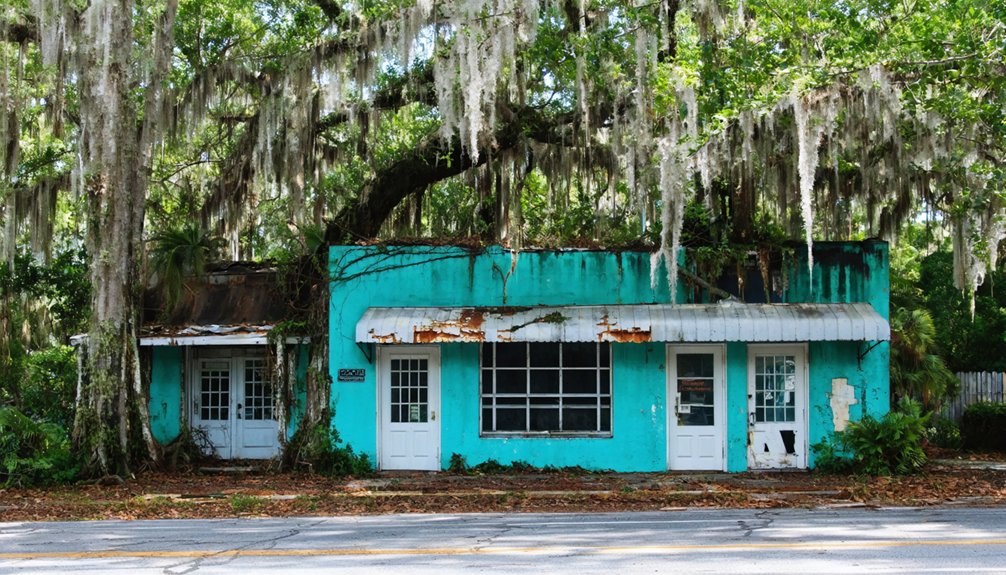
Florida’s subtropical climate wages a silent war against abandoned structures through three destructive forces: relentless humidity, corrosive atmospheric conditions, and aggressive vegetation.
The humidity impact accelerates wood deterioration within decades, fostering fungal growth and mold proliferation across sites like Eldora. Inland ghost towns lack coastal breezes, experiencing amplified structural collapse.
Corrosion effects prove equally devastating—salt-laden air rusts metal reinforcements at Fort Dade, while dissolving lime-based mortars in 20-30 years.
Nature’s reclamation unfolds through:
- Mangrove invasion along coasts, rebuilding land through root systems
- Saw palmetto thickets engulfing foundations completely
- Slash pine reforestation restoring canopy cover within 10-20 years
Climate change intensifies these processes. Rising humidity boosts vegetation vigor while hurricanes deposit corrosive salts, hastening the disappearance of Florida’s built environments into wilderness.
Archaeological Remnants: Float Ponds, Foundations, and Industrial Ruins
When you explore abandoned settlement sites in Florida, you’ll encounter float ponds—log-holding basins carved into creek beds—alongside concrete cattle dip vats and scattered turpentine cups, all physical evidence of Lafayette Creek’s early 1900s logging operations.
Homestead foundations at this same location document a wave of settlement between 1901 and 1909, with recorded sites for Charles Silcox, Alfred D. Mayo, James H.B. Pyles, and William Goodwin marking the temporal clustering of agricultural development.
Industrial ruins from phosphate extraction define Archer’s landscape, where the abandoned Machine Factory stands amid a network of mining-era structures tied to post-Civil War railroad expansion and the Ruby mining district’s late 1800s boom-and-bust cycle.
Logging Infrastructure Remains
Scattered across Northwest Florida’s abandoned timber settlements, physical evidence of industrial-scale logging operations persists more than a century after these communities ceased production.
You’ll discover float pond foundations where workers sorted timber before mill processing, alongside raised tramway systems that moved logs into sawmill zones. Archaeological surveys documented brick wells supplying steam locomotives, while foundation pilings from Southern States Lumber Company still stand at Muskogee Mills.
These industrial archaeology sites reveal sophisticated logging techniques that processed 35,000 feet of lumber daily:
- Rail lines extending 4 miles into woodlands for timber extraction
- Log pen and canal systems integrated with railroad networks
- Turpentine cups and cattle dip vats indicating diversified forest industries
Forty-seven new sites across Escambia, Santa Rosa, and Walton counties demonstrate standardized construction practices throughout Florida’s timber era.
Mining and Mill Foundations
Beyond timber operations, mineral extraction and agricultural processing left equally dramatic archaeological signatures throughout Florida’s hinterlands.
You’ll find mining legacies scattered across the Apalachicola basin, where Ruby’s kaolin operations ended with catastrophic flooding and resource depletion.
North Central Florida’s Archer reveals phosphate boom-era foundations and abandoned rail corridors, its fertilizer wealth exhausted by the early 20th century.
Mill remnants tell parallel stories—Hernando County’s Centralia preserves float pond ruins where logs once traveled to sawmills, artifacts buried beneath forest regrowth.
Sugar processing sites like Dummitt’s and Bulow’s mills stand as moss-covered monuments to antebellum agriculture, their 30-foot chimneys and charred foundations documenting both industrial ambition and violent frontier conflicts that ended operations permanently.
Visiting Florida’s Reclaimed Ghost Towns Through Protected Preserves
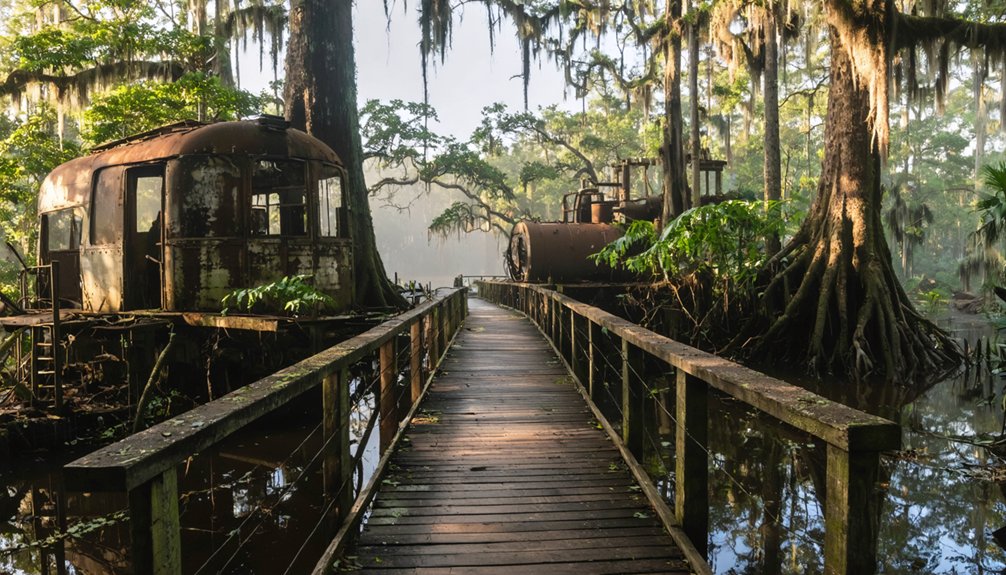
Florida’s protected preserves harbor ghost towns where nature has steadily reclaimed roads, buildings, and entire communities abandoned decades ago.
You’ll find authentic reclaimed landscapes where historical preservation meets wilderness. Sumica’s 4,031-acre tract in Polk County offers hiking through former sawmill operations, while Flamingo’s concrete foundations slowly disappear into Everglades swampland.
Canaveral National Seashore protects Eldora’s trails along Indian River Lagoon.
These sites grant you access to freedom through exploration:
- Sumica: Hike elevated railroad beds through pine flatwoods sheltering twelve rare species
- Flamingo: Navigate Hurricane Donna’s 1960 destruction within Everglades National Park
- Eldora House: Experience restored 1900s citrus-farming settlement as visitor center
You’re prohibited from disturbing artifacts—no metal detecting or digging—preserving temporal records where nature dictates terms.
Frequently Asked Questions
What Personal Belongings or Artifacts Did Residents Leave Behind When Abandoning These Towns?
You’ll find residents abandoned logging equipment, turpentine cups, old cars, and International vehicles—personal artifacts documenting their desperate exodus. Archival records reveal these resident belongings scattered across homesteads from 1901-1909, marking economic collapse and nature’s patient reclamation.
Are There Any Documented Photographs Showing These Towns Before Their Abandonment?
You’ll find limited historical photographs exist for most Florida ghost towns. Town histories rely heavily on archival records and written accounts rather than visual documentation, as photography wasn’t widely accessible during their founding periods in the 1800s.
How Long Does It Typically Take for Nature to Completely Reclaim Abandoned Structures?
Time heals all wounds—nature’s timeline spans months to centuries depending on abandonment factors. You’ll see initial vegetation within weeks, structural decay in decades, and complete forest reclamation after 100+ years. Environmental conditions and building materials accelerate or delay this process.
Were There Any Deaths or Casualties During the Mass Evacuations From These Towns?
You’ll find evacuation stories from Florida’s ghost towns rarely include casualty reports in historical archives. Most settlements emptied gradually through economic decline rather than catastrophic events, leaving sparse documentation of any deaths during residents’ departures.
Can Visitors Safely Explore Building Interiors at These Ghost Town Sites?
No, you can’t safely explore interiors. Safety guidelines prohibit interior access at protected sites like Centralia and SUMICA due to structural collapse risks, while state forest rules restrict you to exterior viewing and designated trails only.
References
- https://www.youtube.com/watch?v=DKesRivP9VU
- https://www.journaloffloridastudies.org/0102ghosttowns.html
- https://www.thetravel.com/skip-bodie-for-abandoned-ghost-towns-in-florida/
- https://fdc.com/blog/ghost-towns-in-florida/
- https://www.youtube.com/watch?v=Lv9sIPn3NgU
- https://www.freakyfoottours.com/us/florida/
- https://floridatrailblazer.com/category/ghost-towns/
- https://abandonedin360.com/abandoned-commercial-properties/winding-oaks-farms/
- https://www.ghosttowns.com/states/fl/sumica.html
- https://usgenwebsites.org/flgenweb/FLPolk/hist/Sumica.html