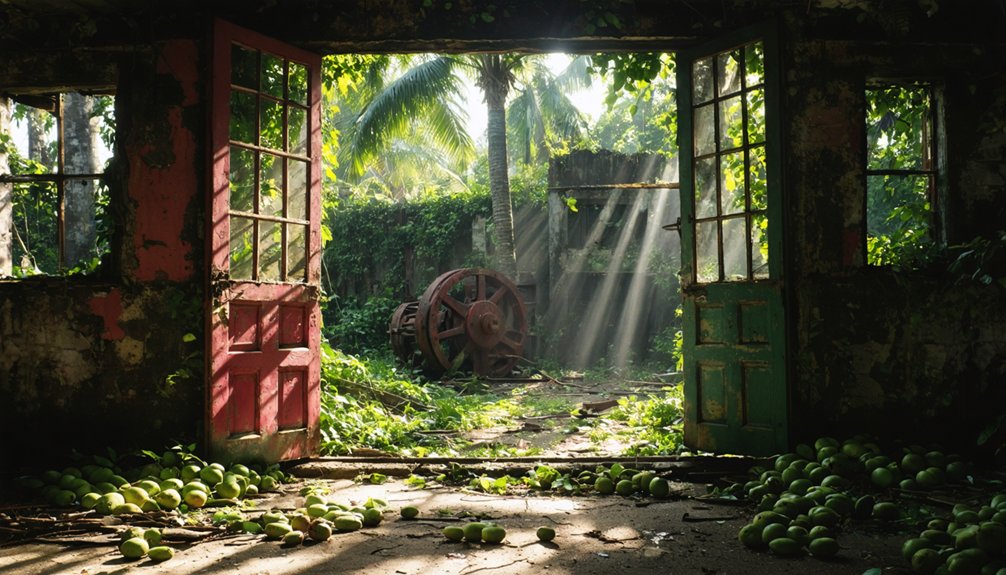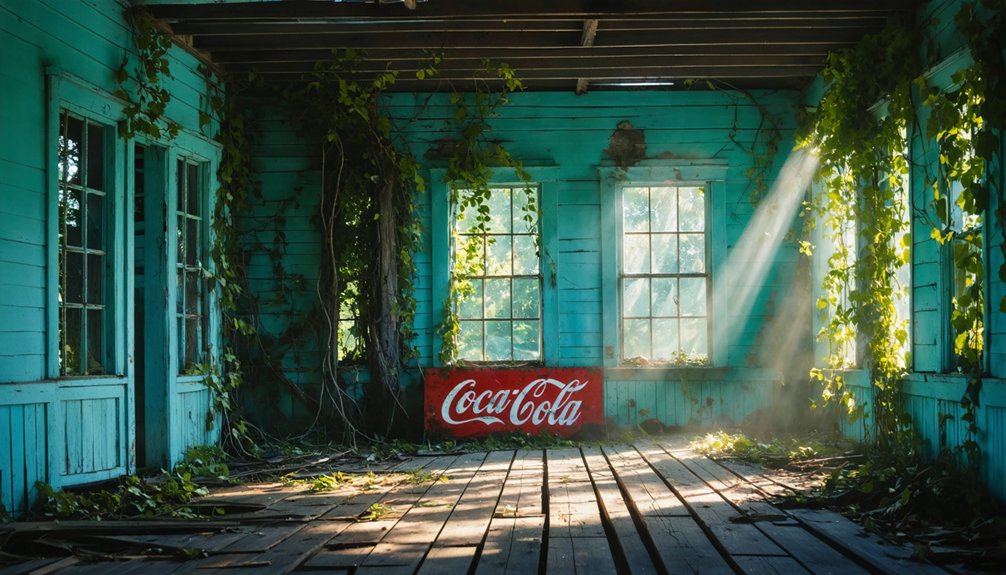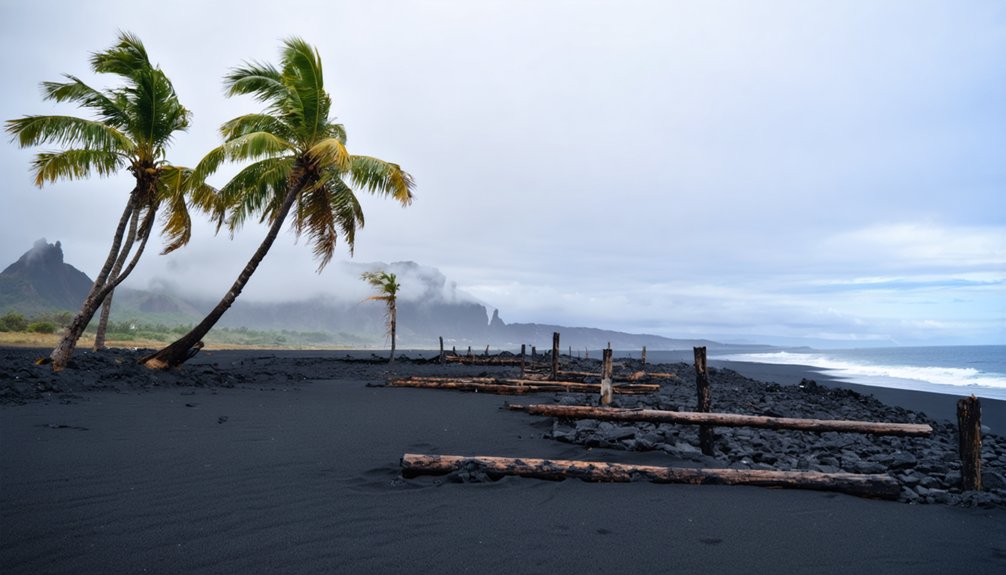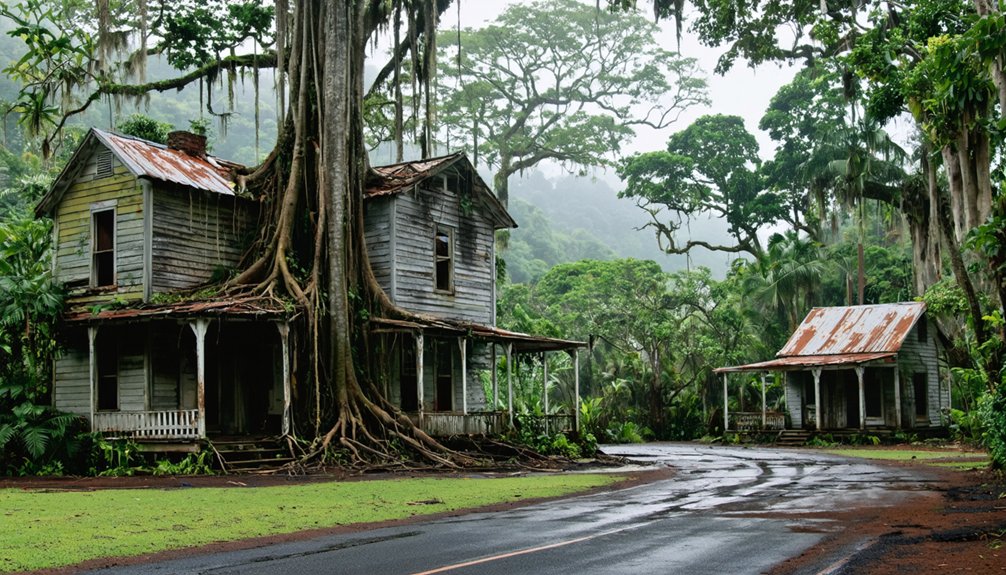
You’ll find Hawaii’s abandoned settlements disappearing beneath tropical vegetation at remarkable speed—from tsunami-devastated Waipi’o Valley (1946) to Kalapana, consumed by lava flows between 1983-1991. Within two decades, moss, vines, and native koa forests transform deserted sugar plantations like Hakalau’s 1878 mill into viridescent monuments. Archaeological evidence shows this cycle repeating across nearly two millennia, from South Point Complex (124 CE) to modern conservation sites where removing invasive species allows native ecosystems to reclaim ancestral territories with surprising resilience. The following sections reveal how cultural practitioners now harness this natural reclamation.
Key Takeaways
- 1946 tsunami forced Waipiʻo Valley evacuation; Kilauea’s lava buried Kalapana homes (1983-1991), creating abandoned settlements reclaimed by nature.
- Hawaii’s tropical climate rapidly transforms abandoned sites: moss covers surfaces in 1-2 years, structures become overgrown within twenty years.
- Sugar plantation ruins like Hakalau’s 1878 mill and Kona Development Mill remain as jungle-covered monuments to the vanished industry.
- Native plants like koa and ʻōhiʻa naturally recolonize abandoned settlements when invasive species and feral ungulates are removed.
- Abandoned areas quickly transform into thriving ecosystems as wildlife returns and vegetation envelops buildings, pavement, and infrastructure.
Ancient Hawaiian Settlements Lost to Time
Long before modern archaeology could piece together their stories, Hawaii’s earliest settlements flourished and faded into the archaeological record, leaving behind material traces that have fundamentally reshaped our understanding of Polynesian migration and adaptation.
You’ll find the most compelling archaeological discoveries at South Point Complex, where evidence dates to 124 CE, and Site H8, continuously occupied until 1868’s Mauna Loa eruption destroyed it.
The historical significance of these vanished communities extends beyond their abandonment—Hālawa Dune Site’s 496 artifacts and Nihoa’s 89 sites reveal sophisticated fishing traditions and ceremonial practices.
Lapakahi’s coastal ruins demonstrate how ancient Hawaiians established self-sufficient villages, sharing medicinal knowledge across islands. These communities supported populations estimated between 200,000 to 1,000,000 people before European contact brought devastating diseases. Nihoa and Mokumanamana together contain 45 heiau shrines, representing some of the densest concentrations of ceremonial structures in the Hawaiian archipelago.
These settlements didn’t simply disappear; they transformed into archaeological treasures documenting a millennium of Pacific Islander resilience.
Natural Disasters That Emptied Thriving Communities
When the Pacific releases its fury, even Hawaii’s most established communities can vanish within hours—a pattern of catastrophic displacement that’s reshaped the islands’ settlement geography throughout the twentieth century.
The 1946 Aleutian tsunami transformed Waipi’o Valley from a thriving settlement into desolation, waves penetrating half a mile inland and forcing mass evacuation.
Within hours, Hawaii’s Waipi’o Valley transformed from generations of settlement to abandoned wasteland beneath tsunami waves penetrating inland.
Kilauea’s relentless lava flows buried Kalapana’s 67 generational Native Hawaiian homes between 1983-1991, while Kaimū disappeared entirely beneath molten rock in 1990.
The 1960 Chile tsunami devastated Hilo’s neighborhoods, killing 61 and destroying over 500 buildings.
Hurricane Iniki’s 1992 assault damaged 14,350 dwellings across Kauaʻi.
Despite disaster impact exceeding billions in damages, community resilience proved insufficient against nature’s overwhelming force.
You’ll find hastily constructed relocation subdivisions that remained empty for decades—monuments to displacement rather than recovery. The state’s $4.6 million Kikala-Keokea subdivision, created for displaced Kalapana families, issued first leases in 1995 but sat vacant for eleven years while infrastructure issues delayed occupancy. Along the coast, Kaloko-Honokohau’s ancient fishponds and agricultural sites stand as reminders of communities that once thrived before natural forces reclaimed the land.
How Quickly Nature Reclaims Abandoned Places
Hawaii’s tropical climate accelerates abandonment’s transformation into wilderness at rates that startle mainland observers—what requires decades elsewhere happens in years across these volcanic islands.
You’ll witness moss covering surfaces within one to two years of abandonment, while vines begin their ascent up walls by year three.
The abandonment effects in places like Houtouwan demonstrate this pattern: grasses fill pavement cracks almost immediately, and within a decade, leafy branches completely envelop buildings.
The vegetation timeline proves remarkably consistent—structures that seem permanent become viridescent monuments within twenty years.
Isolation and tropical moisture accelerate this process, enabling complete submersion where forests flourish unimpeded.
Wildlife returns alongside vegetation, transforming human settlements into thriving ecosystems faster than you’d imagine possible.
Even shipwrecks demonstrate nature’s ability to create ecosystems in minimal space, with mangrove forests establishing on rusting hulls.
These abandoned sites provide valuable glimpses into how rapidly natural forces can reshape human construction, offering lessons about impermanence in our built environment.
Native Wildlife Returns to Protected Areas
When you examine Hawaiʻi’s protected areas over decades, you’ll find that systematic invasive species removal triggers measurable native wildlife recovery.
The transformation at Ka’ena Point demonstrates this pattern—after predator-proof fencing installation in 2011, seabird colonies returned to nest sites abandoned for over a century, with Laysan albatross and wedge-tailed shearwater populations establishing breeding grounds within three years.
Historical records show this recovery model extends across archipelago sites where ungulate removal and alien plant eradication created conditions for endemic forest birds like the Puaiohi and native plant communities to recolonize their ancestral ranges. These conservation efforts address the challenges posed by intentional and accidental introductions of non-native species that have historically threatened Hawaiʻi’s unique ecosystems.
Seabirds Reclaim Ka’ena Point
For thousands of years before human settlement, seabirds dominated Ka’ena Point‘s windswept dunes, but decades of predation by invasive mammals nearly erased their presence from Oahu’s western tip.
Dogs, feral cats, mongoose, and rats devastated ground-nesting colonies, driving chick mortality to 15% and forcing temporary abandonment of traditional nesting sites.
The Ka’ena Point Ecosystem Restoration Project changed everything through predator management—a predator-proof fence now shields one of the largest seabird colonies in the main Hawaiian Islands.
You’ll find extensive monitoring by state and university biologists tracking the recovery, with Pacific Rim Conservation managing all seabird nesting restoration.
Ancient campfire bones prove early Hawaiians coexisted with these colonies, but today’s fence technology offers something unprecedented: a future where federally protected species reclaim their ancestral territories without human interference.
The 2m tall fence encloses 20ha of coastal habitat, creating a sanctuary where native plants and nesting seabirds can flourish without the threat of feral predators. The reserve also serves as pupping grounds for endangered Hawaiian monk seals, adding another layer of ecological significance to this restored coastal ecosystem.
Alien Species Removal Benefits
Though predator fences protect seabird colonies from immediate threats, Hawaii’s most transformative ecosystem recoveries have emerged from systematic removal of invasive species across entire landscape units.
You’ll find Lehua Island stands as proof—achieving 99.99% rat eradication certainty enabled fourteen native plants to return, eleven existing nowhere else on Earth.
Within fenced preserves on Hawaiʻi Island, ungulate removal triggered Acacia koa recovery while targeted herbicide campaigns reduced alien fountain grass by 90%.
This multi-pronged approach restored species diversity that decades of passive protection couldn’t achieve.
Native canopy trees now regenerate where cattle once trampled seedlings, and endemic understory plants reclaim ground from fire-promoting grasses.
The island’s seasonal bird populations now swell to hundreds of thousands, demonstrating how ecosystem restoration cascades beyond initial target species.
True ecosystem balance requires active intervention, not wishful thinking about nature’s resilience.
Expanding Plant Diversity Returns
Since systematic invasive species removal began transforming Hawaii’s degraded landscapes, archival botanical surveys reveal what passive protection alone couldn’t achieve: native plant communities expanding beyond their refugia for the first time in a century.
You’ll find native plant restoration accelerating where feral ungulates no longer trample seedlings and alien grasses can’t outcompete indigenous species.
Forest managers document koa and ‘ōhi’a naturally recolonizing abandoned settlements, their canopies creating conditions for understory natives that haven’t flourished since the 1800s.
This ecological diversity enhancement doesn’t require micromanagement—just removal of what prevents nature’s recovery.
The botanical record confirms what early conservationists suspected: Hawaii’s native ecosystems possess remarkable resilience when you eliminate the invasive pressures that triggered their collapse.
Forgotten Industrial Sites Across the Big Island
While the bustling sugar industry once dominated Hawaii’s Big Island economy, decades of industrial decline have left behind scattered ruins that now serve as silent monuments to a vanished era.
You’ll find Hakalau’s 1878 plantation swallowed by jungle, where workers once processed 16,000 tons annually. Near Kailua, Kona Development Mill‘s cable systems and massive molasses tanks mark Judge Hart’s 1869 venture that collapsed in 1926.
Industrial archaeology reveals how tsunamis devastated Hilo’s railroad infrastructure in 1946, ending an elaborate transport network of tunnels and trestles.
At Punalu’u, C. Brewer & Co.’s abandoned resort deteriorates on black sand beaches.
These sites represent significant heritage conservation opportunities, documenting how water shortages, bankruptcy, and natural disasters transformed Hawaii’s economic landscape while nature reclaims what industry left behind.
Preserving Cultural Heritage Through Ecosystem Restoration
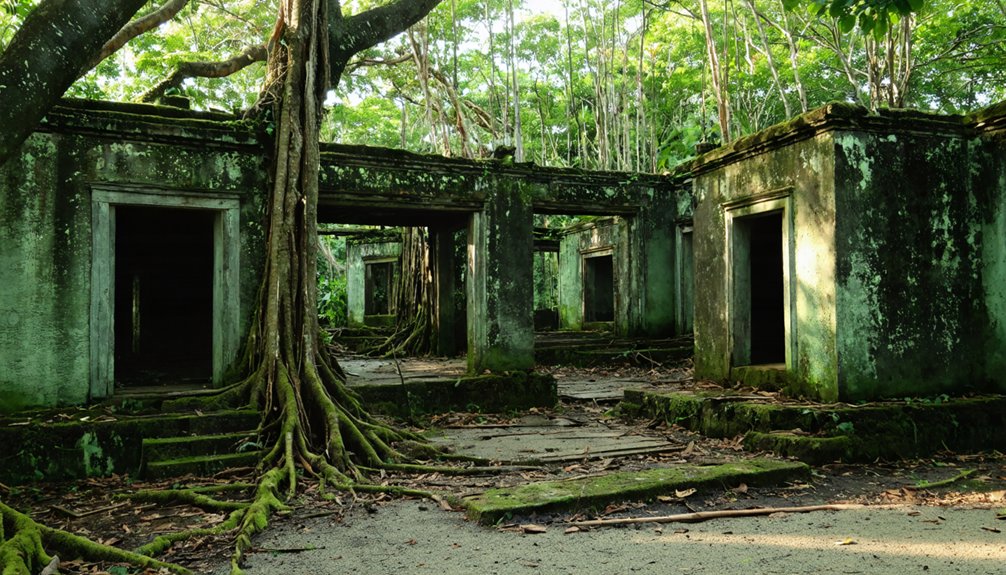
Across Hawaii’s abandoned industrial landscapes, ecosystem restoration projects now reconstruct ancestral food systems that sustained Native Hawaiian communities for centuries before plantation economies transformed the islands.
You’ll find Hawaiʻi Land Trust reviving a 15th-century aquaculture site at Waiheʻe Coastal Dunes, where ancestral knowledge guides the restoration of loko iʻa kalo—traditional fishponds and taro patches that feed communities while supporting native species.
Core sampling reveals ancient pollen preserved in extinct crab claws, directing replanting efforts to prevent sedimentation.
These cultural practices demonstrate nature-based solutions superior to modern infrastructure. Ancient Hawaiian wetland systems captured sediment and nutrients before reaching the ocean, a principle now informing Ala Wai Canal proposals.
Twenty years of conservation in Papahānaumokuākea proves integrating traditional Native Hawaiian methods succeeds where conventional approaches fail, offering you pathways toward ecological and cultural sovereignty.
Frequently Asked Questions
Are Any of Hawaii’s Ghost Towns Accessible to Visitors Today?
While Kalaupapa remains locked behind bureaucratic gates, you’ll find Kaluakoi Resort accessible for urban exploration. Historical preservation hasn’t reached this abandoned Sheraton, where nature’s reclaiming overgrown grounds—offering photographers and freedom-seekers unrestricted access since 2001’s closure.
What Artifacts Remain in Abandoned Hawaiian Settlements?
You’ll find historical artifacts like stone tools, fishing gear, and temple structures throughout abandoned Hawaiian settlements. These remnants hold profound cultural significance, documenting centuries of island life before communities departed their ancestral lands.
Can Former Residents Return to Live in Reclaimed Areas?
You can’t return—like Eden’s gates, these lands remain closed. Federal designations controlling land use prevent resettlement, prioritizing historical preservation and minimal environmental impact over your freedom to reclaim ancestral homes once claimed by nature.
How Do Authorities Prevent Looting at Abandoned Historical Sites?
You’ll find looting prevention relies on regular monitoring crews, protective buffer zones, and regulatory signage. Historical preservation works through State Historic Preservation Division oversight, requiring approved plans before you’re allowed to access or modify protected sites.
What Dangers Exist When Exploring Hawaii’s Ghost Towns?
You’ll face structural instability from decaying buildings and unstable platforms that’ve deteriorated over decades. Wildlife hazards include venomous centipedes, aggressive wild boars, and hidden wasps’ nests. Historical evidence shows collapsed structures and abandoned infrastructure pose the greatest documented risks.
References
- https://nvtami.com/2023/04/26/big-island-hawaii-ghost-towns/
- https://dlnr.hawaii.gov/ecosystems/nars/oahu/kaena/ecosystem-restoration/
- https://www.bbcearth.com/news/abandoned-places-reclaimed-by-nature
- https://www.youtube.com/watch?v=q56mo4VCXtE
- https://www.geotab.com/ghost-towns/
- https://www.onlyinyourstate.com/experiences/hawaii/abandoned-hi
- https://en.wikipedia.org/wiki/List_of_ghost_towns_in_Hawaii
- https://www.youtube.com/watch?v=Z52teax9Muk
- https://kids.kiddle.co/List_of_ghost_towns_in_Hawaii
- https://en.wikipedia.org/wiki/Ancient_Hawaii