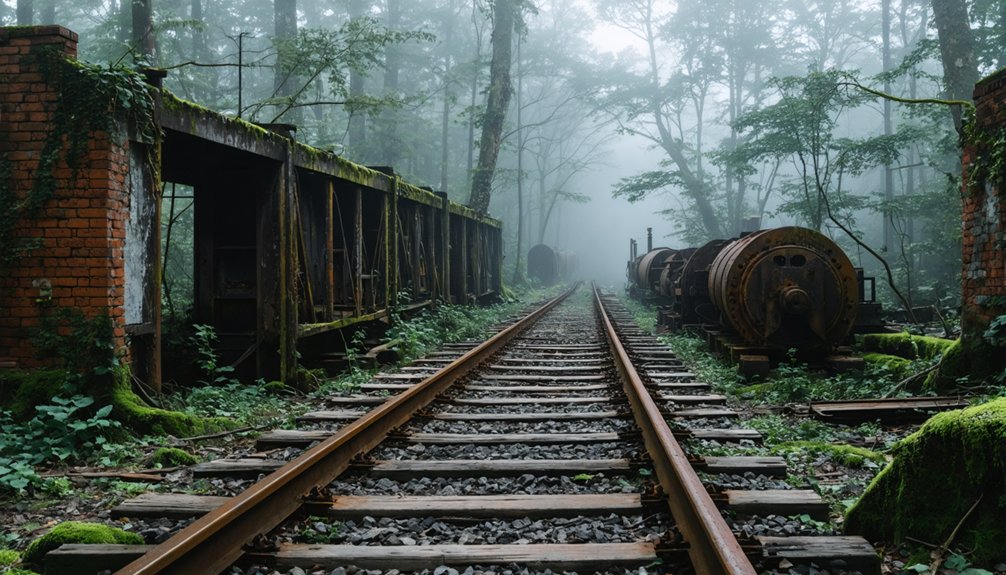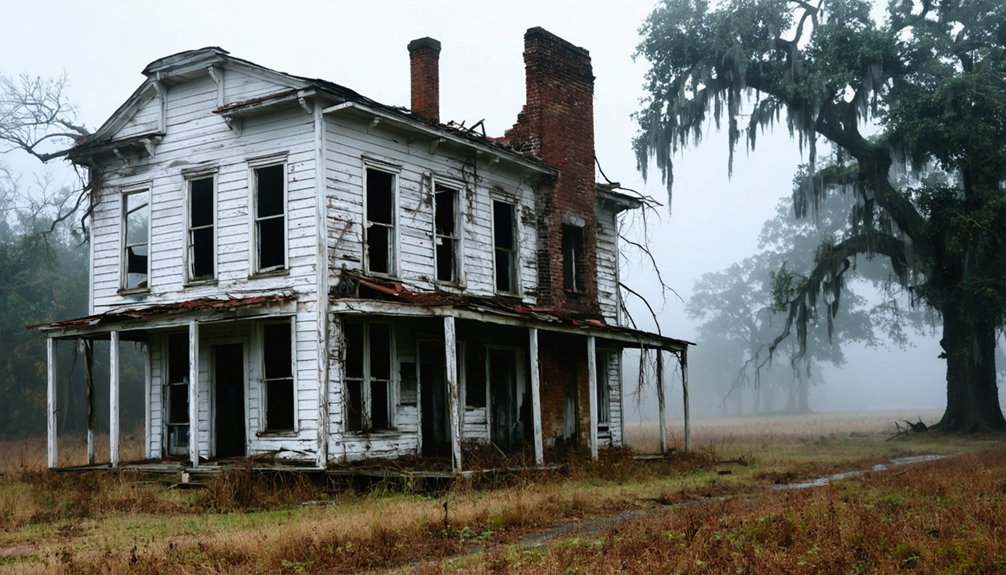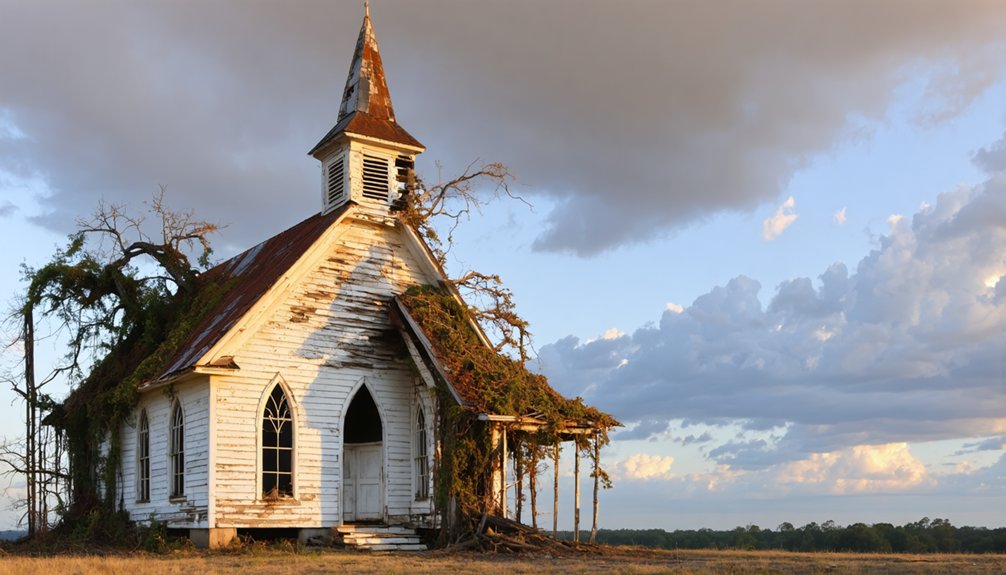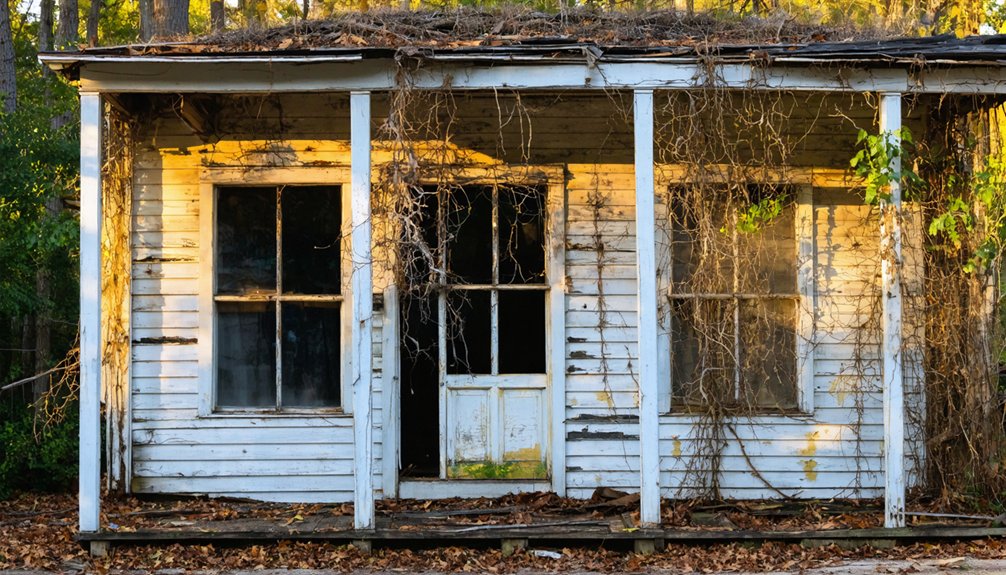
Georgia’s ghost towns vanish beneath nature faster than their Western counterparts, as forests reclaim what industry abandoned. You’ll find Scull Shoals’ 1782 mill ruins overtaken by Oconee River vegetation, while Sweetwater Creek’s forest has enveloped New Manchester’s five-story textile mill since Union forces destroyed it in 1864. Auraria’s gold rush legacy from 1828 now hides beneath dense foliage, and Pine Mountain Valley’s 210 New Deal homesteads gradually surrender to wilderness. Each site reveals how Georgia’s aggressive growth accelerates industrial memory’s disappearance beneath a green canopy.
Key Takeaways
- Sweetwater Creek’s dense forest has enveloped New Manchester Manufacturing mill ruins since Union forces destroyed it in 1864.
- Scull Shoals’ 1782 industrial complex along the Oconee River now lies preserved as ruins within Oconee National Forest.
- Auraria’s gold rush settlement, once housing over 1,000 miners, declined after 1849 leaving scattered remnants behind.
- Pine Mountain Valley’s 1934 New Deal community structures stand partially abandoned, with nature reclaiming former homestead units.
- Vegetation now controls the millrace channel at Sweetwater Creek, demonstrating ecological balance over former industrial operations.
Auraria: Georgia’s Forgotten Gold Rush Town
The discovery of gold at the Calhoun Mine in 1828 set in motion a frenzy that would reshape Georgia’s northeastern frontier and establish the nation’s first true gold rush.
Auraria history began when William Dean built the first cabin in 1832, and the settlement quickly swelled beyond 1,000 fortune-seekers. You’ll find this predated California’s famous rush by twenty years.
Gold mining operations extracted $20 million from Cherokee country between 1829-1839, employing placer techniques along the Chestatee and Etowah rivers.
The town’s decline proved inevitable—Dahlonega claimed the courthouse in 1833, California’s strikes lured miners westward by 1849, and depleted deposits sealed Auraria’s fate. In 1858, the Russell boys departed Georgia and established a new Auraria near Cherry Creek, which would eventually become Denver, Colorado.
Today, crumbling foundations mark America’s first ghost town. Woody’s Store, closed since the 1980s, stands as a prominent landmark among the remnants.
Scull Shoals: Mill Town Ruins Along the Oconee River
Along Scull Shoals history, frontier settlers carved Georgia’s most ambitious industrial experiment from wilderness beside the Oconee River in 1782.
You’ll find where Georgia’s first paper mill operated alongside cotton gins and textile factories that employed 600 workers by 1840. Dr. Thomas Poullain‘s empire commanded 145 slaves and 1,620 acres, transforming frontier outpost into thriving industrial center.
The 1887 flood destroyed this prosperity forever, sweeping away bridges and hundreds of cotton bales while spoiling grain stores.
Nature’s reclamation accelerated after residents abandoned their waterlogged town.
Today’s Oconee National Forest preserves these crumbling foundations where prehistoric mounds remind you that civilizations rise and fall along these riverbanks, leaving freedom-seekers to wander ruins reclaimed by Georgia pines.
New Manchester Manufacturing: Civil War Cotton Mill Remains
You’ll find New Manchester’s five-story textile mill operated as one of North Georgia’s most modern facilities from 1849 until Union General Sherman’s forces burned it in July 1864, ending its role producing Confederate uniforms and displacing its workforce of women and children northward.
The site’s strategic importance along Sweetwater Creek—where a 25-ton waterwheel powered looms processing cotton from Atlanta and Marietta—made it a deliberate target during the Atlanta Campaign, reflecting the Union’s systematic destruction of Southern industrial capacity.
Today’s stabilized brick ruins within Sweetwater Creek State Park document both the antebellum South’s textile manufacturing infrastructure and the long-term ecological processes that transformed abandoned industrial sites into forested landscapes over 160 years. The crumbling walls have been overgrown by dense foliage since the mill’s abandonment, creating a atmospheric setting that served as a filming location for the Hunger Games movie franchise. The park’s exhibits highlight the stories of enslaved workers who built the mill’s infrastructure, including the brick and lumber work that created the facility.
Wartime Cotton Mill Operations
When Confederate authorities contracted the Sweetwater Manufacturing Company in 1861 to produce uniform materials, they transformed a commercial enterprise into a military asset that would ultimately seal its fate.
The factory’s cotton production shifted from commercial fabrics to muslin and osnaburg cloth for army uniforms, making it one of Georgia’s largest wartime manufacturers.
You’ll find that wartime labor patterns reflected broader societal upheaval—nearly 100 workers, mainly women and children, operated the machinery while men fought.
The 25-ton waterwheel continued driving spindles as wagons hauled raw cotton from Atlanta warehouses.
By 1863, local militia protected the facility from robbers, recognizing its strategic value.
This military significance, however, marked the mill as a Union target during Sherman’s 1864 Atlanta Campaign, ending its operational independence.
The ruins remained untouched for over 150 years, standing as a testament to the destructive path of Sherman’s forces through Georgia.
Following years of weathering and deterioration, Aegis Restauro, LLC began a three-month stabilization project to preserve the historic structure for future generations.
Post-War Fire Destruction
Sherman’s orders to destroy Georgia’s manufacturing infrastructure reached New Manchester on July 2, 1864, when Union cavalry occupied the mill without resistance.
Troops initially disabled machinery by removing belt systems, then returned July 9th to complete the destruction.
You’ll find the fire aftermath particularly devastating: soldiers poured flammable liquids across all five floors before ignition, reducing Georgia’s tallest building to ruins.
Worker Displacement Impact:
- Nearly 100 residents, mainly female workers and children, faced immediate detention
- 600 women and children endured forced marches to Marietta for northern deportation
- Many perished from starvation and exposure in overcrowded refugee towns
- Most surviving women never returned, settling permanently in northern states
The scorch-marked brick walls standing in Sweetwater Creek State Park represent liberty’s cost.
During a WWII scrap drive, crews removed the mill’s remaining machinery from the ruins, eliminating the last vestiges of New Manchester’s industrial past.
The mill had been highly profitable before its destruction, with Confederate Army orders totaling nearly $25,000 in 1860.
Nature’s Forest Reclamation
Since the Union’s 1864 destruction, Sweetwater Creek’s forest has waged its own campaign against New Manchester’s brick walls, transforming what once stood as North Georgia’s tallest building into a grotto-like monument to nature’s patient persistence.
You’ll find forest succession slowly dismantling the five-story structure that slaves built between 1846-1849. Dense Georgia foliage now claims what 90 workers once occupied, producing Confederate cloth and muslin.
The millrace channel—engineered to harness Sweetwater Creek’s power—still cuts through the landscape, though vegetation controls the flow now.
This ecological balance between human ambition and natural reclamation draws you along trails like the Red Trail, where stabilized ruins reveal how wilderness ultimately reclaims even the most imposing industrial monuments.
Park rangers access the fenced complex for those seeking tangible proof of nature’s sovereignty.
Pine Mountain Valley: The New Deal Community That Faded Away
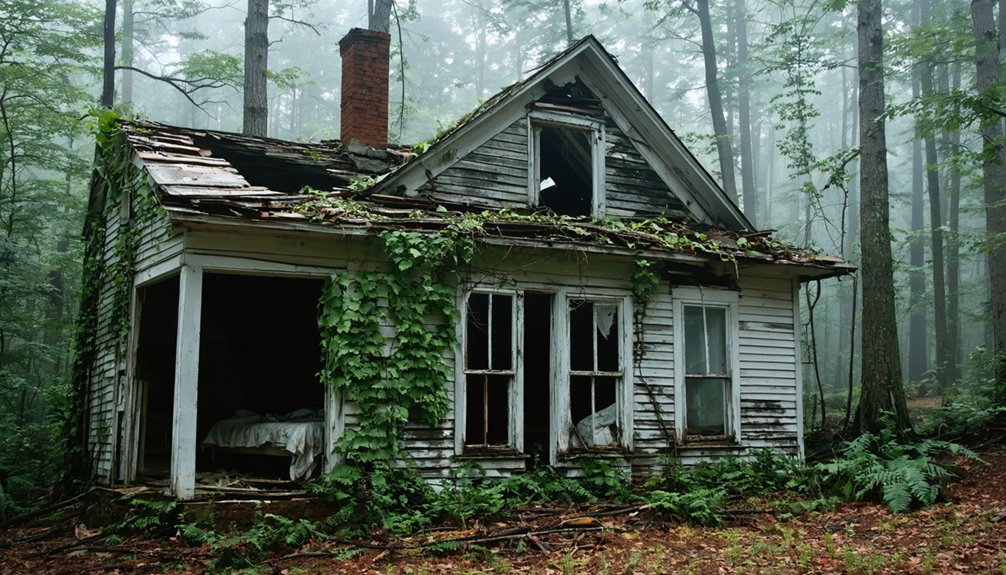
During the depths of the Great Depression, the Federal Emergency Relief Administration launched Pine Mountain Valley in November 1934 as the largest of three rural-industrial communities designed to test Franklin D. Roosevelt’s Community Resettlement principles.
This ambitious New Deal experiment in Harris County relocated impoverished families, providing them homes and agricultural work across 210 homestead units.
The community featured:
- Dairy, hog, and poultry operations alongside cotton and grain farms
- Testing grounds for preventing unprofitable farming practices
- Integration of rural and industrial employment opportunities
- Federal oversight through the Resettlement Administration and Works Progress Administration
Congressional support evaporated with World War II‘s onset, and operations ceased by 1945.
Today, descendants of original settlers still occupy Valley Houses, while a 2002 historical marker commemorates this failed utopian vision of government-directed relocation and economic rehabilitation.
Bridgeboro: Where the Railroad Giveth and Taketh Away
When the Georgia General Assembly incorporated Bridgeboro in Worth County in 1912, legislators codified what railroad developers had already determined: this junction possessed sufficient economic promise to sustain a permanent settlement.
The limestone quarry reinforced this assessment, creating dual economic foundations that attracted workers and merchants seeking opportunity beyond established constraints.
The quarry and railroad junction formed complementary economic pillars that drew ambitious settlers beyond conventional opportunities.
Yet railroad impact proved double-edged. When transportation networks shifted routes elsewhere, Bridgeboro’s commercial infrastructure collapsed with remarkable speed.
The quarry’s subsequent abandonment eliminated the community’s final economic anchor. Today, scattered ruins mark where community resilience ultimately couldn’t overcome geographic isolation and economic obsolescence.
Weathered foundations and vegetation-choked structures demonstrate how quickly nature reclaims settlements once human activity ceases, transforming incorporated towns into historical footnotes accessible only through archival documentation.
Decatur Waterworks: Industrial Decay Meets Urban Exploration
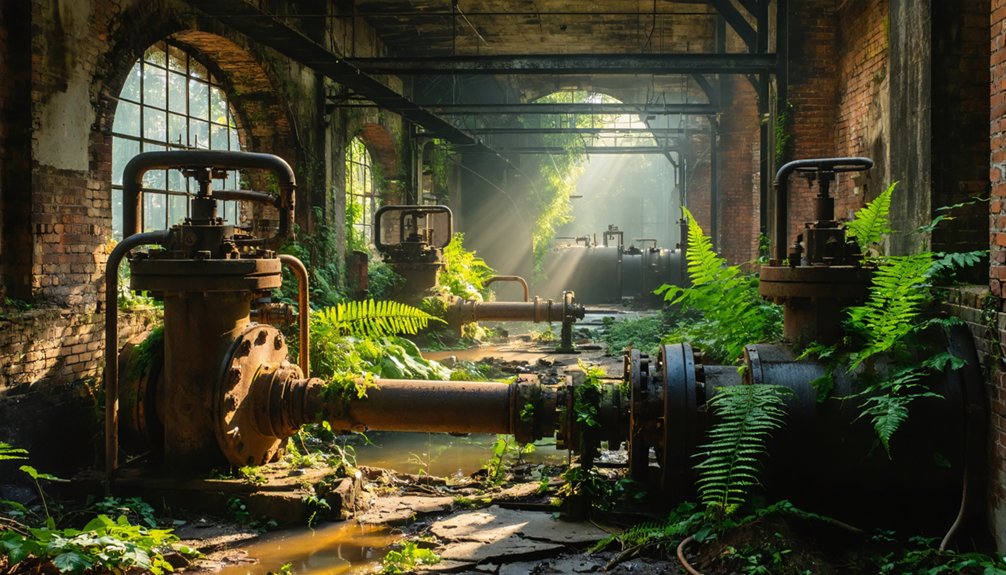
While Bridgeboro’s decline illustrates abandonment through geographic marginalization, the Decatur Waterworks reveals a different trajectory—industrial obsolescence within expanding urban boundaries.
Built in 1907 for $46,517, this facility supplied one million gallons daily before DeKalb County’s 1941 lease rendered it redundant. By the 1950s, neglect consumed the infrastructure, and flooding complaints prompted officials to demolish the dams in the mid-1960s.
Today’s waterworks history intersects with unconventional freedom:
- Industrial heritage transformed into “The Ruins,” Atlanta’s premier graffiti destination
- National Register recognition in 2006 legitimized its cultural significance
- PATH Foundation trail integration enables unrestricted public access
- Concrete tanks showcase layered murals, documenting decades of unauthorized artistic expression
This adaptive reuse demonstrates how communities reclaim obsolete infrastructure, converting municipal control into creative liberation.
Frequently Asked Questions
Are These Ghost Towns Safe to Visit on Your Own?
Solo exploration risks vary considerably—Sparta’s 1 in 435 victimization rate demonstrates real dangers. You’ll need proper safety precautions when visiting abandoned sites with crumbling structures, vegetation-obscured hazards, and documented crime activity in certain locations.
Can You Legally Explore and Photograph These Abandoned Georgia Sites?
You’ll navigate complex legal considerations before exploring Georgia’s ghost towns. Photography permissions depend on land ownership—public sites allow non-destructive documentation, while private property requires owner consent. Historic preservation sites mandate guided access, protecting your freedom through proper channels.
What Wildlife Might You Encounter at These Reclaimed Ghost Towns?
You’ll encounter white-tailed deer, wild turkeys, and various songbirds across these sites. Historical records show diverse wildlife species returning as forests reclaim settlements, demonstrating nature’s ecological impact through decades of undisturbed regeneration and habitat restoration.
Do Any of These Locations Offer Guided Tours or Visitor Facilities?
None offer guided experiences or visitor amenities—you’ll find only wilderness reclaiming history. These sites remain deliberately unmanaged, preserving their authenticity while granting you complete freedom to explore ruins independently through Georgia’s forests.
What’s the Best Time of Year to Visit Georgia’s Ghost Towns?
You’ll find the best seasons are late September through October when weather conditions offer mild temperatures and clear skies. This shoulder period provides accessible mountain roads, fewer crowds, and ideal visibility for exploring abandoned structures before winter limits trails.
References
- https://everafterinthewoods.com/these-forgotten-ghost-towns-in-georgia-are-hauntingly-beautiful/
- https://www.ezhomesearch.com/blog/ghost-towns-in-georgia/
- https://www.onlyinyourstate.com/trip-ideas/georgia/ga-abandoned-places-road-trip
- https://www.atlasobscura.com/things-to-do/georgia/abandoned
- https://www.fireflymadison.com/2022/08/31/ghost-towns-in-georgia/
- https://www.rferl.org/a/georgia-abkhaz-ghost-town-photos/32521040.html
- https://www.youtube.com/watch?v=OfhPAHTOkJE
- https://www.freakyfoottours.com/us/georgia/
- https://sites.rootsweb.com/~gaghstwn/
- https://www.georgiahistory.com/ghmi_marker_updated/auraria/