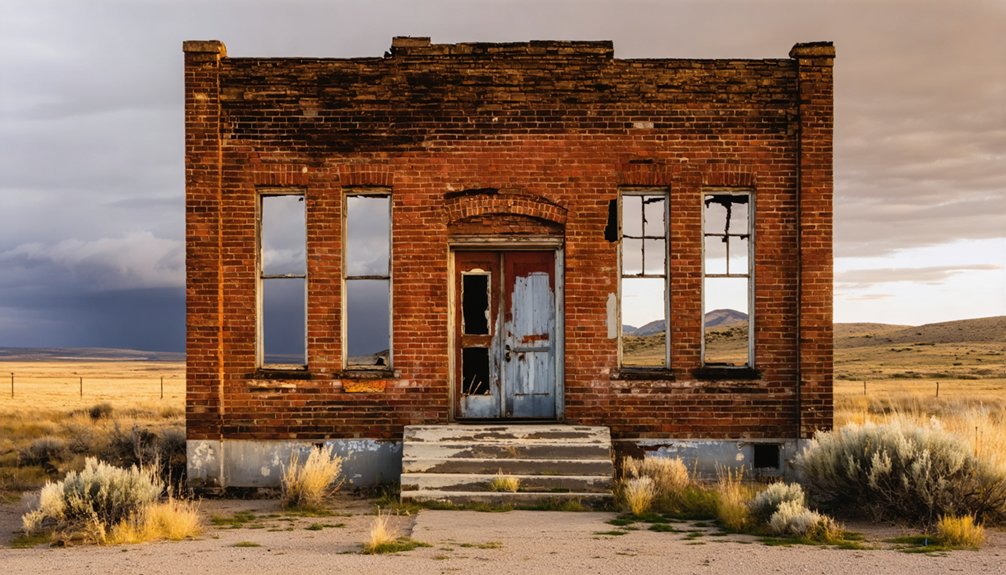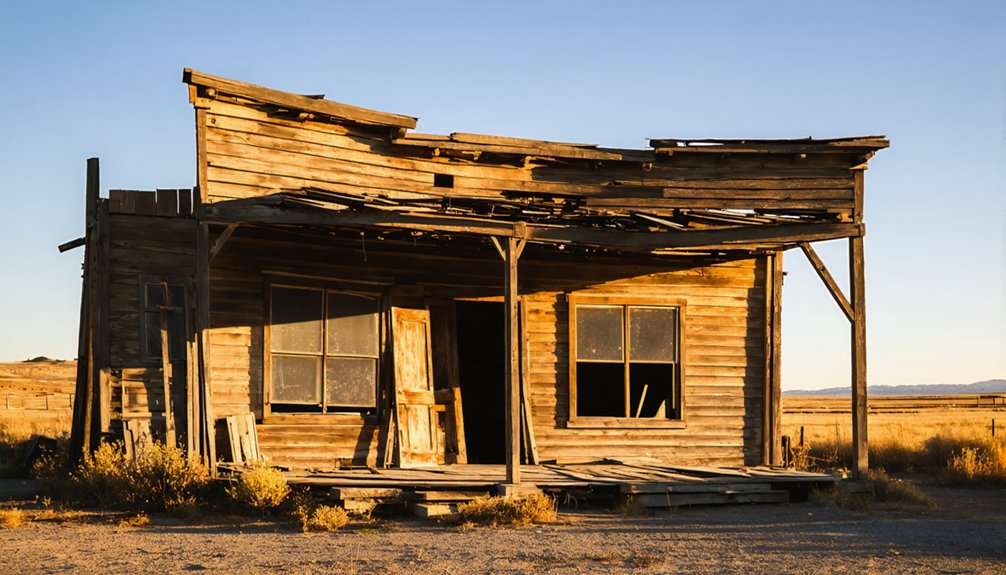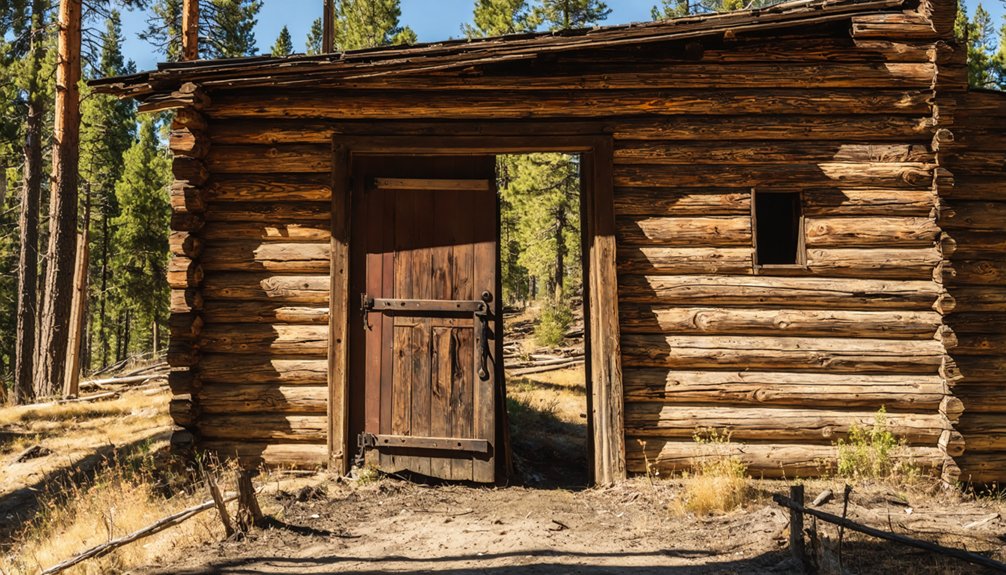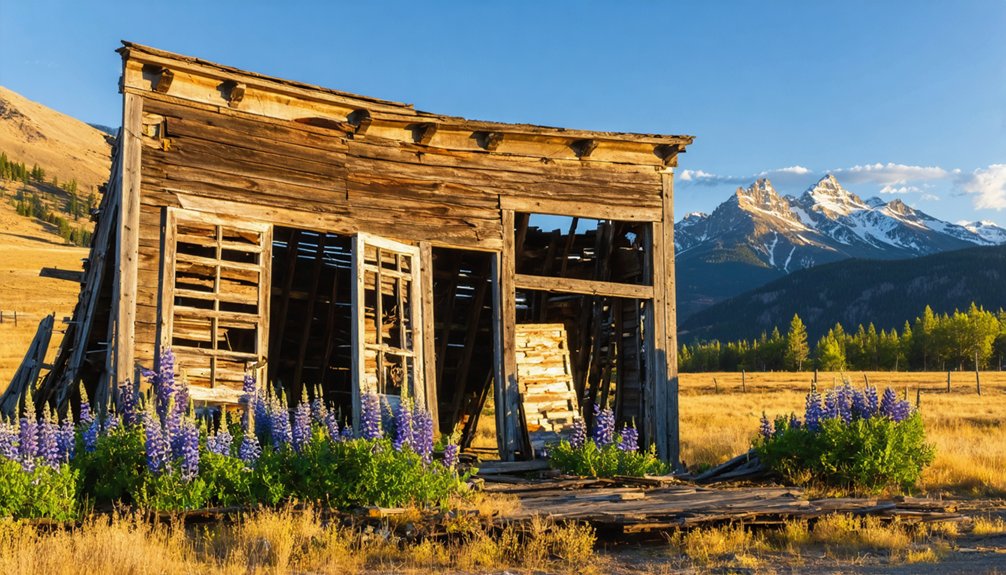
Idaho’s ghost towns are slowly surrendering to nature, though the state’s arid climate has remarkably preserved wooden structures from the 1860s far longer than you’d expect. Towns like Burke, which declined from hundreds of residents to just 15 after its 1991 mine closure, now see lodgepole pines and sagebrush reclaiming canyon spaces once filled with miners’ homes. Meanwhile, Rocky Bar battles harsh winters and Leesburg contends with swamp-like conditions that accelerate nature’s advance. The contrast between preservation and decay reveals how climate fundamentally shapes these settlements’ fates.
Key Takeaways
- Idaho’s arid climate slows natural reclamation, with minimal moisture limiting decay and preserving ghost town structures in suspended animation.
- Burke’s population declined from hundreds to 15 by the 1990s, with nature now overtaking abandoned mining structures and homes.
- Leesburg experiences swamp-like conditions that displace buildings and promote aggressive vegetation growth, accelerating natural reclamation processes.
- Over 9,000 contaminated sites remain across Idaho’s mining regions, requiring ongoing federal environmental restoration efforts to reclaim landscapes.
- Rocky Bar’s abandonment resulted from harsh winters, while Silver City’s arid climate preserves wooden structures from the 1860s.
The Golden Era: Mining Booms That Built Idaho’s Mountain Communities
When prospectors struck gold at Pierce in Clearwater County during 1860, they triggered a transformation that would reshape Idaho’s economic and political landscape for generations.
The 1860 Pierce gold strike ignited Idaho’s transformation, reshaping its economic and political destiny for generations to come.
You’ll find that 5,000 fortune-seekers descended by July 1861, creating enough momentum to establish Idaho Territory. These gold rushes weren’t isolated events—they cascaded from Pierce to Florence, Warren, and the massive Boise Basin, where 20,000 miners worked claims during 1863-1864.
Idaho’s mining heritage produced staggering wealth: 19% of America’s gold between 1860-1866.
The Coeur d’Alene district alone generated $2.88 billion in metals by 1969, representing 80% of Idaho’s total metallic output.
Thunder Mountain’s 1900-1907 boom and Wood River’s silver-lead discoveries in 1879 sustained this prosperity well into the twentieth century. Prospectors like Al Hennessey worked the area from Roosevelt to Yellow Pine, contributing to the region’s expansion during this era. Mining remained the state’s major commercial venture through the mid-1860s, with Andrew Henry initiating the first significant European economic activity through fur trading in 1810.
When the Ore Ran Out: Understanding Town Abandonment Patterns
The prosperity that brought 20,000 miners to Idaho’s mountains proved fragile once ore deposits played out. Economic factors triggered rapid collapse: when production costs exceeded mineral values, investors abandoned unprofitable operations for better opportunities elsewhere.
Price crashes from oversupply devastated remaining ventures. You’ll find over 6,000 people fled Shoshone County alone—a third of its population vanishing as demographic changes reshaped the region. Families who’d migrated during boom times departed en masse, leaving communities gutted.
Today, these areas lead Idaho in unemployment and poverty, ranking dead last in per capita income. The region experienced devastating suicide rates alongside economic decline, marking the social toll of industrial collapse. Most abandonments occurred before responsible reclamation existed, leaving behind 9,000 contaminated sites and 1,800 physical hazards.
Open shafts, toxic tailings, and crumbling structures mark where freedom-seeking prospectors once built thriving communities. The Idaho Geological Survey began documenting these hazards in 1996, mapping locations and recording individual mine histories through video and photography.
Burke: A Canyon Town Surrendering to the Forest
When you examine Burke’s final decades, you’ll find that the 1991 mine closure marked the definitive end of a century-long extraction economy that had sustained up to 1,400 residents.
The town’s population collapse from hundreds of miners to merely 15 inhabitants by the 1990s left multi-story buildings, railroad infrastructure, and hillside cave dwellings to face the forest’s relentless advance.
Today’s landscape reveals how quickly nature reclaims even the most industrially scarred terrain—forested hillsides now obscure mining equipment, twisted tracks, and an unmarked cemetery where Burke’s workers once lay beneath identifiable headstones. The town’s unique construction within Burke Canyon, only 300 feet wide in some areas, created an environment where buildings were squeezed tightly against canyon walls, making the forest’s encroachment even more dramatic. The Tiger Mine, discovered in May 1884 and sold for $35,000, initiated the silver and lead extraction that would define Burke’s economy for over a century.
Mine Closure and Abandonment
After the Tiger and Poorman claims sparked Burke’s mining boom on May 2, 1884, over seventy mining operations rapidly established themselves along Canyon Creek’s narrow confines, transforming the remote gulch into one of the Silver Valley’s most productive districts.
You’ll find that mine impacts extended beyond simple extraction—labor strikes beginning in 1890 revealed fundamental conflicts between worker autonomy and corporate control, while wage cuts and armed confrontations demonstrated the human costs of economic shifts.
The Hercules Mine’s 1925 closure foreshadowed broader decline, though operations continued until 1991 when the last mine shut down.
Burke’s century-long mining era ended not from sudden catastrophe but from systematic depletion of rich ore veins that once made the Coeur d’Alene district America’s premier silver producer.
The decades of crude milling practices and mineral recovery rates below 75% left behind toxic tailings that would later necessitate federal Superfund designation for the entire Silver Valley region.
Today, historical markers and mine remains serve as reminders of Burke’s industrial past while environmental restoration efforts work to reclaim the canyon’s natural landscape.
Nature’s Gradual Takeover
Burke’s extreme canyon geography—a mere 300 feet wide at points—created architectural oddities that now crumble under nature’s resilience. The Tiger Hotel once straddled railroad tracks with a stream flowing through its lobby; fires claimed it in 1954.
Homes carved into canyon walls deteriorate as forests reclaim their foothold, demonstrating urban decay’s inexorable progression.
You’ll find massive mining structures still resisting time’s erosion, though wooden houses cling precariously to steep walls. A grove of trees marks where the old town road ended, while overgrowth slowly engulfs commercial buildings that survived the devastating 1923 fire. The final mining operations in Burke ceased in 1991, leaving behind structures that now quietly succumb to encroaching vegetation. The catastrophic blaze left 600 residents homeless and destroyed over 50 commercial buildings, fundamentally altering the town’s trajectory.
Despite fencing and no-trespassing signs protecting private property seven miles up a deteriorating backroad from Wallace, nature’s advance continues unimpeded, transforming Burke into a monument to impermanence.
Rocky Bar’s Battle Against Wilderness and Winter
Rocky Bar’s prosperity ended not with a single catastrophe but through winter’s relentless siege on a settlement that dared exist 62 miles northeast of Mountain Home in Idaho’s backcountry.
Rocky Bar’s history reveals how isolation became weaponized by brutal snowfall—Charles Sprittles died in 1964 snowshoeing just five miles, his frozen body discovered three months later when searchers unknowingly lunched atop his snow-covered remains.
Peg Leg Annie lost both legs carrying a friend through a blizzard, yet survived in her standing cabin as testimony to human defiance.
Nature’s encroachment accelerated after the devastating 1892 fire and depleted mines drove population from 2,500 to mere hundreds.
Today you’ll find Peg Leg Annie’s abandoned cabin surrendering to forest, tangible evidence that wilderness always reclaims what humans can’t defend year-round.
How Idaho’s Arid Climate Preserves Wooden Relics
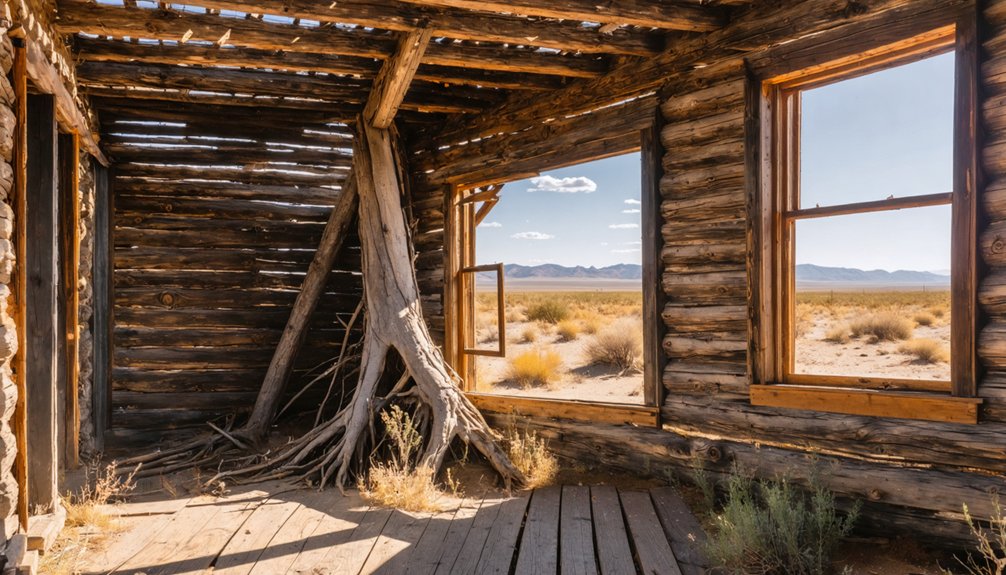
While Rocky Bar’s cabins crumbled under winter’s assault, ghost towns scattered across Idaho’s arid southern deserts tell a different preservation story—one where wooden structures from the 1860s still stand defiant against time’s erosion.
You’ll find wood preservation thrives when moisture content drops below 19%, the critical threshold where fungi and decay organisms can’t survive. Idaho’s desert conditions maintain this naturally, creating accidental museums of frontier architecture.
Temperature extremes—swinging from below 35°F to above 100°F—further inhibit biological degradation, while dampwood termites and other insects find no foothold in the desiccated timber.
These arid environments fundamentally mummify wooden relics. Buildings that would’ve collapsed within decades in humid climates instead endure for centuries, their boards weathered but structurally sound—silent monuments to nature’s preservation capabilities.
Natural Forces Reshaping Abandoned Settlements
You’ll notice that abandoned Idaho settlements face competing natural forces—while the state’s arid climate preserves wooden structures in places like Silver City, moisture-rich zones such as Leesburg reveal entirely different outcomes.
Here, swamp-like conditions have displaced butcher shop floors and sustained aggressive vegetation that now engulfs nearly every standing wall and foundation.
This divergence demonstrates how local microclimates, shaped by proximity to waterways like Napias Creek and the humidity trapped in mountain crevices, determine whether ghost towns mummify or disappear beneath green overgrowth.
Vegetation Engulfs Mining Structures
Across Idaho’s abandoned mining settlements, vegetation advances relentlessly through wooden structures, metal frameworks, and earth scarred by extraction.
You’ll witness this transformation at Leesburg, where over 400 miles of ditches carved for placer gold now integrate seamlessly into mountain terrain.
Vegetation encroachment has nearly swallowed Alice McConey’s pre-1908 barn and the Leburg Hotel’s weathered remains.
Mining relics restoration takes contrasting forms across the region:
- Seven-year Hecla Mining Company project actively reshapes Grouse Creek’s landscape
- Roosevelt’s blue lake and rusting equipment mark passive reclamation within Frank Church Wilderness
- Gilmore’s toxic soil allows unchecked plant advancement without intervention
- Scattered grave markers and bridges disappear beneath Lemhi Mountains’ dense greenery
This ongoing process demonstrates nature’s persistent claim on extraction sites, regardless of human preservation efforts.
Climate Slows Natural Reclamation
Idaho’s arid climate operates as an unintentional preservationist, fundamentally altering the timeline of natural reclamation across the state’s ghost towns.
While you’d expect nature to quickly reclaim abandoned settlements, climate impact dramatically slows this process. Sites like Silver City and Rocky Bar maintain structural integrity decades after abandonment because minimal moisture limits decay.
Harsh winters at high elevations paradoxically preserve rather than destroy, freezing deterioration in place. Frequent droughts restrict vegetative recovery that would otherwise consume mining-era buildings.
Limited rainfall reduces erosion and soil restoration, keeping ghost towns locked in suspended animation. These preservation challenges mean you’ll find authentic remnants rather than nature’s complete takeover.
The dry environment creates a natural museum where freedom-seeking explorers discover history largely unchanged by time’s usual forces.
Structures That Defy Time and Overgrowth
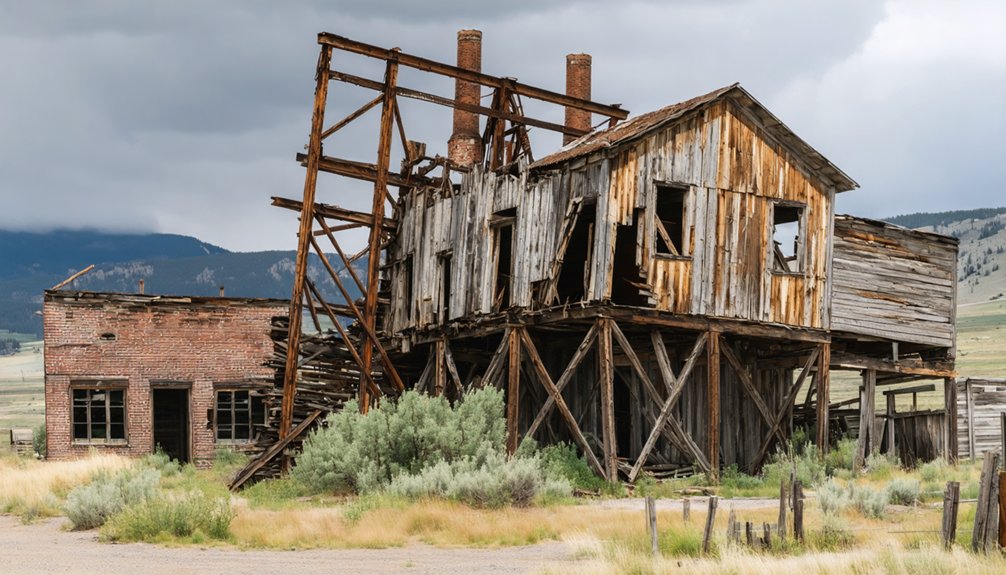
When you examine Idaho’s ghost town structures, you’ll find buildings that have survived over a century of mountain winters and seasonal floods—achievements that stem directly from the state’s arid climate and remote locations.
These remnants showcase remarkable historical preservation across multiple sites:
- Bayhorse’s mining structures stand seven miles from main roads, their architectural significance enhanced by sparse original artifacts still discoverable inside.
- Leesburg’s weathered cabins retain pre-1890 elements including a butcher shop with earth-displaced floors and scattered newspapers.
- Gilmore’s early 1900s buildings remain intact through Lemhi County Historical Society’s maintenance efforts.
- Silver City’s 1863-era remnants defy overgrowth in Owyhee County’s arid conditions.
You’ll discover these structures represent freedom from conventional development pressures, offering unfiltered glimpses into Idaho’s mining heritage.
Balancing Preservation With Nature’s Advance
While these weathered structures continue their slow battle against the elements, Idaho’s abandoned mining sites face an equally complex struggle between environmental remediation and historical retention.
You’ll find preservation strategies at places like Rocky Bar and Bayhorse maintain authentic structures while providing interpretive information, allowing visitors unrestricted access to mining heritage.
Yet achieving ecological balance proves challenging—Bunker Hill’s $263 million cleanup removed contaminated soil from 3,500 properties, transforming hazardous landscapes into functional spaces.
The Eastern Michaud Flats conversion created 400 acres of wetland habitat, demonstrating successful restoration.
However, resistance persists when excavation scales threaten development or personal property.
You’re witnessing ongoing tension: 2,500 additional contaminated yards require remediation while communities promote tourism.
These sites simultaneously preserve historical integrity and restore watershed health across Idaho’s 1,500-square-mile mining region.
Visiting Idaho’s Vanishing Heritage Sites Today
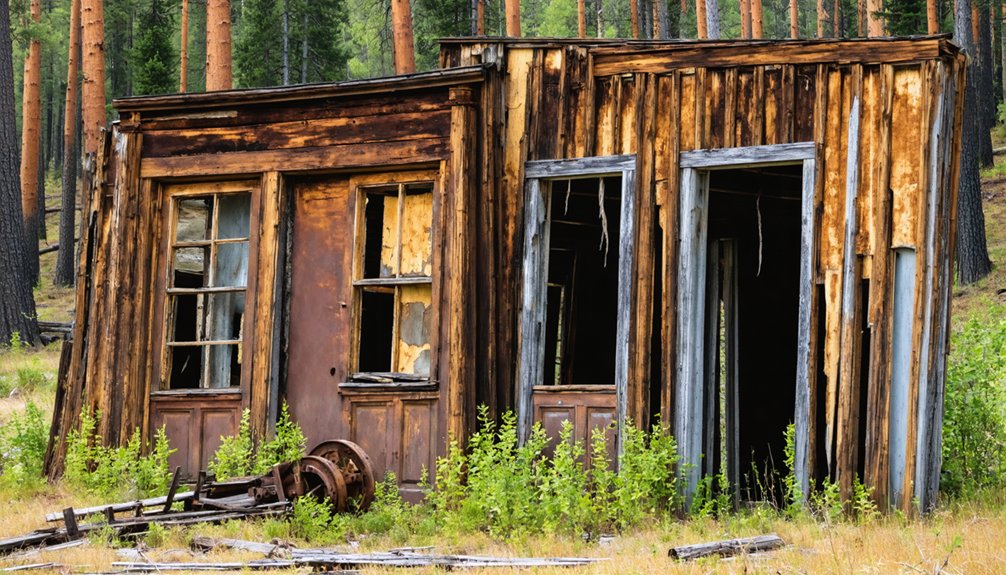
Across Idaho’s backcountry, five distinct ghost towns offer varying degrees of accessibility and preservation, each representing different approaches to managing abandoned mining heritage.
You’ll find managed sites like Custer, where the Land of the Yankee Fork Historical Association provides ghost town tours and July reenactments, contrasting sharply with Bonanza’s unrestored ramshackle structures.
Silver City’s privately-owned buildings demand respectful exploration, while Bayhorse operates as a state park with occasional guided interpretations.
Consider these factors when planning visits:
- Accessibility: Sites near Stanley see thousands of summer visitors; remote Bayhorse remains overlooked.
- Preservation levels: Restored interiors versus weathered exteriors.
- Historical significance: Silver City’s 1863 founding versus later settlements.
- Ownership structures: State parks, associations, private holdings requiring different visitor protocols.
Frequently Asked Questions
Are There Any Guided Tours Available to Idaho’s Ghost Towns?
You’ll find guided ghost tours at Custer’s restored buildings and Sierra Silver Mine, where knowledgeable guides share historical insights about Idaho’s mining heritage. These free tours preserve authentic stories from archival records, letting you explore independently.
Can Visitors Legally Take Artifacts From Abandoned Ghost Town Sites?
No, you can’t legally take artifacts from ghost town sites. Federal and state laws mandate artifact preservation on public lands, with serious legal implications including fines and imprisonment for removing any historical materials or objects.
What Safety Precautions Should I Take When Exploring Ghost Towns?
Wear proper safety gear including respirators, sturdy boots, and headlamps while maintaining wildlife awareness. Historical evidence shows structural failures and toxic exposures remain threats decades later. You’ll need multiple exit strategies and informed companions for genuine exploration freedom.
Which Ghost Towns Are Most Accessible for Families With Children?
Custer and Bayhorse offer the most family friendly ghost towns, with 90% of structures stabilized for safe exploration. You’ll find kid friendly activities like interpretive trails, restored buildings, and picnic areas that let children discover Idaho’s mining heritage firsthand.
Are Overnight Camping Stays Permitted Near Idaho Ghost Town Locations?
You’ll find overnight camping generally permitted near Idaho ghost towns on BLM and Forest Service lands, following standard camping regulations like 14-day limits. Practice respectful ghost town etiquette by staying 200 feet from historic structures and water sources.
References
- https://idaho-forged.com/idahos-ghost-towns-eerie-yet-approachable/
- https://cdapress.com/news/2024/sep/05/over-the-hill-exploring-north-idahos-very-own-ghost-town/
- https://www.bbcearth.com/news/abandoned-places-reclaimed-by-nature
- https://www.blm.gov/sites/default/files/uploads/AML_PUB_DecadeProgress.pdf
- https://history.idaho.gov/wp-content/uploads/2018/08/0064.pdf
- https://idahogeology.org/pub/Staff_Reports/2007/BoiseNF Report.pdf
- https://www.biologicaldiversity.org/programs/public_lands/mining/pdfs/dkt-79_Caldwell-Canyon-Decision-Order-on-MSJ.pdf
- https://eplanning.blm.gov/public_projects/nepa/70697/94514/114120/SFA_DEIS_Main_Text_508.pdf
- https://yellowpinetimes.wordpress.com/2023/03/12/idaho-history-mar-12-2023/
- https://history.idaho.gov/wp-content/uploads/2018/08/0009.pdf