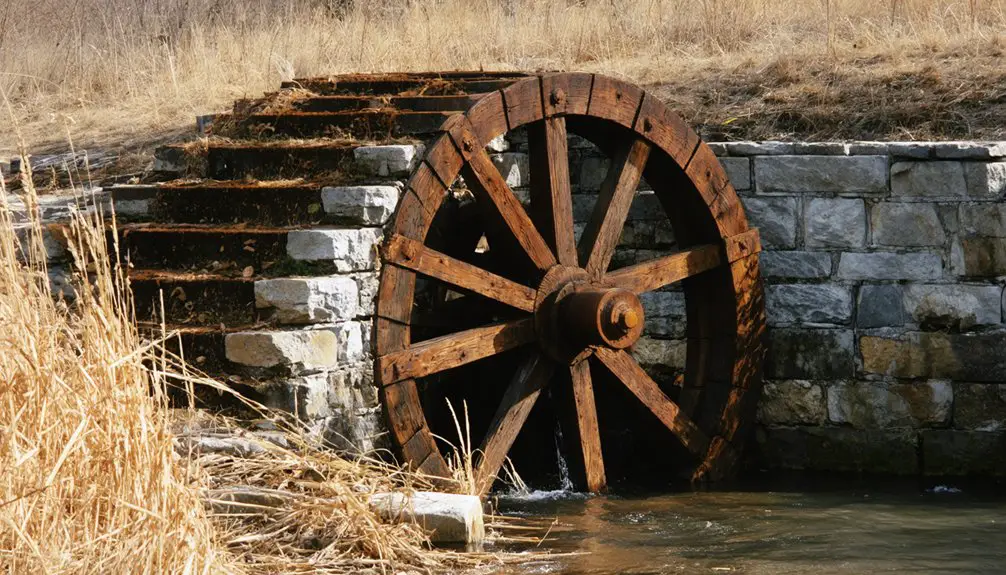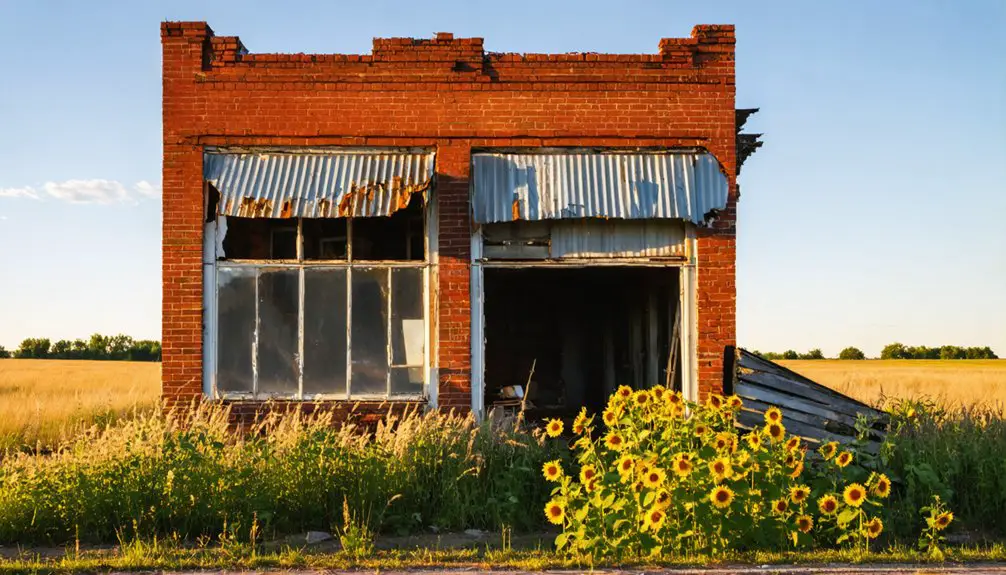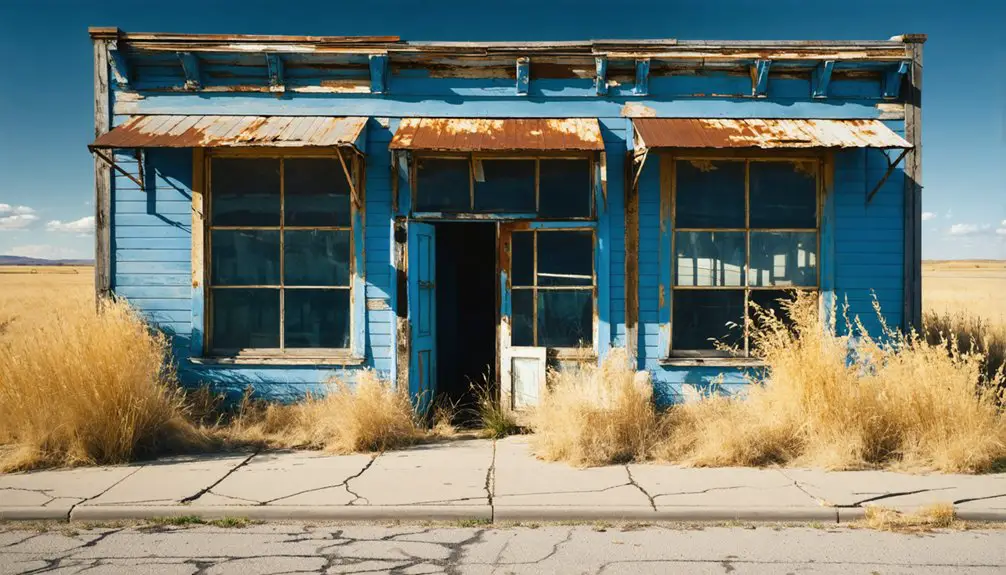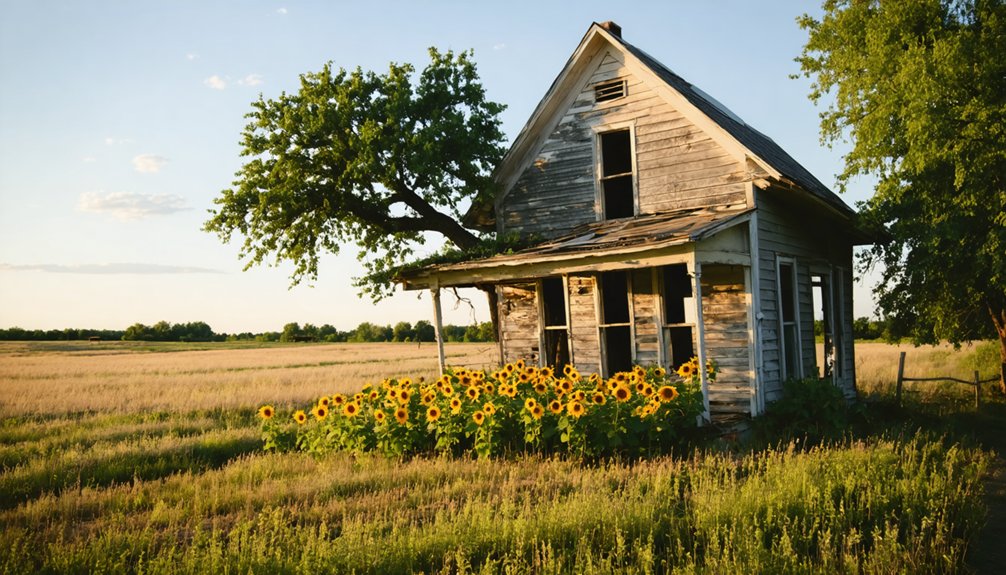
You’ll find Kansas ghost towns rapidly disappearing as nature reclaims them, from Le Hunt’s grass-covered foundations and solitary smokestack to Riverdale’s final two homes surrounded by overgrowth. Communities like those submerged beneath Clinton Lake—Belvoir and Bloomington—vanished entirely after the 1962 Flood Control Act, while Saffordville and dozens more in Chase and Morris Counties sit silent along abandoned railroad lines. These settlements illustrate how prairie ecosystems systematically erase human presence, with crumbling buildings, obscured street grids, and foundations hidden beneath encroaching vegetation revealing fascinating patterns of rural decline.
Key Takeaways
- Le Hunt, a cement town abandoned in 1917, now features overgrown avenues and grass concealing building foundations.
- Riverdale declined to only two remaining homes, with nature reclaiming the area near Belle Plaine.
- Saffordville and other Chase County settlements along railroads now sit silent, marked by abandoned structures.
- Clinton Lake submerged entire communities like Belvoir and Bloomington following the 1962 Flood Control Act.
- Diamond Springs, once a Santa Fe Trail stop, is now marked only by a monument amid reclaimed land.
The Vine-Covered Ruins of Elk Falls
In 1870, seven businessmen led by R.H. Nichols established what became Elk Falls, named for the nearby waterfall on the Elk River.
You’ll find this former county seat reached its peak in the 1880s with hundreds of residents, a grist mill, and thriving commerce. By the 1900s, the population declined to 250, eventually dropping to approximately 100 today.
However, residents transformed decline into opportunity by marketing Elk Falls as the “World’s Largest Living Ghost Town.” This strategy attracted thousands of annual visitors and numerous artists.
You can explore the town’s historic preservation efforts through standing buildings, the National Register-listed Pratt Truss Bridge, and operating bed & breakfast. The iron truss bridge was originally built in 1893 and featured unique expansion joints before flood damage in 1976 led to its condemnation. The historic Pratt Truss Bridge stands as a testament to the engineering achievements of the era.
The annual outhouse tour exemplifies the community’s unique approach to sustaining itself through tourism.
Sumner County’s Vanishing Communities
You’ll find Sumner County’s ghost towns scattered across Kansas’s south-central region, where communities like Riverdale and Bell Plain experienced dramatic population declines throughout the late 19th and early 20th centuries.
Riverdale now contains only two remaining homes, representing a fraction of its former settlement size.
Bell Plain’s population dwindled from a thriving agricultural community to virtual abandonment, mirroring the broader pattern of rural depopulation that affected dozens of Kansas towns during this period.
In Atchison County, the town of Sumner experienced complete abandonment after natural disasters and economic hardship drove residents away, with its last citizen passing away in 1887.
Milan’s population peaked at 240 in 1910, when the town supported a bank, mill, grain elevator, and stores before declining over subsequent decades.
Riverdale’s Remaining Two Homes
Two homes stand as the sole remnants of Riverdale in Sumner County, marking this settlement’s shift from a functioning community to a vanishing footnote in Kansas’s rural landscape.
You’ll find these structures near Belle Plaine, where nature’s encroachment steadily reclaims what residents once built. The surrounding overgrowth tells Riverdale’s story better than any historical marker—a community history that mirrors countless rural Kansas settlements facing population decline and abandonment.
While Zillow lists properties in the Riverdale-Belle Plaine zone, these sales reflect the broader area rather than the original ghost town site. School attendance zone boundaries in the region are subject to change, requiring verification for families considering relocation to nearby communities. GreatSchools ratings provide comparisons of test results for schools in the broader Belle Plaine area, serving as a starting point for parental decision-making.
You’re witnessing a pattern common across non-metropolitan Kansas, where minimal housing persists against advancing wilderness. No new construction communities exist in historic Riverdale itself, contrasting sharply with development trends in nearby metropolitan zones.
Bell Plane Population Decline
Belle Plaine’s demographic trajectory reveals a rural Kansas community caught in the gravitational pull of depopulation that’s consumed countless prairie settlements.
You’ll find population trends showing 1,579 residents at its 1960 peak, then steady urban decline to just 1,467 by 2020—a 12.7% loss in the last decade alone.
The 21st century hit hardest: 14.9% shrinkage between 2000-2020, with 80% of comparable cities outpacing Belle Plaine’s stagnation.
Housing units remain at 877.9 per square mile, shells awaiting occupants who won’t return.
While 2023 saw a modest 2.84% rebound to 1,486 residents, this single-year uptick can’t erase decades of exodus.
The aging community reflects 16.7% aged 65 or older, a demographic imbalance that accelerates rural decline as younger generations flee to urban centers.
The municipality teeters between stabilization and ghost-town status, its fate unwritten.
The name Belle Plaine itself refers to multiple geographical locations, creating potential confusion among those researching this particular Kansas community’s decline.
Historic Sites Near Kansas City Facing Nature’s Return
Near Kansas City, you’ll find historic settlements where natural forces have accelerated abandonment and obscured human traces.
Harlem suffered devastating floods and fires that drove residents away, while the creation of Clinton Lake in the 1970s deliberately submerged entire communities beneath its waters.
Lecompton stands apart as a preserved Civil War-era territorial capital, where restoration efforts actively combat the vegetation and decay consuming its neighbors.
Le Hunt, once home to over 1,000 residents supporting a cement factory, now consists of crumbling ruins slowly disappearing into the landscape.
Diamond Springs began in 1825 as a stop along the Santa Fe Trail, providing fresh water and rest for travelers, but today only a monument and remnants mark where the waypoint once stood.
Harlem’s Flood and Fire
Before Kansas City rose to prominence, Harlem served as a vital river crossing point in the Missouri River valley, its ferry operations guiding travelers between Missouri and Kansas territories.
The 1951 flood devastated this historic settlement with catastrophic force, delivering urban abandonment through nature’s wrath.
Between May and July, relentless rainfall culminated in 8-16 inches during peak days, breaching levees and sending waters to rooftops.
The flood damage reshaped the region permanently:
- Fuel containers toppled along Southwest Boulevard, igniting massive fires visible for miles
- 15,000 residents evacuated from flooded bottoms areas
- West Bottoms stockyards never recovered operations
- Total regional losses exceeded $935 million
You’ll find Harlem’s overlooked ruins reclaimed by vegetation, its ferry landings and structures consumed by the valley’s persistent floods.
Clinton Lake’s Submerged Communities
When the Great Flood of 1951 swept across Kansas, it released nearly one billion dollars in damages and set in motion a federal response that would ultimately erase entire communities from the map.
You’ll find Clinton Lake where Belvoir, Bloomington, Sigel, and Richland once stood—submerged towns that vanished after the 1962 Flood Control Act authorized damming the Wakarusa River.
The U.S. Army Corps of Engineers purchased land starting in 1968, demolished every structure, and filled the valley by 1972. Residents called it the “damn dam,” protesting the government’s seizure of their property. Houses were pushed into creeks or buried on-site.
Today, the Wakarusa River Valley Heritage Museum preserves what officials tried to wash away—proof that these communities existed before bureaucrats chose flood control over freedom.
Lecompton’s Preserved Civil War Era
Just fifty miles from where Kansas City sprawls today, Lecompton preserves the architectural footprint of America’s most consequential political crisis before Fort Sumter.
This territorial capital’s Lecompton history centers on the proslavery constitution that fractured the Democratic Party and propelled Lincoln toward the presidency with just 39% of votes.
The town’s Civil War significance remains tangible through:
- Constitution Hall where delegates drafted the controversial slave-state proposal
- Territorial Capital Museum, originally the unfinished capitol building from 1855
- Rebuilt Fort Titus replica commemorating the 1856 battle where Free-Staters captured 400 muskets
- Pre-Civil War structures lining historic brick sidewalks
Today’s 600 residents maintain these landmarks against nature’s encroachment, preserving the site ironically branded “Where Slavery Began to Die” despite its proslavery origins.
Chase and Morris Counties’ Forgotten Settlements
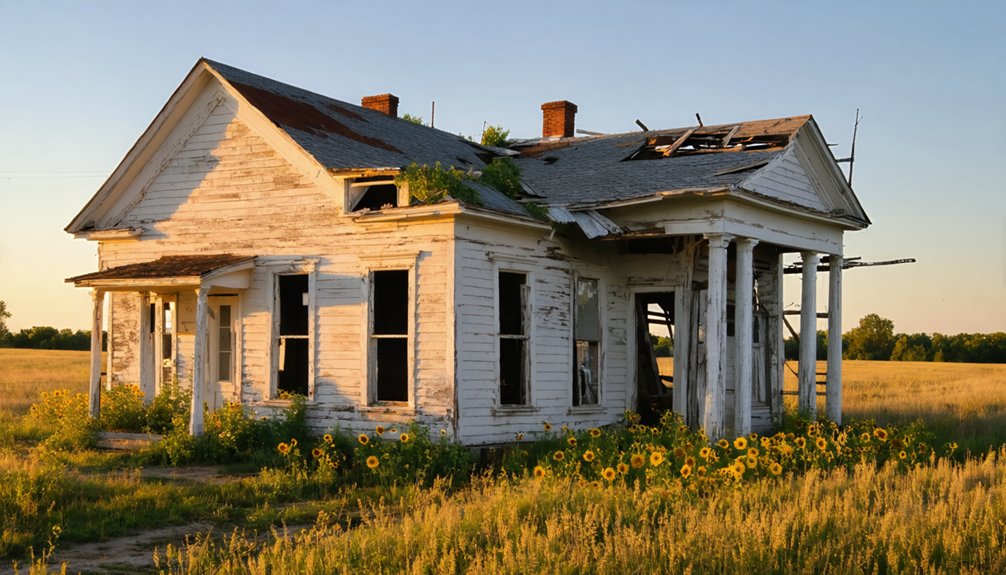
Across Chase and Morris Counties, railroad expansion carved settlement patterns that would eventually lead to widespread abandonment.
You’ll find Saffordville, established in the 1870s along the Atchison, Topeka, and Santa Fe Railroad in eastern Chase County, now silent.
Elmdale stands as the largest town in this southern-central region, its abandoned structures marking Flint Hills decline.
Matfield Green persists minimally along the Flint Hills Scenic Byway, where you’ll hear Santa Fe whistles echo past its cemetery and repurposed bank.
Chase County’s complete ghost roster includes Elk, Ellinor, Homestead, Hymer, and Thurman.
Morris County contributes Comiskey to Kansas’s forgotten settlements.
These railroad-dependent communities couldn’t sustain themselves once transportation patterns shifted, leaving you free to explore their skeletal remains across the prairie landscape.
Complete Natural Reclamation in Le Hunt and Phoenix
Though Le Hunt’s cement empire dominated western Mississippi operations between 1906 and 1917, nature has reclaimed nearly all evidence of this Montgomery County settlement.
Nature has swiftly erased this once-thriving cement town, leaving only scattered ruins beneath Kansas wilderness.
You’ll find minimal traces of what once employed over 300 workers producing 1,500 barrels daily.
The natural reclamation process has transformed Le Hunt’s industrial landscape:
- Overgrown tree-lined avenues obscure the original town layout
- Grass and brush conceal building foundations across multiple acres
- The factory smokestack remains the only prominent landmark above the tree line
- Broken sidewalks and hazardous ruins lie hidden along Elk City Lake’s eastern shore
Posted warnings now restrict visitor access to the tumbled remains scattered east of Table Mound.
This complete natural reclamation demonstrates how quickly Kansas wilderness reclaims abandoned settlements when human intervention ceases.
Life Among the Ruins: Kansas’ Living Ghost Towns
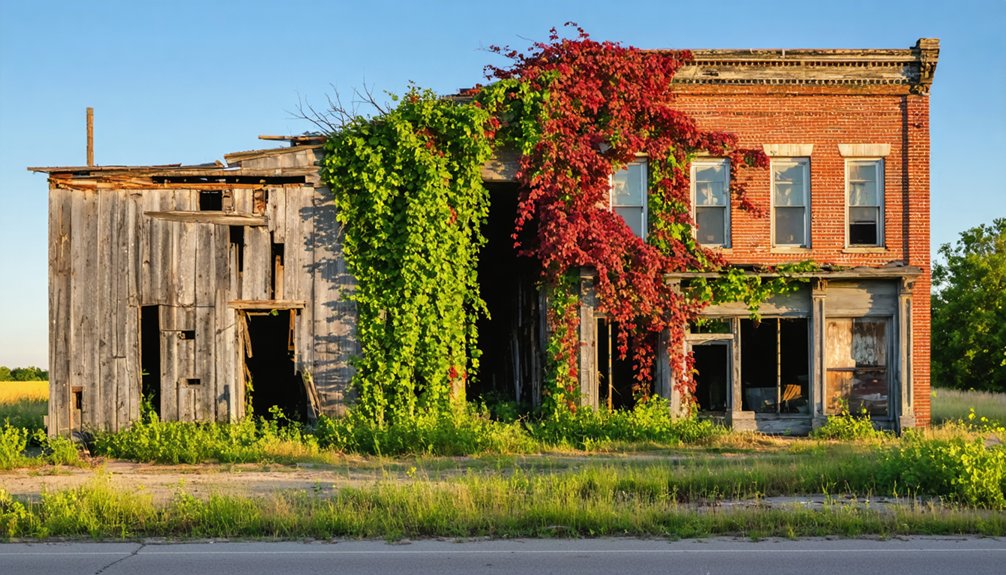
While some Kansas settlements have vanished entirely beneath vegetation and time, others exist in a peculiar limbo between functioning community and abandoned relic.
You’ll find Bushong’s Ruins dominated by its massive empty high school and collapsed gymnasium in Lyon County, monuments to past prosperity.
Sibley’s History ended when it lost the 1869 county seat competition, now reduced to private farmland with minimal traces.
Ruby’s Remnants include visible railroad evidence and scattered modern houses among remnants of its 70-person heyday.
Hoge’s Homesteads in Ness County recall failed 160-acre claims on challenging soil.
Most striking is Coldwater’s Decline—population halved since the 1930s, homes under $75,000, risking total abandonment.
These settlements represent freedom’s harsh reality: communities survive only when circumstances permit.
Frequently Asked Questions
What Legal Restrictions Exist for Exploring Abandoned Buildings in Kansas Ghost Towns?
Kansas trespassing laws prohibit urban exploration of abandoned buildings without owner consent. You’ll face Class B misdemeanor charges despite structures appearing deserted, as they typically retain private ownership. Posted signs, fences, or verbal warnings make entry illegal.
How Do Ghost Towns Impact Local Property Taxes and County Revenue?
Ghost towns devastate county finances—you’ll find property assessments plummeting as buildings decay, creating severe tax implications. Delinquent taxes pile up uncollected, your county loses revenue streams, and shrinking tax bases force budget cuts across essential services.
Are There Organized Tours Available for Visiting Kansas Ghost Towns Safely?
Yes, you’ll find guided expeditions through companies like Ghost Tours of Kansas and Haunted Taxi Tours that provide historical insights while keeping you safe outside private property at Kansas’s most haunted locations.
What Preservation Efforts Exist to Protect Historically Significant Ghost Town Structures?
Historic preservation efforts include National Historic Site designations, National Trust grants, community-led restorations, and right-sizing strategies. You’ll find conservation strategies combining public archives, private enterprise partnerships, and grassroots advocacy protecting Kansas’s abandoned structures from nature’s reclamation.
Can People Legally Purchase and Restore Abandoned Properties in These Towns?
You can legally buy and restore abandoned properties through private sales or land bank acquisitions. Property ownership transfers via standard deed, but restoration challenges include structural decay, unclear titles, and meeting modern building codes despite minimal regulations.
References
- https://www.islands.com/1997785/worlds-largest-ghost-town-outside-wichita-kansas-well-preserved-buildings-waterfall-elk-falls/
- https://www.youtube.com/watch?v=OyBXD18P_j4
- https://www.kcur.org/arts-life/2022-04-09/ghost-towns-are-all-around-kansas-city-if-you-know-where-to-look
- https://thewanderingpigeon.com/2015/10/03/day-of-kansas-ghost-towns/
- https://en.wikipedia.org/wiki/Le_Hunt
- https://matthewbarlow.net/tag/ghost-towns/
- https://www.legendsofamerica.com/ks-elkfalls/
- https://www.hhhistory.com/2019/05/ghost-towns-of-kansas.html
- https://www.youtube.com/watch?v=TkpFQ-8uEgQ
- https://www.worldatlas.com/cities/you-won-t-believe-this-town-is-in-kansas.html