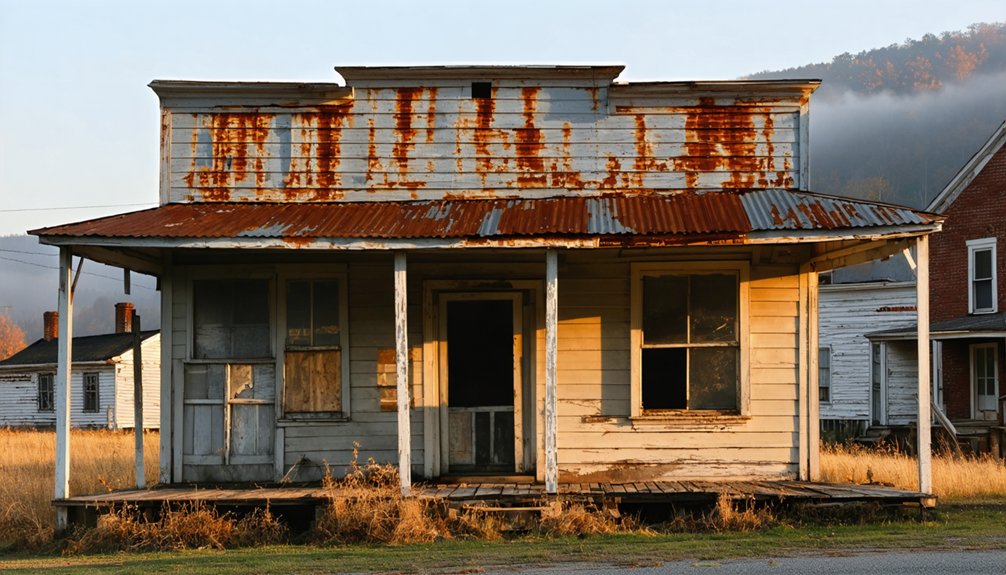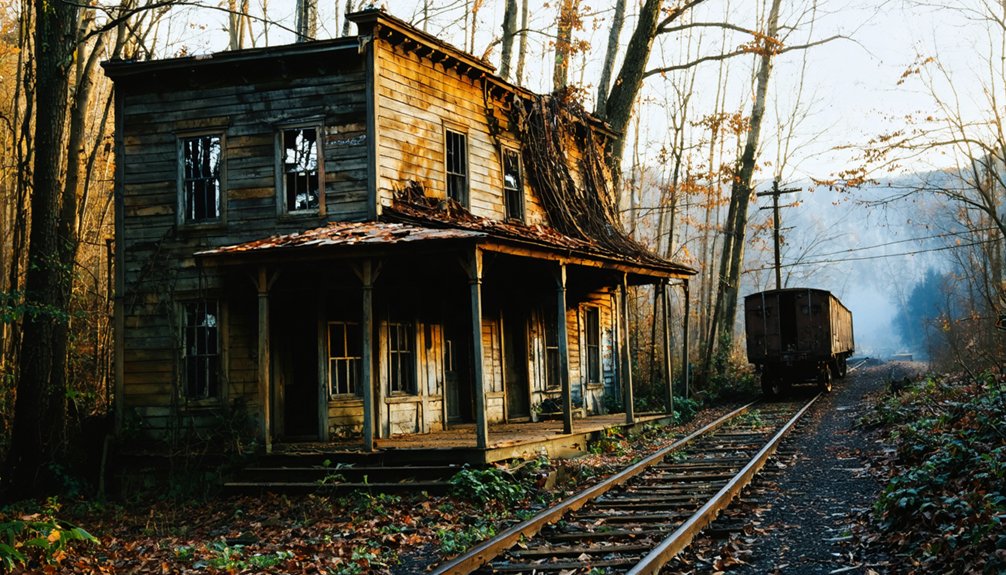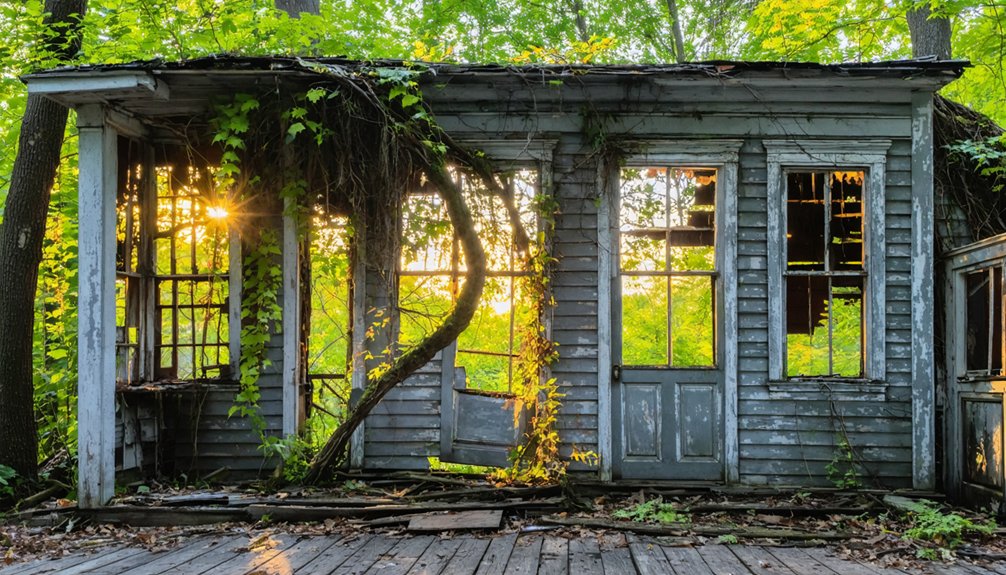
Kentucky’s ghost towns represent economic forces that built communities and then abandoned them to nature’s reclamation. You’ll find coal settlements like Bells Mines where European immigrants once labored, now marked only by cemetery stones beneath encroaching forest. Golden Pond disappeared when TVA purchased 170,000 acres in 1963, while Paradise was completely demolished by 1967 for a fossil plant. These erasures weren’t accidental—they were calculated decisions that transformed thriving settlements into memories, each with documentation that reveals how progress determined which communities would survive and which would vanish beneath Kentucky’s persistent wilderness.
Key Takeaways
- Bells Mines, founded in 1842, ceased operations and now lies reclaimed by forest with only a cemetery remaining.
- Golden Pond was absorbed when TVA purchased 170,000 acres in 1963, destroying homes for Land Between the Lakes recreation area.
- Paradise was completely demolished by 1967 for the Paradise Fossil Plant, erasing the town that pioneered commercial coal mining.
- Blue Heron (Mine 18) closed in 1962, with company buildings abandoned or relocated, now serving as an open-air exhibit.
- Creelsboro declined after Wolf Creek Dam’s 1951 completion, becoming a ghost town with one historical store monument remaining.
Bells Mines: Forest Reclaims a Coal Mining Settlement in Crittenden County
Deep in Crittenden County’s reclaimed forests, Bells Mines stands as a tribute to Kentucky’s boom-and-bust mining economy. Founded in 1842 by Nashville politician John Bell, this settlement once thrived with European immigrants mining some of Kentucky’s finest coal.
You’ll find fascinating Bells Mines history in 1850 census records documenting workers from Bavaria, Scotland, Ireland, and Wales who built farms, schools, and churches around the shafts.
Coal mining impact shaped everything here. When operations ceased after decades of extraction, families scattered and nature reclaimed the land.
When the mines closed, families departed and the forest returned to claim what once belonged to industry.
The Louisville and Nashville Railroad transformed Kentucky’s mining communities in 1888, though it came too late to sustain Bells Mines’ isolated operations.
Alcoa’s 1950s purchase of 11,000 acres for an aluminum smelter that never materialized sealed the community’s fate.
Today, forest covers where miners’ homes once stood, their economic dreams buried beneath Kentucky’s resilient wilderness. Bells Mines Cemetery survives with weathered tombstones marking the community’s departed residents.
Golden Pond: A Trigg County Community Absorbed by Land Between the Lakes
Where Jenny Ridge’s shallow pond caught the sunlight just right, settlers saw gold—enough to name their community after the natural wonder that greeted them each dawn.
Golden Pond history began in 1848 when the first post office opened, merging two settlements into the between-the-rivers region’s largest town. You’d find community resilience tested twice—devastating fires in 1898 and 1936—yet residents rebuilt without incorporation or infrastructure.
Rich bottomlands, timber, and iron ore sustained couple hundred people who’d carved prosperity from wilderness. Cool springs throughout the area provided fresh water and attracted visitors seeking the town’s natural resources. The east-west road improvement in 1919 brought one of western Kentucky’s first modern roadways through the community, later becoming US 68. Then Kennedy’s administration and TVA arrived in 1963, purchasing 170,000 acres for recreational development. Marshals removed holdouts. Homes burned.
Paradise: Muhlenberg County’s Lost Town Erased for Progress
Along Green River’s bend ten miles northeast of Greenville, Leonard Stom established a ferry and store that’d anchor Muhlenberg County commerce throughout the early nineteenth century.
Paradise history began at Stom’s Landing, where settlers found community before coal mining transformed everything. By 1852, you’d find a functioning post office serving what locals renamed Paradise—possibly after a family seeking Indian-recommended healing grounds for their sick child.
Paradise grew from a humble river landing where hope-seeking settlers built community long before industry’s arrival.
Muhlenberg County pioneered commercial-scale coal mining in America, but Paradise paid the ultimate price.
When Pittsburgh and Midway Coal Mining Company exhausted surrounding reserves, Tennessee Valley Authority moved in. They constructed Paradise Fossil Plant starting 1959, systematically purchasing residents’ properties or threatening condemnation. Residents experienced health issues from ash and debris produced by the coal-burning operations. By 1967, TVA had torn down the town entirely due to health concerns from the coal-burning plant’s proximity.
Blue Heron (Mine 18): McCreary County’s Open-Air Mining Exhibit
Unlike Paradise, which vanished beneath TVA’s determination to consume everything for energy production, Blue Heron mining camp disappeared through market forces rather than government decree.
When Stearns Coal & Lumber Company‘s Mine 18 closed in 1962 after unprofitability set in, the corporate overlords simply dismantled their company town and moved on. Buildings were relocated or abandoned to rot along the Big South Fork River.
Today’s visitor experience reveals an uncomfortable truth: those who controlled your labor also controlled your housing, your supplies, your children’s education.
The ghost structures—skeletal metal frames marking where homes, school, and coal tipple once stood—expose the transitory nature of industrial exploitation. Constructed in the 1980s, these themed frameworks mirror the original buildings’ size and orientation. The paved trail winds through these remnants with varying elevations, making the history accessible to most visitors.
You’ll find oral histories of former residents, their voices echoing through interpretive displays accessible via the Big South Fork Scenic Railway.
Creelsboro: Russell County’s Fading River Town on the Cumberland
When the Creel brothers opened their riverside tavern in the early 1800s, they couldn’t have anticipated that their modest trading post would become the Cumberland River’s busiest port between Nashville and Burnside.
You’ll find Creelsboro’s story reflects a broader pattern of Cultural Heritage shaped by transportation technologies. Steamboat commerce sustained this Russell County community for over a century, supporting a bank, hotel, and multiple stores that served independent merchants and travelers.
The Economic Shift began when Wolf Creek Dam‘s 1951 completion fundamentally altered the river’s commercial viability. By the 1960s, the final general store closed, cementing Creelsboro’s ghost town status. Five years ago, the Creelsboro Country Store was auctioned when the original owner became concerned about its preservation and feared demolition.
Today, you can still visit Campbell’s Creelsboro Country Store, built in 1876, standing as a monument to when river commerce defined Kentucky’s economic freedom. Nearby, visitors can explore the Rock House natural bridge, the seventh largest in the United States and a rare dolomite formation.
Frequently Asked Questions
Are There Any Safety Concerns When Visiting Kentucky’s Abandoned Ghost Towns?
You’ll face significant risks from unstable abandoned structures, hidden hazards beneath overgrown vegetation, and legal trespassing issues. Taking proper safety precautions—like securing permission, wearing protective gear, and never exploring alone—remains essential for responsible exploration.
Can Visitors Legally Explore the Remnants of These Former Communities?
You’ll find exploration permissions wildly inconsistent—some sites welcome you freely while others threaten prosecution. National Park Service locations follow clear legal guidelines, but private properties demand respect for no-trespassing signs to maintain your freedom of movement.
What Wildlife Species Now Inhabit Kentucky’s Reclaimed Ghost Town Sites?
You’ll find deer, elk, and songbirds thriving amid abandoned structures, where habitat restoration transformed mining wastelands into wildlife diversity hotspots. Forest reclamation created sanctuaries where nature’s resilience overcame industrial scars through decades of gradual regeneration.
How Long Does Nature Typically Take to Reclaim Abandoned Settlements?
Nature recovery begins within weeks through moss and small plants, but timeframes involved span decades for complete reclamation. You’ll see visible overgrowth in under five years, while full structural submersion typically requires 20-30 years of unrestricted natural processes.
Are There Guided Tours Available for Kentucky’s Ghost Town Locations?
No guided explorations exist for Kentucky’s nature-reclaimed ghost towns. You’ll find urban haunted tours offering historical insights into cities like Lexington and Louisville, but abandoned settlements overgrown by wilderness remain uncharted territory you must explore independently.
References
- https://www.homestratosphere.com/secluded-towns-in-southwest-kentucky/
- https://westernkyhistory.org/exploring-the-forgotten-towns-and-ghost-towns-of-western-kentucky/
- https://www.canarymedia.com/articles/enn/in-the-shadow-of-a-reclaimed-mine-this-kentucky-center-is-retraining-coal-workers-for-high-tech-manufacturing
- https://everafterinthewoods.com/abandoned-ghost-towns-in-kentucky-that-still-hold-echoes-of-the-past/
- https://www.youtube.com/watch?v=3kMLESEo6NE
- https://appalachianmemories.org/2025/10/16/the-lost-towns-of-appalachia-the-forgotten-mountain-communities/
- https://eec.ky.gov/Nature-Preserves/About_Us/news/Reports/Final 2022 Annual Report_ annual KHLCF_ biennial OKNP_ quadrennial Rare Plant.pdf
- https://scholarworks.bellarmine.edu/cgi/viewcontent.cgi?article=1143&context=ugrad_theses
- https://www.federalregister.gov/documents/2003/02/11/03-3365/kentucky-abandoned-mine-land-reclamation-plan
- https://www.nature.org/content/dam/tnc/nature/en/documents/1/1/11.3.25_TNC_Mining_the_Sun_Report.pdf