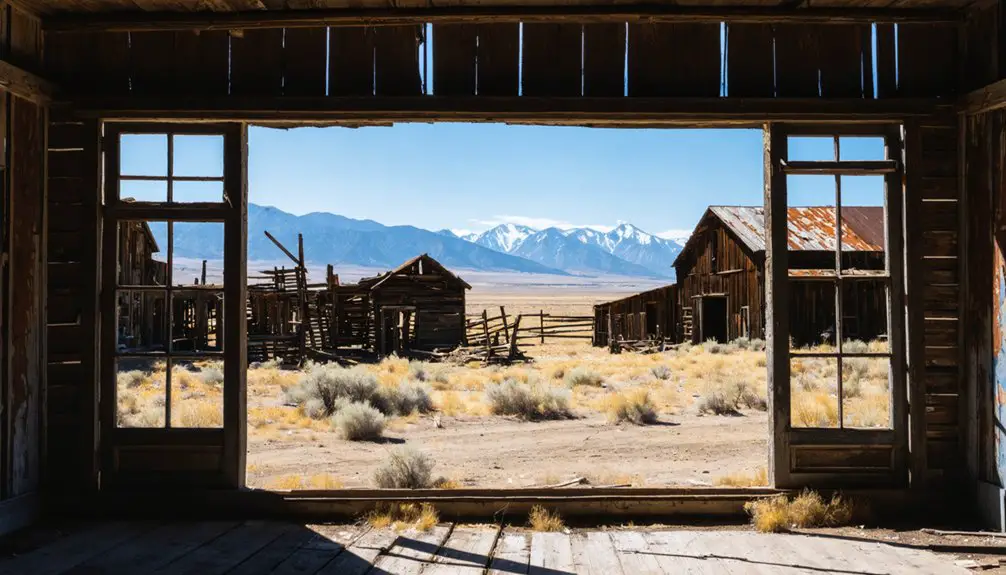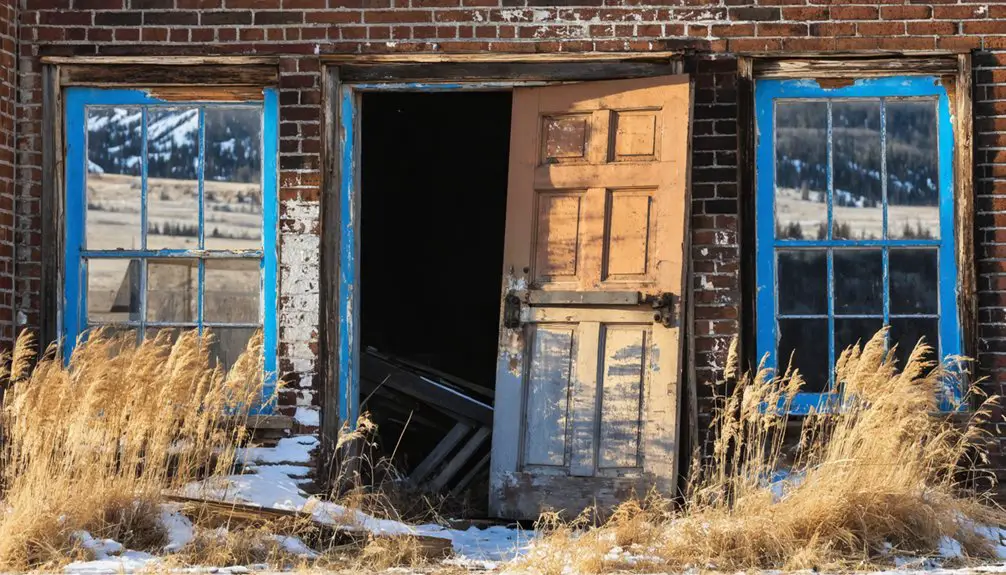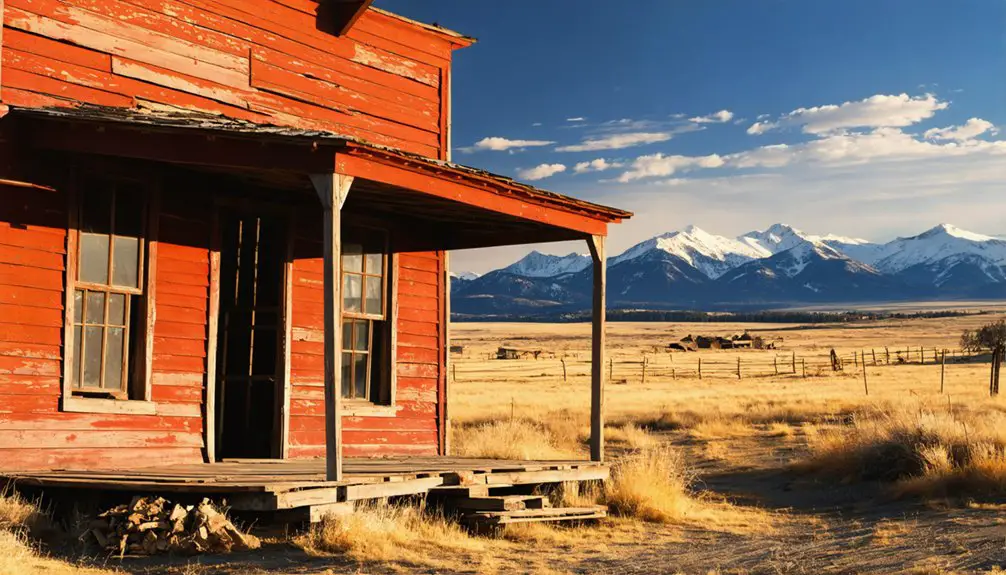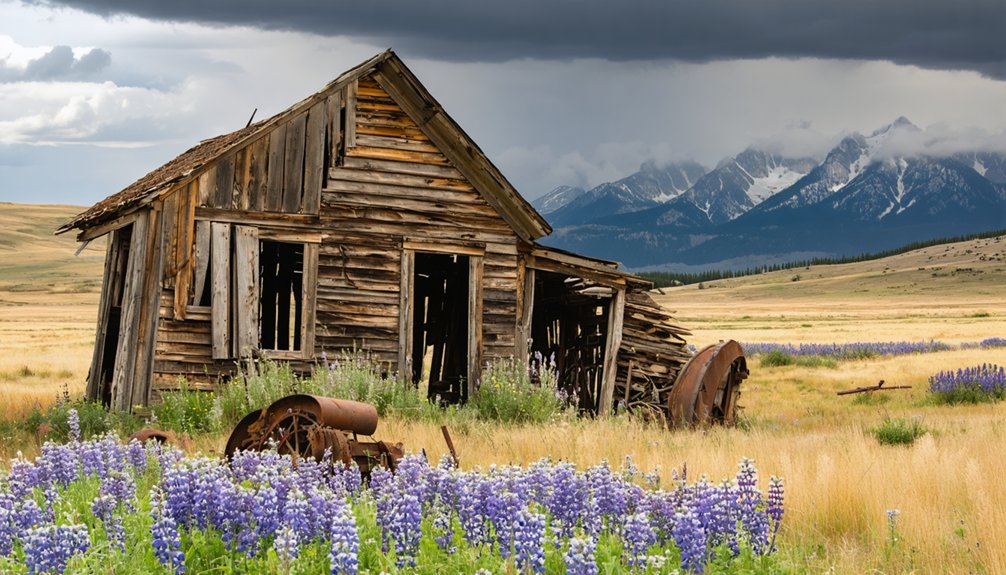
You’ll find Montana’s ghost towns gradually surrendering to wilderness after the mining boom collapsed in the 1940s. Places like Garnet and Granite showcase wooden structures overtaken by pioneer plant species, while native vegetation stabilizes toxic tailings from abandoned operations. Winter snow preserves fragile roofs at high altitudes, and spring reveals wildflowers reclaiming pathways once bustling with prospectors. Metal-tolerant flora now colonizes acidic soils, achieving up to 60% plant cover where mines once scarred the landscape, and deeper exploration reveals how communities balance this natural reclamation with preservation efforts.
Key Takeaways
- Pioneer plant species colonize abandoned mining structures and tailings piles as nature reclaims former Montana mining camps.
- Metal-tolerant vegetation thrives in acidic soils near unreclaimed mines, achieving up to 60% plant cover in some areas.
- Riparian corridors restore naturally along polluted waterways, defying contamination and enhancing biodiversity in ghost town areas.
- Harsh weather and seasonal changes aid preservation while native vegetation stabilizes eroding tailings and captures resources.
- Spring wildflowers emerge through pathways and fire-scarred landscapes show resilient growth reclaiming devastated mining areas.
Montana’s Abandoned Mining Heritage
When prospectors struck gold in Montana’s remote valleys during the late 1850s, they triggered a transformation that would scatter hundreds of settlements across the territory’s rugged landscape.
Gold discoveries in Montana’s remote valleys sparked a territorial rush that planted hundreds of settlements across untamed wilderness during the 1850s.
You’ll find remnants of this explosive growth throughout southwest Montana, where towns like Bannack and Virginia City emerged as territorial capitals and commercial hubs.
Butte eventually dominated as the world’s greatest mining camp, housing over 100,000 residents extracting copper from the earth.
Today’s abandoned infrastructure tells stories of wealth and desolation.
Saloons, boarding houses, and processing plants stand as weathered monuments to an era when miners chased strikes across the wilderness.
Among these relics, Bannack’s Bank Exchange Saloon serves as a notable reminder of the town’s significance as Montana’s first territorial capital.
The Clark Fork River, Montana’s largest waterway, begins its journey from the Continental Divide at Pipestone Pass and flows through the mining region toward Missoula, carrying with it the legacy of contamination.
Historic preservation efforts now compete with nature’s relentless reclamation, as Montana grapples with contaminated watersheds and billions in remediation costs that remain unaddressed.
Garnet: A Frozen Snapshot of the 1800s
Among Montana’s constellation of abandoned settlements, Garnet stands apart as the state’s most remarkably preserved mining camp, its weathered structures clinging to a mountainside at 6,000 feet as if awaiting their residents’ return.
Founded in 1895 when Dr. Armistead Mitchell erected his stamp mill, you’ll discover Garnet’s history etched into thirteen saloons, seven hotels, and a schoolhouse that once served nearly 1,000 souls chasing gold-bearing quartz.
The town’s mining culture thrived on low crime and high spirits until a 1912 fire gutted the business district.
Roosevelt’s 1934 gold price increase breathed temporary life into abandoned cabins, but World War II pulled miners toward defense jobs.
Revenue from Montana’s “Explore Ghost Town” license plates now funds preservation efforts that keep Garnet’s deteriorating structures from disappearing entirely.
Today, the Bureau of Land Management maintains this frozen tableau where furnishings still gather dust inside foundationless buildings—a reflection of freedom-seekers who vanished into history.
Visitors can reach this mountainside relic via Highway 200 from Ovando, turning south onto Garnet Range Road for an eleven-mile journey up steep grades.
Virginia City’s Transformation Into a Living Museum
After Virginia City’s designation as Montana’s territorial capital in 1865, the Alder Gulch settlement swelled to 5,000 residents drawn by gold-bearing quartz veins that promised fortune.
Gold fever transformed a territorial outpost into a 5,000-strong boomtown as fortune seekers rushed to Alder Gulch’s promising quartz veins.
When mines closed in the 1940s, the town deteriorated into abandoned structures until Charles and Sue Bovey launched America’s first major privately funded historical preservation program.
Their multi-decade restoration maintained Virginia City’s 1860s character, creating a living museum that now operates under Montana Heritage Commission management. The collection extends beyond Virginia City to include Nevada City and Reeder’s Alley, forming a comprehensive preservation of the region’s mining heritage.
You’ll find:
- Nearly 300 original structures standing where miners built them, with none relocated
- 1.2 million artifacts forming the nation’s second-largest Old West collection
- Period-costumed interpreters demonstrating blacksmithing, tinsmithing, and weaving every weekend from Memorial Day through Labor Day
The 1997 state acquisition preserved this National Historic Landmark for future generations seeking authentic frontier experiences. Nevada City’s Music Hall showcases automated musical instruments, including one of the world’s largest collections of player pianos that visitors can activate with quarters.
Granite’s Silver Ruins Among Wildflowers
While Virginia City preserved its frontier character through deliberate restoration, Granite’s remains tell a starker story of nature’s patient reclamation.
You’ll find Montana’s former “Silver Queen” perched at 7,000 feet, where wildflower growth now blankets what was once the world’s largest silver operation. The Granite Mountain Mining Company extracted nearly $30 million before the 1893 silver crash triggered overnight abandonment by 3,000 residents.
Today, you can explore mill foundations, the skeletal Miners’ Union Hall, and the fenced Ruby shaft that plunges 1,500 feet into darkness. The town’s best-preserved structure, the Superintendent’s building from 1889, offers a glimpse into the hierarchy of this former company town. Miners once rented lots for $2.50 monthly in this company town, establishing diverse neighborhoods that included Finnlander Lane and Silk Stocking Row. These silver ruins stand as monuments to boom-and-bust capitalism, where alpine meadows have swallowed the streets of Montana’s 11th largest city, proving that freedom sometimes means letting go entirely.
How Nature Reclaims Forgotten Settlements
When you examine Montana’s abandoned mining camps, you’ll notice pioneer plant species have already colonized wooden structures and surrounding tailings piles, initiating the first stage of ecological succession.
Weathering forces—particularly the region’s harsh freeze-thaw cycles and wind-driven precipitation—systematically dismantle roofs, walls, and support beams while vines and shrubs penetrate foundation cracks. Climate change increases the intensity of these storms, accelerating the breakdown of degraded mining structures and creating additional risks from chemical leaching in the surrounding soil.
As vegetation establishes itself, invasive species like box elder maple can dominate these sites, sometimes accounting for up to 75% of the returning plant life and potentially threatening native biodiversity. Proper management of these abandoned areas could increase their potential for carbon storage while supporting the recovery of local ecosystems.
Vegetation Overtaking Mining Structures
Montana’s semiarid ghost towns reveal nature’s persistence through measurable vegetation recovery patterns.
After 45+ years of abandonment, you’ll find vegetation averaging 13% cover across disturbed sites, with some areas reaching 60%.
Plants break through sagging buildings and encircle rusting equipment, though mine adits and standing structures still limit growth in certain quadrats.
Metal-tolerant species colonize acidic soils around unreclaimed mines, gradually forming community food webs.
Nature’s Reclamation Timeline:
- Cottonwoods and volunteer trees from surrounding forests slowly reclaim what industry abandoned.
- Native vegetation stabilizes eroding tailings while capturing resources industry stripped away.
- Riparian corridors restore themselves along polluted waterways, defying decades of contamination.
This recovery happens without permission, proving wilderness doesn’t need government approval to heal itself when you stop interfering.
Seasonal Transformations Through Weather
High-altitude ghost towns experience preservation through paradox—the same brutal weather that expelled their residents now protects what they left behind.
Montana’s seasonal shifts create natural guardianship at places like Garnet, where winter snow insulates roofs against temperature swings that would otherwise crack shingles and warp boards. You’ll find that cold, dry conditions slow wood decay while discouraging termites that devour abandoned structures in warmer climates.
Weather impacts extend beyond preservation to access control. Snow renders Garnet’s dirt road impassable from late fall through early spring, filtering visitors to only those willing to snowmobile or ski in.
This isolation prevents the vandalism and souvenir-hunting that strips most historic sites of authenticity. Nature’s seasonal barriers function as unpaid curators, maintaining architectural integrity through strategic inaccessibility.
The Rise and Fall of Montana’s Mining Boom
As prospectors panned Silver Bow Creek‘s gravel beds in the 1860s, they couldn’t have imagined the industrial empire their modest gold discoveries would release.
Butte’s mining legacy transformed from small gold operations into the “Richest Hill on Earth,” producing 21.5 billion pounds of copper by 2004. The economic impact peaked spectacularly—$23 million generated in 1888 alone, with populations swelling to 100,000 by 1920.
From humble gravel beds to industrial titan—21.5 billion pounds of copper forged America’s extraction empire.
Yet every boom contains its collapse:
- Underground mines that once employed thousands became the Berkeley Pit in 1955, erasing entire neighborhoods.
- Montana’s corporate giant strangled local autonomy until Atlantic Richfield suspended operations in 1983.
- From 100,000 souls to ghost-town silence—freedom sacrificed at industrial altars.
You’ll find Butte’s skeletal headframes still standing, monuments to extraction’s ruthless mathematics.
Preservation Through Remoteness and Restoration
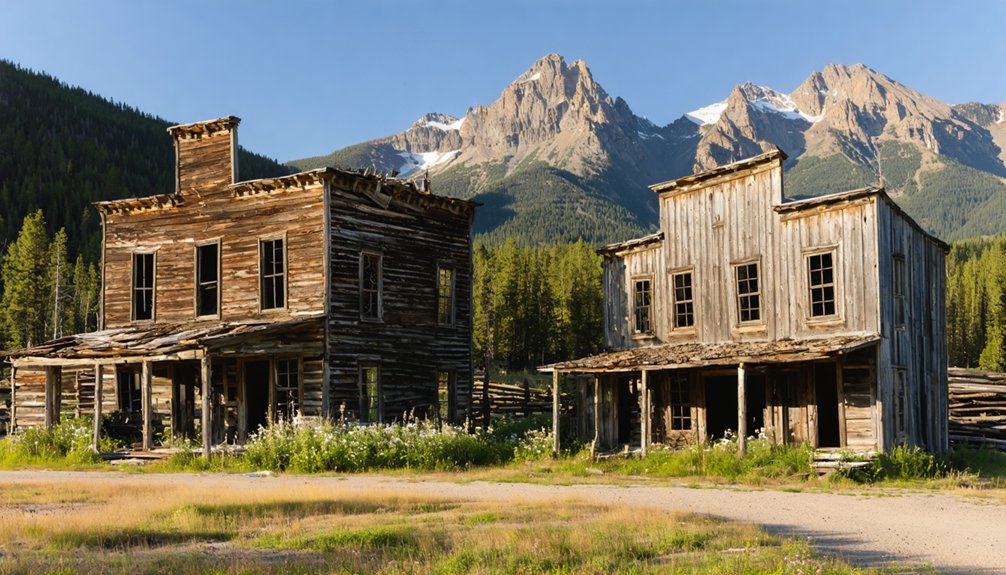
Montana’s ghost towns survive today through two paradoxical forces: the very remoteness that accelerated their abandonment now shields them from vandalism and unauthorized development, while targeted restoration efforts transform the most contaminated sites into productive landscapes.
You’ll find hundreds of thousands of untouched structures on private and state lands where isolation acts as an unintended preservationist, yet federal agencies have invested millions to reclaim mines like Beal Mountain, where reclamation costs reach $39 million.
This dual approach maintains authentic decay in inaccessible areas while actively restoring degraded waterways and soils where mining’s legacy threatened public health and ecosystems.
Remote Locations Preserve History
Remote positioning creates natural preservation conditions that archaeological conservation efforts can’t easily replicate. Montana’s ghost towns occupy mountainsides and grasslands where geographic isolation becomes their greatest protector.
You’ll find Garnet’s 30 original buildings standing with furnishings intact—dishes on tables, personal items frozen in time—preserved through decades of minimal interference. The cultural heritage remains authentic because distance discourages casual disturbance.
What isolation protects:
- Weathered cabins still displaying miners’ belongings through dusty windows
- Rusting equipment positioned exactly where workers abandoned it
- Structural remains interpretable after 45+ years of natural decay processes
This historical significance survives precisely because development pressure can’t reach these remote sites. Nature reclaims what humans left behind while simultaneously stabilizing foundations through vegetation growth, creating living archives of Montana’s mining era.
Active Restoration Balances Access
While geographic isolation shields these settlements from casual interference, deliberate human intervention now sustains what time alone can’t preserve.
You’ll find active volunteerism driving Montana’s ghost town survival—the Montana Ghost Town Preservation Society restored roofs, stabilized crumbling hotels, and transferred titles of historic structures to state stewardship.
At Garnet, preservation strategies blend public donations with innovative funding from specialty license plates, generating resources that support both flagship sites and lesser-known camps.
These efforts counter the alarming loss of 12-24 ghost towns annually to decay and vandalism.
You can explore self-guided trails year-round, rent primitive winter cabins, and experience non-commercialized history.
Strategic restoration doesn’t sanitize these places—it guarantees future generations witness authentic remnants of Montana’s mining heritage without bureaucratic restrictions limiting access.
Seasonal Changes in Ghost Town Landscapes
Each season rewrites the story of Montana’s ghost towns, transforming these abandoned settlements through cycles of protection and exposure.
Winter’s snow blankets preserve fragile structures while blocking roads, creating months of peaceful isolation that deters vandalism. When summer opens dirt roads from 9:30 AM to 4:30 PM, you’ll navigate rutted terrain requiring high-clearance vehicles—filtering casual tourists and maintaining authentic wilderness experiences.
These seasonal contrasts shape landscape evolution distinctly:
- October’s brilliant foliage frames weathered buildings in nature’s final explosion before winter silence
- Spring thaw reveals wildflowers pushing through cracked pathways where miners once walked
- Fire-scarred hillsides show resilient green growth reclaiming devastated slopes
Montana’s extreme climate simultaneously destroys and protects, allowing you freedom to witness history’s remnants standing defiantly against elemental forces.
Modern Reclamation and Environmental Recovery Efforts
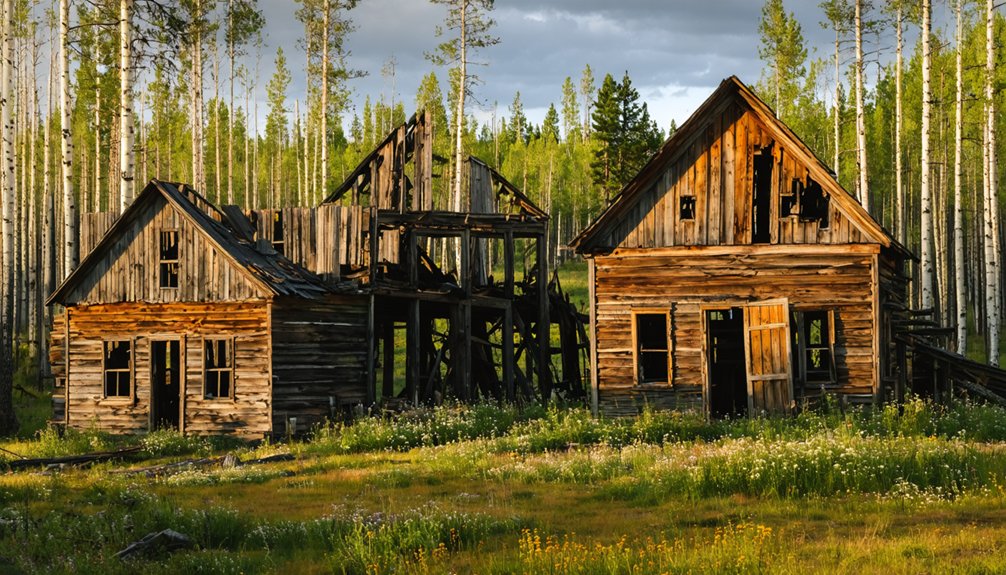
Beneath Montana’s ghost towns lies a toxic legacy that stretches across 300 square miles of contaminated soil, waterways, and mountainsides—the environmental cost of a century’s worth of unregulated mining and smelting operations.
You’ll find modern reclamation methods transforming these devastated landscapes through strategic soil removal, revegetation, and watershed restoration.
Environmental partnerships between federal agencies, state programs, and volunteer organizations like Trout Unlimited are breathing life back into poisoned ecosystems.
The Clark Fork River cleanup excavated contaminated riverbanks while restoring wetlands, bringing trout populations back from near-extinction.
At the Anaconda Smelter site, collaboration covered massive slag piles and revived dead zones in the Pintler Mountains.
These restoration efforts prove that communities can reclaim their poisoned heritage without government overreach strangling voluntary action.
Frequently Asked Questions
Are Ghost Town Sites Safe to Explore on Your Own?
You shouldn’t explore ghost towns alone without proper safety precautions. These historically significant sites present structural hazards from decades of environmental change. Follow exploration tips: research beforehand, bring companions, check weather conditions, respect boundaries, and inform others of your location.
Can You Camp Overnight Near Montana’s Ghost Towns?
You can camp overnight near Montana’s ghost towns, but you’ll need to follow specific camping regulations. Sites like Bannack offer ghost town amenities, while BLM lands permit dispersed camping with fourteen-day limits respecting historical preservation.
What Wildlife Might You Encounter While Visiting Ghost Towns?
You’ll encounter diverse native species reclaiming abandoned settlements—grizzly bears averaging 440 pounds, elk, moose, mountain lions, and wolves surging into human-free spaces. Wildlife sightings include foxes, deer, and raptors thriving where civilization once stood.
Do You Need Permits to Visit Abandoned Mining Sites?
Permit requirements vary by management. You’ll need free Forest Service permits for prospecting on federal lands, while mining regulations restrict panning where active claims exist. State parks like Granite enforce seasonal access without specific entry permits.
Which Ghost Towns Are Wheelchair Accessible for Visitors?
You’ll find accessible paths at Garnet Ghost Town and Bannack State Park, both offering broad trails and visitor facilities. Though nature’s slowly reclaiming these historic sites, you can explore them with sturdy wheelchairs or companion assistance.
References
- https://www.youtube.com/watch?v=GJiYh6Ak0sE
- https://takingthekids.com/montana-ghost-towns-that-are-hauntingly-gorgeous/
- https://everafterinthewoods.com/remote-mountain-towns-in-montana-that-feel-frozen-in-time/
- https://www.blm.gov/sites/default/files/uploads/AML_PUB_DecadeProgress.pdf
- https://the406life.com/hauntingly-beautiful-montana-ghost-towns/
- https://deq.mt.gov/files/land/abandonedmines/documents/recguide.pdf
- https://xlcountry.com/montana-ghosts-towns/
- https://www.osmre.gov/sites/default/files/inline-files/BullMtn_Final_FEIS-and-ROD_06052025.pdf
- https://www.nature.org/content/dam/tnc/nature/en/documents/1/1/11.3.25_TNC_Mining_the_Sun_Report.pdf
- https://www.hcn.org/articles/contaminants-montanas-clark-fork-river-superfund-river-cleanup-mercury-pollution-mines/