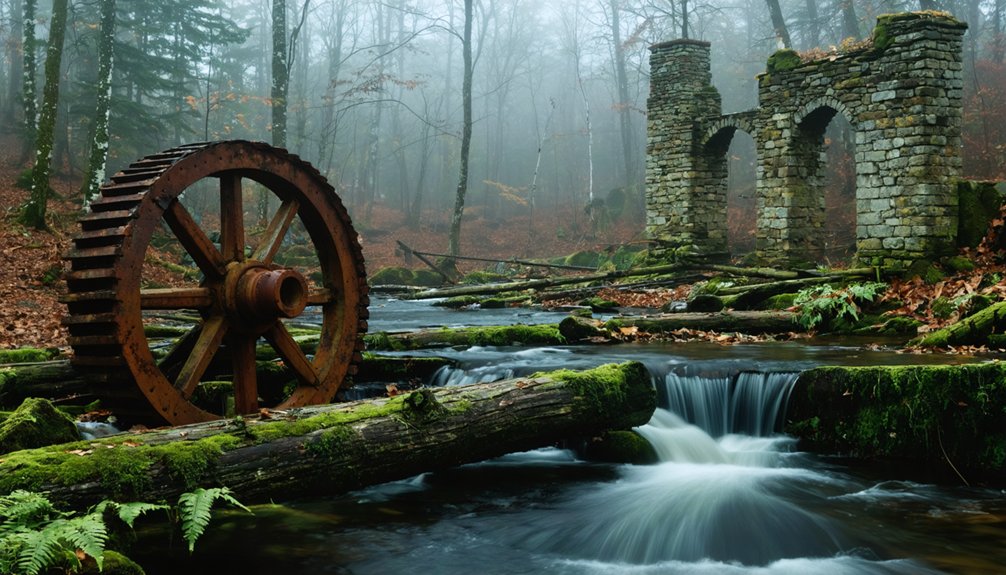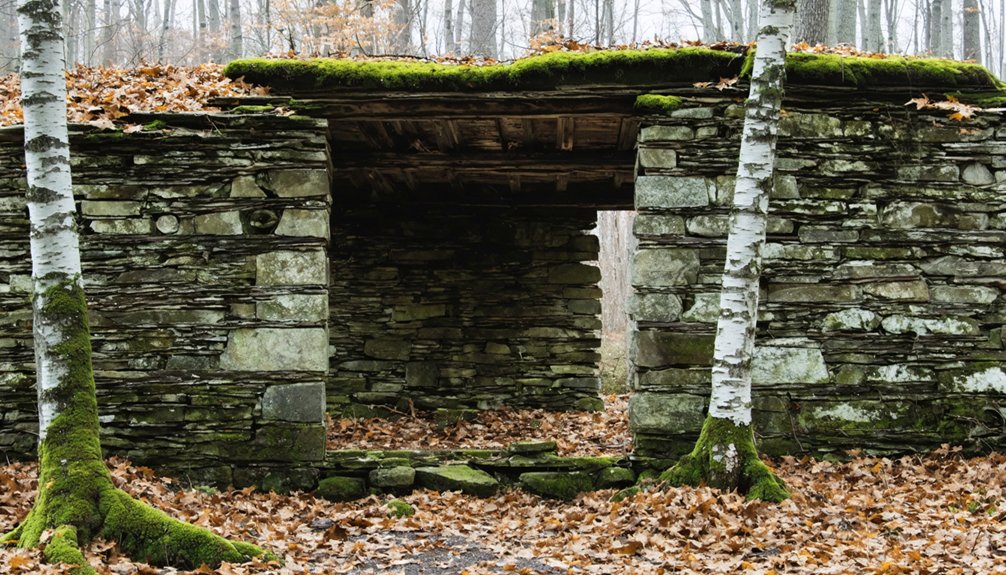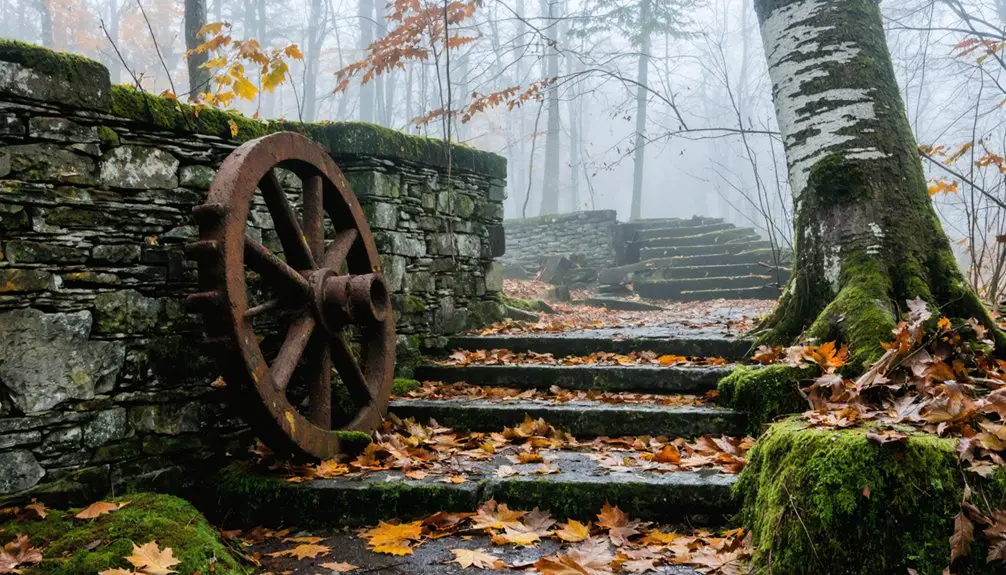
You’ll find over 600 cellar holes scattered throughout New Hampshire’s White Mountain National Forest, marking vanished communities like Monson (abandoned 1770) and Livermore (disincorporated 1951). These ghost towns reveal moss-covered foundations, collapsed sawmill pillars, and crumbling stone staircases where thriving settlements once stood. Nature’s succession has been remarkably swift—apple trees now grow through former homesteads while forests reclaim what logging companies once cleared. The Society for the Protection of New Hampshire Forests has preserved key sites, transforming wilderness into accessible outdoor museums where you can trace the complete arc of settlement, abandonment, and ecological recovery.
Key Takeaways
- Monson, established in 1735 and abandoned by 1770, now features moss-covered foundations and 269 preserved acres with interpretive plaques.
- Livermore, a logging town from 1876 to 1927, left behind collapsed sawmill pillars and cellar holes reclaimed by forest succession.
- Over 600 cellar holes exist across White Mountain National Forest, creating a ghostly open-air museum among reclaimed wilderness.
- Madame Sherri’s Castle, burned in 1962, retains only stone staircases surrounded by vegetation on preserved forest land.
- Apple trees and moss now cover former settlements, with nature actively erasing archaeological remnants without preservation efforts.
Monson: A Colonial Village Frozen in Time
Deep in the forests of modern-day Hollis and Milford lies Monson, New Hampshire’s first inland settlement and a reflection of colonial ambition gone awry.
You’ll find Monson history etched into overgrown cellar holes and crumbling stone walls where six settlers from Massachusetts and Canada staked their claim in 1735. Incorporated in 1746, the town couldn’t overcome harsh conditions, poor soil, and settlers who never built essential infrastructure like meeting houses or schools.
By 1770, the population had dwindled, and the once-promising settlement was abandoned to the encroaching wilderness. Today, the preserved 269-acre site offers visitors a glimpse into this failed colonial experiment, complete with interpretive plaques marking where families once lived.
The Rise and Fall of Livermore’s Logging Empire
When the Saunders brothers secured rights to the Elkins Grant in 1864, they’d already identified what Massachusetts and southern New Hampshire’s burgeoning cities desperately needed: White Mountain spruce and fir.
By 1876, they’d established Livermore—a complete logging town with mills, railroad, and housing for 200 workers. Their logging techniques set them apart from competitors: selective cutting rather than clear-cutting allowed the forest three complete harvests.
This sustainable approach preserved the ecosystem while generating substantial economic impact—$44,000 in annual sales from lumber, lathes, and shingles alone. The Saunders family invested $150,000 into infrastructure, fueling New England’s industrial expansion. The mill operated with a 150 horsepower steam engine and five working boilers, processing timber brought in by the logging railroad.
However, the 1927 flood destroyed the Sawyer River Railroad, severing Livermore’s economic lifeline. Operations ceased by 1928, and the town disincorporated in 1951. Today, the Sawyer River continues to flow through the abandoned town, offering scenic views amid the ruins it once powered.
Madame Sherri’s Enchanted Castle Ruins
While Livermore’s ghost town emerged from economic necessity and industrial decline, New Hampshire harbors stranger ruins—ones born from theatrical excess and bohemian dreams.
You’ll find Madame Sherri’s stone staircase rising toward nothing in West Chesterfield’s forest, remnant of a French chateau built without blueprints in 1930.
Broadway costume designer Antoinette Bramare transformed 600 acres into her theatrical vision, hosting glamorous parties that scandalized rural New Hampshire. She’d arrive in her cream Packard, monkey perched on her shoulder, fur coat trailing behind.
When Charles LeMaire’s subsidies ended post-WWII, poverty consumed her. Fire claimed the castle in 1962; she died penniless in 1965. The property was eventually transferred to the New Hampshire Society for the Preservation of Forest in 1998.
The Chesterfield Conservation Commission now maintains the ruins, having added trails throughout the surrounding forest that was renamed in Madame Sherri’s honor.
Today’s haunted ruins attract hikers seeking phantom echoes of Jazz Age decadence reclaimed by conservation forests.
What Remains: Foundations, Walls, and Ghostly Outlines
The physical archaeology of New Hampshire’s abandoned settlements tells stories through negative space—what isn’t there reveals as much as what remains.
Foundation exploration across the White Mountain National Forest reveals over 600 cellar holes where communities once thrived. At Livermore, moss-covered sawmill pillars stand partially collapsed, their deterioration marking decades since 1920s flood damage ended operations.
The Saunders family’s 26-room mansion survives only as a rectangular outline with exposed piping. Thornton Gore’s cellar holes—from the F. Marden homestead to the well-preserved Parker house foundation—hide beneath forest overgrowth along muddy, moose-tracked trails.
Near the school foundation, explorers discover broken glass pieces and Atlas easy seal bottles scattered among remnants of old hinges and pottery. This ghostly architecture transforms New Hampshire’s wilderness into an open-air museum where you’ll find rusted safes, circular brick silos, and stone walls leading nowhere—testament to vanished autonomy.
In West Chesterfield, Madame Sherri’s stone arches and staircases rise from the forest floor, all that remains of the 1931 estate that burned in 1962, now drawing visitors seeking remnants of extravagant parties and ghostly legends.
Nature’s Patient Reclamation Process
Forest succession began its patient work almost immediately after New Hampshire’s settlements emptied, though the pace varied dramatically based on abandonment circumstances.
You’ll find nature’s persistence most evident in Monson, where 230 years transformed scattered homesteads into moss-covered foundations barely distinguishable from the forest floor.
Ecological recovery accelerated across cutover lands after lumber companies abandoned them at tax sales, leaving structures to collapse without interference.
The White Mountain National Forest now demonstrates how surrounding woods reclaim cleared areas when human maintenance ceases.
Apple trees grow through cellar holes, vegetation swallows stone walls, and forest encroachment requires active effort to prevent complete archaeological erasure.
Walking paths and visible stone walls still mark the boundaries where settlers once divided their properties, though nature continues its steady work of obscuring these human traces.
At Old Hill Village, devastating floods between 1875 and 1941 destroyed gravestones and accelerated the erasure of this relocated settlement near the Pemigewasset River.
What once demanded backbreaking labor to clear now demands equally intensive work simply to locate beneath the reclaimed wilderness.
Preserving History Through Protected Forests
When you visit Monson Center today, you’re walking through a landscape that almost became a luxury subdivision in 1998.
Conservation groups like the Society for the Protection of New Hampshire Forests stepped in to purchase over 200 acres, transforming what was nearly lost into a 200-acre historic park.
You’ll now find mapped trails, labeled cellar holes, and the restored Gould House museum—physical evidence that protected forests can function as outdoor classrooms where New Hampshire’s colonial past remains accessible rather than erased.
Conservation Groups Secure Land
In 1998, a proposed 28-lot luxury housing development threatened to erase one of New England’s most significant archaeological sites—the abandoned colonial settlement of Monson Center.
You’ll find this 1737–1770 settlement survived only through determined preservation efforts led by grassroots activists Russ and Geri Dickerman alongside the Society for the Protection of New Hampshire Forests.
Critical Land Acquisition Timeline:
- State archeologist Gary Hume documented the site’s irreplaceable historical value.
- Forest Society purchased 200 acres to prevent subdivision.
- Dickermans donated 125 additional acres to preservation campaign.
- Hundreds of “Friends of Monson” contributed funds for permanent protection.
This coordinated response transformed threatened property into protected public land, ensuring seven original homesteads and 17,000-acre settlement remnants remain accessible without admission fees—preserving your freedom to explore history undisturbed for over 220 years.
Outdoor Museums and Trails
Trails threading through New Hampshire’s protected forests function as outdoor museums where you’ll encounter architectural remnants that conventional preservation methods can’t accommodate.
These historical trails transform 200 acres of reclaimed wilderness into accessible archives—you’ll find hand-drawn maps marking vanished residences along West Road’s former main street, while Sawyer River Road reveals moss-covered sawmill foundations and crumbled powerhouse bricks.
The Society for Protection of New Hampshire Forests, working alongside NH Division of Historical Resources, created outdoor exhibits where twisted railroad tracks and stone walls document logging communities that peaked near 200 residents before complete abandonment.
At Madame Sherri Forest’s 600 acres, stone staircases ascending toward nothing demonstrate how nature’s encroachment paradoxically preserves history, making these ruins accessible without sanitizing their decay.
Exploring the Trails of Abandoned Communities
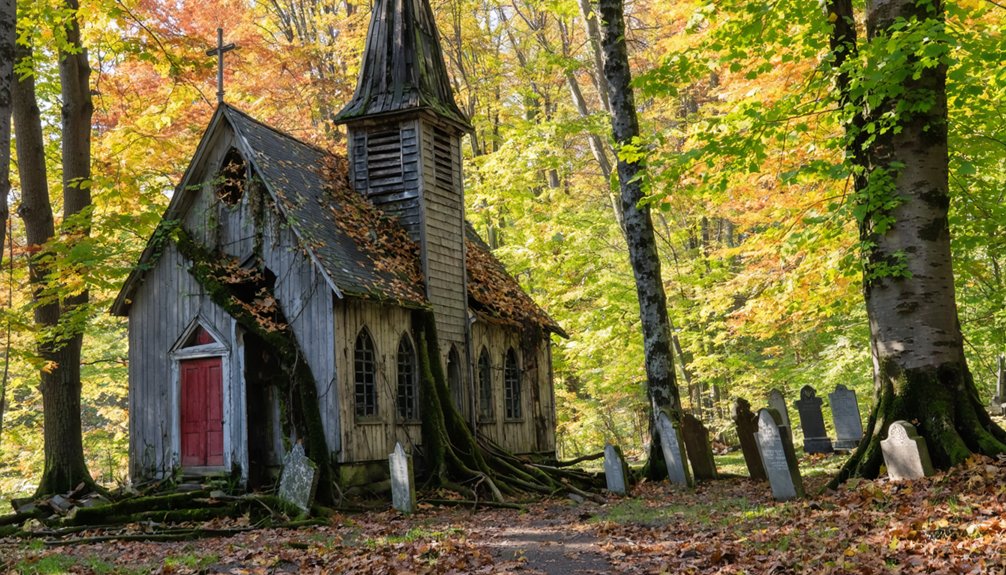
New Hampshire’s abandoned settlements reveal their stories most intimately through the trails that now wind past their crumbling foundations and overgrown homesteads.
These pathways transform your exploration into direct encounters with abandoned architecture where nature steadily reclaims human ambition.
Essential Trail Routes to Ghost Communities:
- Thornton Gore – 5.53-mile trek along Forest Service Road 416 rewards you with stone foundations and apple orchards (4 hours 15 minutes)
- Livermore – 1.5-mile moderate walk via Sawyer River Trail through White Mountain National Forest to scattered remnants
- Monson Village – 2.5 miles of flat loops past cellar holes with plaques documenting former residents’ historical significance
- Madame Sherri Forest – Minimal hiking required to reach 1900s chateau ruins featuring the iconic Stairway to Heaven
Each trail offers unmediated access to these temporal landscapes.
The Stories Behind New Hampshire’s Deserted Settlements
Beyond the physical remnants you’ll encounter along these paths lies a complex tapestry of human ambition meeting environmental reality.
Monson’s 1770 abandonment tested colonial resilience when 17,000 acres proved too harsh for sustained settlement—residents themselves petitioned to dissolve their town charter.
Hill’s story reveals nature’s persistent force: five major floods between 1875 and 1941 ultimately triggered federal intervention and complete relocation.
Livermore’s logging legacy collapsed when 1920s floods destroyed the Saunders family’s mill, ending the timber economy that sustained the community.
These settlements weren’t conquered by outside forces—they fell to unforgiving soil, relentless waters, and resource depletion.
You’re witnessing what happens when determination alone can’t overcome environmental constraints, leaving only foundations and debris scattered through reclaimed forests.
Legends and Lore Among the Ruins
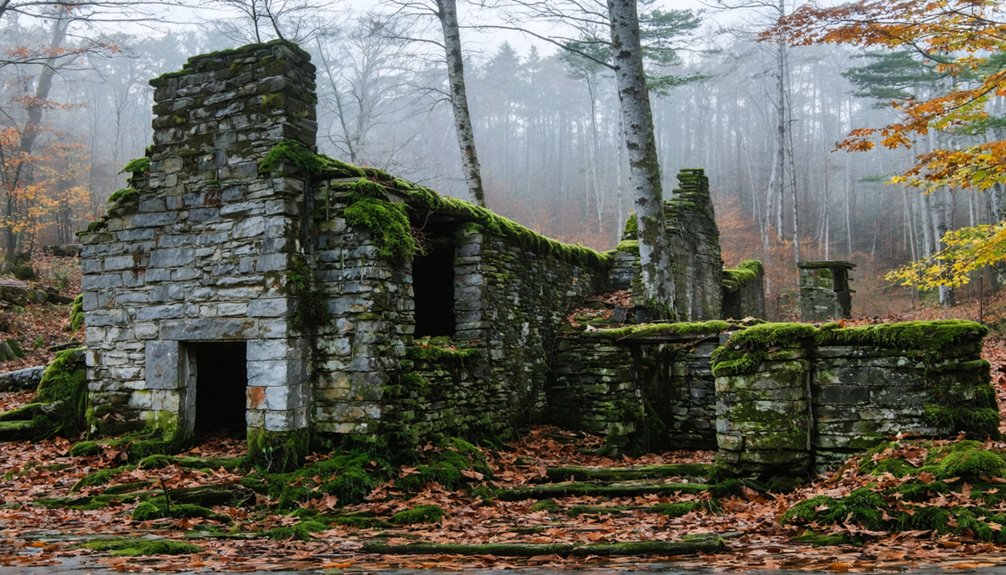
Where abandoned settlements decay, folklore inevitably fills the silence—and New Hampshire’s ghost towns harbor supernatural narratives as persistent as their crumbling foundations.
the toxic waste impact on love canal serves as a stark reminder of the hidden dangers that lurk beneath the surface. As communities grapple with the consequences, stories of resilience emerge, weaving a new chapter in the ever-evolving narrative of these forgotten places. Each tale echoes the persistent struggle to reclaim lost heritage while facing the haunting remnants of past negligence.
You’ll find haunted legends woven through these forsaken places, where ghostly apparitions reportedly manifest among deteriorating structures:
- Goody Cole’s curse (1656-1680) allegedly extends from Hampton’s ruins, where townspeople drove a stake through the accused witch’s heart—her vengeful spirit still roaming Island Path Road through dissipating fog.
- Nancy Barton’s frozen corpse (1778) discovered near Crawford Notch spawned tales of betrayed lovers haunting wilderness trails where settlements once stood.
- Princess Saco’s wedding-dressed specter drifts through Tilton’s abandoned grounds, eternally seeking revenge on cursed Native American land.
- Woodland Cemetery’s giggling child follows trespassers through Keene’s forgotten grounds, punishing profanity with phantom soap-washing.
These narratives preserve history traditional records can’t capture.
Frequently Asked Questions
Are Visitors Allowed to Explore These Ghost Town Sites on Their Own?
Time’s abandoned stages welcome you freely. You’ll find self-guided exploration encouraged across these sites, though proper exploration etiquette matters—respecting boundaries, preserving artifacts, and honoring the historical significance of these communities reclaimed by wilderness.
What Safety Precautions Should People Take When Visiting These Ruins?
You’ll need to watch for structural hazards like unstable floors and collapsing walls that’ve deteriorated over decades. Wildlife encounters, from bears to venomous snakes reclaiming these spaces, require constant awareness and respectful distance maintenance.
Can Artifacts or Objects Be Removed From These Abandoned Sites?
You can’t legally remove artifacts from these sites. Federal and state laws protect archaeological resources, requiring artifact preservation. Beyond legality, ethical considerations demand respecting historical integrity—removal destroys scientific context and denies future generations authentic experiences.
What Is the Best Time of Year to Visit These Locations?
Visit during fall’s peak foliage when 80% of White Mountains display vibrant colors. You’ll witness dramatic seasonal changes enhancing moss-covered ruins while cooler temperatures reduce wildlife interactions, offering safer exploration of these reclaimed historical sites.
Are There Guided Tours Available for Any of These Ghost Towns?
No guided tours exist—you’ll explore these sites independently. The ghost town history and nature reclamation unfold through self-guided discovery, where preservation efforts provide trail access and historical markers rather than structured tour programs limiting your exploration.
References
- https://thefrogandpenguinn.blogspot.com/2021/07/a-nh-ghost-town.html
- https://www.nhpr.org/word-of-mouth/2014-06-02/abandoned-new-hampshire
- https://www.youtube.com/watch?v=eqLu8iKKKfo
- https://outdoorodyssey.net/2022/11/03/the-haunted-ghost-town-of-livermore-nh/
- https://www.youtube.com/watch?v=mFBYIdURBvQ
- https://www.visitwhitemountains.com/blog/post/spooky-stories-ghost-towns-and-historic-haunted-spots/
- https://www.onlyinyourstate.com/experiences/new-hampshire/ghost-towns-nh
- https://www.atlasobscura.com/places/monson-new-hampshire
- https://www.youtube.com/watch?v=LO__zPGtXiI
- https://www.nhmagazine.com/the-mystery-of-monson/